Teaching Philosophy Statement Template: How to Write Yours
You’ve got a job application due tomorrow, and the cursor is blinking under "Teaching Philosophy Statement" on the district’s form. Every draft you write sounds like a fortune cookie: "I believe all students can learn." True, but it won’t get you an interview. A teaching philosophy statement template gives you the structure to sound like yourself instead of a textbook, and that’s exactly what you’ll find here.
This guide walks you through a ready-to-use framework, section by section, so you’re not staring at a blank page wondering where to start. You’ll see what belongs in your opening statement, how to back up your beliefs with classroom examples, and how to close without trailing off into vague platitudes. Real sample language is included, so you can adapt phrasing rather than invent it from scratch.
Whether you’re finishing your teaching credential, applying for your first classroom job, or updating materials for tenure review, the goal is the same: a statement that reads like a confident educator wrote it, in under an hour. Grab the template below, plug in your own experience, and you’ll walk away with a draft that’s honest, specific, and ready to send.
What is a teaching philosophy statement?
A teaching philosophy statement is a one to two page document that explains why you teach the way you do. It’s not a resume, and it’s not a mission statement copied from your school’s website. Think of it as the answer to the question every hiring committee is really asking: "How do you actually think about learning, and what does that look like in your classroom?" Search committees for K-12 positions, adjunct roles, and even tenure files all expect some version of this document, and they can tell within a paragraph whether you wrote it or borrowed it.
Colleges and universities have used these statements for decades as part of hiring and promotion, which is why groups like the Association of American Colleges & Universities publish guidance on reflective teaching practice. K-12 hiring has caught up. Principals now ask for a philosophy statement alongside a cover letter because it reveals judgment that a resume can’t. It tells them whether you’ll manage a classroom with clear routines or wing it, whether you differentiate instruction or teach to the middle, and whether you can articulate your reasoning under pressure, which is basically what an interview panel is testing anyway.
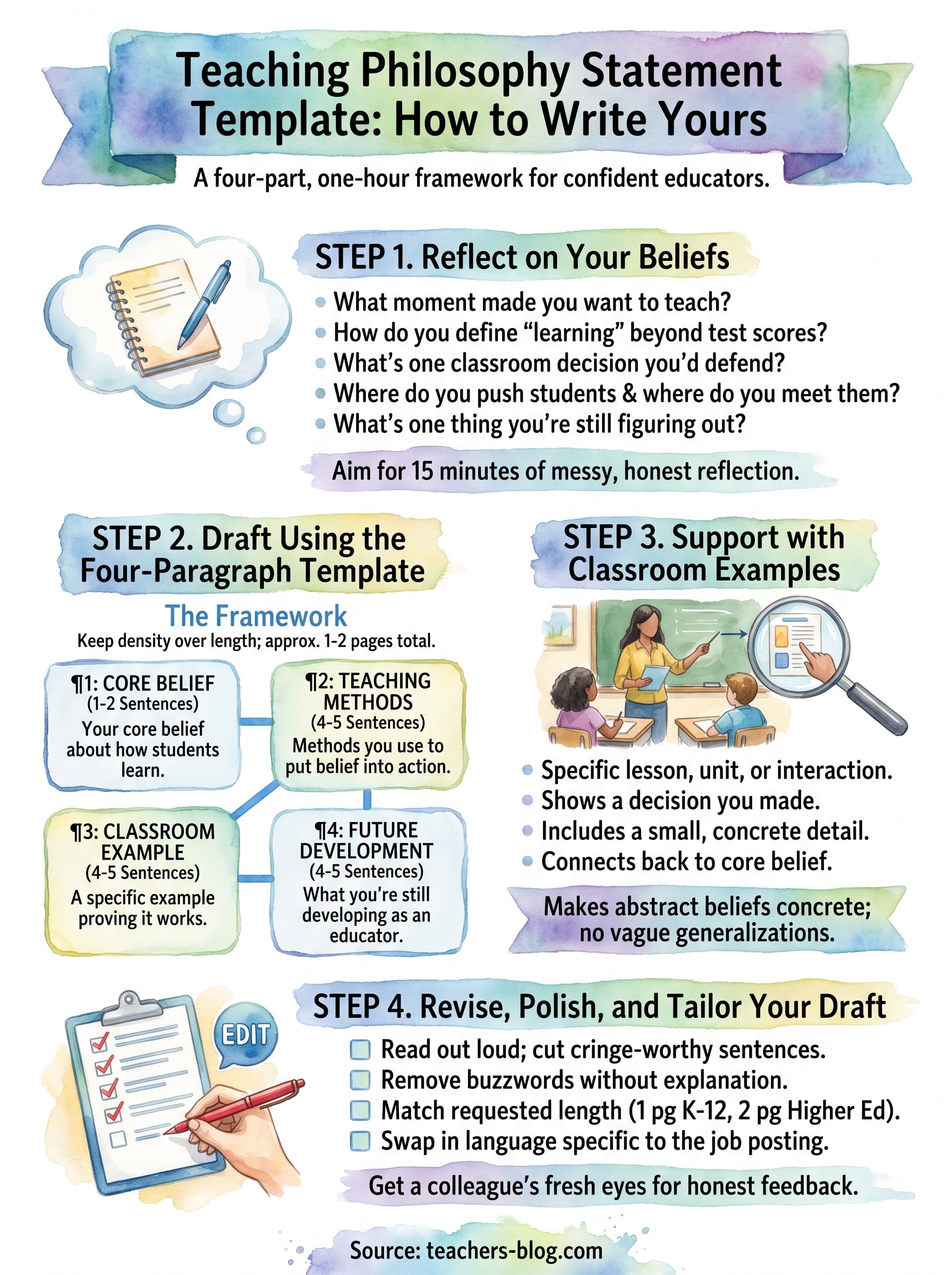
A strong statement covers four things: your core beliefs about how students learn, the methods you use to put those beliefs into practice, concrete evidence from your own classroom, and a clear sense of what you’re still working to improve. Skip any one of these and the statement reads thin. Include all four, using a repeatable structure, and you end up with something that sounds like you, not like a generic mission statement. That structure is exactly what the next four steps walk you through.
Step 1. Reflect on your beliefs about teaching and learning
Before you write a single sentence, figure out what you actually believe. Skip this step and your statement turns into recycled phrases from other people’s philosophies, which any experienced reader spots immediately. Genuine reflection takes fifteen minutes with a notebook, not an hour staring at a blank document, and it’s the difference between a statement that sounds rehearsed and one that sounds like you.
Ask yourself these five questions
Work through these before you open your template:
- What moment made you want to teach, and what does it reveal about your values?
- How do you define "learning" beyond test scores?
- What’s one classroom decision you’d defend to a skeptical principal?
- Where do you push students, and where do you meet them where they are?
- What’s one thing you’re still figuring out as an educator?
Your teaching philosophy statement should describe how you actually teach, not how you think you’re supposed to answer.
Write messy, honest answers first. Polish comes later, once you know what you’re polishing.
Step 2. Draft your statement using a proven template
Now that you’ve got honest answers on paper, turn them into paragraphs using a four-part structure that mirrors what hiring committees expect to read. This isn’t about boxing yourself in. It’s about giving your reflections a shape so a stranger can follow your thinking in under two minutes.
The four-paragraph framework
Copy this outline into a blank document and write directly under each line:
Paragraph 1: Your core belief about how students learn (1-2 sentences)
Paragraph 2: The teaching methods that put that belief into action
Paragraph 3: A specific classroom example that proves it works
Paragraph 4: What you're still developing as an educator
A teaching philosophy statement works best when each paragraph answers one question, not five.
Keep each paragraph to four or five sentences. Reviewers skim these documents fast, often alongside a stack of a dozen others, so density matters more than length. Resist the urge to cite every educational theorist you studied; one reference, used well, beats five dropped in for credibility. Once you’ve filled in all four sections with rough language, you have a full draft. The next step is where it stops sounding generic.
Step 3. Support your philosophy with classroom examples
Generic claims collapse without proof, so this step turns your abstract beliefs into a scene a reader can picture. Every teaching philosophy statement template falls flat here if paragraph three stays theoretical instead of specific. Pick one lesson, one unit, or one student interaction that actually happened, and describe it in enough detail that a stranger could picture your classroom.

Choose an example that proves your point
Good examples share a few traits. Look for one that fits at least two of these:
- It involves a specific lesson, not a vague "I once had a student who…"
- It shows a decision you made, not just an outcome that happened to you
- It includes a small detail, a worksheet, a seating change, a rubric tweak
- It connects directly back to the belief stated in paragraph one
A philosophy statement without a real classroom example reads like a mission statement, not a reflection.
Naming the unit, the grade level, and what changed because of your choice gives reviewers something concrete to remember you by, long after they’ve forgotten the other applicants’ vague generalities.
Step 4. Revise, polish, and tailor your final draft
Drafting feels like the hard part, but revision is where a mediocre statement becomes a memorable one. Read your draft out loud. Any sentence that makes you cringe or sounds borrowed from a textbook needs to go. Cut jargon like "student-centered pedagogy" unless you immediately explain what that looks like in your room.
Run this quick checklist before you submit
- Does every paragraph mention something you actually did, not just believe?
- Have you removed buzzwords that don’t connect to your classroom example?
- Does the length match what’s requested (usually one page for K-12, up to two for higher ed)?
- Have you swapped in language specific to the job posting, like "UDL" or "project-based learning," if the district uses those terms?
Tailoring isn’t about saying what a committee wants to hear. It’s about proving your existing philosophy already fits their classroom.
Send your near-final draft to one colleague who’ll tell you the truth, not just "looks great." Their fresh eyes catch the vague sentence you’ve read so many times you no longer notice it.
Bringing your teaching philosophy to life
A teaching philosophy statement isn’t a hoop to jump through once and forget. Go back to it before every interview, every tenure review, every new job posting, and update it as your classroom experience grows. The four-part structure you used here works for a first draft in your credential program and for a revised version fifteen years into your career. What changes is the evidence, not the framework.
Strip away the jargon and this document boils down to one thing: proof that you know why you teach the way you do. That clarity reads as confidence to any hiring committee, and it’s worth revisiting every time your practice shifts. If you want more practical, no-fluff guidance like this for the rest of your teaching career, from lesson planning to interview prep, browse the resources at The Cautiously Optimistic Teacher and find the next tool that saves you an hour.