15 Teacher Resume Objective Examples to Copy and Adapt
Staring at a blank resume header while a job posting closes in three days is not the time to reinvent the wheel. You need teacher resume objective examples you can adapt in minutes, not a lecture on personal branding. That blank line at the top of your resume matters more than most applicants realize, since it’s often the first thing a principal or hiring committee reads before deciding whether to keep going.
This list gives you exactly that: real, usable statements written for different situations, from first-year teachers with no classroom experience to veterans switching grade levels or subjects. Each example is short, specific, and built around what administrators actually scan for, not generic phrases that could apply to any job.
Below you’ll find 15 objectives grouped by scenario, so you can find one close to your own situation, then tweak the grade level, subject, and skills to match the posting. Whether you’re applying for your first classroom or your fifth school, you’ll walk away with language you can copy today and a clearer sense of how to write the rest of your application with the same confidence.
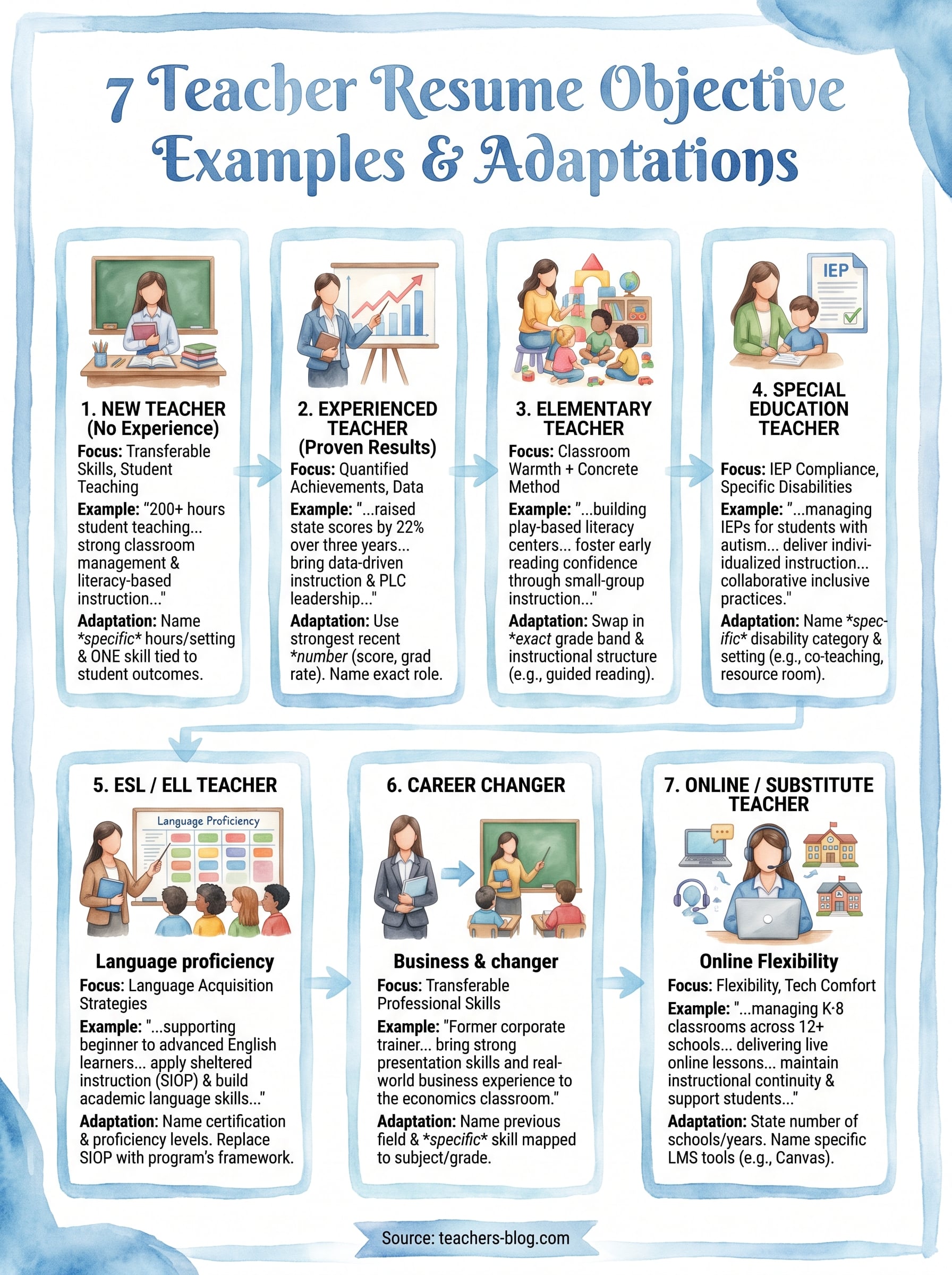
1. Objective for a new teacher with no experience
Breaking into teaching without a full year in your own classroom is the most common hurdle new graduates face, and it’s exactly where a strong objective earns its place. Student teaching, tutoring, and practicum hours count as real experience when you frame them correctly, so this objective focuses on transferable skills rather than apologizing for a thin resume.
Example objective to copy
Enthusiastic education graduate with 200+ hours of student teaching in
4th-grade classrooms, seeking a teaching position at Maple Ridge Elementary
to apply strong classroom management skills and a passion for
literacy-based instruction to help students build confidence as readers.
Who this objective fits
This version suits first-year applicants straight out of a teacher preparation program, career-changers who just finished student teaching, and substitutes applying for their first full-time contract. It works because it names a concrete number (200+ hours) instead of vague enthusiasm, which gives hiring committees something they can verify on your application. Anyone worried that a lack of classroom experience will sink their resume should lean on this format rather than skip the objective entirely.
A specific number beats a confident adjective every time a principal skims your resume.
How to adapt it for your resume
Swap in your own grade level, school name, and one skill the posting mentions, whether that’s differentiated instruction, phonics-based reading, or classroom technology. Keep the structure the same: credential, hours or setting, target school, and one skill tied to student outcomes.
- Replace the grade level with the one listed in the job posting, not the one you student-taught if they differ.
- Name the school directly; a generic objective reads as a mass mailing.
- Match one keyword from the posting, such as "UDL" or "small group instruction," so applicant tracking software flags your resume.
- Cut filler words like "seeking an opportunity to grow," which say nothing about what you’ll contribute.
This structure gives new teachers a fast way to sound prepared, not inexperienced, on paper.
2. Objective for an experienced teacher with proven results
Veteran teachers often skip the objective entirely, assuming their resume speaks for itself. That’s a mistake if you’re changing districts or moving to a school with different priorities. Quantified achievements in your objective signal immediately that you’re not a first-year hire, and they give a hiring committee a reason to keep reading past the header.
Example objective to copy
Results-driven 7th-grade math teacher with 8 years of experience raising
state assessment scores by 22% over three years, seeking to bring
data-driven instruction and PLC leadership to Fairview Middle School's
math department.
Who this objective fits
This format fits mid-career and veteran teachers who have measurable results to point to, whether that’s test score growth, attendance improvements, or successful program launches. It also suits teachers applying for department lead or mentor-teacher roles, since it signals leadership beyond the classroom. Anyone who has spent years refining a specific approach, like project-based learning or data teams, should use this version instead of the entry-level format above.
A specific percentage does more work than three paragraphs of soft skills.
How to adapt it for your resume
Pull your strongest number from the last three years, whether it’s a score increase, a graduation rate, or a program you built from scratch. Name the exact role or leadership skill the new school is likely hiring for, and drop any phrase that doesn’t tie back to a result you can defend in an interview.
3. Objective for an elementary school teacher
Elementary hiring committees read dozens of resumes that all say "nurturing" and "patient," so those words alone won’t set you apart. Classroom warmth still matters, but pairing it with a concrete instructional approach shows you know how young learners actually develop skills, not just how to keep them happy.
Example objective to copy
Dedicated 2nd-grade teacher with 4 years of experience building
play-based literacy centers, seeking a position at Willow Creek Elementary
to foster early reading confidence through small-group instruction and
consistent, positive classroom routines.
Who this objective fits
This works well for teachers applying to K-3 classrooms, where social-emotional development and foundational literacy carry equal weight with academic content. It suits candidates moving from one elementary school to another, as well as teachers shifting from upper elementary to a lower grade where routines and phonics instruction look different. If your strength lies in classroom culture as much as curriculum, this format lets you show both without sounding like a general application.
Naming your instructional method beats calling yourself "nurturing" every time.
How to adapt it for your resume
Swap in the exact grade band from the posting, since K-2 and 3-5 skills read very differently to a principal. Replace "literacy centers" with whatever instructional structure you actually use, such as guided reading groups, math workshop, or morning meeting routines, and match it to language in the job listing wherever possible.
4. Objective for a special education teacher
Special education hiring committees look for something more specific than "caring and patient," since every applicant claims that. IEP compliance experience and familiarity with specific disability categories tell a principal you can handle the paperwork and the legal side, not just the classroom relationships. This objective works best when it names the framework you know, whether that’s IEPs, 504 plans, or a co-teaching model.
Example objective to copy
Certified special education teacher with 5 years of experience managing
IEPs for students with autism and learning disabilities, seeking a
resource room position at Pine Grove Middle School to deliver
individualized instruction and collaborate with general education
teachers on inclusive classroom practices.
Who this objective fits
This version suits teachers holding a special education certification who work in resource rooms, self-contained classrooms, or inclusion settings. It also fits case managers applying to districts where IEP compliance and paperwork accuracy matter as much as instruction. Anyone moving between disability categories, say from a mild-moderate caseload to a program serving students with autism, should adjust the language to match their actual population.
Naming the disability category you serve tells a principal more than any adjective about patience.
How to adapt it for your resume
Replace the disability category and setting with your own caseload, and swap "resource room" for whatever model the posting uses, such as co-teaching or self-contained. If you’ve led transition planning, behavior intervention plans, or Section 504 coordination, name that skill instead of a generic phrase like "support diverse learners."
5. Objective for an ESL or ELL teacher
ESL and ELL positions ask for a specific blend of skills that a generic objective can’t show. Language acquisition strategies and cultural responsiveness matter more here than in a typical classroom posting, and naming your certification or the proficiency levels you’ve taught tells a hiring committee you understand the difference between teaching content and teaching content in a second language.
Example objective to copy
TESOL-certified ESL teacher with 6 years of experience supporting
beginner to advanced English learners in grades 6-8, seeking a position
at Riverside Middle School to apply sheltered instruction strategies (SIOP)
and build academic language skills across content areas.
Who this objective fits
This version fits teachers holding a TESOL or bilingual certification, whether they work in pull-out ESL programs, push-in support models, or dual-language classrooms. It also suits content teachers who hold an ESL endorsement and want to signal that background for a co-teaching or newcomer program role. If you’ve worked across a range of proficiency levels, from newcomers to long-term English learners, this format lets you show that range in one line.
Naming the proficiency levels you’ve taught says more than calling yourself "culturally responsive."
How to adapt it for your resume
Replace SIOP with whatever framework your program actually uses, such as WIDA standards, Newcomer programming, or dual-language instruction, and match the grade band to the posting. If the school serves a specific language community, mention any relevant language skills or cultural background you bring, since districts often weigh that heavily for newcomer or bilingual roles.
6. Objective for a career changer entering teaching
Switching into teaching from another field means your resume has to answer a question before anyone asks it out loud: why should a school trust someone without a traditional education background? Transferable professional skills like project management, public speaking, or client training map directly onto classroom demands, and naming them upfront turns your unconventional path into an asset instead of a question mark.
Example objective to copy
Former corporate trainer with 10 years of experience designing and
delivering professional development, now a certified teacher seeking a
position at Oakdale High School to bring strong presentation skills and
real-world business experience to the economics classroom.
Who this objective fits
This version works for career changers moving from business, healthcare, the military, or any field where you trained, managed, or presented to groups regularly. It also suits alternative certification candidates who completed a fast-track program and need to justify a nontraditional timeline. Anyone worried a hiring committee will see the career switch as a liability should use this format to reframe it as direct, relevant experience instead.
Your old job title becomes an asset the moment you name the skill it taught you.
How to adapt it for your resume
Name your previous field and the specific skill it built, then connect that skill to a subject or grade level where it matters most, like a former nurse teaching biology or an accountant teaching math. Mention your certification path only if the posting asks about it directly, since the skill match matters more than the credential story.
7. Objective for an online or substitute teacher
Substitute and online teaching roles get overlooked on resumes, but they’re proof you can walk into unfamiliar classrooms and keep instruction moving. Flexibility and quick classroom management matter more here than a long tenure at one school, so this objective leans on adaptability and tech comfort instead of a single subject specialty.
Example objective to copy
Reliable substitute and virtual instructor with 3 years of experience
managing K-8 classrooms across 12+ schools and delivering live online
lessons, seeking a long-term substitute or remote teaching position at
Cedar Hill School District to maintain instructional continuity and
support students across varied subjects and grade levels.
Who this objective fits
This format suits substitute teachers applying for long-term coverage roles, as well as candidates seeking fully remote or hybrid teaching positions. It also fits recent graduates using substitute work to build experience while job hunting for a permanent contract. If your resume shows a patchwork of schools or short assignments, this version turns that variety into a strength instead of a red flag.
Range across schools and grade levels reads as adaptability, not instability, when you frame it correctly.
How to adapt it for your resume
Replace the number of schools or years with your own count, and swap "K-8" for the grade band you actually cover. If you have experience with a specific learning management system, like Canvas or Google Classroom, name it directly since online postings often screen for that tool by name.
Making your objective work for you
None of these 15 examples work as a straight copy-paste job, and that’s the point. Pick the version closest to your situation, swap in your grade level, school name, and one real number or skill from your own experience, then read it out loud. If it sounds like it could describe any teacher applying to any job, it’s not specific enough yet.
Once your objective is sharp, the rest of your resume needs the same treatment: concrete numbers, named tools, and language pulled straight from the posting. That consistency is what actually gets you past the first skim and into an interview chair.
If you’re polishing the rest of your application next, from your resume bullets to your interview answers, The Cautiously Optimistic Teacher has practical guides built for exactly that stage of the job search.