
Lesson Plan Objectives Examples: Write Clear, Measurable
This article is part of our Lesson Planning resource hub, where you can find the definition, planning process, components, templates, objectives, and specialized planning guides.
You’ve mapped out an entire lesson, the activity, the materials, the discussion questions, but when you sit down to write the objective, you stare at the screen. "Studentswill understand…" doesn’t cut it, and you know it. If you’ve ever searched for lesson plan objectives examples to figure out what a strong one actually looks like, you’re in good company. Most teacher prep programs spend surprisingly little time on this skill, yet a well-written objective shapes everything that follows in your lesson.
The difference between a vague objective and a measurable one isn’t just semantics. It determines how you assess student learning, how you differentiate instruction, and whether your lesson has a clear finish line. Weak objectives lead to fuzzy lessons. Strong ones give both you and your students a concrete target to hit, and a way to know when you’ve hit it.
Here at The Cautiously Optimistic Teacher, we build resources that help educators work smarter in every part of their practice, from AI-powered planning tools to ready-to-use unit plans. This guide breaks down how to write clear, measurable objectives using frameworks like Bloom’s Taxonomy and the ABCD method, then gives you real examples across subjects and grade levels so you can adapt them to your own classroom. Let’s get into it.
What makes a lesson objective measurable
A measurable objective does one thing above all others: it tells you exactly what students will do to demonstrate their learning, and it does so in a way you can directly observe and verify. If you can’t watch a student perform or produce something to show mastery, your objective probably isn’t measurable. That gap explains why so many lesson plan objectives examples you find online feel either too vague to be useful or too rigid to adapt. Measurability isn’t about length or complexity; it’s about whether you can point to a clear, visible finish line.
A good objective isn’t a description of your lesson; it’s a description of what students will be able to do by the end of it.
The ABCD method: four components that keep objectives concrete
The most reliable framework for writing measurable objectives is the ABCD method, which breaks every objective into four components: Audience, Behavior, Condition, and Degree. Each component does specific work to remove ambiguity.
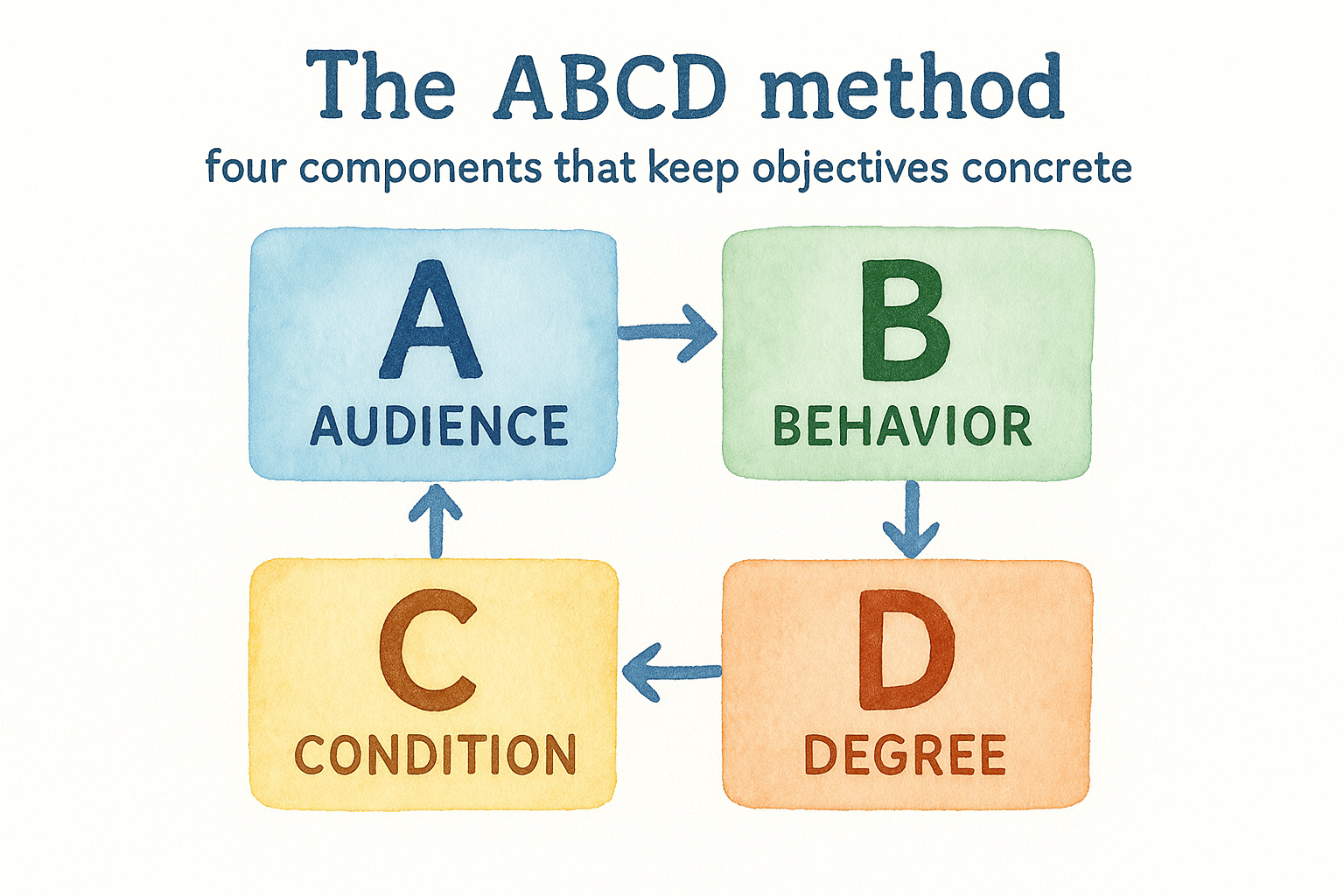
| Component | What it defines | Example |
|---|---|---|
| Audience | Who is doing the learning | "Students will…" |
| Behavior | The observable action they perform | "…identify…" |
| Condition | The circumstances under which they perform it | "…using the provided text…" |
| Degree | How well or how much | "…with at least three supporting details." |
You don’t need to include all four components in every objective, but the more you include, the clearer your finish line becomes. A complete ABCD objective leaves no ambiguity about what counts as success, which makes your assessment design almost automatic. If you already know what students will do, under what conditions, and how well, you’ve essentially already designed your assessment task.
Why "understand" and "know" don’t belong in your objectives
Words like "understand," "know," "appreciate," and "grasp" are the most common culprits in weak objectives, and they share one fatal flaw: you cannot observe them directly. You can’t watch a student "understand" photosynthesis. You can watch them label a diagram, explain the process in their own words, or correctly sequence the steps without notes. Those are observable behaviors. "Understand" is an internal state that only becomes visible through a product or performance.
This matters practically. If your objective says students will "understand the causes of World War I," how do you know when they’ve achieved it? You need a written response, a discussion contribution, an analysis, some external artifact. So skip the middle step and build the objective around that artifact from the start. Replace "understand" with the verb that describes what students actually produce or perform.
How Bloom’s Taxonomy connects to measurability
Bloom’s Taxonomy gives you a ready-made set of cognitive levels, each with corresponding action verbs that are observable by design. The six levels move from lower-order to higher-order thinking: Remember, Understand, Apply, Analyze, Evaluate, and Create. The verbs attached to each level, such as list, summarize, solve, compare, defend, and design, are the building blocks of measurable objectives because they all describe things a person can visibly do.
Matching your verb to the right level also helps you align your objective to the cognitive demand your lesson actually requires. A lesson built around basic recall shouldn’t carry an objective written at the Evaluate level. When your verb, your instructional activities, and your assessment all operate at the same level of cognitive demand, your lesson has genuine coherence and your objective becomes a reliable guide rather than a box to check.
Step 1. Start with standards and the end task
Before you write a single word of your objective, you need two things in front of you: the relevant standard your lesson addresses and a clear picture of the end task students will complete. Most weak objectives get written in isolation, disconnected from both. Starting with the standard and the end task in mind forces your objective to do real work rather than exist as a formality at the top of your lesson plan.
Pull the standard first
Your standard tells you the cognitive work the lesson is supposed to accomplish. Open your state standards or the Common Core framework and find the exact standard your lesson targets. Read it carefully, because the language often contains the seed of your objective verb. A standard that says students will "cite textual evidence to support analysis" already points you toward verbs like cite, identify, or analyze. The standard is doing half the work for you if you pay attention to it.
The standard is your north star. Your objective translates it into a specific, student-facing target for one lesson.
From there, narrow the scope. A single standard can span multiple lessons or even an entire unit, so your job is to isolate the piece of that standard your students will work on today. Write that piece down in plain language before you touch any formal objective format. That plain-language version becomes the raw material you’ll shape into a polished objective in the steps that follow.
Define the end task before you write the objective
Think about what students will actually produce or perform by the end of the lesson. Will they write a paragraph? Label a diagram? Solve a set of problems? Participate in a structured discussion? That product or performance is your end task, and it belongs at the center of your objective. When you look at strong lesson plan objectives examples, you’ll notice they all describe a specific, observable output, not a general learning experience.
Once you have the end task, ask yourself one clarifying question: "What does it look like when a student does this successfully?" Your answer gives you both the behavior and the success criteria you’ll build into the objective in later steps. Writing the objective becomes straightforward because you’re simply describing, in precise language, what you already know students will do. Start here every time, and the rest of the process gets significantly easier.
Step 2. Pick an observable action verb
Once you know your standard and your end task, your next move is selecting a verb that describes what students visibly do. This single word carries more weight than any other part of your objective. The right verb signals the cognitive demand of your lesson, guides your activity design, and tells students exactly what they’re expected to produce. Pick the wrong one and your objective falls apart no matter how carefully you write everything else around it.
Choose the right Bloom’s level for your lesson
Your verb needs to match the cognitive level your lesson actually targets. If students are working with new content for the first time, a lower-order verb like identify or list is appropriate. If they’re synthesizing across sources or defending a position, you need a higher-order verb like construct or evaluate. Using a verb that’s too low undersells the rigor of your lesson; using one that’s too high sets students up to fail an objective they were never equipped to reach.
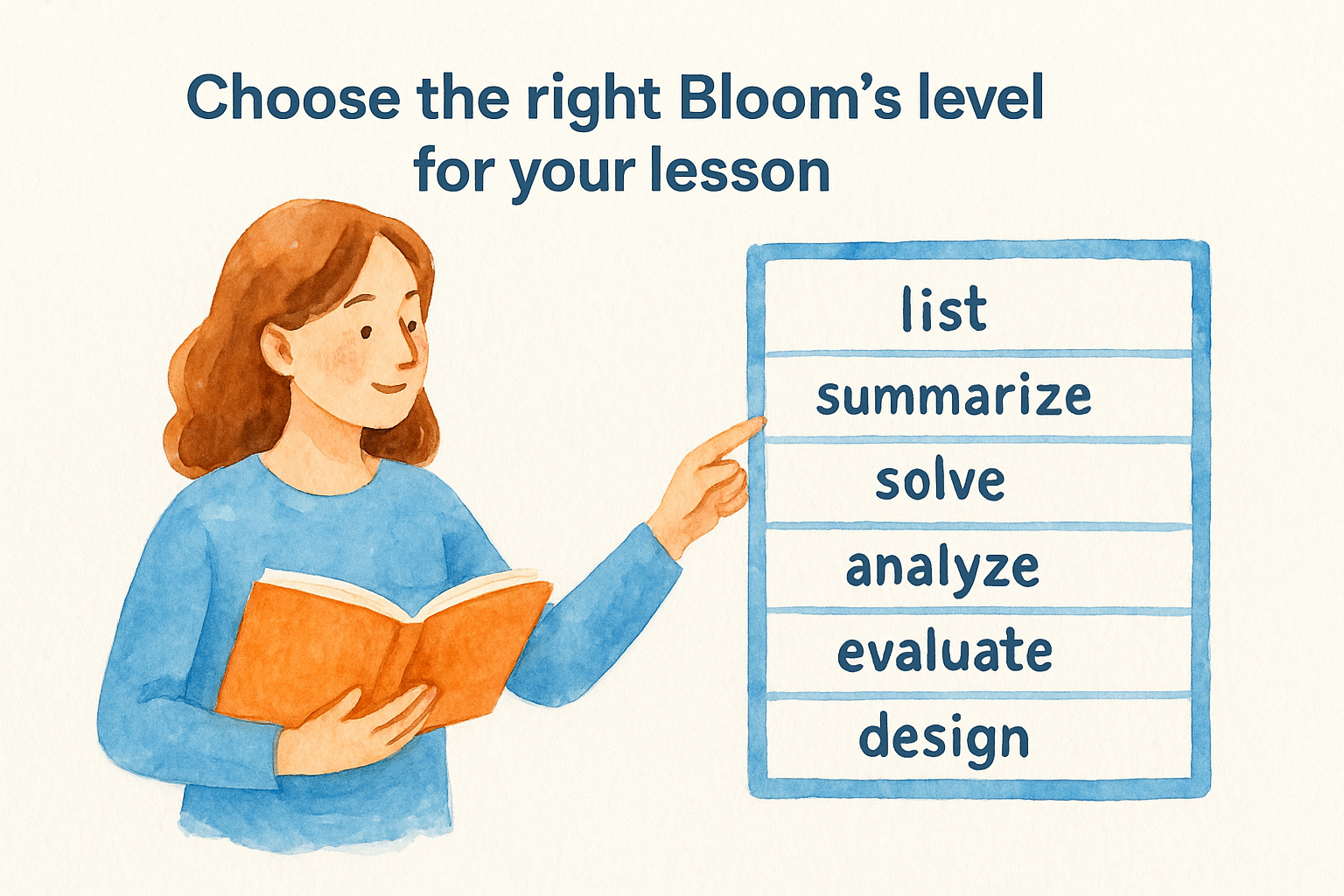
The verb you choose is a commitment: it tells both you and your students exactly what the lesson will demand of them.
The table below organizes Bloom’s six levels with action verbs you can pull directly into your objectives:
| Bloom’s Level | Sample Verbs |
|---|---|
| Remember | list, name, identify, recall, define |
| Understand | summarize, explain, paraphrase, classify |
| Apply | solve, use, demonstrate, calculate, execute |
| Analyze | compare, differentiate, examine, break down |
| Evaluate | defend, justify, critique, assess, argue |
| Create | design, construct, compose, produce, develop |
Match the verb to what students actually produce
Once you’ve identified the right Bloom’s level, check that your verb directly connects to the end task you defined in Step 1. If students are writing a persuasive paragraph, your verb might be construct or compose. If they’re working through a set of equations, solve or calculate fits better. Strong lesson plan objectives examples consistently use a verb that points unmistakably to what lands on your desk or whiteboard at the end of class.
Replace verbs that require guessing what happened inside a student’s head. Swap appreciate for explain, trade learn for identify, and substitute understand with whatever observable action your lesson actually demands. This fix takes under a minute per objective and immediately makes your lesson planning tighter and your assessment design far easier to execute.
Step 3. Add conditions and success criteria
You have your verb, so now you need to complete the picture of what success actually looks like. Conditions and success criteria are the two remaining ABCD components that transform a decent objective into a precise one. Conditions describe the circumstances under which students perform the task, such as what tools, texts, or resources they have access to during the lesson. Success criteria define how well students need to perform to demonstrate mastery. Together, these two elements close the loop on ambiguity and make your objective fully usable.
Define the condition
The condition answers one specific question: "Under what circumstances will students perform this task?" It might specify that students work from memory, use a provided graphic organizer, reference a specific passage, or collaborate with a partner. You don’t need an elaborate condition clause in every objective, but when the context of performance matters to your assessment, include it. A student who labels a diagram with a word bank demonstrates something different from one who labels it from memory, and your objective should reflect that distinction clearly.
Here are condition phrases you can slot directly into your objectives:
- "Given a graphic organizer…"
- "Using the provided primary source document…"
- "Without the use of notes…"
- "After reading the excerpt…"
- "With a partner…"
Set the success criteria
Success criteria answer: "How well does a student need to perform to meet the objective?" This is the Degree component in the ABCD framework, and it’s the part most teachers skip. Skipping it forces you to make judgment calls during assessment that you could have resolved before the lesson started. When you look at strong lesson plan objectives examples, the ones that hold up under scrutiny almost always specify a threshold, a number, a quality standard, or a completion requirement.
The clearest success criterion is one you could hand to a student before the lesson and have them explain back to you in their own words.
Use concrete, numerical, or qualitative markers wherever possible. Instead of writing "correctly," write "with at least four of five steps in the correct order." Instead of "in detail," write "using at least two pieces of textual evidence." The template below combines all three elements you’ve built across Steps 1 through 3:
"Students will [verb + content] + [condition] + [success criterion]."
Concrete example: "Students will identify the author’s central claim using the provided article, citing at least two supporting details from the text."
That sentence tells you, your students, and any observer exactly what success looks like before the lesson even begins.
Step 4. Revise with a fast objective checklist
Writing a first draft of your objective is only half the job. Revision is where most objectives either earn their place in the lesson plan or get rewritten entirely. A quick checklist pass takes under two minutes and consistently catches the issues that make objectives hard to assess: vague verbs, missing conditions, and success criteria left undefined. Before you move on to building the rest of your lesson, run every objective through the questions below.
Use this checklist before you finalize any objective
Most teachers who study lesson plan objectives examples notice that the strongest ones share a consistent set of qualities. Those qualities are exactly what this checklist tests for. Read your objective aloud, then answer each question honestly.
- Is the verb observable? Could you watch a student perform it, or would you have to infer it happened?
- Is the content specific? Does the objective name the exact skill, text, concept, or problem students are working with?
- Is the condition clear? Do students know what resources or constraints apply during the task?
- Is the success criterion present? Does the objective define how well students need to perform to meet it?
- Does it cover one target? If you can spot a second verb or a second skill in the same sentence, split it into two separate objectives.
- Could a student explain it back to you? If the language is too technical or too vague, revise until a student can read it and know exactly what they’re supposed to do.
If you answer "no" to more than one question, rewrite the objective before moving forward rather than patching it during the lesson.
How to fix an objective that fails the check
When your objective doesn’t pass, the fix is almost always one of three targeted edits: swap the verb, add a condition clause, or attach a success criterion. You rarely need to scrap the whole sentence. Start by isolating which question you answered "no" to and make only that change.
Here’s a before-and-after example to see the revision in action:
| Draft Objective | Problem | Revised Objective |
|---|---|---|
| Students will understand the water cycle. | "Understand" is not observable | Students will label the four stages of the water cycle on a blank diagram without notes. |
| Students will analyze the poem. | No condition or success criterion | Students will identify two examples of figurative language in the poem, explaining the effect of each in one sentence. |
Run this revision process on every objective you write, and your lesson plans will immediately become more consistent and easier to assess.
Ready-to-use lesson plan objectives examples by subject
The frameworks and steps above only stick when you see them applied to real content from real classrooms. The examples below are organized by subject area so you can find the closest match to your own lesson, then adapt the language to your grade level and standard. Each one follows the ABCD structure: it names an observable verb, specifies a condition, and sets a success criterion you can actually measure.
ELA and reading objectives
Reading and writing objectives trip up a lot of teachers because literacy skills feel inherently internal. The fix is to anchor every objective to a visible product: an annotated passage, a written response, a structured discussion contribution. Use these lesson plan objectives examples as starting templates.
| Grade Band | Objective |
|---|---|
| 6th grade | Students will identify the central idea of an informational text and support it with two pieces of textual evidence in a written response. |
| 8th grade | Students will construct a five-sentence argument paragraph using a claim, two pieces of evidence, and a concluding sentence, without referring to notes. |
| 10th grade | Students will analyze how an author’s word choice in a given passage contributes to tone, citing at least three specific examples in a written annotation. |
Math and science objectives
Math and science lessons lend themselves naturally to measurable objectives because the end product is almost always a calculation, a diagram, or a lab result. Precision matters here: name the exact operation or procedure students will execute.
The more specific your condition clause, the easier it becomes to design a fair and consistent assessment.
| Grade Band | Objective |
|---|---|
| 5th grade | Students will solve eight two-step word problems involving multiplication and division of whole numbers using a graphic organizer with at least 75% accuracy. |
| 7th grade | Students will label all four stages of the water cycle on a blank diagram, including one written sentence describing what happens at each stage. |
| 9th grade | Students will construct a bar graph using collected class data, correctly labeling both axes and identifying the variable with the highest frequency. |
Social studies and history objectives
History and civics objectives often default to "understand" or "learn about," two verbs that tell you nothing about what students produce. Swap those verbs for ones tied to evidence: analyze, compare, argue, or explain.
| Grade Band | Objective |
|---|---|
| 6th grade | Students will compare two primary source documents about ancient Rome, identifying one similarity and one difference in perspective using a provided T-chart. |
| 8th grade | Students will argue whether a given historical decision was justified, supporting their position with at least two specific pieces of evidence from the unit readings. |
| 11th grade | Students will evaluate the effectiveness of one New Deal program by citing data from two sources and explaining how each supports their conclusion. |
Common objective mistakes and how to fix them
Even experienced teachers repeat a handful of predictable mistakes when writing objectives. Recognizing these patterns in your own drafts is the fastest way to improve. The fixes below are direct and specific: each one takes less than two minutes to apply and immediately makes your lesson plan objectives examples more usable.
Writing objectives that describe teaching instead of learning
The most common mistake teachers make is writing an objective that describes what they will do, not what students will produce. "I will introduce the concept of inference" is a teaching plan, not a learning objective. Your objective belongs to the students, not to you. Reframe every sentence so students are the subject and the verb describes their visible action.
| Mistake | Fix |
|---|---|
| "I will model how to identify theme." | "Students will identify the theme of a short story and support it with two textual examples." |
| "Students will be exposed to figurative language." | "Students will classify five examples of figurative language from the poem using a provided reference sheet." |
| "We will explore the causes of the Civil War." | "Students will list three causes of the Civil War from memory after the lesson." |
Cramming multiple skills into one objective
When you write "Students will identify the main idea and summarize the text and make an inferences," you’ve created three separate assessments inside one sentence. Each skill demands its own measurement, so each skill deserves its own objective. Read your draft and look for the word "and" connecting two different verbs. That’s your signal to split.
One objective, one verb, one measurable finish line: that’s the rule that keeps your assessment design manageable.
Write a separate objective for each skill your lesson targets. If your lesson genuinely covers three discrete skills, you should have three distinct objectives listed in your plan.
Leaving out any standard of performance
Removing the success criterion from an objective turns it into an open-ended question. "Students will write a paragraph" tells you nothing about what counts as success. You end up making that judgment call in real time, inconsistently, under pressure. Pin the threshold down in writing before the lesson starts: specify a word count, a number of required examples, a percentage, or a quality indicator. "Students will write a five-sentence paragraph that includes a claim and two pieces of evidence" leaves no room for guesswork.
Objective templates you can copy and tweak
Frameworks are useful, but ready-to-use templates save you real time. The fill-in-the-blank structures below give you a starting point for almost any lesson, so you spend your energy customizing the content rather than rebuilding the sentence from scratch. Pull whichever template fits your lesson, swap in your specific verb and content, and you have a draft objective in under a minute.
The core single-skill template
This structure covers the majority of lesson plan objectives examples you’ll ever need to write. It follows the ABCD format and works across every subject area and grade band.
Start with this template every time you’re unsure where to begin; it handles roughly 80% of the objectives you’ll write in a given week.
Use the brackets as direct prompts, not optional additions. Fill each one in before you consider the template finished.
Students will [observable verb] [specific content/skill]
[condition clause: given/using/without/after...]
with [success criterion: a number, percentage, or quality standard].
Filled example: Students will compare two persuasive texts using a provided T-chart, identifying at least two differences in the authors’ use of evidence.
Subject-specific templates to adapt
Different subjects carry different default conditions and success criteria. These subject-area templates give you a closer starting point so you spend less time adapting the generic structure to fit your context. Copy the one that matches your content and replace the bracketed text.
Students will [identify/analyze/construct] [specific text feature or writing skill]
using [provided text/graphic organizer/word bank],
citing at least [number] [examples/pieces of evidence/sentences].
Math and science:
Students will [solve/calculate/label/construct] [specific problem type or diagram]
[with/without a calculator or notes],
completing at least [number] items with [percentage]% accuracy.
Social studies and history:
Students will [compare/argue/evaluate/explain] [specific event, document, or concept]
using [primary source/provided reading/class notes],
supporting their response with at least [number] specific [examples/details/pieces of evidence].
Each template keeps students as the subject and builds the success criterion directly into the sentence. Once you have a filled template, run it through the four-question checklist from Step 4 to confirm it holds up before you finalize your lesson plan.
Put your objectives to work
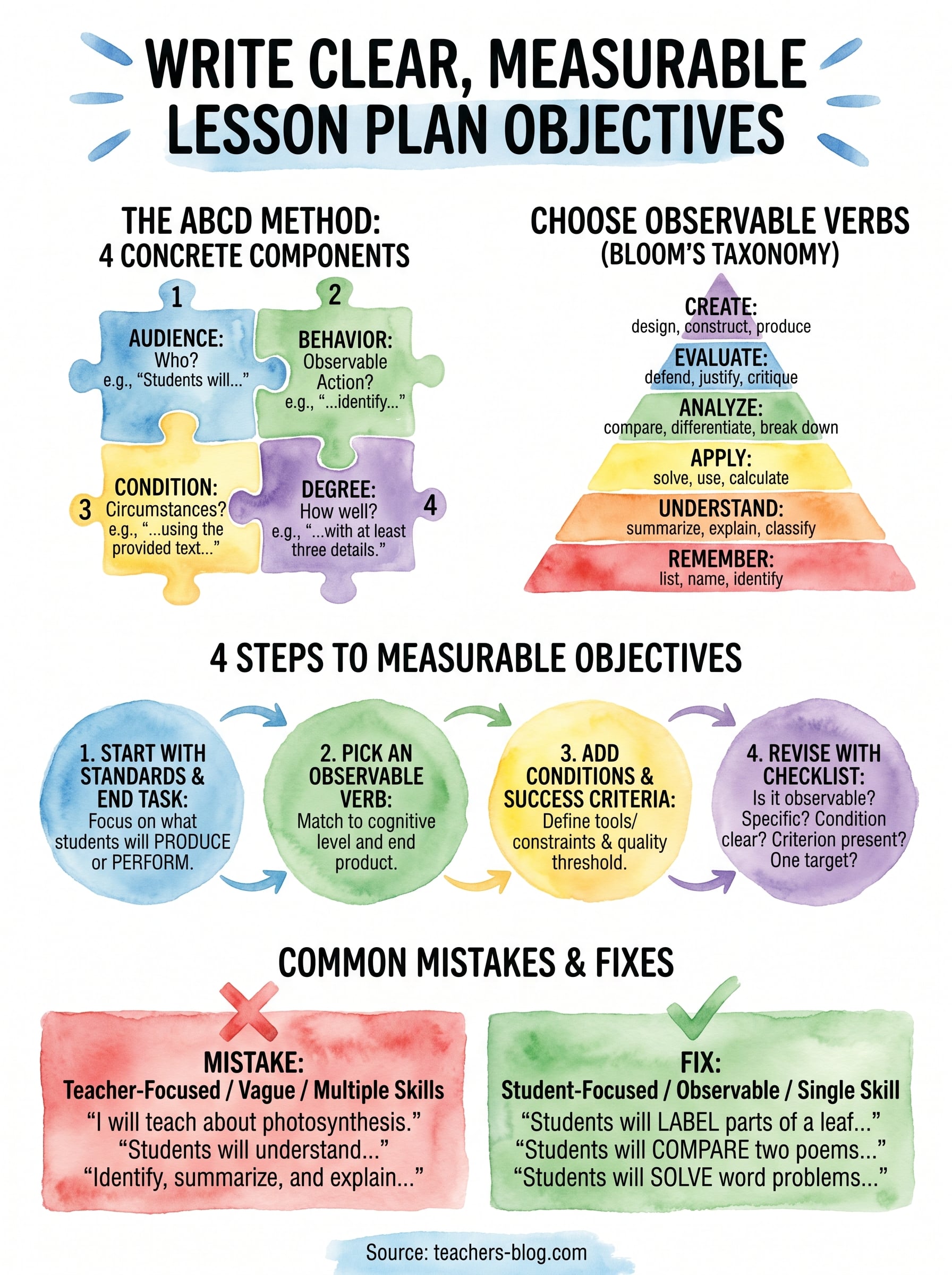
You now have every tool you need to write clear, measurable objectives for any lesson you teach. Start with your standard and end task, choose an observable verb from the right Bloom’s level, add conditions and success criteria, then run the checklist before you finalize. The lesson plan objectives examples in this guide give you ready-made language to adapt, so you’re not starting from scratch every time. Strong objectives take practice, but the process becomes fast once it’s habit.
Your next step is simple: pull one upcoming lesson plan and rewrite its objective using the templates from this guide. Replace any vague verb with an observable one, pin down your success criterion, and check that students are the subject of every sentence. When your objectives are tight, your lessons run tighter too. For more practical strategies and tools built specifically for teachers, visit The Cautiously Optimistic Teacher and put these skills into your daily practice.