
Madeline Hunter Lesson Plan: 7 Steps, Template & Examples
A Madeline Hunter lesson plan is commonly organized around seven instructional elements: anticipatory set, objective and purpose, input, modeling, checking for understanding, guided practice, and independent practice. The framework is especially useful when students need clear explanation, teacher modeling, supported practice, and a gradual move toward independence.
This guide gives you the 7 steps, classroom examples, and a free downloadable, fillable PDF Madeline Hunter lesson plan template on one page. If you are preparing for a practicum, observation, or simply want a structured lesson-planning format, you can use the sequence below as a planning tool and adapt it to your subject and students.
Free teacher resource: Download the two-page Madeline Hunter lesson plan PDF. It includes all seven planning elements, space for objectives and success criteria, differentiation, assessment, and reflection. Print it or type directly into the fillable fields.
Quick links: 7 steps · lesson plan template · how to adapt the model
Important: Hunter’s work was not intended as a rigid checklist that every lesson must display in exactly the same way. The elements are better treated as instructional decisions to consider when they serve the learning goal.
What the Madeline Hunter lesson plan model is
The Madeline Hunter lesson plan model is a structured instructional framework developed by Dr. Madeline Hunter in the 1970s and 1980s. Hunter was a professor and principal at UCLA’s University Elementary School, where she studied what effective teachers actually did in their classrooms and translated those observations into a repeatable sequence. The result was a lesson design approach that moves students through a predictable arc, from capturing their attention at the start to consolidating learning at the end.
Hunter’s work became highly influential in teacher training, but the familiar “seven-step” format is best used as a planning framework rather than a mandatory checklist for every lesson. A California State University Northridge summary makes the same distinction.
The research behind the model
Hunter based her model on principles from educational psychology, drawing on work related to motivation, reinforcement, and retention. She argued that teaching is a decision-making process, and that skilled teachers make deliberate choices at each stage of a lesson. Her seven components are not arbitrary steps; each one targets a specific cognitive function, such as activating prior knowledge, modeling new skills, or checking for understanding.
Her work influenced teacher evaluation systems across the United States and became a foundation for many pre-service teacher training programs. If you went through a credentialing program in the last 40 years, you likely encountered her ideas in some form, even if the course never mentioned her by name.
What sets it apart from other frameworks
Unlike some lesson models that focus narrowly on content delivery, the Hunter approach treats the entire learning experience as a designed sequence. It accounts for student attention, guided practice, and independent application within a single lesson, which makes it practical for daily classroom use rather than just formal observations or evaluations. You get a framework flexible enough to apply across grade levels and subject areas without reinventing your planning process each time.
Why the Hunter model still works in busy classrooms
The Madeline Hunter lesson plan model has survived decades of curriculum trends because it solves a real problem: how do you structure a lesson so that students actually retain what you taught? The answer, Hunter argues, is intentional sequencing. When you design a lesson with a clear beginning, middle, and end tied to specific cognitive purposes, students follow along more easily and you waste less time re-explaining concepts the next day.
It gives you a repeatable system
Planning a lesson from scratch every day is exhausting. The Hunter model gives you a consistent framework to work from, so your cognitive energy goes into choosing the right content and examples rather than figuring out the structure. Teachers who use it regularly find that lesson prep gets faster over time because the sequence becomes second nature, not a new puzzle to solve each period.
It keeps students on track
When students know what to expect from a lesson, classroom management gets easier. The Hunter model builds in moments of guided practice and checking for understanding, which means you catch confusion early rather than after a failed quiz. That predictability reduces behavioral interruptions because students are rarely sitting idle or waiting for direction.
A structured lesson is not a rigid one; it is a roadmap that still leaves room for your professional judgment at every step.
The 7 Steps in a Madeline Hunter Lesson Plan
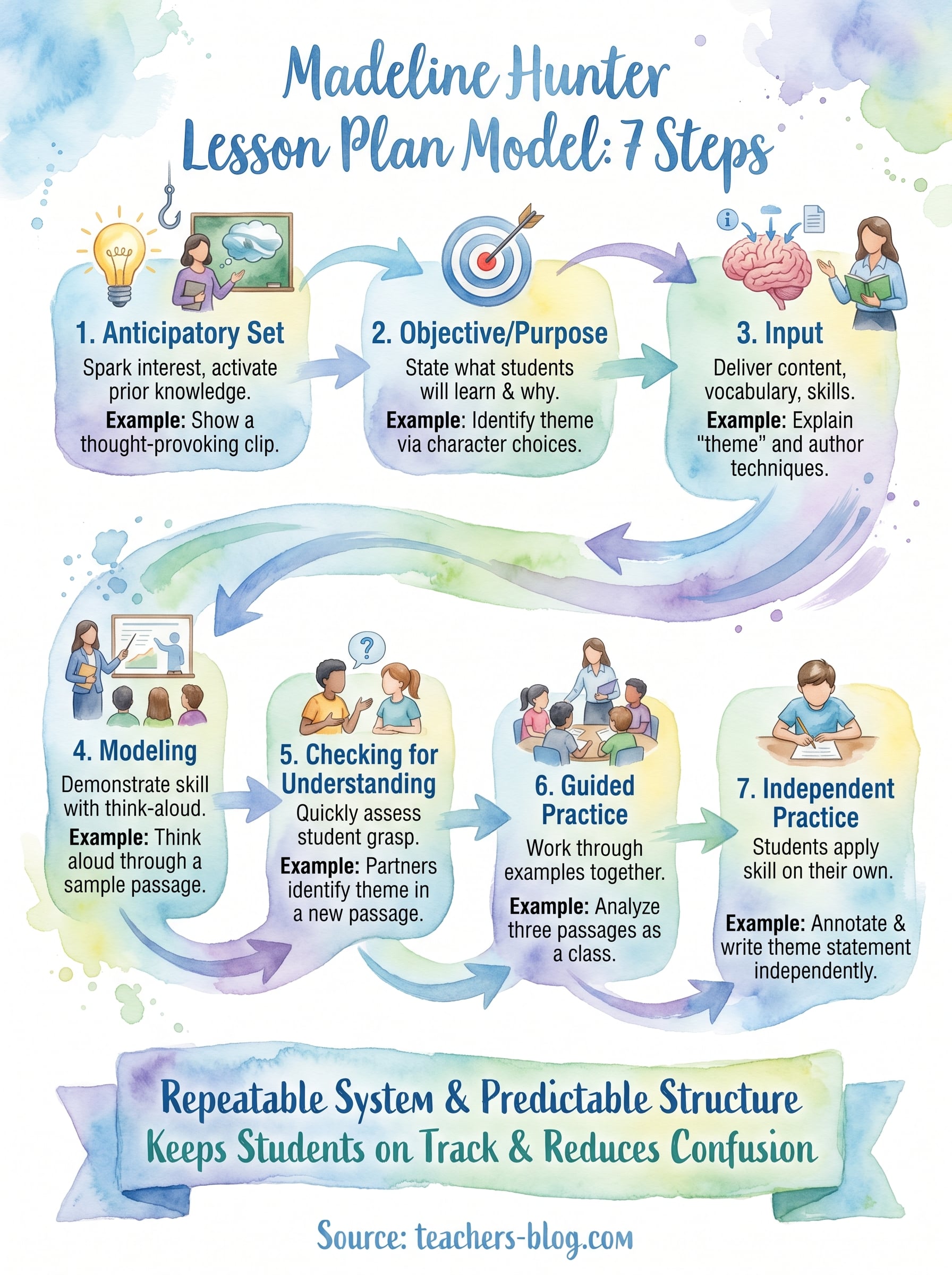
The Madeline Hunter lesson plan model organizes instruction into seven distinct components, each serving a specific purpose. Together, they move students from first contact with new material to independent application, which is the core goal of a well-designed lesson.
Skipping steps, especially checking for understanding, is the most common reason a lesson loses momentum mid-class.
The full sequence at a glance
Each step builds directly on the one before it. Here is a quick breakdown with a classroom example drawn from an 8th-grade reading lesson:

| Step | Component | Quick Example |
|---|---|---|
| 1 | Anticipatory Set | Show a survival clip to spark interest before reading |
| 2 | Objective/Purpose | Tell students they will identify theme through character choices |
| 3 | Input | Explain what theme means and how authors develop it |
| 4 | Modeling | Think aloud through one passage to show your reasoning |
| 5 | Checking for Understanding | Ask partners to identify theme in a second passage |
| 6 | Guided Practice | Work through three examples together as a class |
| 7 | Independent Practice | Students annotate a new passage and write a theme statement alone |
You do not have to treat each step as a rigid block of time. In a 45-minute period, some steps overlap naturally, but each cognitive purpose still needs to be addressed before you move forward.
Free Madeline Hunter Lesson Plan Template (PDF and Copyable Version)
You can download the free two-page, fillable Madeline Hunter PDF template here, or copy the planning prompts in the table below into your usual lesson-planning document. The PDF includes fields for each of the seven instructional elements, plus objectives, success criteria, differentiation, materials, assessment, and teacher reflection.
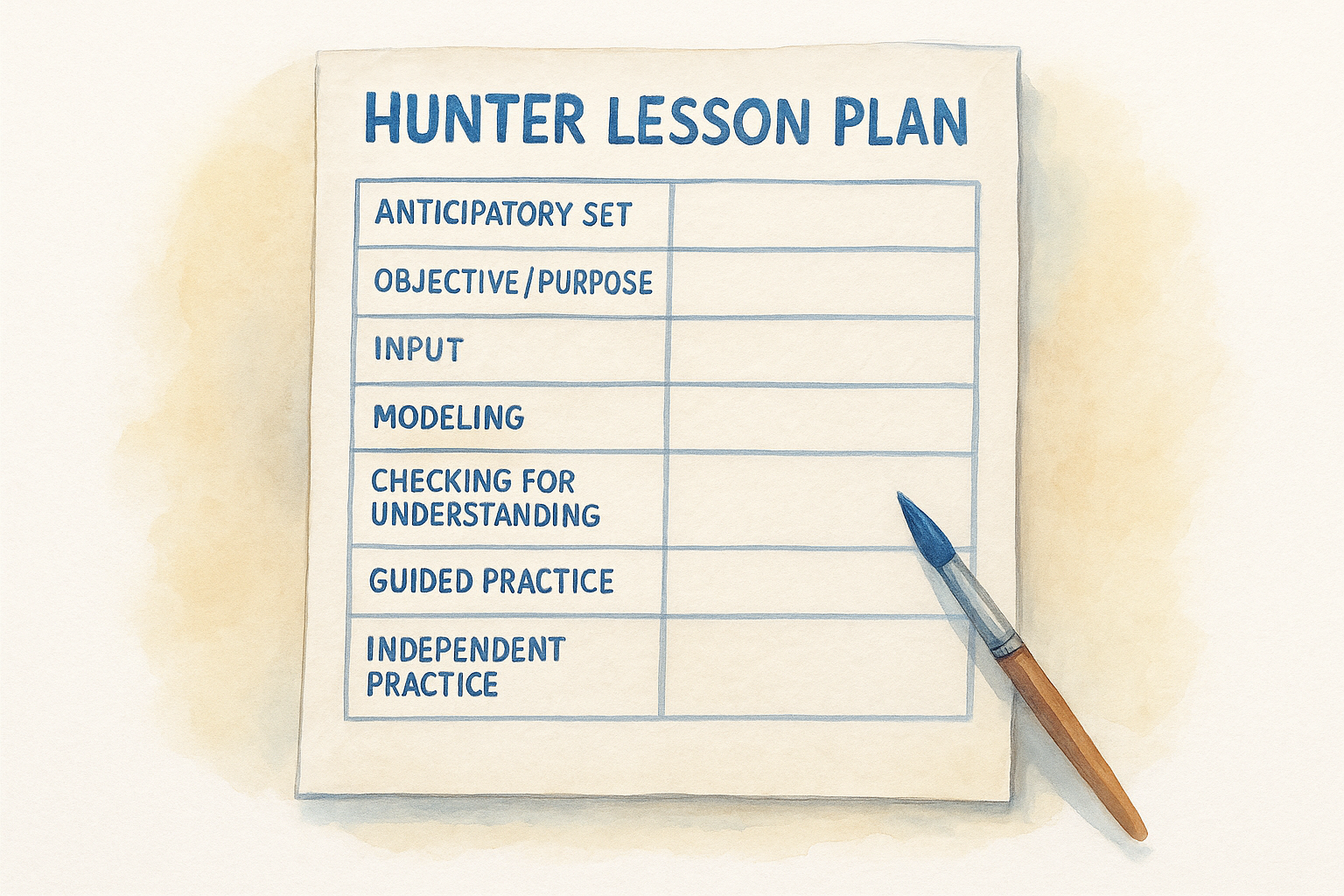
A template works best as a starting point, not a constraint; adjust the space you give each section based on your lesson’s specific needs.
How to use the template
For the PDF: open the download in a PDF reader and type into its fillable fields, or print the two pages and write by hand. For the copyable version: paste the table below into Word or Google Docs and fill in the prompts. Start with the subject, grade level, objective, and success criteria so the seven steps stay aligned to the learning goal. For a broader planning checklist, see the components of a lesson plan.
| Component | Your Notes |
|---|---|
| Anticipatory Set | How will you hook students at the start? |
| Objective/Purpose | What will students be able to do by the end? |
| Input | What content, vocabulary, or skills will you deliver? |
| Modeling | How will you demonstrate the skill or concept? |
| Checking for Understanding | What quick check confirms students are ready to practice? |
| Guided Practice | What activity will you work through together? |
| Independent Practice | What will students complete on their own? |
Fill each row with specific, concrete details rather than vague intentions, and your lesson will come together much faster than starting from a blank page.
How to Adapt the Madeline Hunter Model for Real Students and Subjects
The Madeline Hunter lesson plan model is built to flex. Its seven components give you a stable structure, but nothing in Hunter’s framework demands that every step look the same for every group of students. The real skill is learning where to expand, compress, or modify based on what your students actually need that day.
Adjusting for different grade levels and subjects
Younger students need shorter input and modeling phases with more guided practice, while older students can handle longer independent tasks with less hand-holding. For hands-on subjects like art or physical education, your modeling step carries more weight than the input phase because students learn primarily by watching and doing rather than listening.
Match the length of each step to your students’ attention span and the complexity of the skill, not to a fixed time block.
- Primary grades: Keep input brief and repeat the checking phase often
- Middle school: Balance guided and independent practice with partner work
- High school: Extend independent practice into higher-order tasks like analysis or argument
Working with students who need extra support
If you have students with IEPs or English language learners in your class, guided practice is your most powerful tool. Stretch that phase by adding sentence frames, graphic organizers, or small-group time before moving students to independent work.
Your independent practice tasks should match the learning objective, not the average student’s readiness level. Differentiate the output format while keeping the goal consistent for every student in the room.
Frequently Asked Questions About the Madeline Hunter Lesson Plan
What are the 7 steps in a Madeline Hunter lesson plan?
The commonly used seven-part format includes an anticipatory set, objective and purpose, input, modeling, checking for understanding, guided practice, and independent practice. Teachers often add closure as a separate element or build it into the end of guided or independent practice.
Is the Madeline Hunter model supposed to be followed in a rigid order?
No. The familiar seven-step version is most useful as a planning framework. Not every lesson needs every element in the same order or for the same amount of time. Use the parts that support the learning goal and the students in front of you.
Is there a Madeline Hunter lesson plan template on this page?
Yes. Download the free, two-page fillable PDF template to type into it or print it. The template section also includes a copyable planning table for Word or Google Docs.
When is the Hunter model most useful?
It is particularly useful when students need explicit explanation, teacher modeling, checks for understanding, guided practice, and a clear transition toward independent work. It can be adapted across grade levels and subjects rather than used as a one-size-fits-all script.
Next steps for your next Hunter-style lesson
You now have everything you need to put the Madeline Hunter lesson plan model into practice. Start small: pick one upcoming lesson and use the fill-in-the-blank template from this article to map out each of the seven steps before you teach. You will notice quickly which phases you tend to rush and where your students need more support.
From there, build the habit of structured planning. The more you plan with this sequence, the faster your prep becomes and the more your instruction tightens up naturally. Teaching with a clear framework does not limit your creativity; it gives your ideas a solid place to land.
For more tools and strategies to support your planning and classroom practice, explore the resources at The Cautiously Optimistic Teacher, where you will find AI-powered tools, lesson templates, and practical guides built specifically for educators like you.