
Lesson Planning For English Language Learners: How To Start
You have a new student who speaks limited English, your curriculum hasn’t changed, and you’re expected to make it all work by Monday. If that sounds familiar, you’re not alone. Lesson planning for English Language Learners is one of those skills most teachers need but few receive adequate training for. The gap between what ELLs need and what general lesson plans provide is real, and it shows up in student frustration, disengagement, and stalled progress.
The good news? You don’t have to reinvent your entire approach. What ELL-friendly planning actually requires is a shift in how you structure and deliver content you’re likely already teaching. With the right strategies, think scaffolding, visual supports, and intentional language objectives, your lessons become accessible without being watered down. That’s the balance every effective ELL lesson plan strikes.
Here at The Cautiously Optimistic Teacher, we build resources that help educators work smarter with the students in front of them, including tools like our Differentiated Instruction Helper that can adapt lessons for diverse language needs. This guide walks you through the essentials of planning for ELLs step by step: from setting language objectives to choosing strategies that actually stick. Whether you’re supporting one ELL student or fifteen, you’ll leave with a clear framework you can use right away.
What strong ELL lesson plans include
A strong ELL lesson plan isn’t just a regular lesson with simpler vocabulary swapped in. It’s built from the ground up with language acquisition in mind, treating English development as a goal that sits alongside content mastery, not below it. When you’re doing lesson planning for English language learners, you need a plan that addresses both what students are learning and how they’ll actually access and express it. Miss one of those pieces, and you end up with students who are either lost in the content or stuck with no way to show what they know.
Dual objectives: content and language
Every strong ELL lesson sets two types of goals side by side. Content objectives define what students should know or be able to do (for example: "Students will identify the main conflict in Chapter 3"). Language objectives define how students will use English to demonstrate that knowledge (for example: "Students will describe the conflict using the sentence frame: ‘The main conflict is… because…’"). Without the language objective, many ELL students understand the concept but can’t show it, and you end up guessing at what they actually learned.

Writing language objectives forces you to pinpoint the exact language demands in your lesson, which is the first real step toward removing barriers for ELL students.
You don’t need a separate lesson for each objective. Both content and language goals should live inside the same activity, just with an added layer of language support that makes the task accessible to students at different proficiency levels.
Scaffolding built into every phase
Scaffolding isn’t a finishing touch you add at the end. Strong ELL lesson plans weave support into each phase of the lesson, from the opening hook through independent practice. This includes graphic organizers during instruction, sentence frames during discussion, and word banks during writing tasks. Think of scaffolding not as lowering the bar but as building a temporary structure students use until they can work independently. Here’s a quick reference you can keep at your desk:
| Lesson Phase | Scaffold Type | Example |
|---|---|---|
| Introduce content | Visual support | Photo, video clip, or real object |
| Guided practice | Sentence frames | "I think… because…" |
| Vocabulary | Word bank | Key terms with short definitions |
| Discussion | Discussion stems | "I agree with ___ because…" |
| Writing | Graphic organizer | T-chart, story map, or outline |
Planned opportunities for student talk
Student talk is one of the most powerful and underused tools in ELL instruction, and it needs to be planned deliberately, not improvised in the moment. Strong lesson plans include structured speaking opportunities, whether that’s a think-pair-share, a guided conversation with a sentence starter, or a partner reading task. When you plan these moments in advance, students get low-stakes practice using English before they face higher-stakes writing or speaking tasks.
Those planned talk moments also give you real-time formative data on student language use without requiring a formal assessment. You can circulate, listen, and adjust your next move based on what you actually hear, which makes your lesson far more responsive than one that waits until the exit ticket to find out where students got stuck.
Step 1. Set content and language objectives
Setting objectives is where lesson planning for English language learners diverges most clearly from standard lesson design. In a general lesson, one objective often covers everything. With ELL students, you need two distinct goals: one for the academic content and one for the language students will use to engage with that content. Writing both before you plan any activity keeps your lesson focused and ensures you’re building support around the actual language demands your students face, not just the content.
Writing your content objective
Your content objective names the specific skill or knowledge students will walk away with by the end of class. Use the structure "Students will [action verb] [skill or concept]" to keep it measurable. A content objective like "Students will identify the author’s purpose in a nonfiction passage" is clear, observable, and tells you immediately what evidence of learning should look like. Avoid broad objectives like "Students will understand theme" because you can’t observe "understanding" directly.
Vague content objectives lead to vague instruction. The more specific your objective, the easier it is to build the rest of your lesson around it.
Writing your language objective
Your language objective names how students will use English to show what they know. The formula is: "Students will [language skill] + [topic] + using [language support]." This structure keeps the objective concrete and gives you a natural starting point for choosing scaffolds like sentence frames or word banks. Here are three examples you can pull from directly:
| Content Objective | Language Objective |
|---|---|
| Identify the main conflict in a story | Describe the conflict in writing using: "The conflict is… because…" |
| Explain the water cycle | Explain each stage verbally using: "First… Next… Finally…" |
| Analyze a historical event | Compare two causes using: "One cause was… Another cause was…" |
Place both objectives at the top of your lesson plan where you’ll see them throughout the lesson. Every activity you add should connect back to at least one of them.
Step 2. Build access with background and vocab
Before ELL students can engage with new content, they need two foundational pieces in place: enough background knowledge to make the topic meaningful, and enough key vocabulary to follow the lesson without hitting a wall every few sentences. Skipping this step is one of the most common planning mistakes teachers make when doing lesson planning for English language learners. If students don’t have a hook into the content and the words to talk about it, the rest of your instruction lands in a vacuum.
Activate background knowledge first
Your job in this phase is to connect the new topic to something students already know, even if that connection comes from a different language or cultural context. A quick image sort, a short video clip with no sound, or a simple two-question discussion prompt can open that door. You’re not pre-teaching the whole lesson; you’re giving students a mental frame to hang new information on.
The more clearly students can connect new content to existing knowledge, the faster new vocabulary and concepts stick.
A two-minute routine like "turn and tell your partner what you already know about this topic" works well here because it activates prior knowledge without requiring strong English production from students who are still building fluency.
Pre-teach the vocabulary that matters most
Resist pre-teaching every unfamiliar word. Instead, identify the three to five terms that students absolutely need to understand the lesson’s core concept, and spend your time there. Use this simple template to plan your vocabulary instruction:
| Vocabulary Term | Student-Friendly Definition | Visual or Example |
|---|---|---|
| conflict | a problem between two characters or forces | Image of two people disagreeing |
| resolve | to fix or solve a problem | Show "resolved" in a sentence |
| perspective | the way someone sees a situation | Compare two opinions on one event |
Pairing each term with a visual and a sentence example gives ELL students multiple entry points into the word, which builds retention far better than a vocabulary list alone.
Step 3. Design the lesson flow and talk time
Once your objectives are set and your vocabulary is front-loaded, the lesson flow itself determines whether ELL students can follow along or fall behind. When you’re doing lesson planning for English language learners, think in short, predictable chunks rather than one long instructional stretch. A chunk-based structure gives students repeated processing time and reduces the cognitive load that comes from tracking new content in a second language.
Short instructional chunks with built-in processing time make the difference between students keeping up and students giving up.
Structure your lesson in three phases
Breaking your lesson into three clear phases keeps the pacing manageable for ELL students and mirrors the gradual release model that works well across proficiency levels. Each phase serves a distinct purpose:
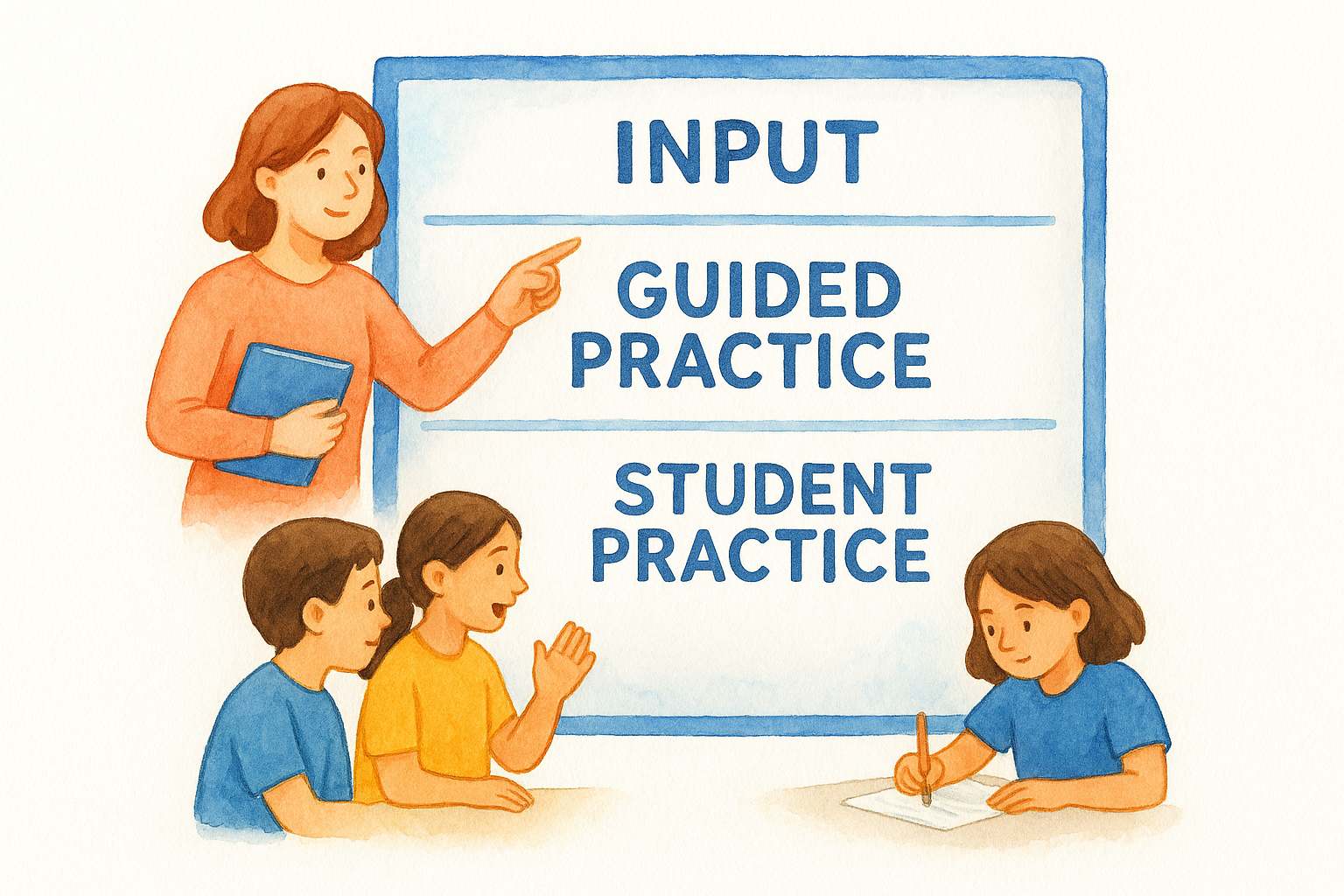
| Phase | Teacher Role | Student Role | Time |
|---|---|---|---|
| Input | Deliver content with visuals | Listen, observe, take notes | 10-15 min |
| Guided Practice | Model the task with the class | Participate with support | 10-15 min |
| Student Practice | Monitor and give feedback | Apply skills with a partner or independently | 10-15 min |
Keep your input phase short and visual-heavy so students aren’t relying solely on spoken English to follow the main idea. Move into guided practice before you think students are fully ready; that productive struggle with support is where much of the learning actually happens.
Plan student talk at specific moments
Talk time needs a designated spot in your lesson plan, not just a vague note to "discuss with a partner." Identify exactly where students will speak, what they’ll say, and what support they’ll have. Write it directly into your plan so it doesn’t get cut when the lesson runs long.
A reliable format is the think-pair-share. Give students 30 seconds to think independently, then 90 seconds to share with a partner using a sentence frame you’ve posted on the board. That structure lowers the barrier to speaking and gives you a real-time window into where students are with both the content and the language.
Step 4. Scaffold, differentiate, and check learning
The final phase of lesson planning for English language learners is where many plans stall because teachers either over-scaffold (removing all challenge) or under-scaffold (leaving ELL students to figure it out alone). Your goal is to match the level of support to the task demand and then pull it back as students show readiness. That balance is what separates a lesson that stretches ELL students from one that either frustrates or bores them.
Choose scaffolds that match the task
Not every activity needs every scaffold. Match your support to what the task actually asks students to do, and you’ll avoid overwhelming students with tools they don’t need. Use this quick reference to match the task type to the right scaffold:
| Task Type | Recommended Scaffold |
|---|---|
| Reading a text | Highlighted key sentences + margin glossary |
| Writing a response | Sentence frame + word bank |
| Oral discussion | Conversation stems posted visibly |
| Listening to instruction | Partially completed notes |
| Independent practice | Worked example to reference |
Build at least one scaffold per task into your lesson plan before class. If you wait until a student struggles to create support, you lose instructional time and the student loses confidence.
Differentiate by proficiency level
Your ELL students are not one group. A beginning-level student needs heavy sentence frames and visual support; an intermediate student may need a word bank but can form their own sentences. Plan two or three versions of the same task so each student is working at the edge of their ability, not below it or beyond it.
Differentiation works best when it’s built into your plan, not improvised mid-lesson.
Check learning before you leave
Exit tickets are the fastest way to see whether your ELL students hit both objectives. Give them a single focused prompt tied to your language objective, for example: "Use today’s sentence frame to describe the main conflict in one sentence." That one sentence tells you what the student understood and how well they can express it, which drives your next lesson.
Next steps for your next class
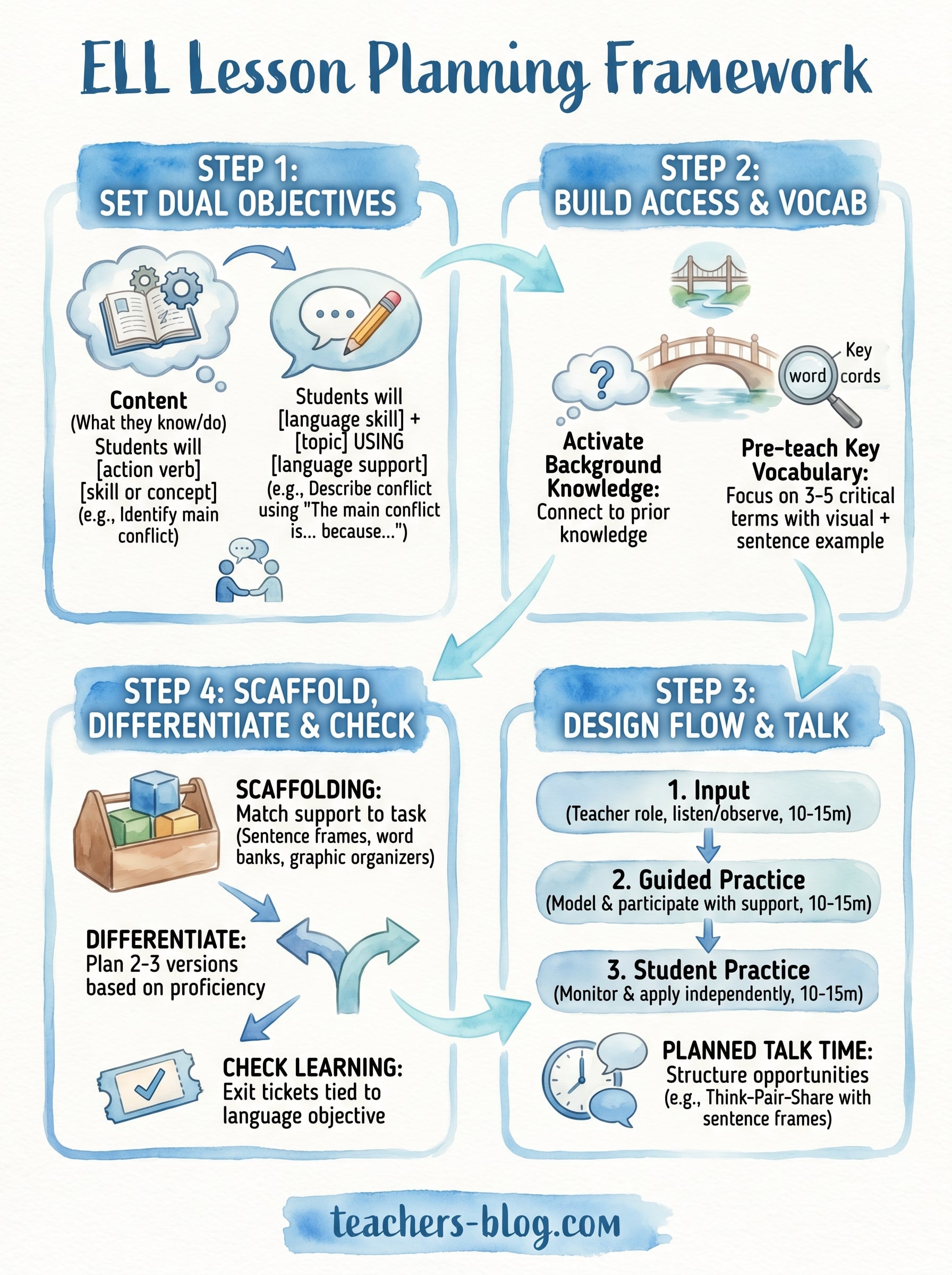
You now have a complete framework for lesson planning for English language learners: dual objectives, front-loaded vocabulary, a chunked lesson flow, and scaffolds matched to each task. The next move is simple. Pick your next lesson and apply one piece of this framework, not all of it at once. Set a content and language objective, build one scaffold per task, and plan two talk moments. That’s enough to make a real difference before Monday.
From there, build the habit. Each time you plan, add one more element from this guide until the full structure feels natural. You’ll start to see ELL students engage more, produce more, and need less redirection during class. That shift happens faster than most teachers expect when the plan is built around how students actually acquire language. When you’re ready to take your differentiation further, explore the tools and resources at The Cautiously Optimistic Teacher to keep building from here.