
11 Effective Report Card Comments That Save Teachers Time
Report card season hits, and suddenly you’re staring down a roster of 30+ students, each needing a comment that’s personal, professional, and actually useful to families. You already know that effective report card comments can strengthen the home-school connection and give students a clear picture of where they stand. But writing them from scratch, for every single kid, is a brutal time sink that eats into your evenings and weekends. You deserve a faster process that doesn’t sacrifice quality.
That’s exactly why we built this guide at The Cautiously Optimistic Teacher. Between our AI-powered Report Card Commentor tool and years of classroom experience shaping our resources, we understand the pressure teachers face during reporting periods. Good comments do real work: they celebrate growth, flag areas for improvement, and give parents something concrete to act on. Bad ones, vague, copy-pasted, or overly generic, waste everyone’s time and erode trust.
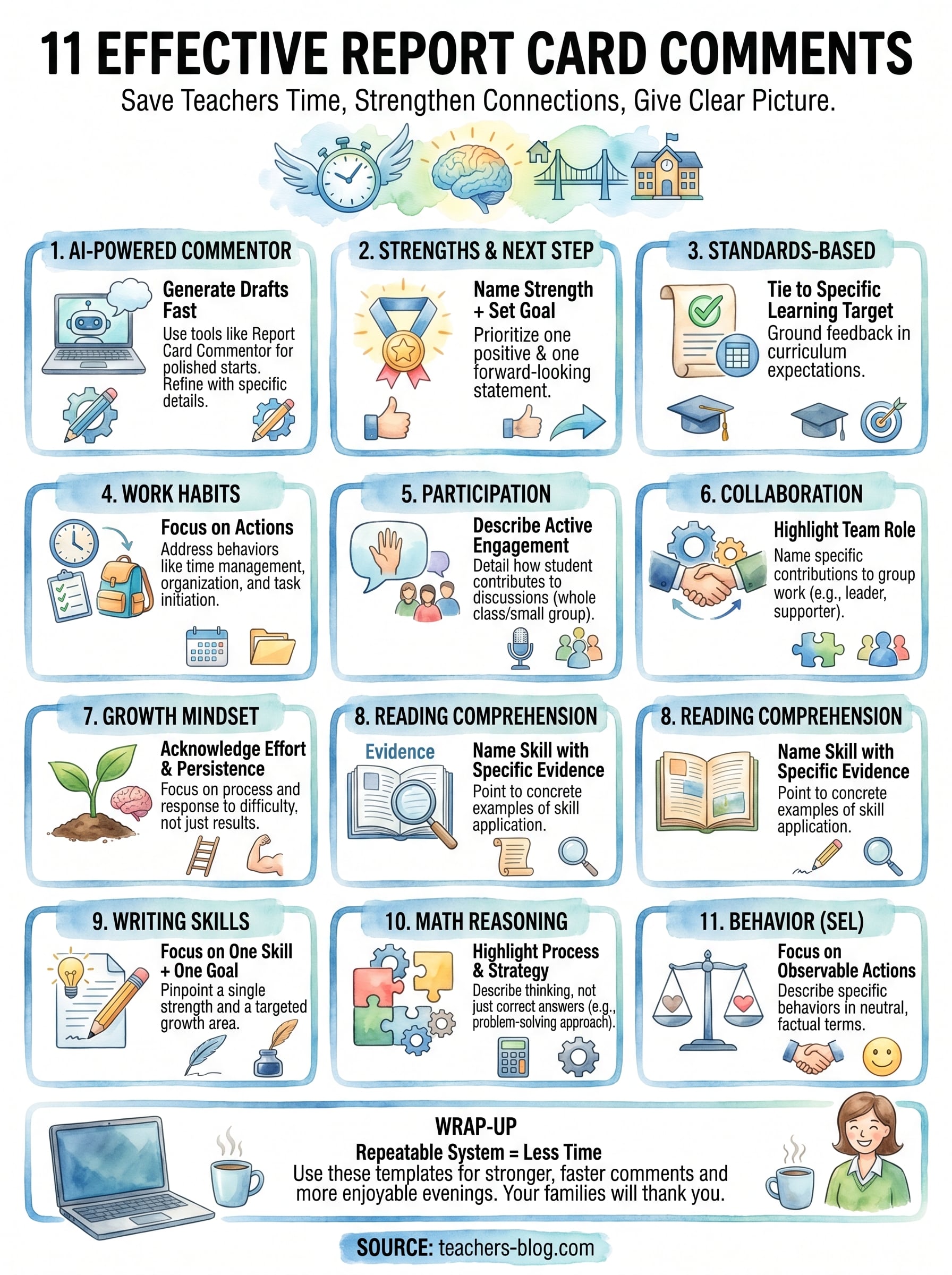
In this article, you’ll find 11 ready-to-use report card comment templates covering academics, behavior, effort, and social-emotional growth. Each one is paired with guidance on why it works and how to adapt it to your students. Whether you teach middle school English or high school science, these examples will help you write stronger comments in less time, so you can close your laptop and actually enjoy your evening.
Explore related resources: The Report Card Comments hub brings together subject-specific feedback, behavior and progress examples, comment banks, and writing guidance.
1. Use the Report Card Commentor on The Cautiously Optimistic Teacher
The fastest way to produce effective report card comments at scale is to start with a strong [AI-generated draft](https://teachers-blog.com/report-card-comment-generator/) rather than a blank page. The Cautiously Optimistic Teacher’s Report Card Commentor is a free tool built specifically for this moment in the school year. It takes your input about a student and returns a polished, classroom-ready comment in seconds, giving you a real head start before you add your personal knowledge.

What this comment approach solves
Writing one unique comment per student is manageable. Writing thirty in a single sitting is exhausting, and quality drops fast. The Report Card Commentor removes the blank-page problem entirely. Instead of composing from nothing, you review and refine, which is a far less draining process. It also reduces the risk of accidentally repeating the same phrasing across multiple comments, a pattern parents notice and that quietly undermines your credibility.
Starting from a quality draft cuts your total comment-writing time in half without cutting the quality of what families actually receive.
What to enter so the draft comes out usable
The tool works best when you give it specific, descriptive input rather than vague labels. Instead of entering "struggles with reading," try "needs support identifying the main idea in non-fiction texts." Name a concrete behavior, skill, or pattern you have observed, and include whether the student is performing above, at, or below grade-level expectations. The more precise your input, the less editing the output requires.
How to personalize fast without rewriting everything
Once you have the draft, you only need to swap in one or two specific details to make it feel individual. Add the student’s name, reference a particular assignment or unit, or adjust the goal statement to reflect what you are actually targeting next quarter. You do not need to rewrite the whole comment. Changing two or three words in the right places shifts a generic draft into something that sounds like you wrote it specifically for that child.
Privacy and professionalism checklist before you paste
Before you copy any AI-generated comment into your gradebook, run a quick check. Confirm no personally identifiable information beyond the student’s first name appears in the text. Read it aloud to catch any phrasing that sounds clinical or cold, and make sure the tone matches your school’s communication norms so that any concern comes across as constructive rather than as a judgment.
2. Use a Strengths Plus Next Step Two-Sentence Comment
The two-sentence format is one of the most efficient structures for writing effective report card comments: sentence one names a specific strength, sentence two names the immediate next goal. Parents read it quickly, students understand it clearly, and you write it without staring at a blank screen.
What this comment approach solves
Many comments fail because they try to say too much at once. This format forces you to prioritize what matters most and prevents comments from tipping into vague praise by requiring one positive and one forward-looking statement every single time.
Copy-ready examples you can adapt
Use the three examples below as starting points. Swap in the student’s name and adjust the skill detail to match your class.
- "[Name] demonstrates strong critical thinking when analyzing texts and consistently supports ideas with evidence. The next step is building smoother transitions to strengthen overall paragraph flow."
- "[Name] approaches math problems with clear organization and solid procedural understanding. Explaining reasoning in writing will deepen conceptual mastery next term."
- "[Name] is a reliable contributor in group discussions and listens respectfully to peers. The focus for next term is building confidence to share ideas during whole-class conversations."
One specific strength paired with one clear goal gives families something concrete to celebrate and act on.
How to personalize fast without rewriting everything
Replace the skill descriptor with something you observed this term, such as a unit, an assignment type, or a recurring behavior. That one swap makes the comment feel individual without a full rewrite.
Common mistakes that make it sound generic
Avoid vague strength words like "great attitude" or "hard worker" that could apply to any student in the building. Generic openers like "a pleasure to have in class" add no real information and waste your limited comment space.
3. Use a Standards-Based Academic Progress Comment
A standards-based comment ties your observation directly to a specific learning target or grade-level expectation. This approach grounds your feedback in curriculum rather than personality, making it one of the most credible and defensible types of effective report card comments you can write.
What this comment approach solves
Many parents don’t know what a letter grade actually means in practice. A standards-based comment fills that gap by explaining what the student can do relative to a clear benchmark. It shifts the conversation from "my child deserves a better grade" to a shared understanding of where the standard sits and what mastery requires.
Copy-ready examples you can adapt
Use these as starting points and substitute the skill or standard that fits your class:
- "[Name] meets the grade-level standard for identifying central ideas in informational texts and summarizes accurately with supporting details. The next focus is analyzing how an author’s word choices shape meaning."
- "[Name] is approaching the standard for multi-step problem solving and consistently applies the correct operation. Building a habit of checking work will help reach full mastery this term."
Naming the standard in plain language gives parents a concrete reference point and removes the guesswork from progress updates.
How to personalize fast without rewriting everything
Replace the standard descriptor with the specific skill from your curriculum, and adjust the mastery-level language (meeting, approaching, exceeding) to reflect your gradebook data. Those two swaps make the comment accurate and individual without a full rewrite.
How to keep it parent-friendly and jargon-free
Avoid code-heavy shorthand like "RL.7.4" or "CCSS benchmark." Translate the standard into plain language: say "identifying how word choice affects tone" rather than citing a curriculum code. Parents connect with clear skill descriptions, not technical labels, so write the way you would explain it at a parent-teacher conference.
4. Use a Work Habits and Independence Comment
Work habits comments address something grades often miss: how a student operates in the classroom, not just what they produce. These comments cover behaviors like time management, task initiation, and organization, giving families a fuller picture of their child’s daily performance. When parents understand the habits behind the grade, they can have far more productive conversations at home.
What this comment approach solves
Many parents assume a lower grade reflects lower ability, when the real issue is often inconsistent effort or underdeveloped work habits. A work habits comment reframes the conversation around behaviors that are learnable and improvable, which is far more actionable than a letter grade alone. That shift moves parents from frustration toward a clear understanding of what needs to change and why it matters.
Copy-ready examples you can adapt
- "[Name] consistently submits work on time and arrives prepared for class each day. The next step is building independence when starting longer assignments without teacher prompting."
- "[Name] is developing stronger organizational habits and has made visible progress tracking assignments this term. Continued practice with task initiation will support greater independence next quarter."
Naming a specific habit rather than a vague trait gives parents a concrete behavior they can reinforce at home.
How to personalize fast without rewriting everything
Replace the specific habit descriptor with whatever pattern you actually observed, whether it is missed deadlines, disorganized materials, or slow starts. Swapping that one behavioral detail transforms the template into an individual observation rather than a generic comment.
Home support line you can add in one sentence
Closing with a home connection strengthens the comment without adding length. Try: "Encouraging [Name] to review upcoming assignments each Sunday evening can help build the planning habit we are actively developing in class."
5. Use a Participation and Discussion Comment
Participation comments capture something that no quiz score can measure: how actively a student engages with ideas in real time. These comments tell families whether their child is showing up mentally, not just physically, and they round out effective report card comments with behavioral evidence that grades alone never reveal.
What this comment approach solves
Many parents have no sense of what their child’s classroom presence actually looks like. A participation comment closes that gap directly, giving families a window into daily engagement. It also documents patterns, both strong and developing, that matter for long-term academic confidence and help teachers track growth across terms.
Copy-ready examples you can adapt
- "[Name] participates regularly in class discussions and offers thoughtful responses that move conversations forward. The next step is building the habit of asking follow-up questions to deepen analytical thinking."
- "[Name] is developing confidence in whole-class settings and shares ideas consistently in small-group work. Encouraging risk-taking during full-class discussions will be the focus next term."
Naming a specific discussion context, whether small group or whole class, makes your observation far more credible than a general participation label.
How to personalize fast without rewriting everything
Swap out the discussion format detail (small group, partner work, Socratic seminar) to match what you actually observed. That single change anchors the comment in your specific classroom, not a generic template, and takes under thirty seconds.
Constructive versions That Don’t Sound Harsh
When participation is genuinely low, focus on the behavior rather than the student’s character. Say "contributes infrequently during whole-class discussion" instead of "is quiet" or "disengaged." Behavior-focused language keeps the comment professional, factual, and forward-looking without putting families on the defensive.
6. Use a Collaboration and Group Work Comment
Collaboration comments give families specific insight into how their child functions as part of a team, something no individual assignment grade can capture. These are among the most effective report card comments you can write because they address real-world skills that matter far beyond your classroom.
What This Comment Approach Solves
Group work is often where student character shows up most clearly, yet grades rarely reflect it. A collaboration comment fills that reporting gap by naming exactly what a student contributes when working alongside peers. It also shifts parent focus toward interpersonal skills that employers and colleges consistently prioritize.
Naming a student’s role in group work tells families far more than any participation checkmark on a rubric.
Copy-Ready Examples You Can Adapt
Use these as your starting point and swap in the student’s name and context:
- "[Name] takes on a leadership role in group projects and keeps team members focused on shared goals. The next step is practicing active listening when peers share competing ideas."
- "[Name] is a dependable team contributor who completes assigned tasks reliably and supports classmates. Building confidence to contribute ideas early in the planning phase will strengthen overall impact."
How to Personalize Fast Without Rewriting Everything
Replace the role descriptor (leader, supporter, recorder, facilitator) with whatever role you actually observed that student filling. That one swap anchors the comment in your real classroom observation rather than a generic script.
Role-Based Language That Stays Specific
Avoid broad labels like "good team player." Instead, name the specific function the student performed, such as "organized the group’s timeline" or "encouraged quieter teammates to contribute." Specific role language makes your comment credible, observable, and impossible to apply to every child on your roster.
7. Use a Growth Mindset and Perseverance Comment
Growth mindset comments do something most academic comments skip entirely: they acknowledge the effort and process behind a student’s performance, not just the result. These are some of the most effective report card comments you can write for students who are working hard in a subject where their grade does not yet reflect that effort.
What This Comment Approach Solves
Grades tell families what a student produced. They rarely tell the story of how a student responded to difficulty, which is often the more important detail. A perseverance comment documents that a student pushed through a challenging unit, revised their work repeatedly, or recovered after a rough start. That behavioral evidence matters to families and motivates students when they see their effort recognized in writing.
Naming a specific moment of persistence is far more powerful than any broad statement about a student’s attitude.
Copy-Ready Examples You Can Adapt
- "[Name] tackled a difficult concept this term with consistent effort and did not give up when initial attempts fell short. That persistence directly contributed to the progress shown on recent assessments."
- "[Name] responded to critical feedback by revising work multiple times and demonstrated real growth from the first draft to the final submission."
How to Personalize Fast Without Rewriting Everything
Replace the situation descriptor with the actual challenge that student faced this term, whether a specific unit, a test they retook, or an assignment they revised. That one swap ties the comment directly to your real classroom observation.
Phrases to Avoid That Accidentally Label Kids
Avoid phrases like "finally got it" or "not a natural at this subject" because these accidentally frame ability as fixed. Instead, keep your language focused on behaviors: what the student did, how often they tried, and what specific action led to improvement.
8. Use a Reading Comprehension Comment With Evidence
Reading comprehension comments work best when they name a specific skill and back it up with a concrete reference. Pointing to what a student can actually do with a text gives families far more useful information than a grade ever can, and it makes your effective report card comments harder to dismiss as boilerplate.
What This Comment Approach Solves
Many reading comments stay too surface-level, saying things like "reads well" without explaining what that means in practice. A comment grounded in specific evidence tells families exactly where their child succeeds and where targeted practice will help. It also signals to parents that you know their child’s reading habits individually, not just as part of a class average.
Copy-Ready Examples You Can Adapt
Use these as your starting point and adjust the skill and text reference to match your class:
- "[Name] identifies the author’s purpose in informational texts and uses details from the passage to explain their thinking. The next focus is drawing inferences when meaning is implied rather than stated directly."
- "[Name] summarizes narrative texts accurately and tracks character development across a full story arc. Building skills in analyzing theme will be the priority next term."
Naming a specific reading skill alongside a concrete next step tells parents exactly what progress looks like.
How to Personalize Fast Without Rewriting Everything
Replace the skill descriptor with the comprehension strategy you actually emphasized this term. Swap in a text title or genre your class worked with, and the comment immediately sounds personal rather than copied from a bank.
Quick Ways to Reference Evidence Without Overexplaining
You do not need to quote the student’s work directly. Simply naming the assignment type ("in our nonfiction unit" or "during independent reading checks") gives parents enough context to trust your observation without turning the comment into a full report.
9. Use a Writing Skills Comment That Names One Skill and One Goal
Writing comments are easy to get wrong because writing itself covers so many overlapping skills. The most effective report card comments for this area do one thing well: they name a single strength and a single growth target, so families walk away with clarity instead of a vague sense that writing is either good or bad.
What This Comment Approach Solves
Most writing grades leave parents without a clear picture of where their child actually stands. A comment that pinpoints one specific skill (organization, voice, sentence fluency) and pairs it with one focused goal gives families a usable takeaway. It also prevents you from writing the same bloated paragraph about every dimension of writing at once, which saves time and improves readability for the parent.
A focused writing comment is more actionable than a detailed critique covering every skill at once.
Copy-Ready Examples You Can Adapt
- "[Name] constructs well-organized paragraphs with a clear topic sentence and supporting details. The next step is varying sentence structure to strengthen the overall flow of longer pieces."
- "[Name] writes with a strong and consistent voice that engages the reader throughout. The focus for next term is tightening word choice to eliminate unnecessary repetition."
How to Personalize Fast Without Rewriting Everything
Swap in the specific writing skill you emphasized this term, whether it is thesis development, use of evidence, or transitions. That one change anchors the comment in your actual instruction rather than a generic writing bank.
Editing and Conventions Language That Stays Clear
When conventions are the concern, name the specific pattern you observed, such as "inconsistent comma use" or "frequent run-on sentences." Avoid broad labels like "needs to proofread," which gives families no concrete direction for how to help at home.
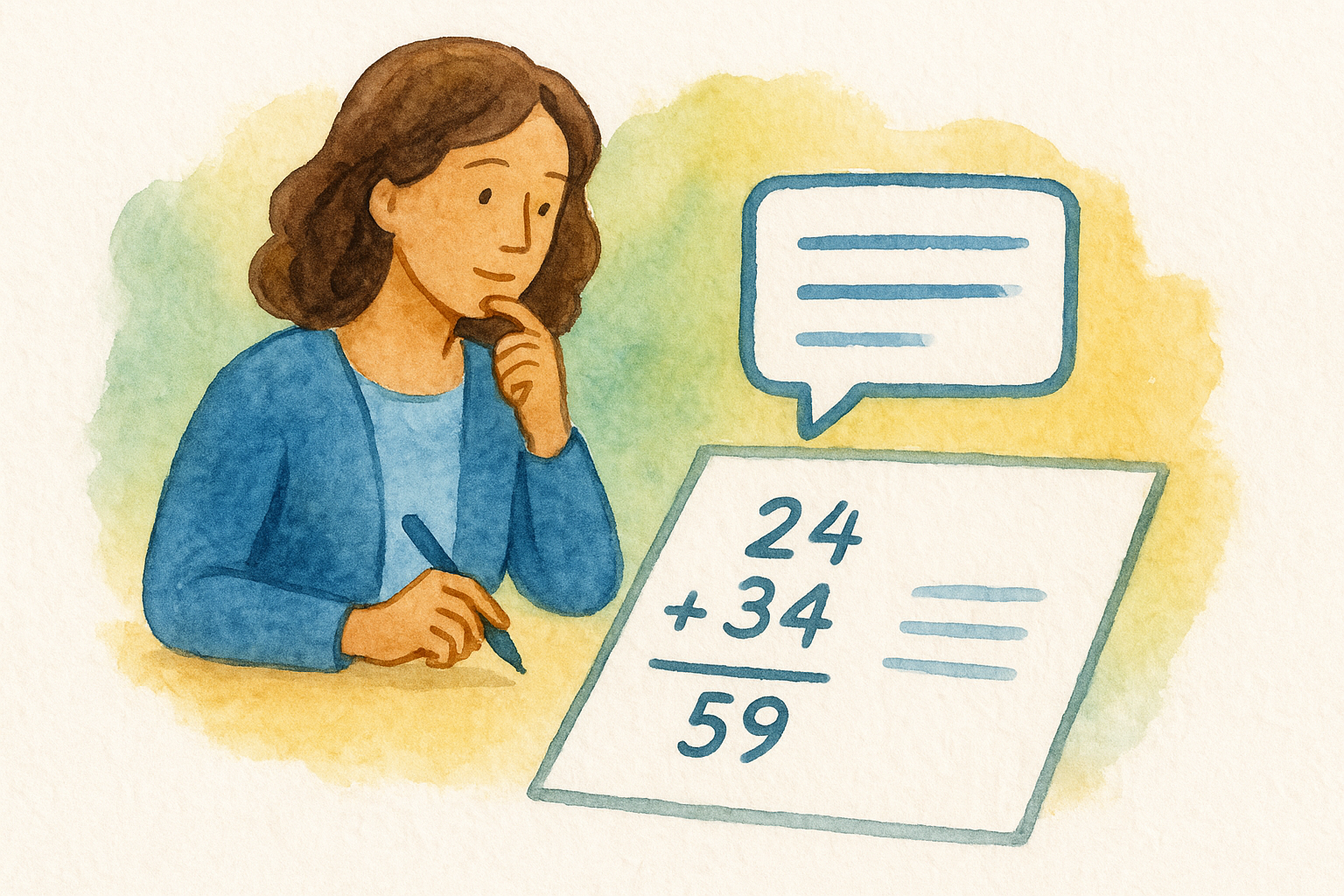
10. Use a Math Reasoning Comment That Highlights Process
Math comments too often focus entirely on whether a student gets the right answer, which misses the bigger picture. How a student thinks through a problem tells you far more about their mathematical development than a score alone, and effective report card comments for math should reflect that. Centering your comment on process and reasoning gives families a useful picture of what their child understands and what to build next.
What This Comment Approach Solves
A grade communicates outcome. A process-focused comment communicates understanding, which is what families actually need to know. When you describe how a student approaches problems, rather than simply whether they solved them correctly, you give parents actionable context they can use to support learning at home.
Naming the reasoning strategy a student uses tells families far more than any percentage score on an assessment.
Copy-Ready Examples You Can Adapt
Use these as your starting point and swap in the skill that fits your current unit:
- "[Name] breaks multi-step problems into smaller parts and applies each operation accurately. The next step is explaining reasoning in writing to demonstrate full conceptual understanding."
- "[Name] approaches new problem types with a clear strategy and self-corrects when an initial method does not work. Building speed with basic fact recall will strengthen overall fluency."
How to Personalize Fast Without Rewriting Everything
Replace the strategy descriptor with the specific problem-solving approach you observed this term. Naming a particular unit or skill (fractions, equations, geometry) anchors the comment in your actual classroom instruction.
Goal Language for Accuracy, Fluency, and Explanation
Match your goal language to the actual gap you observed. Use "accuracy" when errors are procedural, "fluency" when speed with foundational facts is the concern, and "explanation" when a student solves correctly but cannot articulate their thinking. That precision makes your goal feel specific rather than recycled.
11. Use a Behavior and Social-Emotional Comment Based on Actions
Behavior and social-emotional comments are among the most delicate effective report card comments you will write. The core rule: focus on observable actions, not character traits. Saying a student "acted out" gives parents nothing useful. Describing what the student actually did and what support is in place gives families a clear, actionable picture of their child’s classroom experience.
What This Comment Approach Solves
Vague labels like "disruptive" or "immature" put parents on the defensive fast. Action-based language removes that friction by describing specific behaviors in neutral, factual terms. This approach also protects you professionally, because documented behavioral observations are far easier to defend than broad character judgments if a parent conversation becomes difficult.
Grounding your comment in observable behavior keeps the focus on growth, not on who the student is as a person.
Copy-Ready Examples You Can Adapt
Use these as your starting point and adjust the behavior detail to fit your student:
- "[Name] manages classroom transitions smoothly and arrives prepared to focus. The next step is sustaining that self-regulation during longer independent work periods."
- "[Name] is developing strategies for resolving peer conflicts respectfully and has made visible progress this term. Continued practice with self-advocacy will be the focus next quarter."
How to Personalize Fast Without Rewriting Everything
Replace the specific behavior descriptor with the pattern you actually observed, whether it involves self-regulation, peer interactions, or emotional responses. That swap anchors the comment in your real classroom observation.
Restorative, Classroom-Safe Phrasing for Concerns
When a behavior is genuinely a concern, frame your comment around the action and the support in place, not the student’s identity. Say "is working on managing frustration during group tasks" rather than "has anger issues." That phrasing is professional, restorative, and safe to share in a written document that parents, administrators, and sometimes students will read.
Wrap-Up and Next Steps
Writing effective report card comments does not have to drain your evenings every term. The eleven approaches in this guide give you a repeatable system you can rely on across every subject, skill area, and student personality. Whether you start with a two-sentence strengths comment or a process-focused math observation, the goal is the same: give families something specific, useful, and clear.
Your next move is simple. Pick two or three templates from this list that fit your current roster and test them this reporting period. Notice how much less time you spend staring at a blank screen. When you want to move even faster, the Report Card Commentor at The Cautiously Optimistic Teacher generates a solid first draft from your input in seconds, so you spend your energy refining rather than composing. Stronger comments, shorter evenings, and families who actually feel informed. That outcome is completely within reach.