20 Trends in Education That Are Just Starting to Take Off
If you’ve been teaching for a while, you’ve probably noticed something interesting: education moves in waves.
One year it’s all about technology. The next, we’re rethinking technology. One year it’s standardized everything. The next, we’re pushing for personalization and flexibility.
Right now, we’re in one of those transition moments—and it’s a fascinating one.
Many of the “next big things” in education aren’t brand new ideas. They’re shifts. Corrections. Rebalances. And in many cases, they’re a response to what hasn’t worked as well as we hoped.
Here are 20 trends in education that are just starting to gain real traction—and why they’re happening.
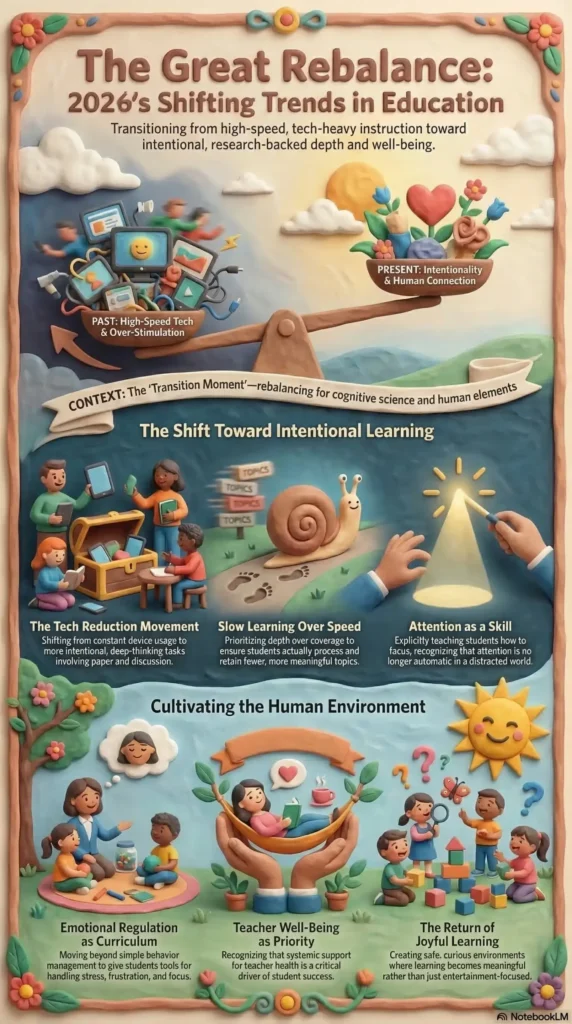
1. The Tech Reduction Movement
Let’s start with the big one.
After years of pushing devices into classrooms, many educators are starting to pull back. Not eliminate technology—but use it more intentionally.
Why it’s happening:
We’re seeing the downsides—distraction, shallow engagement, and reduced stamina for deep thinking. Teachers are rediscovering the value of paper, discussion, and sustained focus.
2. Slow Learning
This is the opposite of cramming content.
Slow learning emphasizes depth over speed—fewer topics, explored more meaningfully.
Why it’s happening:
Research on memory and learning shows that deeper processing leads to better retention. Teachers are realizing that “covering everything” often means students learn very little.
3. Attention as a Skill
We used to assume students would just “pay attention.” Now, we’re teaching it explicitly.
Why it’s happening:
Students are growing up in a world of constant distraction. Attention is no longer automatic—it’s a skill that needs to be built and practiced.
4. Knowledge-Rich Curriculum
There’s a renewed focus on content knowledge—not just skills.
Why it’s happening:
Critical thinking depends on background knowledge. You can’t analyze what you don’t understand. This shift is pushing back against overly skill-based approaches.
5. Explicit Instruction Comeback
Clear modeling, guided practice, and structured lessons are back in style.
Why it’s happening:
Cognitive science has reinforced what many teachers already knew: students learn more efficiently when instruction is clear and direct.
6. Micro-Routines for Classroom Management
Instead of big rules, teachers are focusing on small, repeatable routines.
Why it’s happening:
Consistency reduces cognitive load and creates predictability. It also prevents many behaviour issues before they start.
7. Emotional Regulation as Curriculum
We’re not just managing behaviour—we’re teaching students how to regulate themselves.
Why it’s happening:
Post-pandemic classrooms made it clear: students need tools for stress, frustration, and focus.
8. Teacher Language as a Strategy
What we say—and how we say it—is becoming a central focus.
Why it’s happening:
Small shifts in language can dramatically change student behaviour and engagement. Teachers are becoming more intentional with their words.
9. Low-Stakes Assessment
More frequent, smaller check-ins instead of high-pressure tests.
Why it’s happening:
Assessment is most powerful when it informs instruction—not when it just evaluates students at the end.
10. Interleaving and Spaced Practice
These science-of-learning strategies are moving into everyday teaching.
Why it’s happening:
They improve long-term retention, even though they feel harder in the moment.
11. The “Boring is Better” Movement
This one always makes me smile.
Some educators are realizing that learning doesn’t always need to be flashy.
Why it’s happening:
Overstimulating lessons can actually reduce retention. Calm, focused environments often lead to better learning.
12. Writing Across the Curriculum
More writing in all subjects—not just English.
Why it’s happening:
Writing forces thinking. When students write, they process ideas more deeply.
13. Oral Language Revival
Discussion, debate, and speaking skills are making a comeback.
Why it’s happening:
Strong oral communication supports thinking, confidence, and understanding.
14. Culturally Responsive Text Selection
Representation is becoming a priority—not an afterthought.
Why it’s happening:
Students engage more when they see themselves reflected in what they learn.
15. Flexible Seating… with Structure
Flexible seating isn’t going away—but it’s becoming more purposeful.
Why it’s happening:
Teachers are balancing student choice with the need for focus and routine.
16. AI as a Thought Partner (Not a Shortcut)
AI is entering classrooms—but with more caution than excitement.
Why it’s happening:
Teachers are realizing that AI can support thinking—but can also replace it if used poorly.
17. Retrieval Practice as a Daily Habit
Quick recall activities are becoming standard practice.
Why it’s happening:
Retrieval strengthens memory more than re-reading or reviewing notes.
18. Project-Based Learning with Guardrails
PBL isn’t disappearing—it’s evolving.
Why it’s happening:
Teachers are adding more structure to ensure real learning happens, not just activity.
19. Teacher Well-Being as a System Priority
This is long overdue.
Why it’s happening:
Burnout is real. Schools are starting to recognize that teacher well-being directly impacts student success.
20. The Return of Joyful Learning
Not entertainment—joy.
Why it’s happening:
When students feel safe, curious, and engaged, learning becomes meaningful.
What This All Means for Teachers
If there’s one pattern across all of these trends, it’s this:
We’re moving from “more” to “better.”
Not more technology—better use of technology
Not more content—deeper learning
Not more strategies—more intentional ones
And honestly, that’s encouraging.
Because it means that great teaching isn’t about chasing every new trend. It’s about understanding why these trends are emerging—and choosing what works for your classroom.
Final Thought
If you’re feeling overwhelmed by all the changes in education, here’s the good news:
You don’t have to do all 20 of these.
In fact, you shouldn’t.
Pick one. Try it. Reflect. Adjust.
That’s how real change happens—not in big leaps, but in small, thoughtful steps.
And if this current wave continues, the future of education might not be louder or faster…
…it might just be smarter.