What Is Reading Comprehension? A Guide for Teachers
You’ve watched a student read every word on a page correctly, then stare blankly when you ask what it meant. That gap between decoding and understanding is exactly why what is reading comprehension matters so much in your classroom. It’s not just "getting" a text; it’s the active process of constructing meaning from words, and it depends on skills like vocabulary, background knowledge, and inference that many students never learn explicitly.
Reading comprehension breaks down into distinct components and levels, from literal recall to critical analysis, and knowing the difference changes how you plan instruction. A student who struggles with inferential thinking needs different support than one who can’t retain literal details, so a clear definition becomes a diagnostic tool, not just a vocabulary lesson.
This guide walks through the core definition, the main types of comprehension you’ll encounter in middle and high school classrooms, and the evidence-based strategies that actually move struggling readers forward. You’ll leave with a practical framework you can apply to your next unit, whether you’re teaching a novel or a short nonfiction passage, and a clearer sense of the classroom strategies worth prioritizing.
Why reading comprehension matters for your students
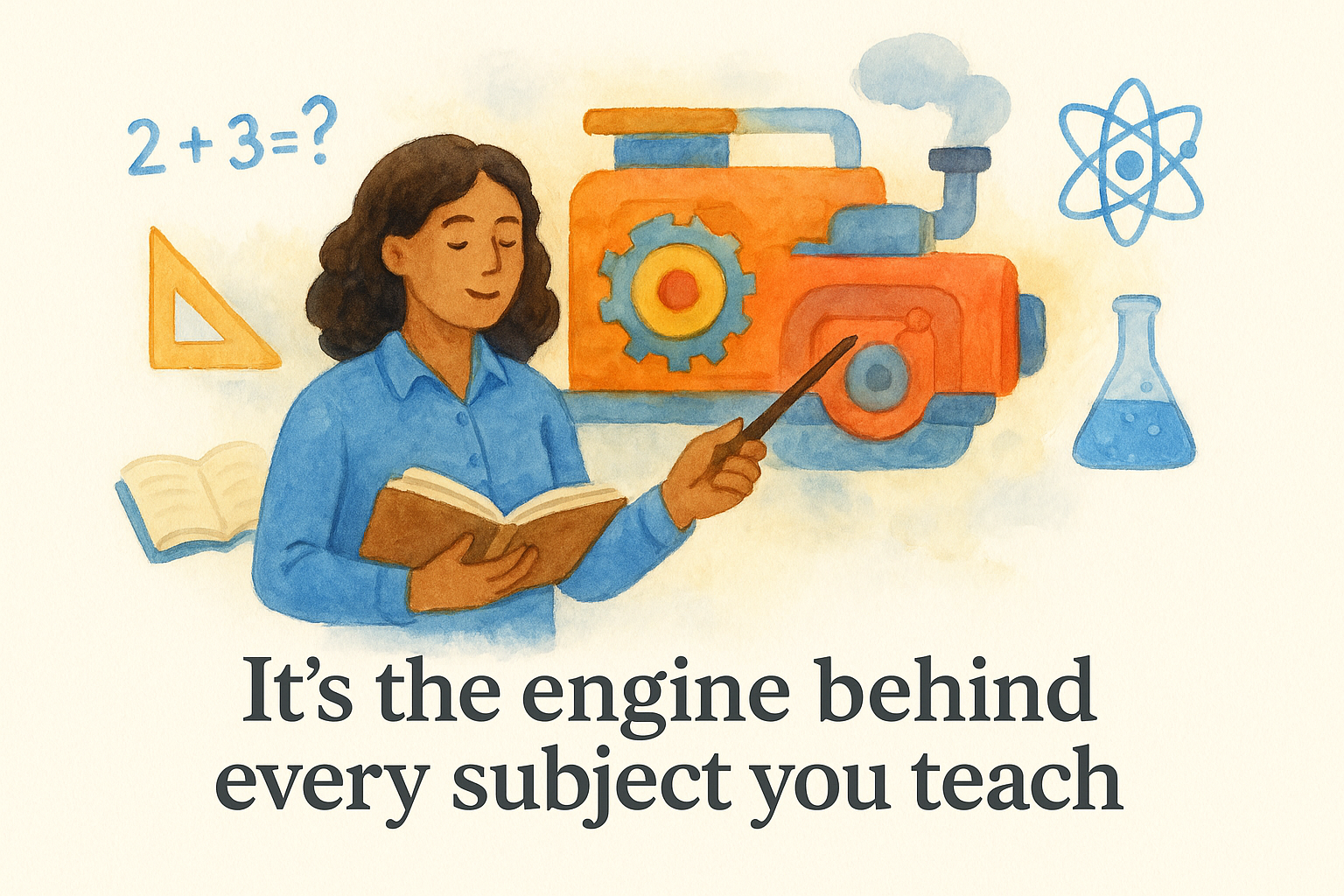
It’s the engine behind every subject you teach
Reading comprehension doesn’t stay contained in your English block. Every subject you teach leans on it, whether students realize it or not. A word problem in math requires the same inferential skills as a short story. A primary source document in social studies demands the same close reading you’d use for a poem. When a student can’t comprehend a science textbook passage about photosynthesis, the problem often isn’t the science content itself, it’s the reading skill underneath it.
| Subject | Where comprehension shows up | What breaks down without it |
|---|---|---|
| Math | Word problems, instructions | Students solve the wrong equation |
| Science | Textbook passages, lab procedures | Misapplied steps, missed concepts |
| Social studies | Primary sources, timelines | Surface-level analysis only |
| English | Novels, essays, poetry | Plot recall without meaning |
This is why a comprehension deficit rarely shows up as a single-subject problem. It shows up everywhere, and teachers outside the English department often mistake it for a content gap instead of a literacy gap.
The data on struggling readers should worry you
National data backs this up in a way that’s hard to ignore. According to the National Assessment of Educational Progress, roughly a third of eighth graders in the United States read at or above the proficient level, meaning the majority are reading below the standard needed to fully engage with grade-level text. That’s not a small subgroup of students. That’s most of your classroom on any given day.
A student who can’t comprehend text can’t fully access any subject that requires reading it.
Those numbers matter because comprehension gaps rarely close on their own. Students who struggle in fourth grade tend to struggle in eighth grade, and the gap between strong and weak readers tends to widen, not narrow, as texts get more complex and less scaffolded by pictures or simple sentence structures.
It shapes how students see themselves as learners
Confidence takes a hit long before grades do. Students who can decode but can’t comprehend often develop a quiet belief that they’re
How to teach reading comprehension step by step
Teaching reading comprehension works best as a sequence, not a single lesson. You’re building a skill in layers, starting with what students already know and ending with them applying strategies independently. Skip a layer and the whole structure wobbles, which is why so many students can answer surface-level questions but freeze on anything requiring inference or synthesis. Here’s the sequence that holds up across grade levels and subjects.
Start with background knowledge and vocabulary
Before students read a single sentence, check what they already know about the topic. A passage about the Dust Bowl means little to a student with no context for the Great Depression, no matter how strong their decoding skills are. Spend five to ten minutes front-loading key vocabulary and context, because prior knowledge does more heavy lifting in comprehension than most teachers give it credit for. Skipping this step is the fastest way to watch a strong reader stall on an unfamiliar topic.
Model your thinking out loud
Next, show students what comprehension actually looks like inside your head. Read a paragraph aloud and narrate your thought process: what you predicted, where you got confused, how you resolved it. This is often called a think-aloud, and it turns an invisible mental process into something students can copy.
You can’t teach comprehension by only assigning it; you have to demonstrate it.
Students who’ve never seen an adult struggle with a confusing sentence assume good readers never get confused. Modeling breaks that myth fast.
Guide practice with scaffolds
Once students have seen the strategy modeled, they need to try it with support before trying it alone. This is where guided practice happens, usually in small groups or partnerships where you can circulate and correct misunderstandings before they calcify. Useful scaffolds at this stage include:
- Sentence starters for making predictions ("I think this will happen because…")
- Graphic organizers for tracking cause and effect
- Annotation codes (a question mark for confusion, a star for main ideas)
- Partner check-ins after every paragraph, not just at the end
These supports aren’t crutches you remove all at once. You fade them gradually as students show they can apply the strategy without prompting.
Release responsibility gradually
Finally, hand the strategy over completely. Students read independently and apply the same strategy you modeled and scaffolded, without a worksheet walking them through each step. This gradual release, sometimes called the "I do, we do, you do" model, matches how the International Literacy Association describes effective comprehension instruction: explicit, then supported, then independent.
Gauging readiness for this last stage matters more than rushing to it. If half your class still needs the sentence starters, don’t pull them yet. Independent practice only works when students have genuinely internalized the strategy, not when the calendar says it’s time to move on. Rushing this step is why so many students revert to guessing once the scaffolds disappear.
Practical strategies and activities for the classroom
Strategies mean nothing if they stay theoretical, so this section moves from the "why" to the "what you actually do on Tuesday morning." Reading comprehension improves fastest when students practice a strategy repeatedly across different texts, not when they encounter it once in a single lesson. Repeated exposure to a strategy across genres, from a short story to a lab report, builds the flexibility students need for a state test and for reading outside your classroom.
Turn annotation into a habit
Annotation forces students to interact with text instead of letting their eyes glide past it. Give them a simple, consistent system they can use across subjects:
- Underline the main idea in each paragraph
- Circle unfamiliar vocabulary
- Write a one-word summary in the margin every few paragraphs
- Draw an arrow connecting cause to effect
Keeping the system small matters. A ten-symbol code overwhelms students and turns annotation into busywork instead of genuine thinking.
Use graphic organizers to visualize structure
Visual structure helps students see relationships that plain text hides, especially in nonfiction packed with cause-and-effect or compare-and-contrast patterns. Match the organizer to the text structure instead of defaulting to the same web every time.
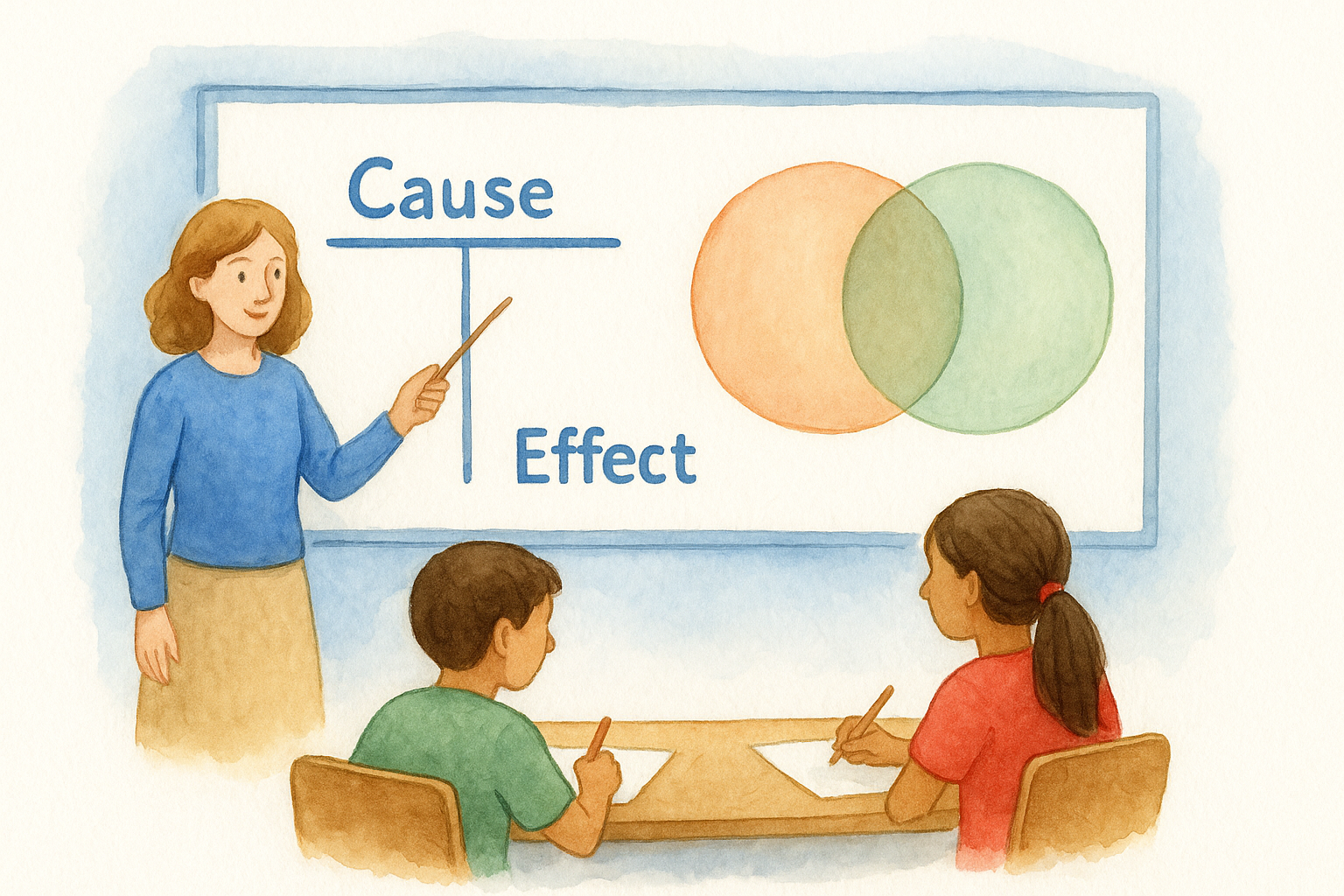
| Text structure | Best organizer | Example use |
|---|---|---|
| Cause and effect | T-chart | Historical events, science processes |
| Compare and contrast | Venn diagram | Two characters, two arguments |
| Sequence | Timeline or flowchart | Lab procedures, plot events |
| Problem and solution | Two-column chart | Editorials, case studies |
Choosing the wrong organizer for the structure confuses students more than skipping one entirely, so spend a minute identifying the text’s shape before assigning the tool.
Build comprehension through discussion
Talking about a text forces students to organize their thinking out loud, which is often where gaps in understanding surface first. Structured discussion protocols, like Socratic seminars or turn-and-talk with a specific prompt, push students past summary and into interpretation.
Discussion reveals comprehension gaps faster than any worksheet can.
Pairing discussion with accountability, a quick exit ticket or a written reflection, keeps the conversation from turning into a handful of vocal students carrying the room while everyone else coasts.
Recognizing when a student struggles with comprehension
Most comprehension struggles hide behind fluent-sounding reading, which is why so many teachers miss them until a test score forces the issue. A student who reads aloud smoothly, with proper pacing and expression, can still walk away from a passage with almost nothing retained. Comprehension struggles rarely announce themselves the way a decoding problem does, so you have to know what to look for instead of waiting for a student to say "I don’t get it."
Warning signs show up in specific patterns
Certain behaviors repeat across grade levels once you know to watch for them. A student who can summarize a paragraph but can’t explain why it matters is often stuck at the literal level, unable to make the jump to inference. Another student might retell a story accurately but freeze when you ask what the character was feeling or why they made a choice, a sign that inferential thinking hasn’t developed yet. Watch too for students who read a passage twice and still can’t answer a basic "what happened" question; that’s usually a working-memory issue tangled up with comprehension, not laziness.
Fluent reading and real comprehension are not the same skill, and testing only one hides problems with the other.
Questions that require students to connect two parts of a text, like linking a character’s earlier decision to a later consequence, expose gaps that simple recall questions never will.
Separate a decoding problem from a comprehension problem
Determining whether the issue is decoding or comprehension changes your next move entirely. If a student stumbles over unfamiliar words, mispronounces multisyllabic terms, or reads word by word instead of in phrases, the breakdown is happening before comprehension even gets a chance. Give that student a passage read aloud to them instead of by them; if their understanding improves dramatically, decoding was the bottleneck, not meaning-making. If comprehension stays weak even when decoding isn’t a factor, you’re looking at a genuine comprehension gap that needs strategy instruction, not more phonics practice.
Track patterns over time, not single incidents
One bad quiz doesn’t mean a student struggles with comprehension; a repeated pattern does. Keep a simple running record of what trips a student up across several texts and question types:
- Struggles only with nonfiction, not fiction (a sign of unfamiliar text structure, not weak comprehension overall)
- Answers literal questions fine but misses every inferential one
- Comprehension drops sharply with longer passages, suggesting stamina or working-memory limits
- Understands text read aloud but not the same text read independently
Spotting these patterns early, ideally within the first few weeks of a unit, gives you time to intervene before a student falls far enough behind that catching up feels impossible. Ongoing observation, more than any single assessment, tells you what a student actually needs next.
How to assess reading comprehension effectively
Assessment only helps if it tells you something you can act on, so the goal isn’t just a grade in the gradebook. Good assessment separates literal recall from inference, tracks growth over time, and points you toward the next lesson instead of just confirming what you already suspected. Reading comprehension assessment works best as an ongoing habit, not a single end-of-unit event that arrives too late to change your instruction.
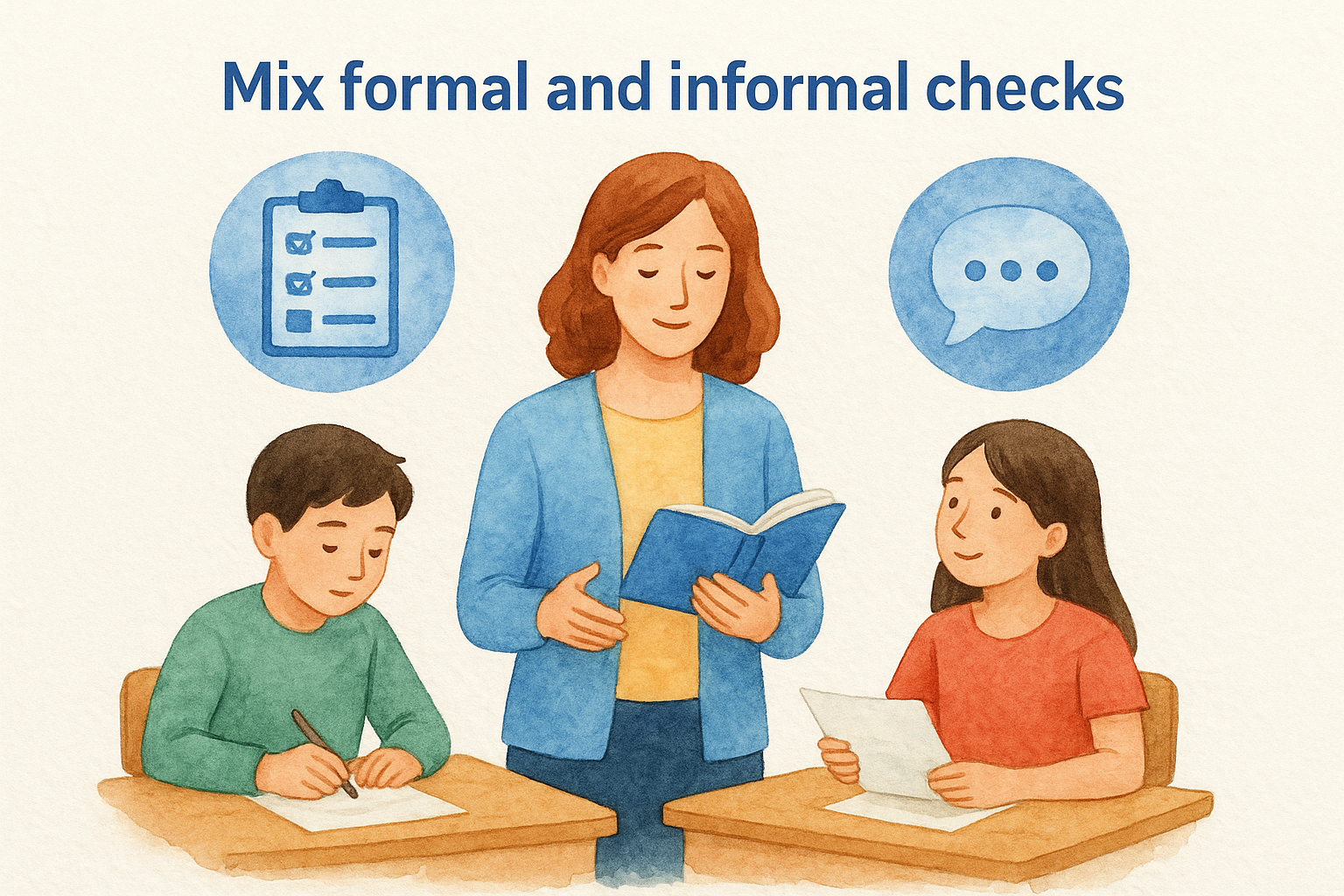
Mix formal and informal checks
Formal assessments, like standardized reading tests or unit exams, give you a snapshot compared against grade-level benchmarks, but they tell you little about what happened in a student’s head while reading. Informal checks fill that gap. Running records, quick oral retells, and one-on-one conferences catch problems days or weeks before a formal test would surface them. Neither type replaces the other; they answer different questions.
| Assessment type | What it tells you | Best used for |
|---|---|---|
| Standardized test | Grade-level standing, broad trends | Reporting, identifying at-risk groups |
| Running record | Real-time decoding and fluency issues | Early intervention, weekly check-ins |
| Oral retell | Whether a student grasped the main idea | Quick daily formative checks |
| Written response | Depth of inference and analysis | Unit assessments, exit tickets |
Ask questions at every level
A quiz full of literal recall questions tells you almost nothing about whether a student can infer, analyze, or evaluate. Structure your questions across levels so weak spots show up clearly instead of hiding behind a passing score:
- Literal: What happened first in the passage?
- Inferential: Why did the character make that choice?
- Evaluative: Do you agree with the author’s argument, and why?
- Synthesis: How does this connect to something else we’ve read?
Grouping your gradebook by question type, not just total score, shows you exactly where a student’s comprehension breaks down. A student scoring 90% overall but missing every inferential question needs different support than a student missing everything evenly.
A single score hides more than it reveals; question-level data tells you what to teach next.
Use rubrics that isolate comprehension from writing skill
Written responses are useful, but grading them with one blended score muddies the picture. A student with strong comprehension and weak writing mechanics can look identical on paper to a student with the opposite problem. Build a simple rubric that scores comprehension and expression separately, even if it’s just two columns: did the student understand the text, and did they communicate that understanding clearly? This distinction matters most for English language learners and students with writing-specific learning differences, where comprehension often outpaces the ability to express it on the page.
Frequent, low-stakes checks beat infrequent high-stakes ones for another reason: they normalize struggle as part of learning rather than something to hide until a big test forces it into view. A weekly five-minute conference, tracked over a semester, tells you more about a student’s trajectory than any single test score ever will.
Guiding students toward stronger reading skills
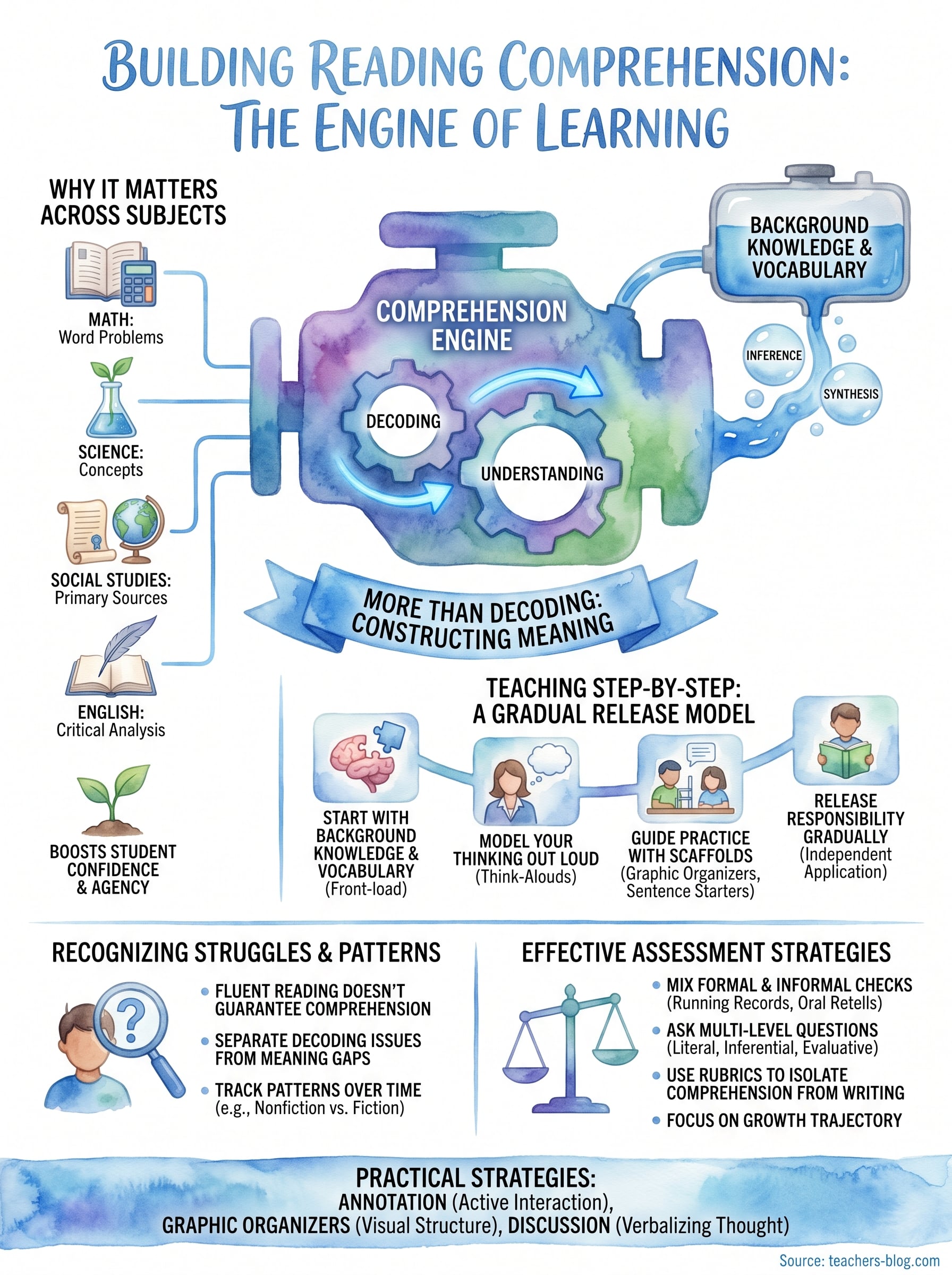
At its core, reading comprehension is the skill that determines whether everything else you teach actually lands. You can deliver the best lesson in the building, but if students can’t construct meaning from the text in front of them, the content never reaches them. That’s why the definition matters less than what you do with it: diagnosing where a student’s understanding breaks down, teaching the strategy that addresses that specific gap, and checking whether it worked.
None of this requires a complete overhaul of your curriculum. Small, consistent moves, a think-aloud here, a better annotation system there, a rubric that separates comprehension from writing, compound over a semester. Start with one strategy from this guide and watch it for a few weeks before adding another.
If you want more ready-to-use tools for building these skills into your daily lessons, browse the classroom resources at The Cautiously Optimistic Teacher.