Universal Design for Learning in the Classroom, Explained
You’ve got one lesson plan and thirty different brains sitting in front of you. Some students need visuals, some need movement, some need extra time, and a few need all three. That gap between the plan and the reality of your classroom is exactly what universal design for learning in the classroom was built to close.
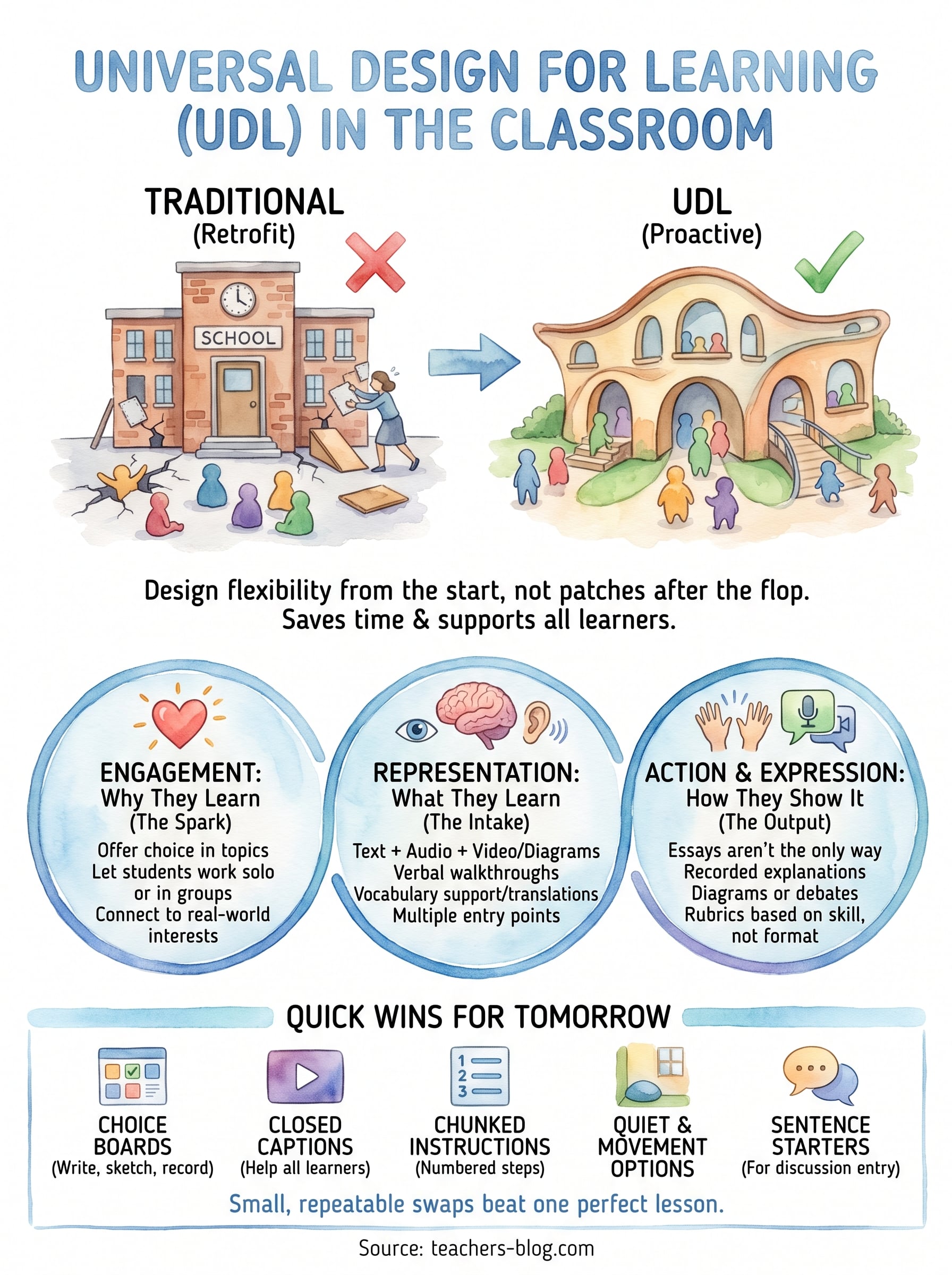
At its core, UDL means designing lessons with flexibility built in from the start, rather than retrofitting accommodations after a lesson flops. It rests on three principles: multiple means of engagement, representation, and action or expression. Instead of one path through a lesson, you offer several, so students choose the route that actually works for their brain.
This article breaks down what UDL really looks like day to day, not just the theory. You’ll get a plain-language explanation of the framework, examples of UDL strategies you can use tomorrow, and practical ways to build lessons that reach struggling readers, English language learners, and advanced students without writing three separate lesson plans.
Why universal design for learning matters in your classroom
Every class you teach already has built-in variability, and pretending otherwise costs you time you don’t have. When you plan for the middle of the class and then scramble to accommodate the edges, you end up writing extra worksheets at 10 p.m. and still watching kids disengage. Universal design for learning in the classroom flips that process: you plan for variability up front, so fewer students fall through the cracks and you spend less time patching holes after the fact.
The variability is already in your room
Research from CAST, the organization that developed the UDL framework, shows that learner variability is the norm, not the exception. Reading levels in a single grade can span several years, attention and processing speed vary widely, and background knowledge differs student to student even when everyone sits through the same lecture. Traditional lesson design assumes a "typical" student who barely exists. Inclusive classroom design built around UDL principles accepts that spread instead of fighting it, which is why the framework is now referenced in federal education guidance and cited by the U.S. Department of Education as a model for accessible instruction (ed.gov).
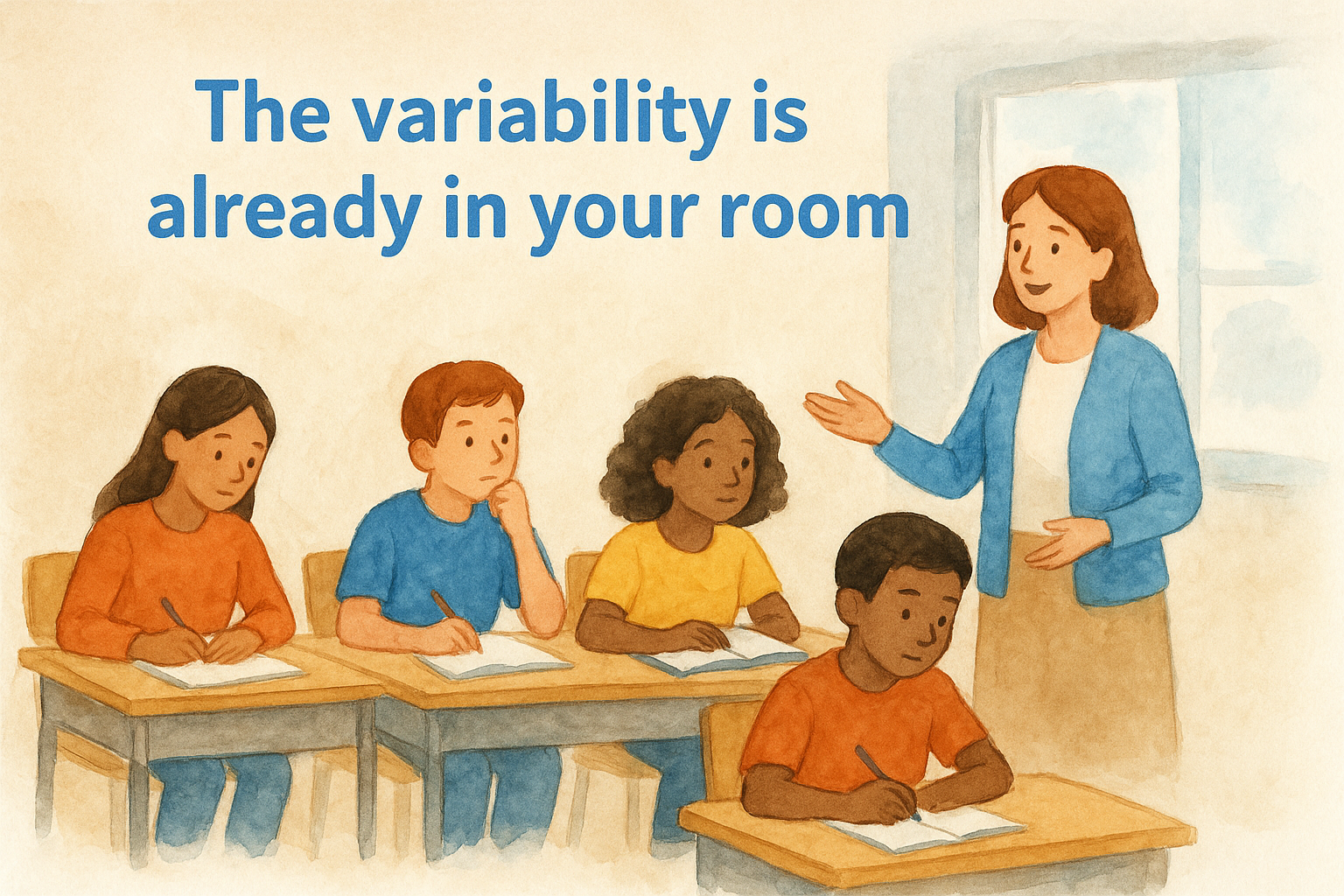
Plan for the range of students you actually have, not the one student who doesn’t exist.
What happens when you skip it
Without UDL, you end up retrofitting: a student struggles, you add an accommodation, another student struggles differently, you add another. That patchwork approach works in the short term but multiplies your workload every semester. It also means some students never get support until they’ve already failed a quiz or shut down in class.
| Approach | What it looks like | Cost to you |
|---|---|---|
| Retrofit after the fact | One lesson, accommodations added when students struggle | High, ongoing, reactive |
| UDL from the start | Multiple paths built into the original plan | Lower over time, proactive |
Skipping UDL doesn’t just hurt struggling readers. Advanced students coast through lessons with no challenge, English language learners miss content buried in dense text, and students with ADHD lose focus during long stretches of passive listening. Building flexibility into the original design means you write one strong lesson instead of three weak patches, and every student, not just the ones who ask for help, gets a real shot at the material.
How to apply the three UDL principles in lesson planning
Applying UDL principles doesn’t mean rewriting your curriculum from scratch. It means checking each lesson against three questions: how will students get motivated, how will they take in the material, and how will they show what they know. Build those checks into your planning template and the framework starts running on autopilot instead of feeling like extra work.
Engagement: give students a reason to care
Before you touch content, think about why a student would want to learn it. Offer choice in topics, let students work solo or in groups, and connect material to something outside the classroom walls. A history lesson on propaganda lands differently when students analyze current ads instead of only WWII posters.
If students don’t see a reason to engage, no amount of scaffolding will save the lesson.
Representation: present content more than one way
Text alone excludes readers who struggle, English language learners, and students with vision issues. Pair written instructions with:
- A short video or diagram
- A verbal walkthrough
- Vocabulary support or translated terms
This is where differentiated instruction and UDL overlap most directly, since both push you toward multiple entry points into the same content.
Action and expression: let students show learning differently
A five-paragraph essay isn’t the only way to prove understanding. Some students demonstrate mastery better through a recorded explanation, a diagram, or a short debate. Keep the learning goal fixed, but loosen the format. A rubric built around the skill, not the medium, makes grading fair across all three options and keeps your standards consistent no matter which path a student picks.
UDL strategies and examples you can try tomorrow
You don’t need a curriculum overhaul to start using universal design for learning in the classroom tomorrow morning. Small swaps in how you deliver a lesson often produce the same payoff as a full redesign, and they take minutes to plan instead of hours.
Quick wins for your next lesson
Start with changes that touch every student, not just the ones flagged for accommodations. A few that work in almost any subject:
- Post choice boards so students pick between a written response, a sketch, or a short recording
- Add closed captions to any video, which helps English language learners and kids who process audio slowly
- Chunk instructions into numbered steps instead of one paragraph of text
- Offer a quiet corner and a movement option during independent work
- Provide sentence starters for discussion so quieter students have an entry point
Small, repeatable swaps beat one perfect lesson you never have time to plan again.
A ready-to-use example
Take a typical reading comprehension lesson. Instead of assigning one text and one set of questions, give students a choice of a print article, an audio version, and a short video covering the same content. Let them answer comprehension questions through writing, a voice memo, or a labeled diagram. Nothing about the learning target changes, but the paths to reach it multiply. This is where UDL strategies stop being abstract and start looking like actual Tuesday-morning lesson plans.
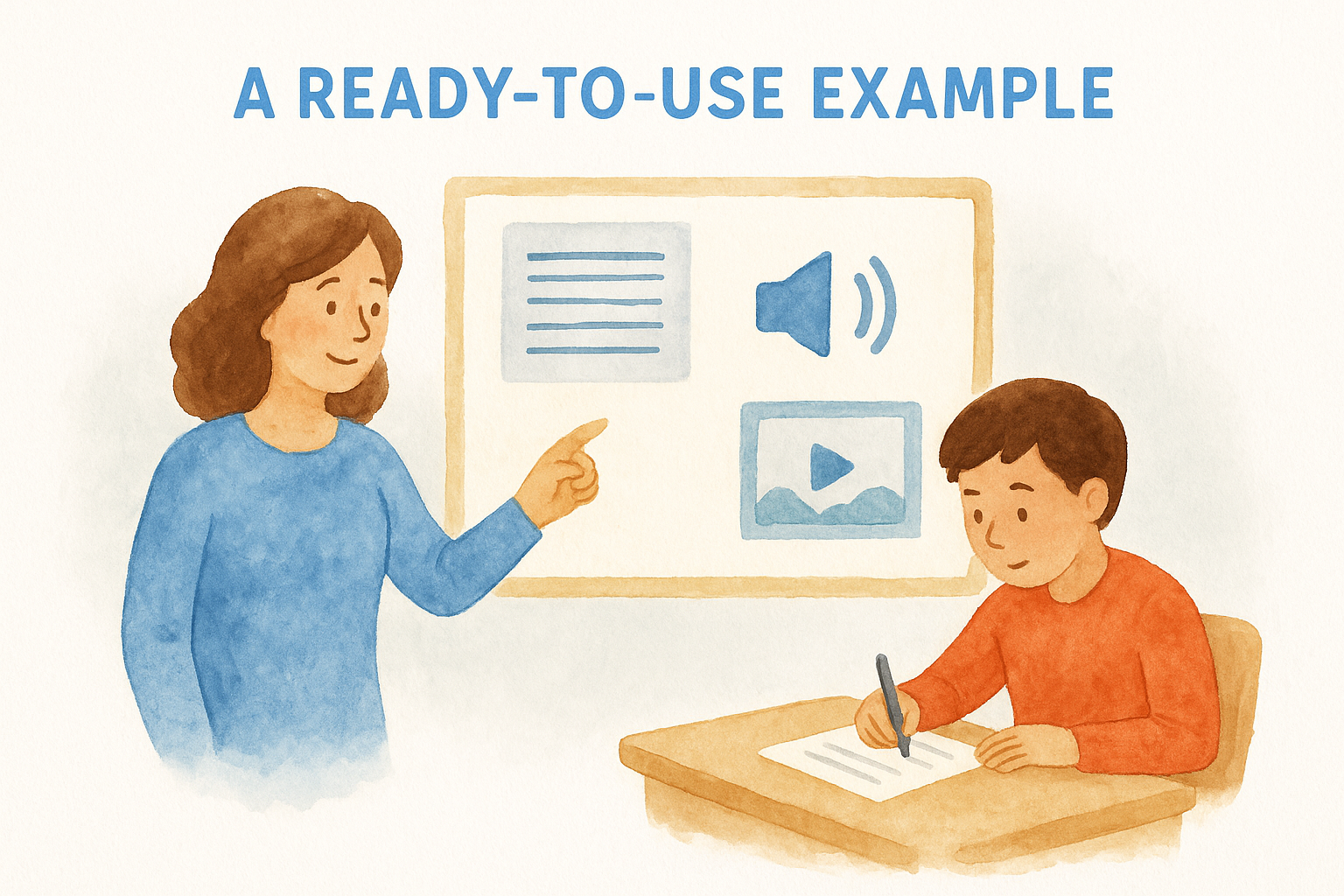
Repeat this pattern across a unit and you’ll notice fewer students stuck waiting for help, because they’ve already got a route that fits how they process information. Over a semester, these small adjustments add up to real time saved on reteaching and fewer students falling behind quietly.
Common misconceptions and challenges with UDL
Misunderstanding UDL causes more resistance to it than any actual flaw in the framework. Teachers hear "multiple means of everything" and picture triple the grading, triple the planning, and zero extra hours in the day. That fear is understandable, but it comes from a misreading of what UDL principles actually ask you to do.
"UDL means three lesson plans instead of one"
Nothing about UDL requires separate lessons for separate students. You build one lesson with built-in options, not three parallel curricula. A single choice board or a single video-plus-text pairing covers the variability without multiplying your prep time. The confusion usually comes from mixing up UDL with differentiated instruction, which sometimes does mean tailoring content student by student. UDL front-loads flexibility so fewer individual adjustments are needed later.
UDL isn’t three lesson plans, it’s one lesson plan with three doors in.
"UDL is only for special education students"
This one costs classrooms the most. UDL was designed for every learner in the room, not as an accommodation layer bolted onto an IEP. Advanced students benefit from choice and challenge just as much as students who need extra support.
The real challenge: time and habit
The honest obstacle isn’t the framework, it’s changing habits under time pressure. Building UDL checks into your existing planning template, rather than treating it as a separate task, solves most of this. Start with one unit, reuse the choice boards and multi-format materials across future lessons, and the upfront investment shrinks fast. Grading multiple formats fairly also worries teachers, but a skill-based rubric applied consistently across formats keeps that manageable, not messier.
Bringing UDL into your everyday teaching
Start small. Pick one lesson this week and add a single choice point, maybe a choice board, maybe a video-and-text pairing. Universal design for learning in the classroom isn’t a mandate to rebuild your curriculum overnight, it’s a habit you build one lesson at a time until flexibility becomes your default setting instead of an afterthought.
You already know your students better than any framework does. Use UDL as a checklist, not a rulebook, and let it flex around your actual classroom rather than forcing your classroom to match a theory. The goal is fewer students falling through the cracks and fewer nights spent writing patchwork worksheets after a lesson stalls.
If you want ready-made choice boards, rubrics, and lesson templates built around these principles instead of starting from a blank page, browse the free resources at The Cautiously Optimistic Teacher and grab what fits your next unit.