Understanding Trauma Responses in the Classroom
Trauma-informed classroom strategies are essential tools for supporting students whose nervous systems are stuck in “survival mode.” By recognizing that disruptive behaviors are often survival responses—Fight, Flight, Freeze, or Fawn—teachers can provide the predictability and safety necessary to bring the prefrontal cortex back “online.” This shift allows students to move from reactive protection to behavioral fluency and active learning.
This is Lesson 1 of Module 7: Trauma-Informed and Neurodiversity-Affirming Management | Full Course Outline
Mindset Shift: From “Will” to “Wiring”
| The Disciplinary Lens (Will) | The Trauma-Informed Lens (Wiring) |
| View: The student is choosing to be defiant. | View: The student is having a stress response. |
| Logic: “They need a firmer consequence.” | Logic: “They need to feel safe to regulate.” |
| Teacher Role: The Enforcer of Rules. | Teacher Role: The Predictable Anchor. |
| Focus: Extinguishing the behavior. | Focus: Identifying the trigger and teaching a skill. |
| Result: Escalation and re-traumatization. | Result: De-escalation and behavioral fluency. |
If you’ve taught for more than a year, you’ve seen it.
A student shuts down completely over a small correction.
Another explodes over a minor peer interaction.
One avoids work at all costs.
Another scans the room constantly, unable to settle.
These aren’t “personality issues.” They’re often trauma responses.
And understanding trauma responses in the classroom isn’t about lowering standards or excusing behavior. It’s about responding strategically so learning can actually happen.
This module will walk you through:
What trauma responses look like in school
Why they happen
How they affect behavior and learning
Practical, trauma-informed classroom strategies you can use immediately
What Are Trauma-Informed Classroom Strategies?
Trauma isn’t just a single catastrophic event.
In school settings, trauma can include:
Chronic stress at home
Community violence
Family instability
Poverty-related stress
Neglect or inconsistent caregiving
Ongoing bullying
Systemic marginalization
From a neuroscience perspective, trauma affects the brain’s stress-response system. When a student experiences repeated stress without adequate support, their nervous system becomes highly reactive.
The result?
They may perceive neutral situations as threats.
The Brain Under Stress: Why Behavior Changes and Trauma-Informed Classroom Strategies
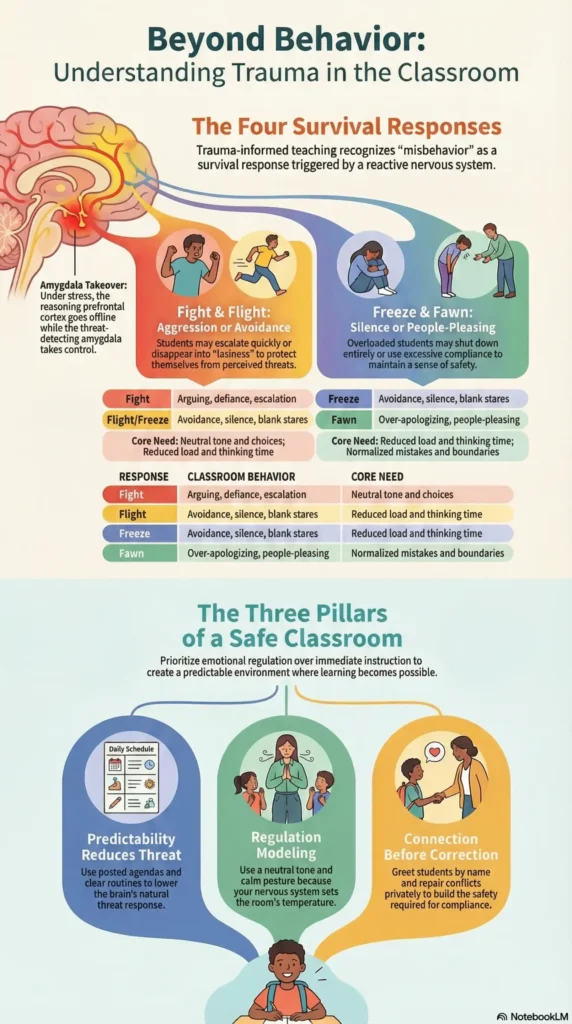
When a student feels unsafe — emotionally or physically — the brain shifts into survival mode. The prefrontal cortex (reasoning, impulse control, planning) goes offline. The amygdala (threat detection) takes over. In survival mode, students typically show one of four trauma responses:
Fight
Flight
Freeze
Fawn
Let’s look at what each can look like in your classroom.
1. Fight Response
What it looks like:
Arguing
Defiance
Talking back
Aggressive tone
Quick escalation
What’s happening underneath:
The student feels threatened — even if the trigger seems minor. Their nervous system is protecting them by pushing the threat away.
Trauma-informed classroom strategies:
Lower your voice, don’t raise it.
Use neutral language (“I see you’re upset.”).
Offer choices to restore control.
Address privately when possible.
Avoid public power struggles.
The goal is regulation first. Consequences come after regulation.
2. Flight Response
What it looks like:
Avoidance
Frequent bathroom requests
Work refusal
Daydreaming
Chronic lateness
What’s happening underneath:
The student’s nervous system is saying, “Get out of here.”
Academic tasks can feel overwhelming, especially if past failure is tied to shame.
Trauma-informed classroom strategies:
Break tasks into smaller chunks.
Preview expectations.
Provide visual anchors.
Offer structured choice (“Start with question 1 or 3.”).
Reinforce effort, not perfection.
Flight often looks like laziness. It’s usually anxiety.
3. Freeze Response
What it looks like:
Silence
Inability to start work
Blank stare
Slow processing
“I don’t know” repeated
What’s happening underneath:
The nervous system shuts down to survive.
This student isn’t refusing — they’re overloaded.
Trauma-informed classroom strategies:
Reduce verbal load.
Give written instructions.
Offer a first small step.
Sit beside, not over.
Allow thinking time.
Freeze responses require patience, not pressure.
4. Fawn Response
What it looks like:
Excessive people-pleasing
Over-apologizing
Taking responsibility for others
Fear of disappointing adults
What’s happening underneath:
Safety is achieved by pleasing authority figures.
These students may look “well-behaved,” but they are often operating from anxiety.
Trauma-informed classroom strategies:
Normalize mistakes.
Avoid public praise that singles them out.
Reinforce intrinsic motivation.
Model boundaries.
Encourage independent thinking.
Trauma-informed practice isn’t only for “disruptive” behavior.
What Trauma-Informed Classroom Strategies Are Not
Being trauma-informed does NOT mean:
Ignoring harmful behavior
Removing all consequences
Lowering academic standards
Becoming a therapist
It means recognizing that regulation must come before instruction.
In many ways, trauma-informed classroom strategies align with preventative frameworks like CASEL and school-wide systems like Positive Behavioral Interventions and Supports. Both emphasize predictability, emotional safety, and explicit skill-building.
The Three Pillars of Trauma-Informed Classroom Strategies
1. Predictability
Clear routines
Posted agendas
Advanced notice of changes
Consistent responses
Predictability lowers the brain’s threat response.
2. Emotional Regulation Modeling
Neutral tone
Slow movements
Calm posture
Pausing before responding
Your nervous system sets the temperature of the room.
3. Connection Before Correction
Greet students by name
Repair after conflict
Check in privately
Separate the student from the behavior
Students comply more readily when they feel safe.
What This Means for Classroom Management
Understanding trauma responses in the classroom shifts your thinking:
Instead of asking:
“Why is this student doing this to me?”
You ask:
“What is this behavior protecting?”
That one shift changes everything.
Because once we understand behavior as protection, our response becomes instructional — not punitive.
And that’s where real classroom management lives.
Practical Implementation Plan for Trauma-Informed Classroom Strategies
Here’s a simple 5-step plan you can use this week:
Identify one student who escalates or shuts down quickly.
Notice their pattern: fight, flight, freeze, or fawn?
Pre-correct before known triggers.
Lower your voice during moments of tension.
Debrief privately after regulation.
Do not try to change everything at once.
Small, consistent shifts are what create safe classrooms.
Try This Tomorrow
Before your first class, choose one phrase you will use consistently when students escalate:
“Let’s pause.”
“We can solve this.”
“I’m here.”
“Take a breath.”
Then practice saying it calmly.
Not sarcastically.
Not loudly.
Not as a warning.
Just calmly.
Over time, that predictability becomes safety.
And safety is where learning begins.
If you’re building out your classroom management framework, this module connects directly with:
Trauma-informed classroom strategies aren’t a trend. They’re a foundation. And when students feel safe, they can finally think.
Trauma-Informed Classroom Strategies FAQ
What are common trauma responses in the classroom? Trauma typically manifests in four ways: Fight (defiance/aggression), Flight (avoidance/absconding), Freeze (shutting down/silence), and Fawn (excessive people-pleasing). Recognizing these as nervous system responses rather than ‘bad choices’ is the first step in trauma-informed teaching.
How do trauma-informed strategies help with classroom management? These strategies prioritize emotional safety and predictability. When a student feels safe, their brain can shift out of survival mode and back into learning mode. This reduces disruptions and allows the student to work toward behavioral fluency.
Does being trauma-informed mean there are no consequences? No. Being trauma-informed means that regulation must come before correction. You still hold high expectations and use logical consequences, but you wait until the student is calm and ‘online’ before addressing the behavior, ensuring the moment is instructional rather than punitive.
Reflection
Earlier in my teaching, I sometimes interpreted challenging behavior as resistance instead of a sign that a student was overwhelmed or stressed. As I learned more about trauma-informed strategies, I began focusing more on predictability, calm responses, and relationship-building before correction. That shift helped me respond with more patience and clarity—and I noticed students were quicker to settle and re-engage with learning.
- When a student reacts strongly in your classroom, how often do you pause to consider what might be happening beneath the behavior?
- Which routines or supports in your classroom currently help students feel safe and predictable—and where might there still be gaps?
- What is one small trauma-informed strategy you could introduce this week that would lower stress without lowering expectations?
Continue the Classroom Management Course
In the next lesson, you will learn how supporting neurodivergent students through predictable routines, flexible expectations, sensory awareness, and strengths-based instruction helps reduce behavioral stress and create classrooms where more learners can participate successfully.
Next Lesson: Supporting Neurodivergent Students Through Design
Module 7 Progress:
- Understanding Trauma Responses in the Classroom
- Supporting Neurodivergent Students Through Design
- Avoiding Power Struggles and Shame
Back to Module 7 Overview
Return to Full Course Outline