The Benefits of Human-Centered AI Pedagogy in Modern Classrooms
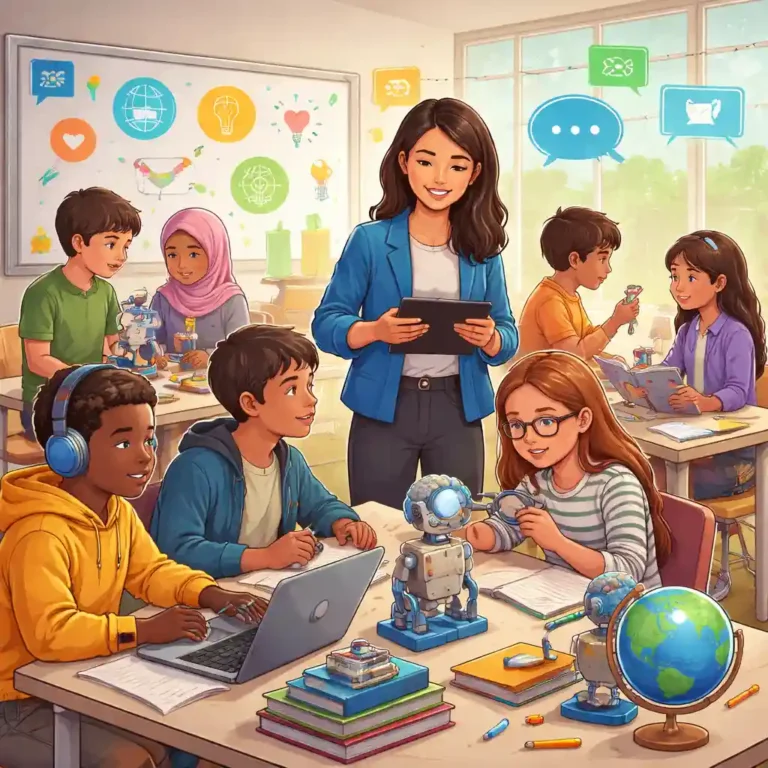
Human-Centered AI Pedagogy is an approach to teaching with artificial intelligence that keeps human judgment, relationships, and values at the center of learning. Rather than asking what can AI replace?, this pedagogy asks a far better question: how can AI support teachers and students without diminishing human agency?
In practice, Human-Centered AI Pedagogy treats AI as a tool, not an authority. It emphasizes transparency, ethical use, critical thinking, and student voice. AI might help generate ideas, provide feedback, or personalize learning—but teachers remain the designers of learning, and students remain active thinkers rather than passive consumers.
This approach aligns closely with good teaching practice. Effective classrooms have always been human-centered; this pedagogy simply extends that principle into the age of artificial intelligence.
A Brief History of Human-Centered AI Pedagogy
Human-Centered AI Pedagogy grows out of two parallel movements.
The first is human-centered design, popularized in education through institutions like Stanford. This framework emphasized empathy, iteration, and designing solutions with people rather than for them.
The second is the growing concern around the rapid expansion of AI technologies. As machine learning tools entered workplaces, governments, and schools, researchers began asking hard questions about bias, transparency, surveillance, and over-automation. Organizations such as the OECD and UNESCO began promoting ethical AI frameworks that prioritize human rights and social responsibility.
Human-Centered AI Pedagogy emerges at the intersection of these ideas: it applies ethical AI principles directly to classroom practice, ensuring that educational uses of AI enhance learning without undermining trust, creativity, or equity.
Why Human-Centered AI Pedagogy Matters in Classrooms
AI is already shaping how students write, research, problem-solve, and create. Ignoring it does not protect students—it simply leaves them unprepared. Human-Centered AI Pedagogy matters because it gives teachers a way to address AI thoughtfully and responsibly.
First, it protects student agency. When students are taught to question AI outputs, evaluate bias, and make informed decisions, they remain thinkers rather than button-pressers.
Second, it strengthens teacher professionalism. This pedagogy positions teachers as ethical guides and learning designers, not AI supervisors or content police.
Third, it promotes equity and inclusion. Human-centered approaches recognize that AI systems reflect human bias. Teaching students to examine whose voices are amplified—and whose are missing—supports critical literacy and culturally responsive teaching.
Finally, it prepares students for the real world. Outside school, AI will be a collaborator, not a replacement. Classrooms that model this reality help students develop discernment, not dependency.
What the Research Says
Research consistently shows that technology is most effective when it augments human learning rather than automates it. Studies in learning sciences emphasize that deep learning occurs through reflection, feedback, and social interaction—areas where human judgment is irreplaceable.
Research on AI in education highlights several key findings:
Students learn more when AI tools are used for scaffolding, not answer-giving
Teacher mediation significantly improves outcomes when AI-generated feedback is involved
Explicit instruction on AI limitations improves student critical thinking and metacognition
Scholars in educational technology increasingly argue that AI should function as a cognitive partner, supporting idea generation, revision, and exploration while leaving interpretation and decision-making to humans.
Human-Centered AI Pedagogy operationalizes these findings into classroom practice by emphasizing transparency, reflection, and ethical discussion alongside AI use.
How Teachers Can Easily Use Human-Centered AI Pedagogy
You do not need advanced technical skills to implement Human-Centered AI Pedagogy. Small, intentional shifts make a big difference.
One simple approach is to make AI visible. When using an AI tool, talk openly about what it does well and where it struggles. Model skepticism and curiosity rather than blind trust.
Another strategy is to use AI as a starting point, not a final product. Ask students to critique AI-generated responses, improve them, or compare them with human-created work. This reinforces higher-order thinking rather than shortcut learning.
Teachers can also integrate ethical reflection. Short discussions or exit tickets asking questions like “Who benefits from this tool?” or “What might this system get wrong?” build digital citizenship naturally.
Finally, keep assessment human-centered. Use AI for brainstorming, drafting, or practice—but rely on conferences, reflections, and authentic tasks to understand student learning.
Final Thoughts
Human-Centered AI Pedagogy is not about resisting technology or embracing it uncritically. It is about teaching with intention. By keeping human values, relationships, and judgment at the core of AI use, teachers can harness powerful tools without losing what matters most.
When classrooms adopt Human-Centered AI Pedagogy, AI becomes something far more meaningful than a shortcut—it becomes a catalyst for deeper thinking, ethical awareness, and truly human learning.