Teaching Growth Mindset: Why It Matters for Students
Students do not need another poster telling them to “believe in themselves.” What they need are practical ways to respond when learning becomes difficult.
That is where teaching growth mindset can be valuable. A growth mindset is the belief that abilities can develop through effective effort, practice, feedback, strategies, and support. In the classroom, that belief matters most when it changes what students actually do after they struggle.
A student with a fixed response may see a difficult task as proof that they are “not good at this.” A more productive response is different: identify what is making the task hard, choose a strategy, ask for useful help, and try again. The goal is not forced positivity. It is helping students develop habits that make persistence and improvement more likely.
Research supports this more careful view. A large national study of U.S. secondary students found that a brief growth-mindset intervention improved grades for lower-achieving students and increased advanced-math enrollment overall. More recent research also suggests that growth mindset can be associated with stronger performance in unfamiliar academic areas. At the same time, newer studies caution that mindset is not a cure-all for achievement gaps or structural inequities. In other words, growth mindset is most useful when it is paired with good teaching, meaningful feedback, appropriate challenge, and real opportunities to improve.
That distinction is important. Growth mindset should not become another slogan. It should become a classroom routine.
Why Teaching Growth Mindset Matters
The biggest benefit of growth mindset is not that students suddenly become more confident. It is that they can learn a different response to difficulty.
When students believe ability is fixed, struggle can feel threatening. A mistake may seem like evidence that they lack talent. Feedback may feel like criticism. A difficult assignment may be interpreted as a reason to stop.
Growth mindset gives teachers a way to reframe those same moments. Challenge becomes information. Mistakes become evidence about what needs to change. Feedback becomes a tool. Progress becomes something students can notice rather than something they either have or do not have.
This is especially useful in middle and high school, when students are increasingly likely to label themselves: “I’m a math person,” “I’m not a writer,” “I’m bad at presentations,” or “I just can’t memorize things.” Those labels can quietly shape the choices students make.
A growth-mindset classroom does not deny that students have different strengths, prior knowledge, or learning needs. Instead, it emphasizes that current performance is not the same thing as permanent ability.
Challenge Should Feel Manageable, Not Comfortable
One of the most useful ideas to teach early is that learning often happens between “too easy” and “too much.” Students benefit from recognizing a stretch zone: work that is difficult enough to require effort but still manageable with time, strategy, or support.
This language helps students understand that challenge is not automatically a sign that something is wrong. It also prevents growth mindset from turning into “just work harder.” Sometimes the right response to a difficult task is not more effort. It is breaking the task into smaller steps, changing strategies, using a model, asking a better question, or getting support.
A simple classroom prompt can be powerful: What would move this task from “too much” into the stretch zone?
That question encourages students to think about learning conditions rather than judging themselves.
Students Need to Learn How to Use Mistakes
Mistakes are often praised in theory and avoided in practice. Students hear that mistakes help them learn, but many still rush to erase them, hide them, or move on without understanding what happened.
Teaching growth mindset means making reflection on mistakes part of normal classroom life. After an error, students can ask:
- What did I think was going to work?
- Where did my thinking break down?
- What feedback or clue can I use?
- What will I change on the next attempt?
This approach also helps students distinguish between productive mistakes and careless ones. Trying a reasonable strategy that does not work can produce useful information. Skipping directions or rushing without checking is different. Both can be corrected, but the reflection should be different.
If this is an area you want to explore further, I have also written about how students with a growth mindset see their mistakes.
Growth Mindset Is Closely Connected to Self-Talk
The language students use with themselves can influence whether they keep working or disengage. Statements such as “I should already know this,” “I always mess this up,” or “I’m just bad at this” close the door on action.
The goal is not to replace those thoughts with unrealistic affirmations. A useful reframe should acknowledge the difficulty and point toward a next step.
For example:
- Instead of “I can’t do this,” try “I do not understand this step yet.”
- Instead of “I’m terrible at writing,” try “My introduction needs revision, so I’m going to compare it with the model.”
- Instead of “This is impossible,” try “I need to figure out which part is confusing me.”
This is one reason short, repeated routines can be more effective than a one-time lesson. Students need opportunities to notice unhelpful thinking, practise a better response, and eventually use that response without teacher prompting.
Confidence Should Be Built from Evidence
Growth mindset and confidence are related, but confidence should not be built on empty praise. Students are more likely to trust confidence that comes from evidence: improvement over time, a strategy that worked, a difficult task they completed, feedback they acted on, or a skill they can now perform independently.
A useful reflection question is: What is one piece of evidence that you are better at this than you were before?
This shifts attention away from comparison with classmates and toward personal growth. It also helps students see progress that might otherwise be easy to miss.
Growth Mindset Helps Goal Setting Become More Practical
Many students can name a goal. Fewer can explain the process that will move them toward it.
Growth mindset gives goal setting a more useful structure. Students can identify a target, anticipate obstacles, choose strategies, monitor progress, and adjust when the original plan does not work. The focus becomes less about whether they “achieved the goal” and more about what they learned while pursuing it.
This pairs naturally with classroom goal-setting routines. If you want a deeper look at this process, see these goal-setting activities for students.
Daily Practice Is More Powerful Than an Occasional Mindset Lesson
One of the challenges with social-emotional learning is finding time for it. Growth mindset can easily become something teachers discuss in September and then rarely revisit.
A more practical approach is to use short routines throughout the year. Eight or ten minutes at the beginning of class is enough time for a focused discussion, quick write, partner sort, reflection, mini challenge, goal check, or mistake analysis.
The routines can also progress over time. Students might begin by learning how to recognize manageable challenge, then move into mistakes and feedback, constructive self-talk, confidence, goal setting, perseverance, resilience, creativity, leadership, and reflection.
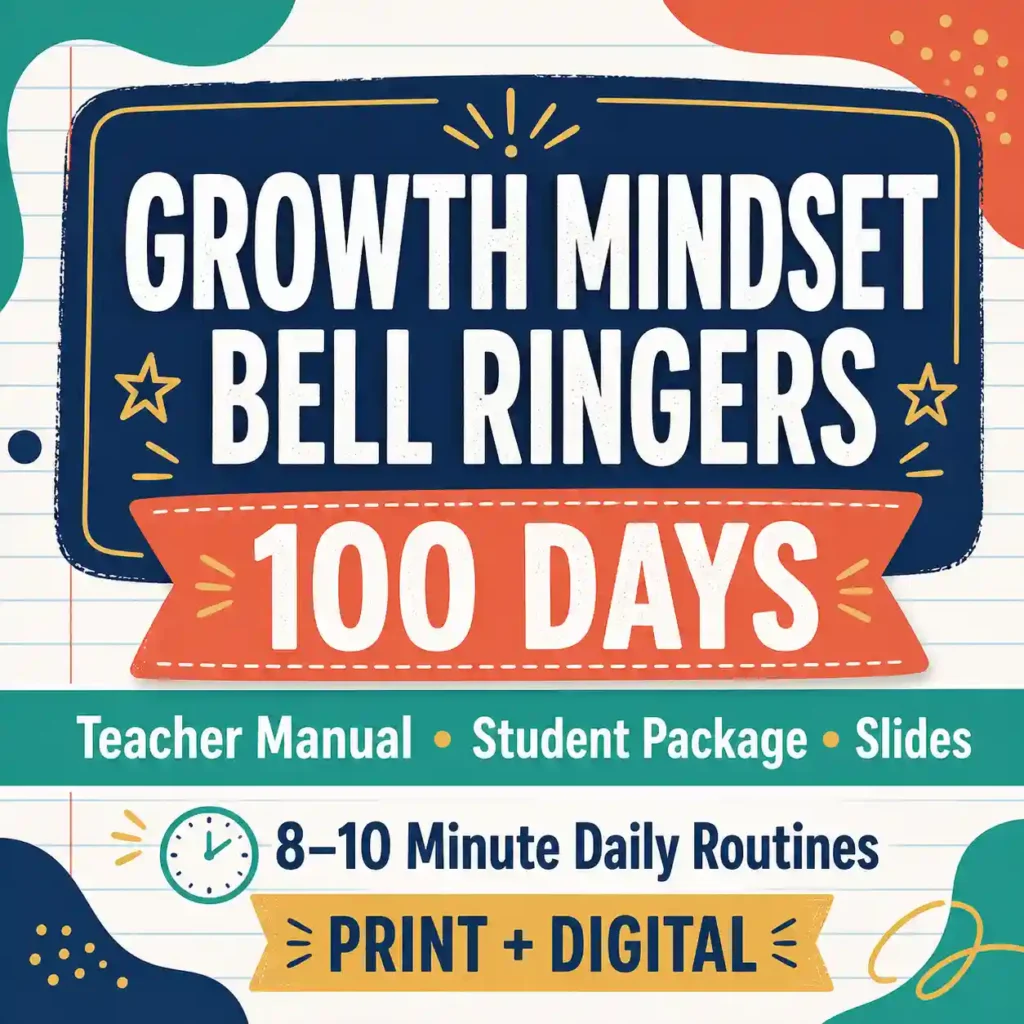
If you want that progression already planned, my 100 Days of Growth Mindset Bell Ringers provides a complete sequence of short daily activities with coordinated slides, teacher guidance, student materials, and printable or editable options.
What Growth Mindset Should Not Become
There are a few traps worth avoiding.
First, growth mindset should not mean praising effort no matter what. Effort matters when it is connected to learning. If a strategy is not working, students need permission to change it.
Second, growth mindset should not place responsibility for every difficulty on the student. Some tasks are poorly designed. Some students need accommodations, explicit instruction, more background knowledge, or additional support. A mindset lesson cannot replace those things.
Third, growth mindset should not become forced positivity. Students are allowed to feel frustrated. The more useful question is what they can do next.
That is also consistent with newer research. Growth mindset can support learning, but its effects depend on context, student needs, and the learning environment. It should be one part of strong instruction rather than a substitute for it.
A Simple Growth-Mindset Routine Teachers Can Use
If you want to begin without overhauling your course, try building one short reflection into the beginning or end of class. Rotate among questions such as:
- What felt challenging today, and why?
- What mistake gave you useful information?
- What strategy helped when you were stuck?
- What feedback could improve your next attempt?
- What is one small step toward your current goal?
- What evidence shows that you have improved?
The questions are simple, but consistency is what makes them useful. Over time, students begin to internalize the language of challenge, strategy, feedback, and reflection.
Why I Prefer Bell Ringers for Growth Mindset
Bell ringers make growth mindset part of classroom culture without requiring an entire period. They create a predictable place for students to practise the skills repeatedly, and they work across subjects because the thinking applies to almost any kind of learning.
They also give teachers variety. Growth mindset does not need to mean 100 journal prompts. Short routines can include partner interviews, class polls, challenge sorts, error investigations, sentence reframing, mini role-plays, visual organizers, commitment cards, goal checks, creative challenges, and reflection.
That variety matters because students are more likely to engage when mindset instruction feels like something they do, not simply something they are told to believe.
Final Thoughts
The importance of teaching growth mindset comes down to one practical question: What do students do when learning gets hard?
Students will face difficult texts, confusing problems, disappointing grades, feedback they did not expect, goals that take longer than planned, and skills that do not come easily. Teachers cannot remove every struggle, nor should we.
What we can do is help students build a more productive response to those moments. Challenge can be broken down. Mistakes can be studied. Feedback can be used. Self-talk can become more realistic. Strategies can change. Goals can be revised. Progress can be noticed.
That is growth mindset at its most useful: not a slogan about success, but a set of habits students can carry into the next difficult thing they have to learn.
Research background: Nature’s national growth-mindset study, 2025 research on mindset and performance trajectories, and 2025 cross-national research on growth mindset and achievement inequality.