How Do Students With a Growth Mindset See Their Mistakes?
If you’re searching for how do students with a growth mindset see their mistakes, here’s the short answer: they see them as proof they’re learning, not proof they’re failing. A wrong answer isn’t a verdict on their intelligence. It’s information about what to try next.
This distinction matters whether you’re a student answering a quiz question or a teacher explaining the concept in class. Students with a growth mindset treat errors as useful feedback rather than embarrassing evidence of a fixed limitation. They expect to struggle, they expect to get things wrong on the way to getting them right, and they keep working instead of shutting down. That’s the core answer, and the rest of this article unpacks exactly what that looks like in practice.
Below, you’ll find a clear breakdown of how these students respond to errors, how their reactions differ from students with a fixed mindset, and what this actually looks like in a classroom, from raised hands after a wrong answer to revised drafts after tough feedback. If you teach middle or high schoolers, you’ll also find practical ways to build this response into your daily routines, drawn straight from real classroom strategies.
Why how students view mistakes shapes their learning
A student’s reaction to a wrong answer predicts more about their long-term learning than their test scores do. Research from Stanford psychologist Carol Dweck, who coined the term growth mindset, found that students who treat setbacks as temporary and fixable keep trying harder problems, while students who see mistakes as proof of low ability start avoiding challenges altogether. This isn’t a minor personality quirk. It’s the difference between a student who raises their hand again after getting something wrong and one who stops raising their hand at all.
The brain science of struggle
Brain-imaging studies cited in Dweck’s work show that when students with a growth mindset make an error, their brains show increased activity in regions tied to attention and problem-solving. They’re not panicking. They’re processing. The error itself becomes a learning signal, prompting the brain to focus more closely on the material rather than shutting down. Students with a fixed mindset, by contrast, tend to disengage after a mistake, showing less neural activity related to correcting the error and more activity tied to self-protection.
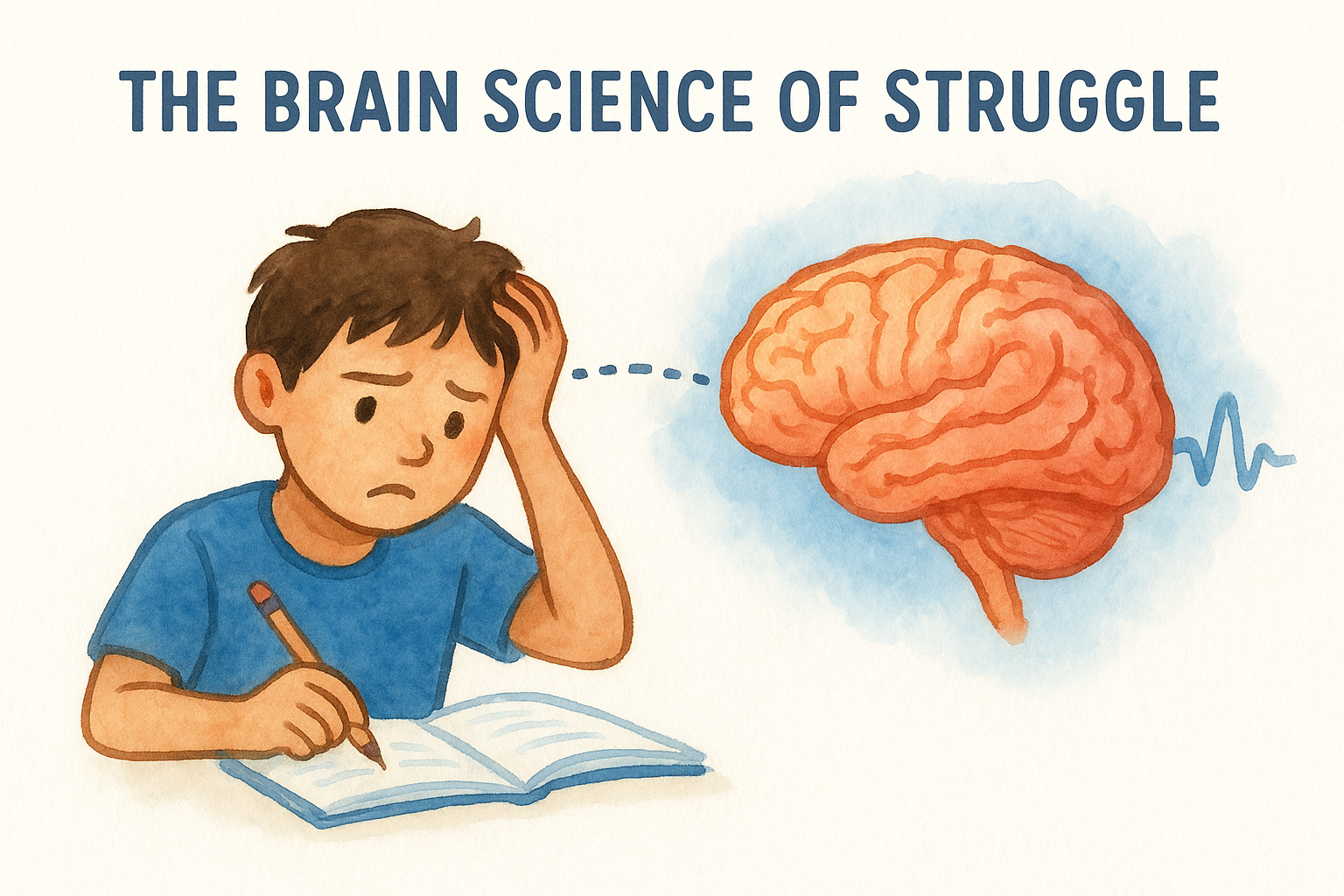
A mistake either sharpens a student’s focus or shuts it down, and mindset decides which one happens.
That single sentence explains why two students can miss the same question on the same quiz and walk away with completely different outcomes. One reviews the problem, figures out where the logic broke, and remembers the fix for weeks. The other memorizes nothing except the feeling of being wrong.
What fear of mistakes costs students
Students who dread errors develop what researchers call performance avoidance. They pick the easy essay prompt instead of the challenging one. They guess on math problems instead of showing their work, because showing work means exposing exactly where their thinking went sideways. Over time, this avoidance narrows their skill growth, since real improvement almost always requires attempting something you’re not yet good at.
Teachers see the pattern show up in specific, recognizable ways:
- Blank test answers instead of attempted, partially correct work
- Rushed, low-effort submissions to avoid spending time on something that might still be wrong
- Reluctance to revise drafts, treating first attempts as final rather than starting points
- Silence during discussions when a question doesn’t have an obvious right answer
- Comparing scores with classmates instead of comparing their own progress over time
Each of these behaviors is a symptom of the same underlying belief: that a mistake reveals a permanent flaw rather than a temporary gap.
What this looks like in your classroom
Growth-minded students, on the other hand, treat a wrong answer the way an athlete treats a missed shot. They check their form, adjust, and try again. You’ll notice them asking clarifying questions after getting something wrong, rather than shutting the notebook and mentally checking out. They talk about their errors out loud, sometimes even laughing about them, because the mistake doesn’t threaten their sense of being capable.
Daily assignments become data instead of judgment. A student with this mindset looks at a graded quiz and asks, "Which question do I need to study more?" instead of "What does this say about me?" That single shift in framing, from identity to information, is exactly what separates students who improve steadily over a semester from students who plateau. It’s also the mindset you can actively teach, which is where practical classroom strategy comes in next.
How to help students see mistakes as growth opportunities
Teaching kids to see mistakes differently isn’t a lecture you give once. It’s a set of small, repeated habits that reshape how they talk to themselves after getting something wrong. Explicit modeling works better than a poster on the wall, because students copy what they see adults actually do, not what they’re told to do. When you make your own errors visible and narrate how you fix them, you give students permission to do the same.
Normalize the struggle out loud
Start class by sharing a mistake you made, whether it’s a grading error, a mislabeled diagram, or a lesson that flopped last period. Say what you learned from it in plain terms. This models the exact behavior you want students to internalize: mistakes get named, not hidden. Over a semester, this habit chips away at the fear that keeps hands down and drafts unrevised.
Students copy how adults handle mistakes long before they copy what adults say about mistakes.
Rebrand feedback as next steps
Instead of marking an answer simply wrong, write the specific gap: "You’ve got the formula right, but check your order of operations." This kind of targeted feedback shows students exactly what to fix, which turns a graded paper into a to-do list instead of a verdict. Combine this with revision opportunities, since students rarely internalize a correction if they never get to apply it.
Give students a script for self-talk
Many students don’t have language for reframing an error in the moment. Giving them a script closes that gap fast:
Old thought: "I got this wrong, I'm bad at this."
New thought: "I got this wrong right now, and now I know what to study."
Post it near your classroom’s work area and reference it when a student stalls out on a hard problem.
Quick strategies to try this week
- Ask "What did this mistake teach you?" instead of "Why did you get this wrong?"
- Grade a rough draft on effort and specific revision, not just correctness
- Celebrate a "best mistake" of the week during class discussion
- Let students redo one assignment per unit for a blended grade
- Praise the process students used, not just the final score
Each of these moves the classroom culture a little further from performance and a little closer to genuine learning, which is exactly what students with a growth mindset need reinforced daily.
Growth mindset vs. fixed mindset: mistakes side by side
Putting these two responses next to each other makes the contrast impossible to miss. Growth mindset students treat a wrong answer as one data point in a longer process, while fixed mindset students treat it as a final judgment on who they are. Seeing the two side by side also helps answer the original question more precisely, since the clearest way to describe how growth mindset students see mistakes is to show what they’re not doing, which is what a fixed mindset student does instead.
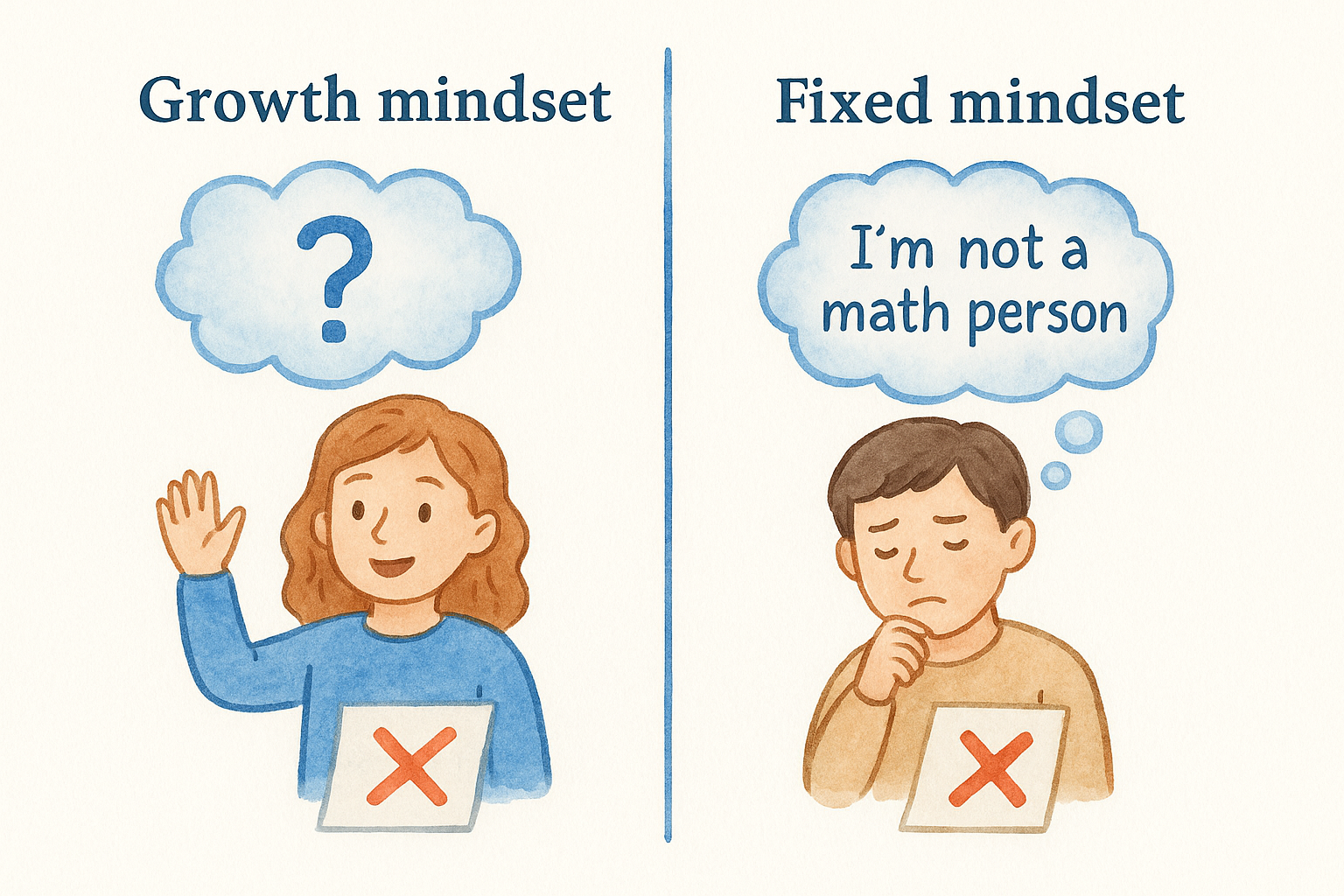
A direct comparison
The table below lines up the same situation, an incorrect answer, and shows how each mindset processes it differently.
| Situation | Growth Mindset Response | Fixed Mindset Response |
|---|---|---|
| Gets a question wrong | Asks what the correct approach was | Assumes they’re "not a math person" or similar |
| Receives critical feedback | Reads it for specific next steps | Feels criticized and disengages |
| Faces a hard assignment | Sees it as a chance to stretch skills | Avoids it to protect their image |
| Watches a peer succeed | Gets curious about their strategy | Feels threatened or discouraged |
| Reflects on a low grade | Plans what to study differently | Blames the test, the teacher, or luck |
The question isn’t whether a student made a mistake. It’s what they decide the mistake means about them.
That single line under the table sums up the entire comparison. Every other difference, the raised hand versus the shutdown, the revised draft versus the abandoned one, traces back to that one belief.
Why these patterns aren’t fixed traits
Neither column describes a permanent personality type, and that’s the detail teachers need most. A student can show fixed mindset behavior in math class and growth mindset behavior in art class, depending on where they feel safe to fail. Language matters here too, since the same student who says "I’m just bad at fractions" might say "I haven’t figured out fractions yet" if a teacher consistently models that framing. Recognizing which column a student is operating from in the moment, subject by subject, gives you a much more useful diagnostic than labeling a kid "growth mindset" or "fixed mindset" once and moving on. The goal isn’t sorting students into categories. It’s noticing the pattern early enough to shift it before performance avoidance becomes a habit.
Classroom phrases that build a growth mindset around mistakes
Words shape how students interpret an error before they even process the content of the mistake itself. The exact phrase a teacher uses in the ten seconds after a wrong answer often decides whether a student tries again or shuts down. Small shifts in language, repeated daily, train students to hear mistakes as information rather than indictments. This is where how students with a growth mindset see their mistakes gets built, phrase by phrase, before it becomes automatic.
Phrases to reach for in the moment
Swap out reflexive responses like "that’s wrong" for language that keeps the student thinking instead of retreating. A few that work well in real classroom exchanges:
- "You’re not there yet, but you’re close. What’s one thing you’d change?"
- "Tell me how you got that answer, walk me through your thinking."
- "That’s a great mistake, it shows me exactly what to teach next."
- "What would you try differently on attempt two?"
- "Your brain is growing right now, this is the hard part working."
Each line does the same job: it separates the error from the student’s identity and points them toward the next step.
The words a teacher uses in the first ten seconds after a mistake often matter more than the correction itself.
Phrases to retire from your vocabulary
Some common classroom phrases quietly reinforce the fixed mindset you’re trying to dismantle, even when the intent behind them is encouraging. "Not everyone is good at math" or "some people just aren’t writers" hands students an excuse to stop trying rather than a reason to keep going. Retiring lines like these, and replacing them with process-focused feedback, closes the gap between what you say you value and what students actually hear.
Building phrases into routine, not just reaction
Consistency turns a good phrase into a classroom norm. Post a short list of go-to responses near your desk, use the same three or four phrases across every subject and grade level you teach, and ask students to practice rephrasing their own self-talk using the same pattern. Over a semester, students start using this language on themselves, muttering "not yet" instead of "I can’t," which is the real marker that the mindset has taken hold rather than just the vocabulary.
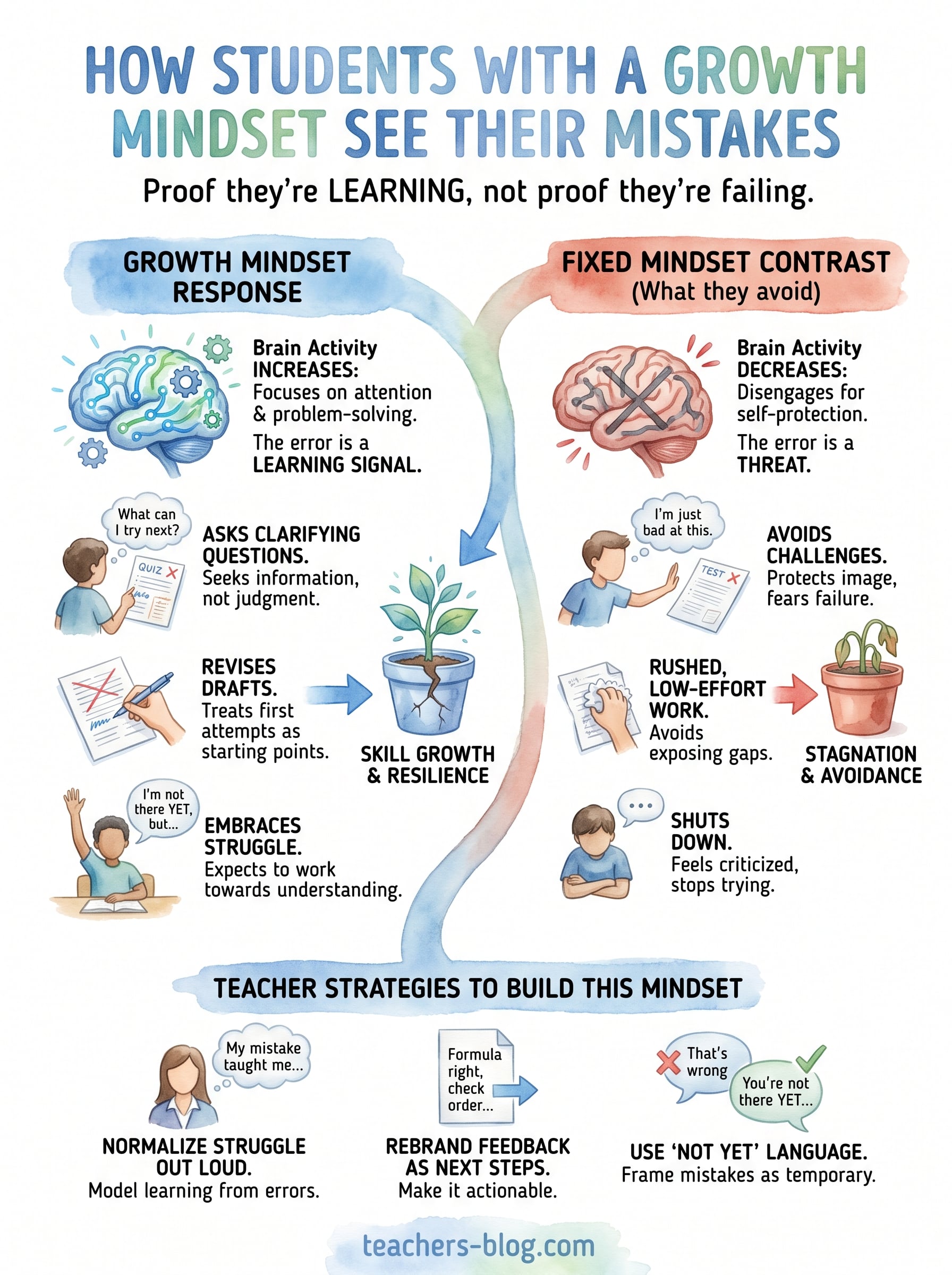
Turning mistakes into stepping stones
So here’s the answer in full: students with a growth mindset see mistakes as proof they’re working at the edge of their ability, not proof they’ve hit a ceiling. They ask what went wrong, they try again, and they let a wrong answer inform the next attempt instead of defining who they are. That single shift in framing, from identity to information, is what separates students who keep growing from students who quietly stop trying.
None of this happens by accident. It takes teachers who model their own mistakes out loud, who swap judgment for specific feedback, and who repeat the same handful of phrases until "not yet" replaces "I can’t" in a student’s own head. That’s a daily practice, not a one-time lesson, and it’s worth building into every subject you teach.
If you want more classroom-tested strategies like these, explore the resources at The Cautiously Optimistic Teacher and start building that mindset into your routines this week.