
Supporting Neurodivergent Students: Classroom Design Strategies That Improve Behavior
Supporting neurodivergent students is not about lowering expectations, but about intentional classroom design. By reducing sensory overload, building predictability, and supporting executive function, teachers create an environment that lowers cognitive load for all learners. This proactive design prevents dysregulation and allows every student to move toward behavioral fluency by removing the environmental barriers that often trigger “problem” behaviors.
This is Lesson 2 of Module 7: Trauma-Informed and Neurodiversity-Affirming Management | Full Course Outline
Mindset Shift: From Compliance to Accessibility
| The Traditional Lens (Behavior) | The Design Lens (Environment) |
| Focus: Correcting the student’s reaction. | Focus: Removing the environmental trigger. |
| View: “The student is being defiant.” | View: “The environment is overwhelming.” |
| Logic: “They need to learn to sit still.” | Logic: “They need a regulation path to focus.” |
| Teacher Role: The Behavior Monitor. | Teacher Role: The Instructional Designer. |
| Result: Friction and exhaustion. | Result: Regulation and behavioral fluency. |
When we talk about classroom management, we often focus on behavior. But behavior is the outcome. Design is the cause.
Supporting neurodivergent students through intentional classroom and content design doesn’t just help a small group of learners — it improves behavior, engagement, and emotional regulation for everyone in the room.
And here’s the key shift:
Neurodivergent students don’t need lower expectations.
They need better design.
This module will walk you through research-informed, practical ways to design your classroom so that it supports executive function, sensory regulation, predictability, autonomy, and belonging — all of which directly reduce behavior challenges.
First, What Do We Mean by Neurodivergent?
Neurodivergence simply means that some students process information, attention, language, movement, or sensory input differently from what schools traditionally expect. Research in developmental neuroscience shows that when environments are unpredictable or cognitively overwhelming, the brain shifts resources away from executive functioning and toward stress-response systems—making regulation, attention, and planning harder in the moment. For example, the National Scientific Council on the Developing Child explains how stress disrupts the brain systems responsible for self-regulation and learning.
Neurodivergent students may include learners with:
ADHD
Autism
Dyslexia
Dyspraxia
Anxiety disorders
Sensory processing differences
Tourette syndrome
Or other neurological differences
The goal is not to diagnose or categorize.
The goal is this:
Design environments that reduce unnecessary cognitive and emotional load. Because when the environment is overwhelming, confusing, or unpredictable, behavior becomes communication.
And that’s when “management” starts to feel hard.
Why Design for Supporting Neurodivergent Students Is a Classroom Management Strategy
From a neuroscience perspective:
Stress impairs executive function.
Overstimulation increases emotional reactivity.
Unclear expectations increase anxiety.
Cognitive overload reduces impulse control.
In other words:
If the classroom environment overwhelms the nervous system, behavior escalates.
But when design reduces stress and increases clarity?
Students regulate better.
Transitions improve.
Disruptions decrease.
Instructional time increases.
Supporting neurodivergent students through thoughtful design is one of the most powerful preventative classroom management tools you can use.
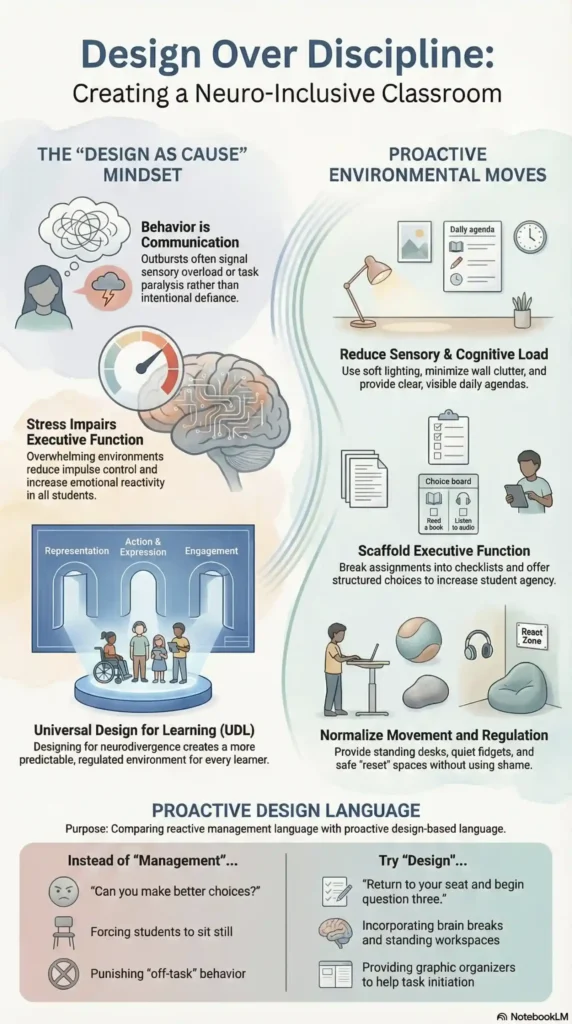
8 Steps to Supporting Supporting Neurodivergent Students
1. Reduce Sensory Overload
Many neurodivergent students are highly sensitive to:
Noise
Fluorescent lighting
Visual clutter
Strong smells
Physical proximity
Practical Design Moves
Use softer lighting where possible.
Keep wall displays purposeful, not overwhelming.
Provide noise-dampening options (tennis balls on chairs, soft seating areas).
Offer optional noise-reduction tools (ear defenders, study carrels).
Create a calm-down or regulation corner.
Classroom Management Connection
When sensory input decreases:
Students are less irritable.
Transitions are smoother.
Outbursts are less frequent.
Students can focus longer.
Many “defiant” moments are actually nervous system overload.
2. Supporting Neurodivergent Students by Building Predictability Into the Classroom
Neurodivergent learners often struggle with sudden changes, unclear expectations, or ambiguous instructions.
Uncertainty increases anxiety.
Anxiety increases dysregulation.
Practical Design Moves
Post a visible daily agenda.
Preview transitions verbally before they happen.
Use consistent routines for entry and exit.
Give time warnings before shifts in activity.
Use the same structure for assignments whenever possible.
Classroom Management Connection
Predictability reduces power struggles.
Students are less likely to resist when:
They know what’s coming.
They understand the structure.
They feel prepared.
Consistency is calming.
3. Design for Executive Function Support
Executive function includes:
Task initiation
Organization
Planning
Impulse control
Working memory
Many neurodivergent students struggle here — especially those with ADHD.
Practical Design Moves
Break large assignments into visible chunks.
Use checklists for multi-step tasks.
Provide graphic organizers.
Post “What to do when you’re done” instructions.
Model thinking out loud.
Classroom Management Connection
When students know how to start, they are less likely to:
Avoid the task
Distract others
Seek negative attention
Off-task behavior often stems from task paralysis, not defiance.
4. Supporting Neurodivergent Students by Offering Structured Choice
Autonomy increases motivation.
Lack of control increases resistance.
Many neurodivergent students feel constantly corrected or controlled.
Choice changes that dynamic.
Practical Design Moves
Let students choose between two assignment formats.
Offer flexible seating options.
Provide choice in reading materials.
Allow alternate demonstration of learning when possible.
Classroom Management Connection
When students feel agency:
Compliance improves.
Engagement increases.
Power struggles decrease.
Choice is not chaos. It is structured autonomy.
5. Normalize Movement
Some students regulate through movement.
Sitting still is neurologically difficult for many learners with ADHD.
When movement is forbidden, it becomes disruptive.
When movement is built in, it becomes regulation.
Practical Design Moves
Incorporate standing workspaces.
Use brain breaks.
Allow quiet fidgets.
Integrate movement into lessons.
Permit silent movement breaks when appropriate.
Classroom Management Connection
Movement decreases:
Blurting
Tapping
Wandering
Escalation
A regulated body supports a regulated brain.
6. Use Clear, Concrete Language
Many neurodivergent students struggle with:
Figurative language
Multi-step verbal directions
Implicit expectations
Practical Design Moves
Use short, direct instructions.
Pair verbal instructions with visuals.
Avoid sarcasm when redirecting.
State expectations explicitly.
Instead of:
“Can you make better choices?”
Try:
“Please return to your seat and begin question three.”
Classroom Management Connection
Clarity reduces conflict.
Students cannot meet expectations they do not understand.
7. Supporting Neurodivergent Students by Creating Safe Regulation Pathways
Students need ways to recover from dysregulation that do not involve shame.
Practical Design Moves
Teach calming strategies proactively.
Provide a quiet reset space.
Normalize short breaks.
Allow private correction whenever possible.
Classroom Management Connection
When students can recover safely:
Escalations shorten.
Learning resumes faster.
Relationships stay intact.
Regulation is a skill, not a character trait.
8. Design for Belonging
Neurodivergent students often experience:
Social rejection
Frequent correction
Feeling “different”
Belonging improves regulation and engagement.
Practical Design Moves
Highlight diverse strengths.
Avoid public comparisons.
Use strength-based feedback.
Celebrate multiple types of intelligence.
Classroom Management Connection
Students who feel safe and valued:
Take fewer defensive stances.
Participate more willingly.
Show increased persistence.
Belonging reduces oppositional behavior.
Universal Design = Supporting Neurodivergent Students
Here’s the powerful truth:
Every strategy above supports all learners.
This aligns closely with Universal Design for Learning (UDL) principles:
Multiple means of engagement
Multiple means of representation
Multiple means of expression
When you design proactively for variability, you spend less time reacting to disruption.
That’s not “soft” management.
That’s smart management.
What Supporting Neurodivergent Students Is Not
Supporting neurodivergent students does NOT mean:
Lowering standards
Eliminating accountability
Avoiding consequences
Removing structure
It means designing structure that works for more brains.
High expectations + high support.
Always.
Supporting Neurodivergent Students: Try This Tomorrow
Choose ONE of these:
Post a visible agenda.
Add a task checklist to your next assignment.
Offer two structured choices.
Provide a quiet reset option.
Reduce visual clutter in one area of your room.
Small design changes compound.
Supporting Neurodivergent Students FAQ
How does classroom design support neurodivergent students? Classroom design supports neurodivergent learners by reducing sensory triggers and providing clear visual structures. When the environment is predictable and sensory-friendly, students spend less energy on regulation and more energy on learning, which improves overall classroom behavior.
What are executive function supports in the classroom? Executive function supports include visual checklists, graphic organizers, and ‘chunked’ instructions. These tools help students with ADHD or Autism initiate tasks and manage their time, reducing the frustration that often leads to off-task behavior.
Is neurodivergent-friendly design ‘soft’ on management? No. It is ‘smart’ management. By removing unnecessary obstacles to learning, you are actually holding higher standards because you are ensuring every student has the tools to meet them. It reduces the need for reactive discipline by preventing the dysregulation that causes it.
Reflection
When I first started teaching, I hadn’t even heard the term neurodivergence. Learning about it changed how I understood student behavior and helped me see how many challenges in the classroom were really about environment and expectations, not effort or attitude. Since then, I’ve become much more intentional about creating structures that support students who think and learn differently.
- How might your classroom routines already support neurodivergent learners—and where might they still create unnecessary barriers?
- When a student struggles to follow expectations, how often do you consider whether the environment itself might need adjustment?
- What is one small change you could make this week to make participation more predictable or accessible for students who process information differently?
Continue the Classroom Management Course
In the next lesson, you will learn about how avoiding power struggles in the classroom means maintaining calm, dignity-preserving authority by correcting behavior without shame or public confrontation.
Next Lesson: Avoiding Power Struggles and Shame
Module 7 Progress:
- Understanding Trauma Responses in the Classroom
- Supporting Neurodivergent Students Through Design
- Avoiding Power Struggles and Shame
Back to Module 7 Overview
Return to Full Course Outline