What Restorative Practices Are (and Aren’t) in the Classroom
Restorative practices in the classroom are a set of strategies designed to build community and manage conflict by focusing on repairing relationships rather than just enforcing rules. By shifting from punitive to restorative accountability, teachers help students take ownership of their actions and develop the social-emotional skills necessary for long-term behavioral fluency.
This is Lesson 1 of Module 8: Restorative Approaches to Classroom Management | Full Course Outline
Mindset Shift: From Compliance to Restoration
| The Punitive Lens (Compliance) | The Restorative Lens (Fluency) |
| Question: “What rule was broken?” | Question: “Who was harmed and how?” |
| Action: Exclusion (time-out, detention). | Action: Inclusion (repair, reflection). |
| Focus: The past (the mistake). | Focus: The future (making it right). |
| Goal: Silence or submission. | Goal: Accountability and relationship repair. |
| Long-term Result: Resentment and repeated behavior. | Long-term Result: Empathy and behavioral fluency. |
Restorative practices in the classroom are not about removing accountability. They are about changing how accountability happens. If you’ve been teaching long enough, you’ve probably heard someone say: “Just use restorative practices.”
And depending on the tone, that sentence either sounds hopeful… or terrifying.
As an Ontario educator and member of the Ontario College of Teachers, I’ve seen restorative practices misunderstood in both directions. Some people treat them as a magic fix. Others dismiss them as “no consequences.”
Both are wrong.
Let’s clarify what restorative practices actually are — and what they absolutely are not.
What Restorative Practices in the Classroom Are
Research on restorative practices shows that when schools shift from punishment-focused discipline to relationship-focused responses, students demonstrate improved behavior, stronger connections to school, and fewer exclusionary discipline incidents. In other words, the most effective classroom management doesn’t just ask what rule was broken—it asks how relationships were affected and how they can be repaired.
1. A Shift From “Rule Breaking” to “Relationship Harm”
Traditional discipline asks:
What rule was broken?
Who broke it?
What is the consequence?
Restorative practices ask:
Who was affected?
How were they affected?
What needs to happen to repair the harm?
This is a relational lens. And classroom management is fundamentally relational.
When a student disrupts class, the real issue isn’t just noise. It’s the impact on learning, safety, and trust.
2. Structured Conversations That Build Accountability
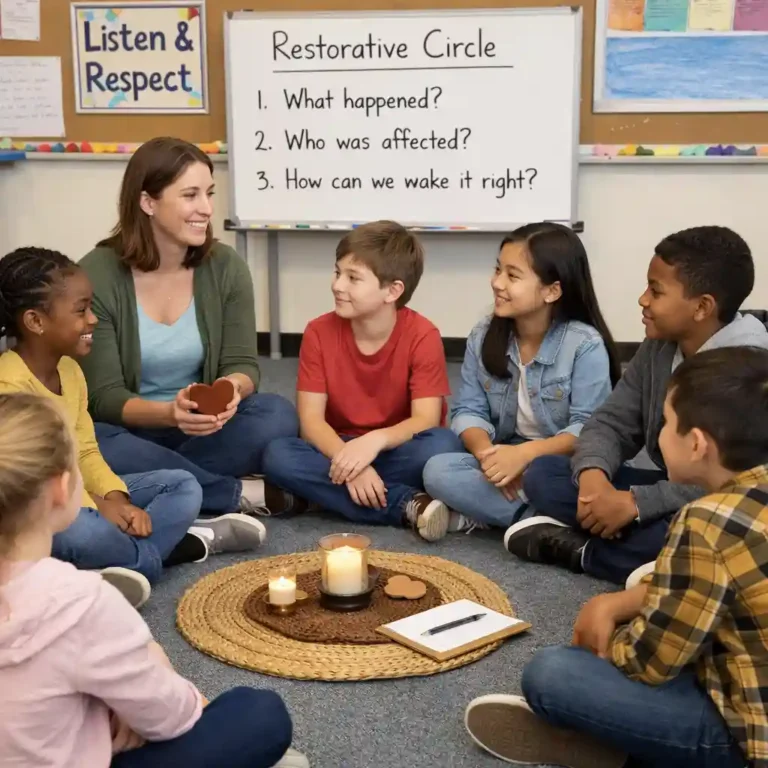
Restorative practices are not vague “talk it out” moments. They rely on structured prompts such as:
What happened?
What were you thinking at the time?
Who has been affected?
What can you do to make this right?
Notice what’s happening here:
The student is not escaping responsibility.
They are naming the impact of their actions.
That builds ownership far more effectively than a lecture ever could.
3. Proactive Community Building
Restorative practices are not only reactive.
They include:
Community circles
Shared norms creation
Regular check-ins
Repair conversations after small conflicts
When done proactively, they reduce major disruptions later.
Prevention is management.
4. Accountability With Dignity
Restorative practices maintain standards.
The difference is:
Instead of shame → reflection
Instead of isolation → connection
Instead of power struggle → problem solving
Students still face consequences.
But consequences are tied to repairing harm, not experiencing humiliation.
What Restorative Practices in the Classroom Are Not
This is where clarity matters.
❌ They Are Not “No Consequences”
A student who damages property may still:
Clean it.
Repair it.
Replace it.
Apologize.
Restore trust over time.
Restorative ≠ permissive.
If there is no accountability, it is not restorative practice.
❌ They Are Not Endless Group Therapy
Teachers are educators — not therapists.
Restorative practices are structured, brief, and focused.
They are not emotional deep dives into every possible childhood wound.
When conversations drift into therapeutic territory, schools need trained professionals.
❌ They Are Not Public Shaming in Disguise
If a circle becomes:
Forced apologies
Public embarrassment
Emotional ambush
It stops being restorative.
Students must feel psychologically safe to participate honestly.
❌ They Are Not a Replacement for Clear Expectations
Restorative practices work best when paired with:
Clear routines
Explicit expectations
Consistent follow-through
They do not replace structure.
They operate within structure.
Why Restorative Practices in the Classroom Strengthen Classroom Management
Let’s connect this directly to management.
Traditional discipline often creates:
Compliance in the moment
Resentment under the surface
Repeated behavior later
Restorative practices aim for:
Ownership
Empathy
Repaired relationships
Long-term behavior change
When students feel heard — and responsible — behavior improves.
And when relationships improve, management becomes lighter.
You spend less time policing.
You spend more time teaching.
When Restorative Practices in the Classroom Work Best
Restorative approaches are most effective when:
✔ The teacher remains calm and neutral
✔ There is an existing relationship foundation
✔ Expectations were already clear
✔ The student is regulated enough to reflect
They are not ideal during:
Active escalation
Safety threats
Severe trauma responses
Moments when a student is dysregulated
In those cases, regulation comes first.
Restoration comes second.
A Simple Restorative Script Teachers Can Use
You do not need a full circle every time.
For everyday classroom issues, try this 3-step structure:
Describe the impact
“When you interrupted, several students lost focus.”Invite reflection
“What was going on for you?”Move toward repair
“What would be a fair way to fix this?”
This keeps dignity intact while maintaining authority.
The Big Misconception About Restorative Practices in the Classroom
The biggest myth about restorative practices in the classroom?
That they weaken teacher authority.
In reality, they strengthen it.
Authority built on fear requires constant enforcement.
Authority built on relationship requires far less effort.
Try This Tomorrow
Choose one small incident tomorrow and respond restoratively.
Instead of:
“Why did you do that?”
Try:
“Who was affected by that choice?”
Notice the difference in tone.
Notice the shift in ownership.
Restorative Practices in the Classroom FAQ
What are restorative practices in the classroom? Restorative practices are strategies used to build classroom community and address misbehavior by focusing on the harm caused to relationships. Instead of just delivering a punishment, restorative practices involve structured conversations that help students understand the impact of their actions and take steps to repair that harm.
Are restorative practices the same as ‘no consequences’? No. Restorative practices actually require higher accountability. A consequence in a restorative model is directly tied to repairing the harm (e.g., cleaning a mess, making a sincere apology, or completing a reflection) rather than just serving a penalty that has no connection to the behavior.
How do restorative practices improve classroom management? By focusing on relationships, restorative practices reduce the resentment that often fuels power struggles. When students feel a sense of belonging and understand their responsibility to the community, they are more likely to achieve behavioral fluency and stay engaged in learning.
Reflection
I often sent a students out of the room after a disruption, and although the class settled quickly, the tension between me and the disciplined student sometimes lasted for weeks afterward. Later, in my career, I started using restorative conversations and asked who had been affected and how we could fix what happened together. The shift in responsibility and tone was immediate. That experience helped me realize that repairing relationships often solves problems that consequences alone don’t.
- When a disruption happens in your classroom, how often do you focus on repairing relationships rather than just addressing the behavior?
- How comfortable are you giving students structured opportunities to reflect on the impact of their actions?
- What is one situation in your classroom where a restorative conversation might strengthen trust instead of relying only on consequences?
Continue the Classroom Management Course
In the next lesson, you will see sample scripts that you can use as part of your restorative classroom practices.
Next Lesson: Restorative Conversations for Everyday Issues
Module 8 Progress:
- What Restorative Practices Are (and Aren’t)
Back to Module 8 Overview
Return to Full Course Outline