Restorative Conversations in the Classroom: A Practical Guide for Everyday Issues
When teachers hear “restorative practices,” they often imagine full-class circles, formal mediation, or long emotional discussions.
But most classroom behavior doesn’t require a summit meeting.
Most issues are small.
Side conversations.
A sarcastic comment.
A skipped assignment.
A moment of disrespect.
A conflict between two students.
And this is exactly where restorative conversations in the classroom matter most.
Not as a grand event.
As a quiet, two-minute interaction that protects relationships while still holding students accountable.
This module will show you how to use restorative conversations for everyday issues — without losing instructional time or authority.
What Is a Restorative Conversation (In Practical Terms)?
A restorative conversation is a brief, structured interaction that:
Focuses on impact instead of blame
Encourages student reflection
Maintains dignity
Reinforces expectations
Preserves the relationship
It is not:
A therapy session
A debate
A lecture
A punishment disguised as empathy
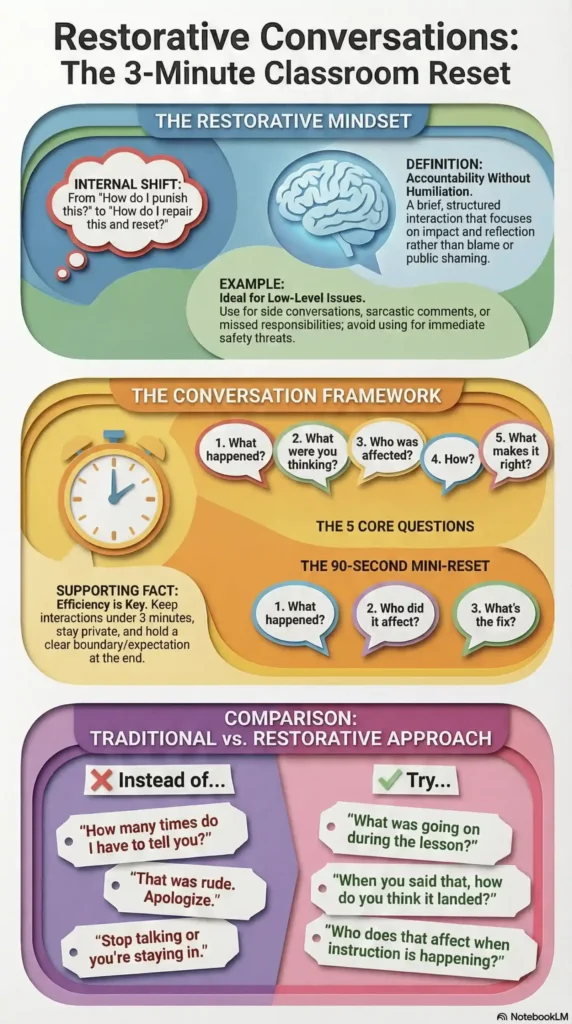
It is accountability without humiliation.
When to Use Restorative Conversations
Use them for:
Minor disrespect
Repeated low-level disruptions
Conflict between peers
Missed responsibilities
Hurtful comments
Tension after redirection
Not for:
Immediate safety threats
Severe incidents requiring admin
Situations where a student is escalated and dysregulated
(De-escalate first. Restore second.)
The 5 Core Questions of a Restorative Conversation
You don’t need a script — but you do need structure.
These five questions form the backbone:
What happened?
What were you thinking at the time?
Who was affected by what happened?
How were they affected?
What needs to happen to make this right?
That’s it.
Simple.
Predictable.
Repeatable.
What It Looks Like in Real Life
Scenario 1: Side Conversations During Instruction
Instead of:
“How many times do I have to tell you to stop talking?”
Try:
“What was going on during the lesson just now?”
Student:
“We were just talking.”
You:
“Who does that affect when instruction is happening?”
Student:
“You. Other people.”
You:
“What do we need to do next time so everyone can focus?”
You reinforce the expectation — without escalating.
Scenario 2: A Disrespectful Comment
Instead of:
“That was rude. Apologize.”
Try:
“When you said that, what do you think it sounded like?”
“How do you think that landed?”
“What do you want to do now?”
Notice:
Calm tone
Neutral language
No sarcasm
No public shaming
Private whenever possible.
Scenario 3: Two Students in Conflict
Bring them together briefly:
“What happened from your perspective?”
“What did you need in that moment?”
“What would help fix this?”
Your job is facilitator, not judge.
The Teacher Mindset Shift
Restorative conversations in the classroom only work if we shift internally.
From:
“How do I punish this?”
To:“How do I repair this?”
From:
“How do I win?”
To:“How do we reset?”
Authority isn’t lost.
It’s strengthened through fairness and predictability.
How to Keep It Efficient (Because Time Is Real)
You’re not running a counseling office.
Here’s how to keep it tight:
Keep it under 3 minutes for minor issues
Use the same structure every time
Hold the boundary at the end (“Next time, I expect…”)
Follow up later only if needed
The more consistent you are, the faster students move through the process.
What Makes Restorative Conversations Powerful
They:
Reduce repeat behaviors
Increase student reflection
Protect student dignity
Lower defensiveness
Strengthen classroom climate
Over time, students begin to anticipate the questions.
And that’s the goal.
When a student starts saying:
“I know. It distracted everyone.”
You’re building internal accountability.
Common Mistakes to Avoid
Turning it into a lecture
Asking questions with a sarcastic tone
Doing it publicly
Skipping the “repair” step
Letting it drift into negotiation about expectations
Restorative does not mean permissive.
The expectation remains clear.
A Simple 3-Step Mini Framework (For Busy Days)
If you’re overwhelmed, just remember:
1. What happened?
2. Who did it affect?
3. What’s the fix?
That’s your 90-second reset.
Try This Tomorrow
Pick one predictable, low-level issue that happens regularly.
Instead of correcting it the usual way, try:
Pull the student aside.
Ask the 3 questions.
End with a clear expectation.
No lecture.
No power struggle.
No public moment.
Just reset.
Repeat consistently for two weeks.
You’ll notice:
Less defensiveness
Faster compliance
More ownership
And most importantly —
The relationship stays intact.
Final Thought
Restorative conversations in the classroom are not about being soft.
They’re about being strategic.
Every classroom has disruptions.
But the teachers who build calm accountability — without shame — create spaces where students feel safe enough to improve.
And that’s real classroom management.