Why Predictability and Trust are Critical in the Classroom
Predictability and trust in the classroom are the effective, “invisible scaffolds.” When a classroom is predictable, students move from a state of “survival monitoring” to a state of learning, as their brains no longer need to brace for inconsistency. By pairing reliable routines with emotionally steady responses, teachers build the trust necessary to handle redirections and conflict without triggering power struggles.
This is Lesson 2 of Module 3: Building Teacher-Student Relationships | Full Course Outline
Mindset Shift: Rigidity vs. Predictability
| The Rigid Lens (Control) | The Predictable Lens (Safety) |
| Goal: Forcing students to follow a script. | Goal: Providing a reliable map for the day. |
| Feel: Robotic, cold, or inflexible. | Feel: Calm, steady, and secure. |
| Reaction to Change: Frustration or “powering through.” | Reaction to Change: Clear communication and transition cues. |
| Student Experience: Anxiety about “doing it wrong.” | Student Experience: Confidence in knowing what comes next. |
| Result: Fragile compliance that breaks under stress. | Result: Resilient cooperation and lower background stress. |
Classroom management doesn’t start with rules.
It starts with whether students feel safe enough to learn.
Predictability and trust are two of the most underrated—but powerful—forces shaping student behavior. When students know what to expect and believe their teacher is consistent and fair, behavior improves without constant correction.
This isn’t about being rigid.
It’s about creating a classroom that students don’t have to brace themselves to survive.
What Predictability Really Means in the Classroom
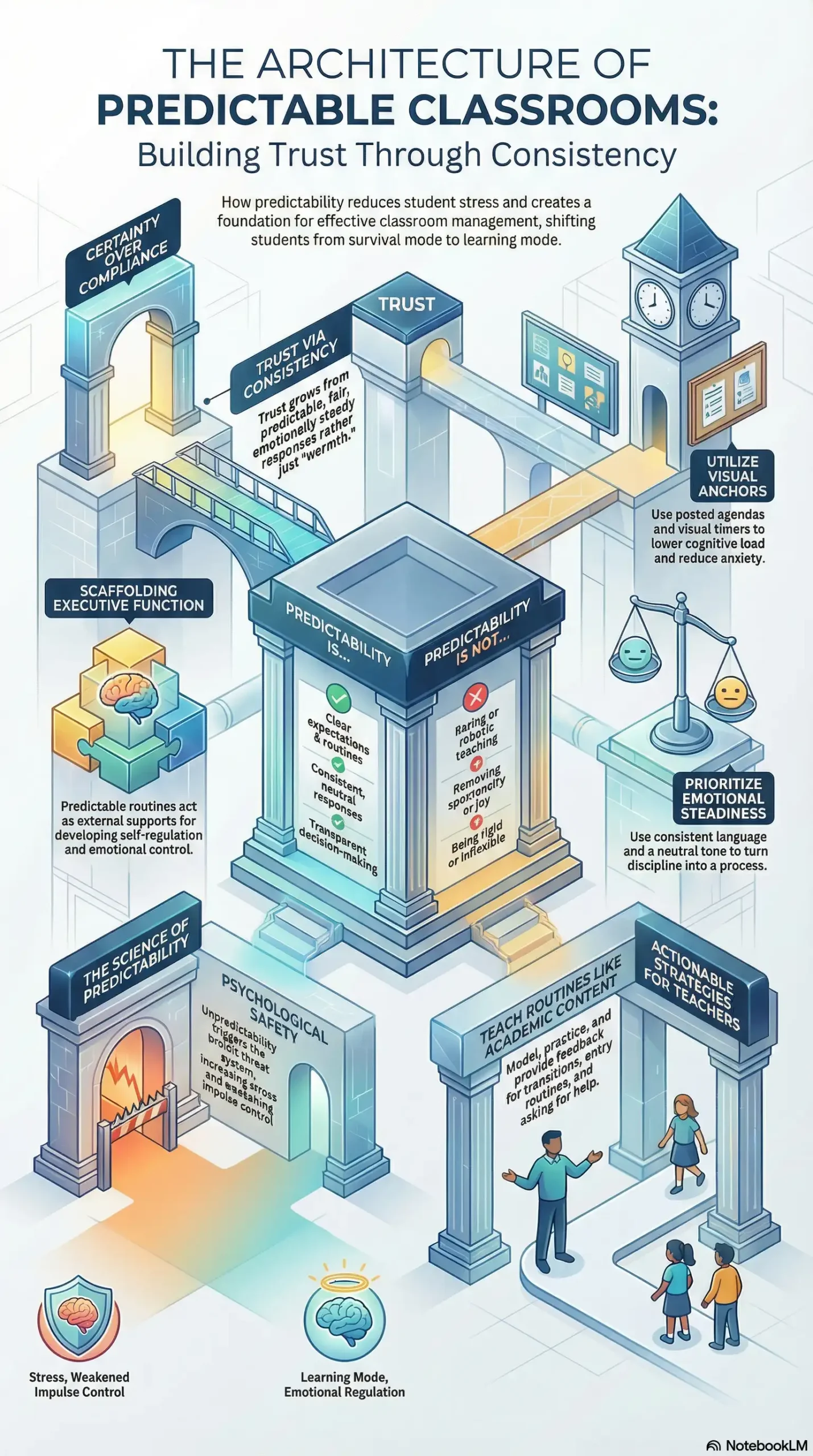
Predictability is not:
Boring routines
Robotic teaching
Doing the same thing every day
Removing spontaneity or joy
Predictability is:
Clear expectations
Consistent responses
Familiar routines
Transparent decision-making
In predictable classrooms, students don’t waste mental energy asking:
What’s going to happen next?
Am I about to get in trouble?
Is this teacher going to react emotionally?
They already know the answers.
The Science: Why Predictability and trust in the Classroom Changes Behavior
1. The Brain Prioritizes Certainty Over Compliance
From a neuroscience perspective, unpredictability activates the brain’s threat system.
When students experience inconsistency—unclear expectations, sudden rule changes, emotional reactions—their brains shift into survival mode:
Stress hormones increase
Working memory decreases
Impulse control weakens
This is why students often look defiant when they’re actually dysregulated.
Predictability reduces this background stress.
A predictable environment tells the brain:
“You’re safe. You can focus.”
2. Predictability Strengthens Executive Function
Executive function skills—like self-regulation, task initiation, and emotional control—are still developing, especially in adolescents.
Predictable routines act as external scaffolds:
Entry routines reduce decision fatigue
Clear transitions reduce impulsivity
Known expectations reduce emotional escalation
Instead of asking students to self-regulate in chaos, predictable classrooms help students practice regulation within structure.
3. Trust Grows From Consistency, Not Warmth Alone
Students don’t build trust because a teacher is “nice.”
They build trust when a teacher is:
Consistent
Fair
Emotionally regulated
Clear about boundaries
Trust develops when students can predict how a teacher will respond—even when things go wrong.
When trust is present:
Students accept redirection more easily
Power struggles decrease
Repair happens faster after conflict
Why Predictability and Trust in the Classroom Prevents Power Struggles
Many classroom power struggles are rooted in uncertainty:
Am I about to be embarrassed?
Is this fair?
Am I losing status in front of my peers?
Predictability removes the emotional guessing game.
When students know:
The procedure
The consequence
The tone the teacher will use
There’s nothing to push against.
Predictability turns discipline from a personal confrontation into a neutral process.
Actionable Strategies: How Teachers Can Build Predictability and Trust in the Classroom
1. Teach Routines Like Academic Content
Never assume routines are “obvious.”
Teach them the same way you would:
Model the routine
Practice it
Give feedback
Revisit it when needed
High-impact routines include:
Entry and exit routines
Transition procedures
How to ask for help
What to do when finished early
2. Be Predictable in Your Responses—Not Your Personality
Students don’t need you to be monotone.
They need you to be emotionally steady.
This means:
Responding with the same tone every time
Using consistent language for redirection
Separating behavior from identity
Example:
Instead of “How many times have I told you?!”
Try: “This is a reminder of our expectation.”
Same message. Radically different impact.
3. Use Visual Anchors to Reduce Uncertainty
Visual supports lower cognitive load and reduce anxiety:
Posted routines
Daily agendas
Visual timers
Clear written expectations
These tools answer student questions before they need to ask.
4. Explain the “Why” Behind Expectations
Trust grows when students understand purpose.
When appropriate, explain:
Why a routine exists
What it supports
How it helps learning
Students don’t need control—but they do need logic.
The Predictability and Trust in the Classroom Loop
Predictability builds trust.
Trust makes predictability effective.
When both are present:
Students regulate themselves more often
Corrections feel neutral, not personal
The classroom feels calmer—even on hard days
This is not about perfection.
It’s about being reliably human in front of students.
Predictability and Trust in the Classroom FAQ
Why is predictability important for classroom management? Predictability reduces the ‘threat response’ in a student’s brain. When students know exactly what to expect from their environment and their teacher, they can devote their mental energy to learning and self-regulation rather than scanning for social or academic danger.
How does consistency build trust with students? Trust is built when a teacher’s actions match their words over time. Consistency in how you respond to both positive and negative behaviors tells students that you are fair and emotionally regulated, which makes them feel safe enough to take risks and accept redirection.
Can a classroom be predictable without being boring? Yes. Predictability refers to the structural ‘bones’ of the classroom—routines, transitions, and teacher temperament. Within those reliable structures, there is actually more room for spontaneous, creative, and joyful learning because students feel secure enough to participate fully.
Reflection
One year, I realized my transitions between activities were inconsistent, and a few students were becoming restless every time we switched tasks. I started using the same brief transition routine each day and posted the schedule where everyone could see it. Within a week, those same students settled more quickly and trusted the flow of the class instead of testing its boundaries.
- Which moment in your class feels least predictable to students—and how could you make that routine clearer tomorrow?
- How consistently do you respond to the same behaviors from day to day, and what message might that consistency (or inconsistency) be sending to students?
- What is one simple visual or verbal routine you could introduce that would help students feel more secure about what happens next in your classroom?
Continue the Classroom Management Course
In the next lesson, we will discuss how holding students to high expectations while providing clear guidance, encouragement, and scaffolding creates a “warm demander” classroom.
Next Lesson: High Expectations + High Support
Module 3 Progress:
Back to Module 3 Overview
Return to Full Course Outline