
50 Fun and Engaging Minds-On Activities to Kickstart Any Lesson
Every teacher knows the struggle of those first few minutes of class. Students wander in like they’ve just emerged from hibernation—half-awake, half-talking, and entirely unsure what century they’re in. That’s where minds-on activities come in.
A minds-on task is a short, engaging warm-up that activates students’ thinking, gets them focused, and connects their prior knowledge to the day’s lesson. Think of it as a mental coffee—something to wake up the brain before diving into the main event.
Whether you teach middle school, high school, or college, these 50 fun minds-on activities will help your students start class energized, focused, and ready to learn.
How to Use These 50 Minds-On Activities as Bell Ringers
Minds On activities are brief, purposeful lesson openings that activate relevant prior knowledge, spark curiosity, or reveal what students already understand. Bell ringers, also called do-nows or lesson starters, describe the routine students begin as class starts. The two often overlap: a two-minute prediction can be both a bell ringer and a Minds On activity when it connects to the learning goal. A worksheet students complete simply to stay busy may be a bell ringer, but it is not necessarily a meaningful Minds On.
Start here: Choose one activity below, connect it to your next learning goal, and give students 3–7 minutes to respond. End with a one-minute bridge: “How does this relate to what we’re learning today?” For a reusable system, see our bell ringer routines for middle and high school and the complete Bell Ringers and Minds On resource collection.
Jump to an Activity
Activities 1–10 · Activities 11–20 · Activities 21–30 · Activities 31–40 · Activities 41–50 · Ready-to-teach classroom examples · Teacher FAQs
Choose by Teaching Purpose
- Activate prior knowledge: Try Concept Match (#6), Brain Dump (#18), or the 10-Second Summary (#38).
- Invite predictions and curiosity: Use the Mystery Image (#9), Mystery Object (#20), or Daily Wonder (#41).
- Start academic talk: Try Would You Rather (#2), Micro Debate (#23), or One-Minute Partner Teach (#32).
- Build vocabulary and connections: Use Vocab Charades (#21), Guess the Connection (#26), or Analogy Time (#31).
- Offer a calm, independent start: Choose Quick Draw (#1), Silent Start (#29), or a short Warm-Up Write (#36).
Teacher planning rule: A strong opening is not necessarily loud or entertaining. It should be accessible, short enough to preserve the main lesson, and connected to what students are learning or about to learn. If your goal is long-term retention, try our 12 retrieval practice bell ringers, which require students to recall material before checking their notes.
1. Quick Draw
Give students a topic (like “justice” or “ecosystems”) and 60 seconds to draw it. Stick figures are encouraged. Then, have them explain their sketch to a partner.
2. Would You Rather…?
Pose a thought-provoking question tied to your lesson, like “Would you rather explore Mars or the deepest ocean trench?” Students must justify their choice.
3. Two Truths and a Lie (Lesson Edition)
Have students write two true facts and one false one about yesterday’s topic. Their peers guess which one is the lie.
4. The Prediction Jar
Give a one-sentence teaser from today’s lesson. Ask students to predict what they’ll learn and why it might matter.
5. Emoji Reactions
Display an image, quote, or question. Students choose or draw an emoji that captures how they feel about it—and explain their reasoning.
6. Concept Match
Write vocabulary terms on one side of the board and examples on the other. Students race to match them.
7. Brain Warm-Up Riddles
Start with a lateral-thinking puzzle or riddle related to your subject. Even better if it’s delightfully weird.
8. Five Things
Pick a topic and challenge students to name five related things in 30 seconds. (“Name five renewable resources!”)
9. The Mystery Image
Project a zoomed-in photo of something connected to your lesson. Students guess what it is and how it might connect.
10. One-Minute Story
Give three random words related to your subject. Students have one minute to write a short, silly story using them.
11. The Soundtrack
Play a short instrumental clip. Ask: “How does this music connect to our topic today?” Works great in history or English.
12. This or That
Students move to one side of the room or the other based on your question: “Poetry or prose?” “Romeo or Juliet?” “Coffee or tea?”
13. Picture Prompt
Show a single striking image and ask: “What’s happening here?” or “What does this make you think of?”
14. Three Words
Students summarize what they remember from the previous class in exactly three words.
15. The Meme Starter
Show a meme template and ask students to caption it using today’s topic.
16. Human Graph
Students line up based on their opinion about a statement: “Strongly agree to strongly disagree.” Discuss patterns.
17. Quote Connect
Display a quote tied to the lesson theme. Ask: “Do you agree or disagree? Why?”
18. Brain Dump
Give one minute for students to write down everything they remember from yesterday’s lesson. No pressure, no judgment.
19. Rapid Fire Questions
You ask quick review questions; students shout out answers lightning-round style.
20. The Mystery Object
Bring in a real object related to the day’s topic. Students make inferences about what it tells us or how it connects.
21. Vocab Charades
Students act out a vocabulary word while others guess.
22. Caption This
Show a related image and have students write a funny or serious caption connected to the topic.
23. The Micro Debate
Pose a short debate question (“Should school uniforms be mandatory?”). Each student gives one sentence for or against.
24. Sticky Note Connections
Each student writes one idea or question about the topic on a sticky note. Collect and post them on the board to form a visual brainstorm.
25. Lightning Sketch Notes
Students quickly doodle symbols or diagrams showing what they remember from the previous class.
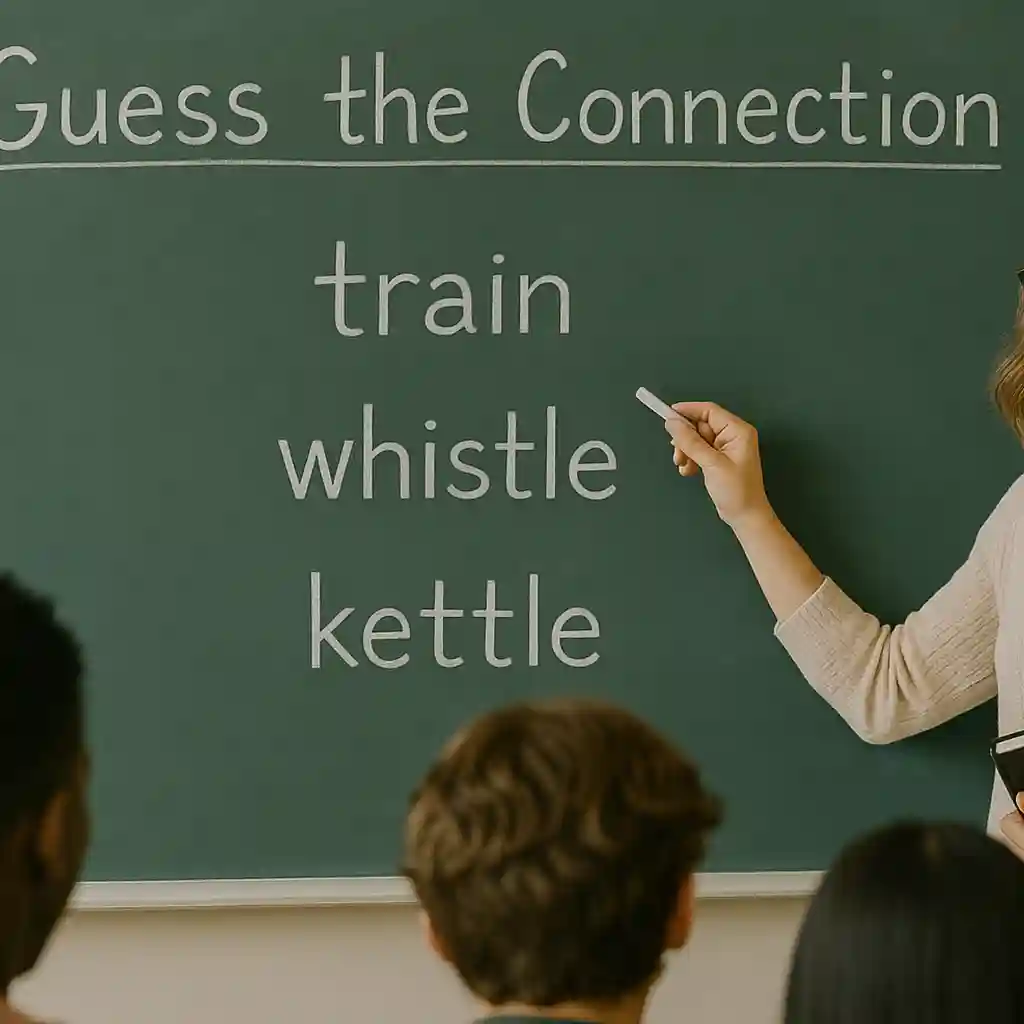
26. Guess the Connection
Write three seemingly random words on the board. Ask students to figure out what connects them.
27. The Brain Chain
Students form a chain of related ideas—each person must add a word or phrase that connects logically to the last one.
28. Class Poll
Use digital tools (like Mentimeter or Kahoot) or simple hand-raising to survey opinions related to the lesson topic.
29. The Silent Start
Challenge students to communicate about a review question without speaking—using only gestures or drawings.
30. The Object Metaphor
Bring a random item (like a rock or rubber band). Ask: “How is this like our topic today?”
31. Analogy Time
Give students a concept and ask them to finish this sentence: “___ is like ___ because…”
32. One-Minute Partner Teach
Students turn to a partner and explain yesterday’s lesson as fast and accurately as they can.
33. The Question Ball
Toss a ball around the room. Whoever catches it must answer or ask a question related to the topic.
34. Fact or Fiction
Share a surprising statement about the topic and ask students to guess if it’s true or false.
35. Timeline Scramble
Give out major events or steps from a process. Students must arrange them in order.
36. The Warm-Up Write
Give a provocative prompt: “Describe a time when you felt misunderstood.” Use it to transition into theme or character discussions.
37. Image Sorting
Show several pictures and ask which best fits the theme, concept, or historical period.
38. The 10-Second Summary
Each student has 10 seconds to summarize what they remember from yesterday’s lesson.
39. Word Association Chain
Say a key term—students shout out the first related word that comes to mind, chaining responses.
40. Classroom Escape Starter
Give one puzzle or clue related to your lesson’s topic that opens the “first lock” of a larger classroom escape activity.
41. The Daily Wonder
Pose a “wonder” question like, “What would happen if gravity stopped for one second?” Then relate it to science concepts.
42. Mini Mystery
Describe a short, unsolved situation. Students make inferences and justify their reasoning.
43. Post-It Predictions
Students write one prediction for what they think will happen in the next part of a story or unit.
44. Three-Image Story
Show three related images. Students create a short narrative connecting them.
45. Ranking Challenge
Give students five related items (e.g., characters, inventions, causes). They rank them from least to most important and explain why.
46. Sensory Start
Play a sound, show a texture, or release a scent related to the topic (think cinnamon for “Christmas stories”). Ask students to guess the connection.
47. The Rule Maker
Provide several examples (like “run, jump, swim”). Students infer the rule (“All are verbs!”). Then flip it—they create examples, and classmates guess the rule.
48. The “What If” Game
Ask big questions like: “What if everyone could read minds?” or “What if Shakespeare had Twitter?” Connect to your theme or text.
49. Student Choice Start
Let students choose the day’s opener from a list: drawing, quick write, debate, or Kahoot.
50. Mindful Minute
Before the chaos begins, dim the lights, breathe deeply, and let everyone clear their minds. Then say, “Okay—let’s think.”
Need more English-specific prompts? Our 20 English bell ringers provide four weeks of ready-to-use reading, grammar, writing, and media literacy questions with teacher discussion cues.
Five Ready-to-Teach Minds On Examples by Subject
These examples turn the quick ideas above into a repeatable opening routine. Each needs only a board, paper, or a brief discussion; adapt the material and reading level to your students.
English: Predict a Character’s Decision (5 Minutes)
Learning goal: Support an inference using evidence. Display one short, authorized excerpt in which a character must make a choice. Students underline two clues and write: “I predict ___ because the text shows ___.” Give partners 30 seconds to compare reasoning, then revisit the prediction after reading. This extends the Prediction Jar (#4) into literary analysis; see our Grade 9 English lessons for more reading activities.
Math: Which Answer Does Not Belong? (4 Minutes)
Learning goal: Explain a mathematical property. Put four expressions on the board, such as 12 ÷ 3, 2 + 2, 16 ÷ 4, and 3 + 3. Students identify which expression differs and explain their rule. Accept mathematically sound alternative explanations. This adapts Guess the Connection (#26) and encourages reasoning, not just a quick correct answer.
Science: Mystery Image and Evidence (5 Minutes)
Learning goal: Distinguish observation from inference. Display a close-up image of a familiar natural phenomenon. Students record two observations, one inference, and one question. Reveal the full image and connect their thinking to the lesson’s scientific concept. This adapts the Mystery Image (#9) without requiring a long presentation.
History: Rank the Evidence (6 Minutes)
Learning goal: Evaluate the usefulness of historical sources. Give students three brief descriptions of documents connected to the same historical question. Ask them to rank the sources for that specific question and justify their choices. Allow students to change their ranking after learning more about author, date, and context. This extends the Ranking Challenge (#45).
Life Skills: A Quick Real-World Choice (5 Minutes)
Learning goal: Explain a decision using criteria. Present a realistic choice such as spending a limited budget on transportation, groceries, or recreation. Students pick a first priority and explain how their needs and responsibilities shaped the choice. This turns Would You Rather (#2) into applied decision-making.
Differentiate a 5-Minute Minds On Without Losing Time
- Students who need extra support: Show one worked example; offer two response options; provide a sentence starter; or let students point, sketch, or dictate.
- Multilingual learners: Preview the two or three essential words needed to respond and allow a brief partner rehearsal before sharing.
- Students ready for extension: Ask for a second possible interpretation, a counterexample, or a connection to a previous unit.
- Quiet or anxious learners: Avoid requiring every student to share personal experiences or speak publicly. A private written response can still demonstrate thinking.
- Limited technology: Use a paper image, a spoken question, or mini-whiteboards. No student accounts are necessary.
Minds On Activities: Frequently Asked Questions
What is the difference between a Minds On activity and a bell ringer?
A bell ringer is an opening classroom routine. A Minds On activity deliberately prepares students for learning by connecting prior knowledge, generating relevant questions, or surfacing ideas the lesson will develop. A single activity can serve both roles.
How long should a Minds On or bell ringer take?
Three to seven minutes is a useful planning range for many lessons, including a short debrief. The best length depends on the age group, task, and learning goal. Stop while there is still enough time for the main teaching and practice.
Should bell ringers be graded?
Not routinely. Many openings work best as low-stakes practice that helps the teacher notice misconceptions. Give clear feedback and, when using retrieval, let students check and correct their answers. The Australian Education Research Organisation recommends regular opportunities for spaced, low-stakes recall.
Can Minds On activities work in high school?
Yes. Use more complex content—an ambiguous quotation, a historical claim, a graph, or competing solutions—while keeping the opening focused and brief. For older students, our middle and high school bell ringer activities offer additional formats.
Where can I find more 5-minute Minds On ideas?
Explore five-minute Minds On mini-lessons, a week of classroom priming examples, and the full Bell Ringers category.
Why Minds-On Activities Matter
A well-crafted minds-on activity does more than entertain. It:
Activates prior knowledge: Students connect old information to new learning.
Increases engagement: Starting with curiosity hooks students immediately.
Reduces anxiety: Fun, low-stakes tasks make learning approachable.
Builds community: Minds-on activities often involve movement and collaboration.
Improves focus: A good mental warm-up helps students transition from “social mode” to “learning mode.”
Think of it as flipping the classroom’s “on” switch. When students start class already thinking, discussing, and laughing, the rest of the lesson just flows.
Tips for Using Minds-On Activities
Keep it short: Aim for 3–5 minutes max.
Connect it: Always tie the activity back to your learning goal.
Rotate often: Keep things fresh—students love novelty.
Reflect quickly: End with one sentence or question linking it to the main task.
Adapt and reuse: Many of these can fit any subject—tweak them for math, science, or English.
Wrapping Up
Minds-on activities don’t have to be complicated to be effective. The best ones are short, clear, and connect naturally to your lesson. Whether your students are dissecting Shakespeare, building circuits, or graphing data, the first few minutes set the tone for everything that follows.
So go ahead—try one (or ten) of these minds-on activities this week. Your students will thank you, your lessons will start stronger, and you might even find yourself looking forward to those first chaotic minutes of class.