Logical Consequences In The Classroom: Examples & Scripts
A student talks over you for the third time in ten minutes. You’ve already given a warning. Now what? If your go-to move is some version of "that’s a detention," you’re not alone, but you might be missing a more effective option. Logical consequences in the classroom connect a student’s behavior directly to a meaningful response, one that teaches rather than simply punishes. They’re the difference between a kid sitting silently in resentment and a kid who actually understands why the boundary exists.
Here at The Cautiously Optimistic Teacher, we build resources that help educators manage real classrooms with real students, not theoretical ones. And behavior management is one of those areas where practical strategies matter far more than abstract philosophy. That’s exactly why this article exists: to give you a clear framework you can use starting tomorrow.
Below, you’ll find a straightforward breakdown of what logical consequences are, how they differ from punishment, and, most importantly, ready-to-use examples and scripts you can adapt for your own classroom. Whether you teach 6th graders or 12th graders, these strategies will help you respond to behavior in ways that build accountability without damaging your relationship with students.
Why logical consequences work in real classrooms
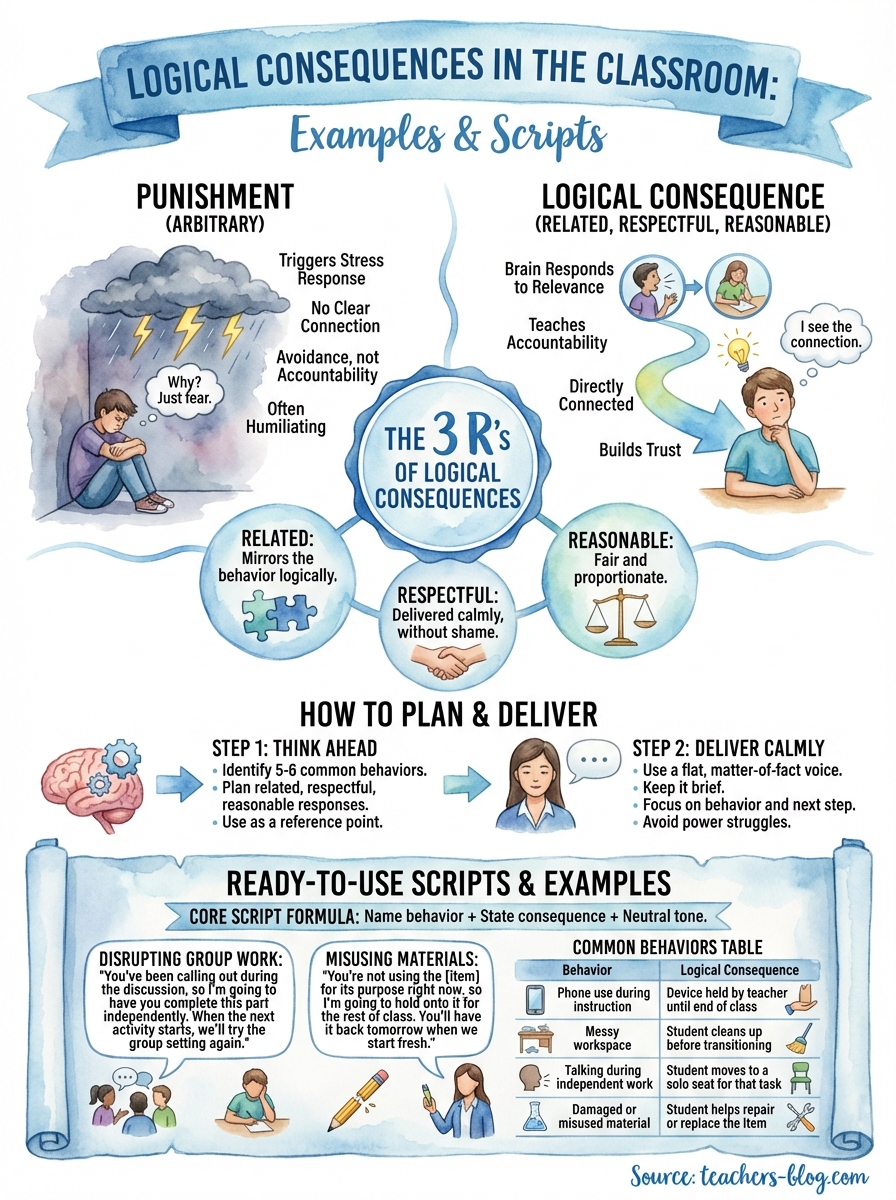
When students experience logical consequences in the classroom, they’re not just receiving a reaction to their behavior, they’re receiving information. A consequence that directly connects to what a student did gives their brain something concrete to work with. Punishment, by contrast, often triggers a stress response that shuts down reflection. The student focuses on the consequence itself rather than the behavior that caused it, which is exactly why detention rarely changes behavior long-term. You can assign punishments indefinitely and never shift a student’s choices, but a well-placed logical consequence can land in one moment.
The most effective classroom consequences are ones students can trace directly back to their own choices.
The brain responds to relevance
Adolescent brains are still developing the prefrontal cortex, the region responsible for cause-and-effect reasoning and impulse control. When a consequence feels arbitrary or disconnected from the behavior, that developing brain has nothing to anchor to. But when the response is relevant, students can actually trace the logic: "I disrupted the class, so I need to fix the disruption." That traceable path is what makes relevant consequences stick more effectively than fear. It is not magic. It is simply how learning works when you give the brain a clear, connected reason to adjust behavior.
Students learn accountability, not avoidance
When you deliver a consequence that matches the behavior, you shift the conversation from "you’re in trouble" to "here’s what happens next." That shift matters more than it sounds. Students who regularly experience arbitrary punishment often become skilled at avoiding getting caught rather than avoiding the behavior itself. Logical consequences flip that pattern entirely. A student who drew on a desk spends five minutes cleaning it, and they are far less likely to do it again because the connection is direct and personal. They own the outcome.
Teachers also benefit from this approach in ways that are easy to overlook. When your responses follow a consistent, logical pattern, students learn to predict outcomes, which reduces power struggles before they start. You spend less energy enforcing rules and more energy teaching. That consistency builds trust over time, and a classroom where students trust your judgment is one where behavior problems come up far less often. The relationship you build through fair, logical responses to behavior pays dividends every single day you spend with that group of students.
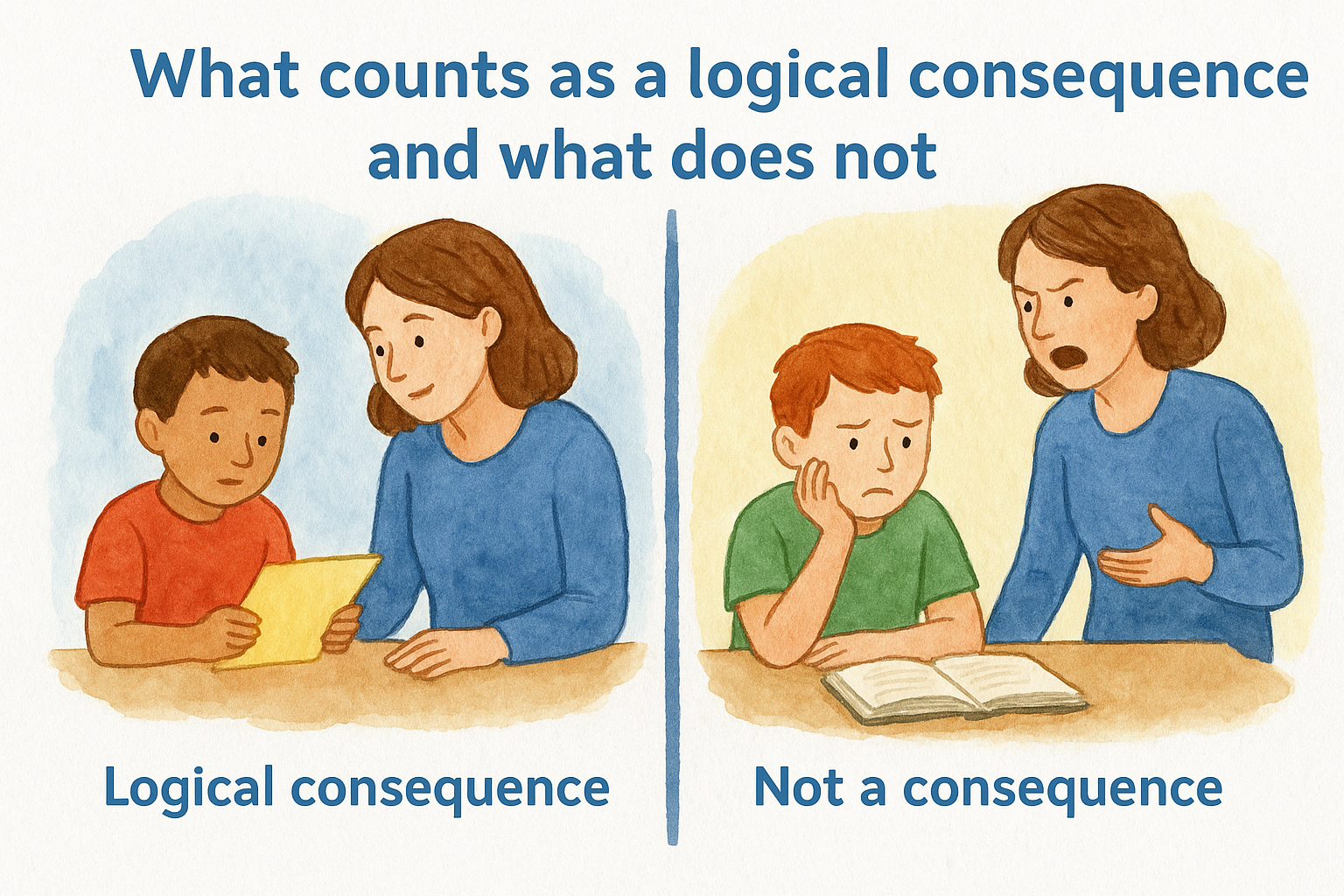
What counts as a logical consequence and what does not
Not every response to misbehavior qualifies as a logical consequence. The key test is simple: does the consequence connect directly to the behavior, and does it help the student understand what to do differently? If you can answer yes to both, you’re in the right territory. Logical consequences in the classroom follow three core principles: they are related, respectful, and reasonable. All three need to be present.
When a consequence qualifies
A consequence qualifies when it mirrors the behavior logically. A student who talks over others during group work completes the remaining task independently instead of with the group. A student who misuses a material has to set it aside and earn it back by demonstrating they can handle it. In each case, the response teaches the natural outcome of that specific behavior without shame or arbitrary penalty.
The three R’s of logical consequences: related, respectful, and reasonable. If your response fails any one of those, reconsider it.
When it crosses into punishment
A consequence becomes punishment the moment the connection disappears. Telling a student who talked out of turn to write a 500-word essay has no logical link to the behavior. Making an entire class miss free time because one student misbehaved is punishment, not a consequence. Humiliation, volume, and severity are warning signs you’ve left logical consequence territory entirely.
Common signs a response has crossed into punishment:
- The consequence has no clear connection to what the student actually did
- The student feels ashamed rather than redirected
- The response targets the student’s character rather than the specific action
How to plan and deliver logical consequences
Planning logical consequences in the classroom before a situation arises is what separates a calm, effective response from a reactive one you’ll regret. When you walk in with a rough mental map of common behaviors and their logical responses, you stop improvising under pressure and start responding with intention. That preparation is what makes the whole approach feel sustainable rather than exhausting.
Think through responses in advance
Spend ten minutes before the semester starts listing the five or six behaviors you encounter most often in your classroom. For each one, identify a response that is related, respectful, and reasonable. Write them down somewhere accessible. This is not about scripting every possible scenario; it is about giving yourself a clear reference point so you are not inventing a consequence on the spot while 30 students watch you figure it out.
The teacher who has thought through responses in advance almost always delivers them more consistently and more calmly.
Deliver the consequence calmly and briefly
The tone you use when delivering a consequence matters as much as the consequence itself. A flat, matter-of-fact voice signals that this is simply what happens next, not a personal confrontation. Students read emotional escalation as a power struggle, and that reading invites pushback. Keep your words short, direct, and focused on the behavior and the next step rather than on your frustration with the student. The less dramatic the delivery, the more the consequence does its own work without you having to defend it.
Logical consequence scripts you can use tomorrow
Having a ready script removes the hesitation that makes logical consequences in the classroom harder to deliver under pressure. You do not need to memorize every word, but having a reliable sentence structure means you spend your mental energy on the student in front of you rather than searching for the right words in real time. The core formula is simple: name the behavior, state the consequence, and keep your tone neutral.
A script is not about being robotic; it is about removing the guesswork when you are standing in front of 30 students.
When a student disrupts the group
Students who repeatedly call out or interrupt group work need a response that connects directly to the disruption. Use this script: "You’ve been calling out during the discussion, so I’m going to have you complete this part independently. When the next activity starts, we’ll try the group setting again." Short, calm, and directly traceable to what actually happened.
When a student misuses materials
A student who misuses a tool, whether that is a laptop, art supply, or lab equipment, loses access to it for a set period. Try this: "You’re not using the [item] for its purpose right now, so I’m going to hold onto it for the rest of class. You’ll have it back tomorrow when we start fresh." This script keeps the focus on the item and the behavior without turning the moment into a character judgment. The student hears a clear path forward, which makes the consequence easier to accept and faster to move past.
Examples for common classroom behaviors
These scenarios give you a direct reference for applying logical consequences in the classroom to situations that come up every week. Each one follows the same standard: the consequence connects directly to the behavior and gives the student a clear path back.
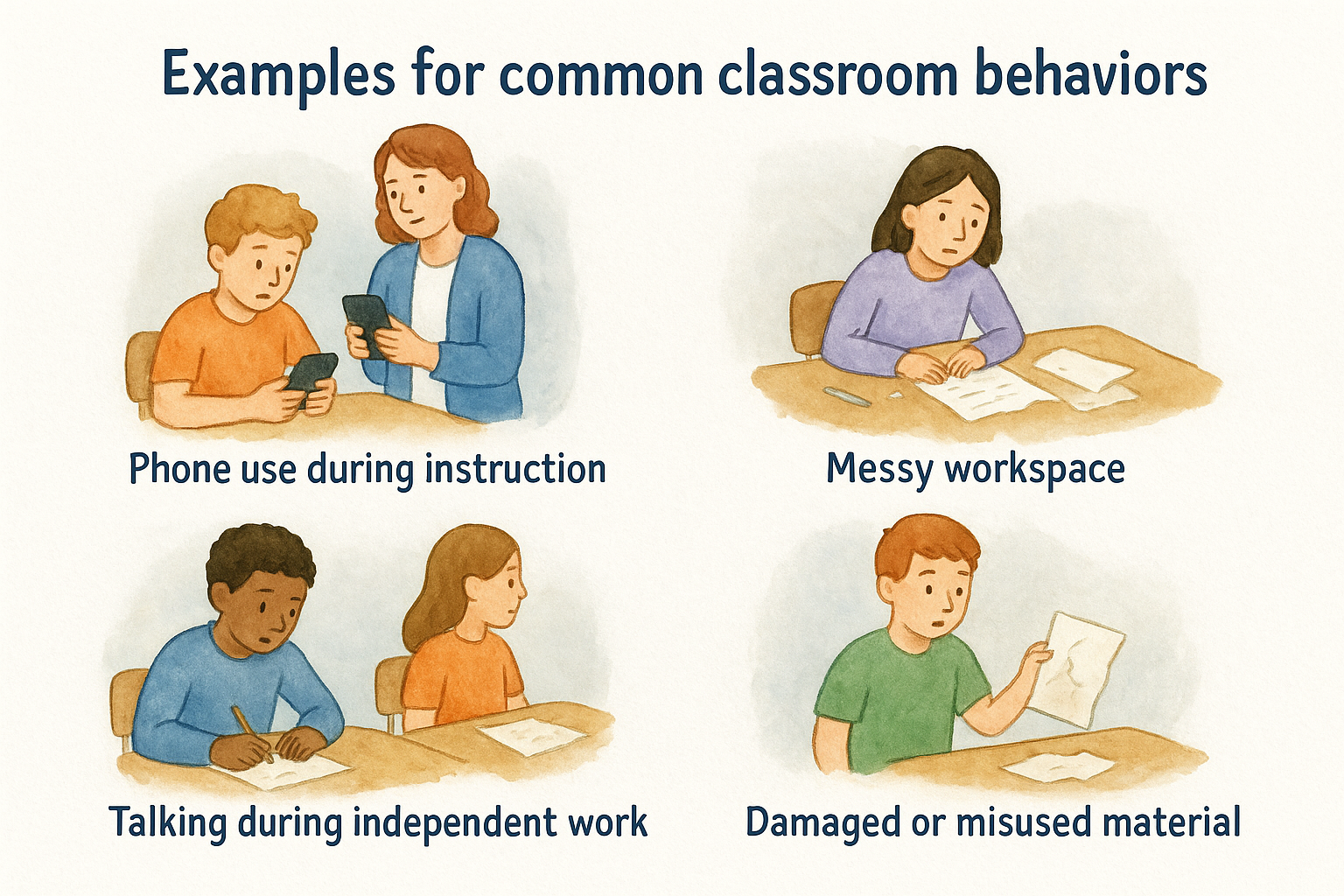
| Behavior | Logical Consequence |
|---|---|
| Phone use during instruction | Device held by teacher until end of class |
| Messy workspace | Student cleans up before transitioning |
| Talking during independent work | Student moves to a solo seat for that task |
| Damaged or misused material | Student helps repair or replace the item |
When a student disrupts peers
A student who interrupts group discussion repeatedly finishes that portion of work alone. The group continues without them, and the student rejoins when the next activity begins. This response removes the disruption without excluding the student for the entire period.
Effective consequences do not outlast the behavior that caused them.
Keeping the consequence time-limited reinforces that the student controls how quickly things return to normal, which builds accountability far more than an open-ended penalty.
When a student mishandles materials or space
A student who leaves a mess or breaks something through careless use addresses the problem directly, whether that means cleaning up, repairing the item, or replacing it. You are not asking for an apology; you are asking for a concrete action that fixes the situation.
That distinction keeps the focus on responsibility rather than guilt. Students who clean up their own mess or contribute to fixing what they damaged tend to be significantly more careful with shared materials going forward.
Key takeaways
Logical consequences in the classroom work because they connect behavior directly to a meaningful response that students can trace back to their own choices. When your response is related, respectful, and reasonable, students build accountability instead of just avoiding getting caught. Scripts and pre-planned responses let you stay calm under pressure, which makes the consequence land without turning into a power struggle.
The biggest shift this approach requires is in your framing. You are not trying to make students feel bad; you are showing them what happens next and giving them a clear path forward. That distinction changes how students receive your response entirely.
If you want more practical strategies like these, The Cautiously Optimistic Teacher has tools and resources built specifically for real classrooms. Start with one or two of the scripts from this article, try them this week, and adjust from there.