Logical Consequences vs. Punishment: What Actually Changes Student Behavior?
Logical consequences in the classroom are instructional responses to misbehavior that are directly related, respectful, and reasonable. Unlike punishment, which relies on exclusion or shame, logical consequences focus on reparative action and skill-building. This approach preserves the student-teacher relationship and fosters behavioral fluency by teaching students how to fix their mistakes rather than just fear the results.
This is Lesson 3 of Module 6: Responding to Disruptions Without Escalation | Full Course Outline
Mindset Shift: From Penalty to Practice
| The Punitive Lens (Discomfort) | The Logical Lens (Learning) |
| Goal: To make the student “regret” the action. | Goal: To help the student “repair” the situation. |
| Connection: Often unrelated (e.g., missed recess for talking). | Connection: Directly related (e.g., practicing quiet entry). |
| Logic: “You broke a rule, so you lose a privilege.” | Logic: “You missed the instruction, so you need to review it.” |
| Teacher Tone: High emotion, stern, or sarcastic. | Teacher Tone: Neutral, matter-of-fact, and calm. |
| Long-term Result: Resentment and “loophole” seeking. | Long-term Result: Accountability and behavioral fluency. |
If classroom management is about control, punishment makes sense. If classroom management is about teaching, logical consequences make sense. Too often, we respond to behavior in ways that feel strong in the moment but don’t actually change anything long-term. The student complies temporarily — or shuts down — and we mistake that for improvement. Understanding the difference between punishment and logical consequences in the classroom is one of the most powerful shifts a teacher can make.
Let’s break it down.
What Is Punishment?
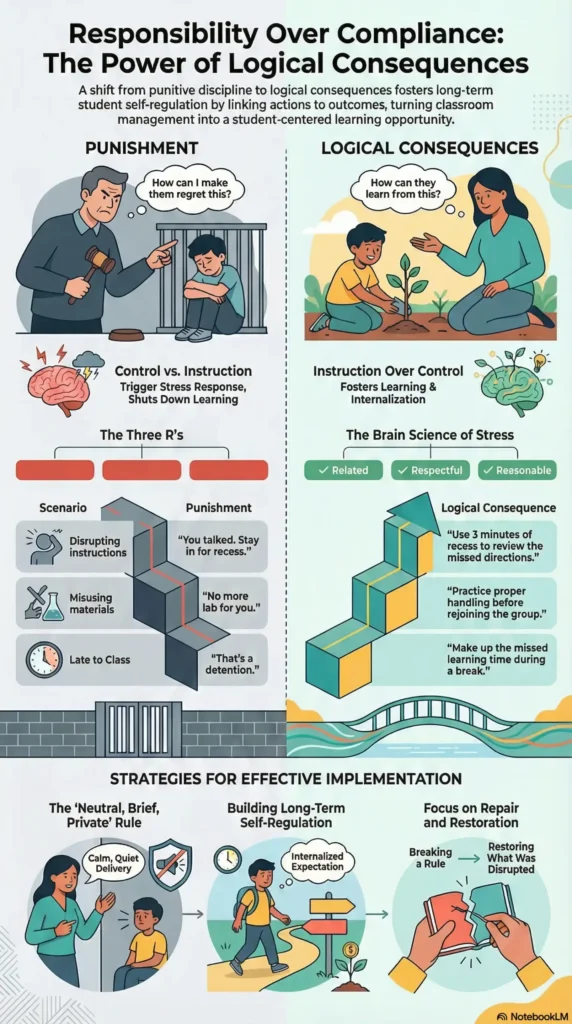
Punishment is designed to cause discomfort in order to stop behavior.
It answers the question:
“What can I do to make this student not want to do that again?”
Common examples:
Public reprimands
Detentions unrelated to the behavior
Removing privileges that don’t connect to the action
Sending students out automatically
Sarcasm or shaming
Punishment is usually:
Adult-driven
Emotionally reactive
Focused on control
Designed to “teach a lesson” through discomfort
And here’s the problem:
Punishment often creates compliance — not responsibility.
Students may stop the behavior…
But they rarely understand why it mattered.
And they often feel resentment instead of accountability.
What Are Logical Consequences in the Classroom?
Logical consequences are directly connected to the behavior.
They answer a different question:
“What outcome makes sense based on what happened?”
Logical consequences in the classroom are:
Related to the behavior
Respectful (no shaming)
Reasonable (proportionate)
Revealed in advance whenever possible
This approach is deeply aligned with relational models like Responsive Classroom and preventative frameworks such as Positive Behavioral Interventions and Supports, both of which emphasize skill-building over punishment.
The goal is not to hurt.
The goal is to teach.
The Science Behind Logical Consequences in the Classroom
When students feel attacked, embarrassed, or powerless, their stress response activates.
Once that happens:
Executive function decreases
Reflection decreases
Defensiveness increases
Learning shuts down
Punishment often triggers this stress response.
Logical consequences, when delivered calmly and predictably, keep the nervous system regulated. That means:
The student can think.
The student can process.
The student can learn from the mistake.
And that’s the point.
Side-by-Side Comparison
| Punishment | Logical Consequence |
|---|---|
| “You talked. Stay in for recess.” | “You talked during instructions. I need you to use the first 3 minutes of recess to review the directions so you’re ready tomorrow.” |
| “You’re late. That’s a detention.” | “You’re late. You’ll need to make up the missed learning time.” |
| “You misused materials. No lab for you.” | “You misused lab equipment. You’ll practice proper handling before rejoining the lab.” |
| Public calling out | Private correction |
| Emotional tone | Neutral tone |
Notice the difference?
One says: You messed up.
The other says: Let’s fix this.
The Hidden Danger of Punishment
Punishment often creates one of four outcomes:
Compliance through fear
Escalation
Withdrawal
Power struggle
None of these build long-term self-regulation.
In fact, repeated punitive environments can damage classroom trust. And once trust erodes, management becomes exponentially harder.
When Teachers Confuse the Logical Consequences in the Classroom and Punishment
Here’s where it gets tricky.
Not everything labeled a “consequence” is logical.
Ask yourself:
Is this connected to the behavior?
Is this proportionate?
Would this make sense to a neutral observer?
Am I doing this out of frustration?
If the answer to the last question is yes, pause.
Emotional reactions create punishment.
Calm responses create logical consequences.
What Logical Consequences in the Classroom Teach
When done well, logical consequences teach:
Cause and effect
Responsibility
Repair
Problem-solving
Self-regulation
They shift the focus from:
“You broke the rule.”
To:
“How do we restore what was disrupted?”
That’s a huge mindset shift.
Practical Examples of Logical Consequences in the Classroom
1. Disrupting Instruction
Logical Consequence:
Student reviews missed instructions.
Student practices attentive listening.
Private conversation to plan improvement.
2. Damaging Materials
Logical Consequence:
Repair the item.
Help reorganize supplies.
Practice correct usage.
3. Off-Task Phone Use
Logical Consequence:
Phone placed in designated spot for remainder of class.
Student completes work during study period.
4. Disrespectful Language
Logical Consequence:
Private conversation.
Apology or restorative conversation.
Reflection on impact.
Notice something important:
Logical consequences are often more work for the teacher.
But they are also more effective.
How to Deliver Logical Consequences in the Classroom Effectively
The delivery matters as much as the consequence itself.
1. Stay Neutral
No sarcasm. No raised voice.
Just clarity.
2. Keep It Brief
Over-explaining feels like lecturing.
State it simply and move on.
3. Do It Privately When Possible
Public consequences often become public battles.
4. Follow Through
Inconsistency turns logical consequences into empty threats.
What Logical Consequences in the Classroom Are Not
They are not:
Negotiations
Bribes
“Natural consequences” that are unsafe
Ignoring serious behavior
Safety always comes first.
Serious infractions may require administrative involvement.
Logical consequences work best for everyday classroom behavior.
The Long-Term Payoff
When students consistently experience logical consequences:
They begin predicting outcomes.
They internalize expectations.
They feel respected — even when corrected.
Power struggles decrease.
Classroom climate improves.
This is sustainable classroom management.
Not because it’s soft.
But because it’s smart.
Try This Tomorrow
Pick one common classroom behavior that frustrates you.
Before class, write down:
The behavior.
A punishment you’ve used before.
A logical consequence that is directly connected instead.
When the behavior appears, respond calmly with the logical consequence.
Then reflect:
Did escalation decrease?
Did the student seem defensive — or reflective?
Did instruction continue more smoothly?
Small shifts create big changes.
Logical Consequences in the Classroom FAQ
What is the difference between a logical consequence and a punishment? The main difference is the connection to the behavior. A punishment is often unrelated to the action and designed to cause discomfort (e.g., a detention for a messy desk). A logical consequence is directly related, respectful, and reasonable (e.g., cleaning the desk before leaving). Punishment focuses on the past, while logical consequences focus on future behavior.
Do logical consequences actually work for disruptive students? Yes, because they keep the student’s nervous system regulated. Punishment often triggers a ‘fight or flight’ response, which shuts down learning. Logical consequences provide a clear path for the student to fix the mistake, which builds self-regulation and long-term behavioral fluency.
Are logical consequences the same as ‘soft’ management? No. Logical consequences are often more rigorous than punishment because they require the student to actively repair the harm or practice the correct behavior. It is not ‘soft’ to require a student to finish missed work or fix a damaged relationship; it is instructional and highly effective.
Reflection
I sometimes gave consequences that felt firm in the moment but didn’t actually help students change their behavior. Over time, I realized that when consequences were directly connected to what happened—redoing work, fixing a disruption, or repairing a mistake—students understood expectations much more clearly.
- When you respond to behavior, how often is the consequence directly connected to what the student actually did?
- Which repeated behavior in your classroom might improve if students practiced a “fix-it” response instead of receiving a penalty?
- How could using logical consequences change the tone of behavior conversations in your classroom this week?
Continue the Classroom Management Course
In the next lesson, we will explore how effective classroom management depends on choosing whether to address behavior publicly or privately based on its cause
Next Lesson: When to Address Behavior Publicly vs. Privately
Module 6 Progress:
Logical Consequences vs. Punishment
Back to Module 6 Overview
Return to Full Course Outline