Fixed vs Growth Mindset Quiz: Take It and Score Yourself
You’ve heard the terms in every staff meeting: growth mindset, fixed mindset, Carol Dweck’s research on how belief shapes achievement. But knowing the vocabulary and knowing where you actually land are two different things. That’s why so many teachers search for a fixed vs growth mindset quiz before they try teaching it to a room full of teenagers. You want proof, not just theory, and a number you can reflect on.
This article gives you exactly that. Below, you’ll find a short self-assessment built directly from Dweck’s original framework, with statements you rate honestly based on how you actually think, not how you wish you thought. Once you finish, you’ll get a clear scoring guide that tells you what your results mean and where you fall on the spectrum, because almost nobody is purely one or the other.
We’ll also break down what a growth mindset vs fixed mindset quiz score actually predicts about your classroom habits, and how to use your own results as a model before you bring this same assessment to your students. Whether you’re checking your own thinking or looking for a fixed vs growth mindset test to hand out this week, you’re in the right place.
Why your quiz score matters more than the label
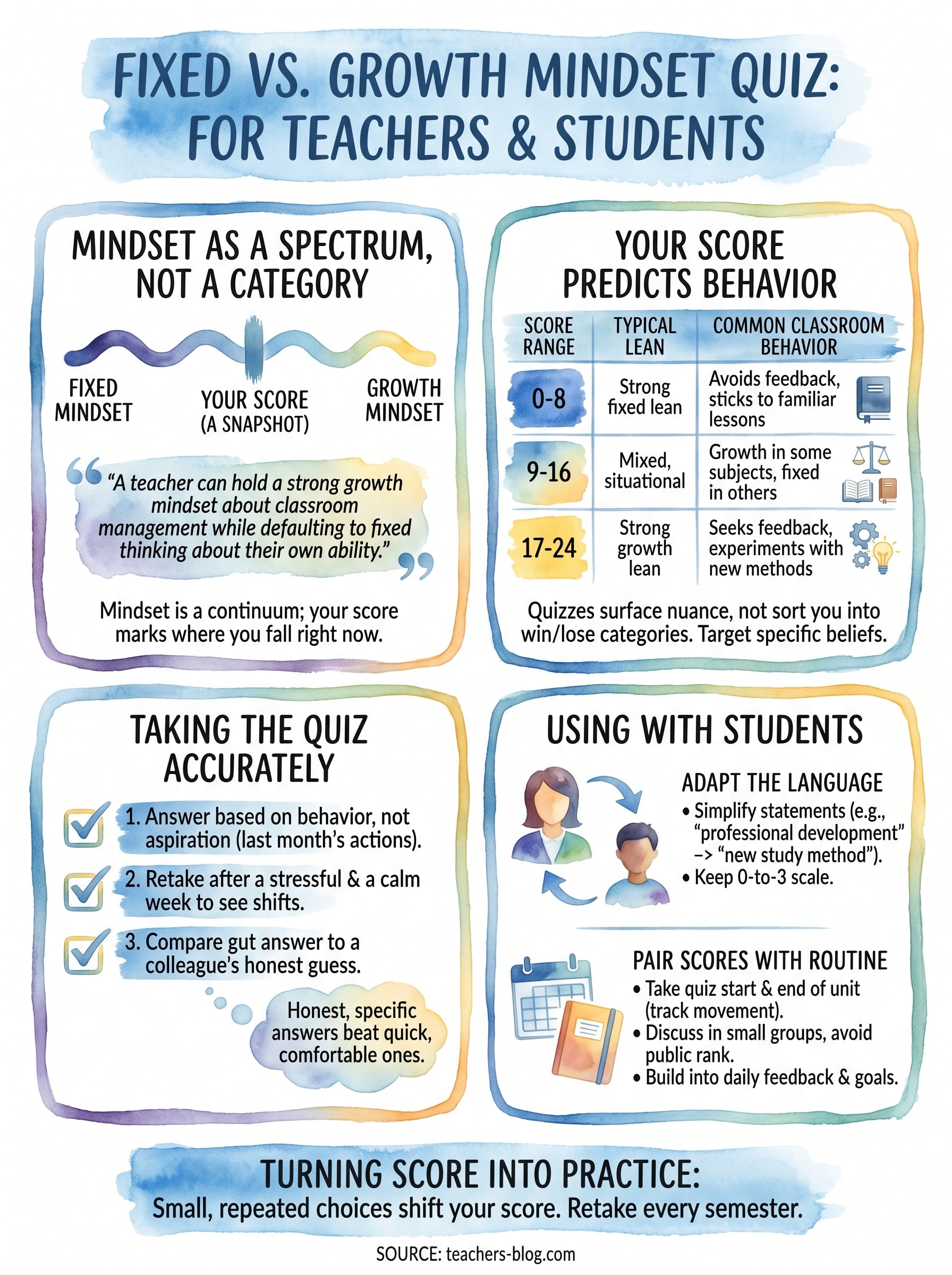
Mindset is a spectrum, not a category

Most people who take Carol Dweck’s growth vs fixed mindset assessment expect a tidy verdict, growth or fixed, pass or fail, without first sorting out what teachers need to know about the two mindsets. That’s not how the research works. Dweck’s own studies show mindset sits on a continuum, and your score simply marks where you fall on it right now, in this domain, on this day. A teacher can hold a strong growth mindset about classroom management while defaulting to fixed thinking about their own math ability. Recognizing that split matters more than memorizing a label, because it tells you exactly where to focus your energy instead of leaving you with a vague self-image.
Your score is a snapshot of a habit, not a permanent verdict on your potential.
Your score predicts behavior, not identity
Scores matter because they map directly onto observable classroom habits, the kind you can actually change once you see them named. A teacher scoring high on fixed-mindset statements tends to avoid new strategies for fear of looking incompetent in front of colleagues. Someone scoring high on growth statements treats a rough lesson as data, not proof of failure. Use the table below to see how score ranges tend to line up with real behavior patterns you’ll recognize from your own staff room:
| Score Range | Typical Mindset Lean | Common Classroom Behavior |
|---|---|---|
| 0-8 | Strong fixed lean | Avoids feedback, sticks to familiar lessons |
| 9-16 | Mixed, situational | Growth in some subjects, fixed in others |
| 17-24 | Strong growth lean | Seeks feedback, experiments with new methods |
Notice how the middle range covers most working teachers. Quizzes like this one exist to surface that nuance, not to sort you into a winner or loser column. Once you know your actual pattern, you can target the specific belief that’s holding you back instead of trying to overhaul your entire personality. That’s the practical payoff of scoring yourself honestly before you ever hand the same fixed vs growth mindset test to a classroom of students.
How to take and score the quiz accurately
Before you rate a single statement, sit somewhere quiet and set aside ten minutes without interruptions. Rushing through a fixed vs growth mindset quiz skews the results, because you’ll default to the answer that sounds good instead of the one that’s true. Read each statement twice if you need to, and picture a specific recent moment, like the last time a lesson bombed or a student challenged you, rather than answering in the abstract.
Score each statement on a scale of 0 to 3, where 0 means "strongly disagree" and 3 means "strongly agree." Reverse-score any statement written from a fixed-mindset angle, so a strong agreement there actually lowers your growth total. Add every adjusted score together for your final number, then check it against the range table from the previous section.
Honest, specific answers beat quick, comfortable ones every time you take a mindset assessment.
Keep these three habits in mind while you work through the growth mindset vs fixed mindset quiz:
- Answer based on behavior, not aspiration; write down what you actually did last month, not what you plan to do next month.
- Retake the quiz after a stressful week and after a calm one to see how much your score shifts.
- Compare your gut answer to a colleague’s honest guess about you, since blind spots are common.
Understanding your baseline this way makes the sample statements coming next far more useful.
Sample quiz questions to test yourself now
Grab a pen and rate each statement below from 0 (strongly disagree) to 3 (strongly agree), just like you practiced in the last section. These ten prompts mirror the structure of any credible fixed vs growth mindset test, mixing growth-oriented beliefs with fixed-oriented ones so you can practice reverse-scoring in real time.
- I believe my teaching ability can improve significantly with effort and practice. (growth)
- When a lesson fails, I assume the material or my skills need work, not that I’m simply not cut out for teaching. (growth)
- I avoid trying new strategies in front of colleagues because I don’t want to look unprepared. (fixed, reverse-score)
- Constructive criticism from a coworker feels like useful data, not a personal attack. (growth)
- I think some teachers are just naturally gifted, and no amount of training changes that. (fixed, reverse-score)
- I actively seek out professional development even when it exposes gaps in my current skills. (growth)
- A student’s low test score reflects effort and instruction, not fixed intelligence. (growth)
- I hesitate to ask for help because it might reveal I don’t already know the answer. (fixed, reverse-score)
A single honest answer to a hard question tells you more than ten easy ones ever will.
Once you’ve rated all eight statements, reverse-score items 3, 5, and 8, then total everything against the range table above. Running this same growth vs fixed mindset quiz on paper first, before typing anything, keeps your answers instinctive rather than curated.
How to use this quiz with your students
Adapt the language, not the framework

Handing teenagers the exact wording you used on yourself rarely lands, so simplify the statements without softening their meaning. Swap "professional development" for "trying a new study method" and "colleagues" for "classmates," then keep the same 0-to-3 scale so the scoring math still works. Middle and high schoolers respond well to a fixed vs growth mindset quiz framed around grades and feedback rather than career risk, since that’s the territory they actually live in daily.
A quiz only teaches mindset if students recognize themselves in every single question.
Pair scores with a real classroom routine
Scores mean nothing without a follow-up activity, so pair a printable mindset sorting worksheet with this same growth vs fixed mindset quiz at the start of a unit and again eight weeks later to show measurable movement. Our Brain Builders Workshop gives you ready-made lessons that turn a single score into a semester-long habit-tracking project, complete with reflection prompts students can revisit after setbacks. Discuss results in small groups instead of assigning a public rank, and build mindset into your daily routines, feedback, and goals, because comparing scores out loud undoes the entire point of teaching growth over fixed thinking. Keep a simple log for each student:
- First score and date taken
- One specific fixed-mindset statement they want to work on
- Second score after eight weeks
Tracking that shift, not the label itself, is what actually changes behavior in your classroom, especially when you back it with classroom activities that reinforce the habit.
Turning your score into daily practice
A number on a page only matters if it changes what you do on Monday morning. Once you know whether you lean fixed or growth, follow the practical steps for developing your own growth mindset and pick one specific habit to test for the next two weeks, like asking a colleague for feedback instead of avoiding it, or trying a lesson you’re not sure will work. Small, repeated choices shift your score more than any amount of reading about Dweck’s research ever will.
Remember that this fixed vs growth mindset quiz is a mirror, not a verdict. Retake it every semester, watch where you’ve moved, and notice which beliefs still trip you up under stress. The same honesty you brought to your own answers is what you’ll ask of your students next.
If you’re ready to turn this reflection into real classroom practice, grab our free growth mindset lesson plans and activities by grade and build these habits with your students all year long.