Dylan Wiliam Formative Assessment: 5 Strategies That Work
You’ve probably heard the name Dylan Wiliam mentioned in professional development sessions. His work on Dylan Wiliam formative assessment has shaped how educators think about checking for understanding, not as an afterthought, but as the engine driving real student growth.
Here’s the reality, though: knowing about formative assessment and implementing it effectively in your classroom are two different challenges. That’s where Wiliam’s five key strategies come in. They provide a practical framework that moves assessment from abstract theory to something you can actually use every day.
At The Cautiously Optimistic Teacher, we focus on giving you tools and strategies that work with real students in real classrooms. This article breaks down Wiliam’s framework from his book "Embedded Formative Assessment," walks through each of the five strategies, and shows you how to put them into action starting tomorrow.
Why Dylan Wiliam focuses on formative assessment
Dylan Wiliam built his career around one core principle: the only assessment that matters is the one that changes what happens next in the classroom. After decades of research with Paul Black at King’s College London, he found that formative assessment can double the speed of student learning. That’s not a small improvement or a nice-to-have strategy. It’s transformative impact backed by rigorous evidence.
The research that changed everything
Wiliam and Black’s 1998 meta-analysis examined 250 studies across multiple countries and grade levels. They discovered that formative assessment produced effect sizes between 0.4 and 0.7, which translates to massive gains in student achievement. To put that in perspective, typical educational interventions struggle to reach effect sizes above 0.3.
The findings showed something even more powerful: formative assessment helped struggling students the most. While all students benefited, those who typically fell behind made the largest gains. This research didn’t just validate formative assessment as a nice teaching practice. It proved that Dylan Wiliam formative assessment strategies address fundamental inequities in how students learn.
"Assessment for learning is one of the most powerful ways to improve learning and raise standards." – Dylan Wiliam
Why traditional assessment misses the mark
Most teachers assess students after learning has happened, when it’s already too late to adjust instruction. You give a quiz on Friday, grade it over the weekend, and return it Monday. By then, you’ve moved on to new content, and students who struggled get left behind.
Traditional assessment focuses on measuring what students know rather than improving what they learn. Wiliam argues this approach wastes the most valuable resource you have: real-time information about student thinking. When you wait until the end of a unit to discover misconceptions, you’ve missed dozens of opportunities to intervene and redirect learning.
What makes formative assessment fundamentally different
Formative assessment flips the entire purpose of checking for understanding. Instead of using assessment to judge student performance, you use it to adjust your teaching decisions while learning is still happening. The key word here is "while." You don’t assess to see if they got it. You assess to figure out what to do next.
Wiliam emphasizes that formative assessment isn’t about the tools you use. It’s about how you use information to close the gap between where students are and where they need to be. A quiz can be formative if you use the results to change your instruction tomorrow. A class discussion can be summative if you just move forward regardless of what students reveal.
This distinction matters because teachers often confuse frequency of assessment with formative practice. Giving more quizzes doesn’t make your teaching more formative. What matters is whether you act on the evidence those quizzes provide to help students learn better.
The five strategies and their classroom moves
Dylan Wiliam didn’t create a complex system that requires specialized training or expensive materials. His five strategies for Dylan Wiliam formative assessment work because they focus on what you already do in your classroom, just with more intentional purpose. Each strategy represents a different way to gather and use evidence of student thinking to adjust instruction in real time.
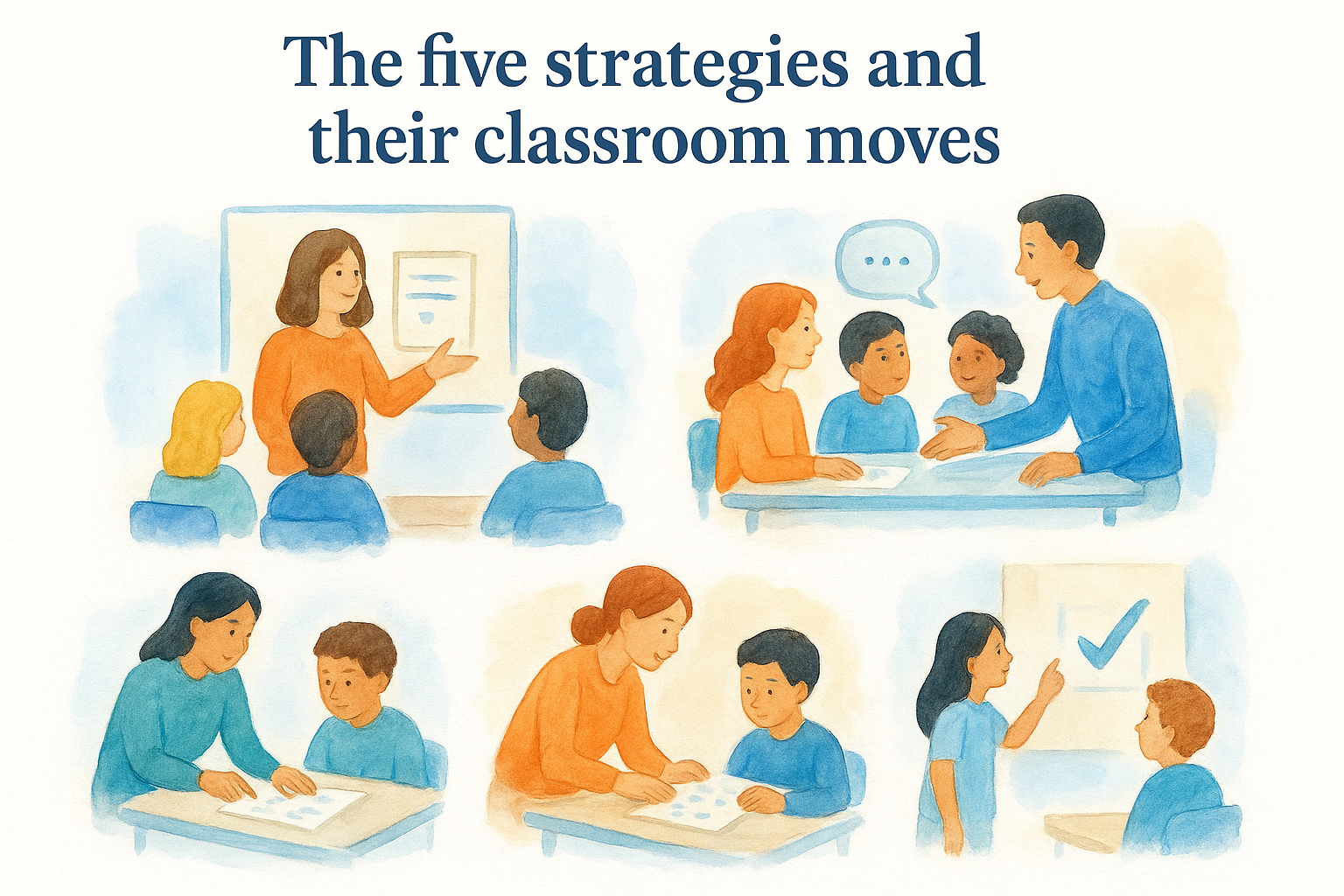
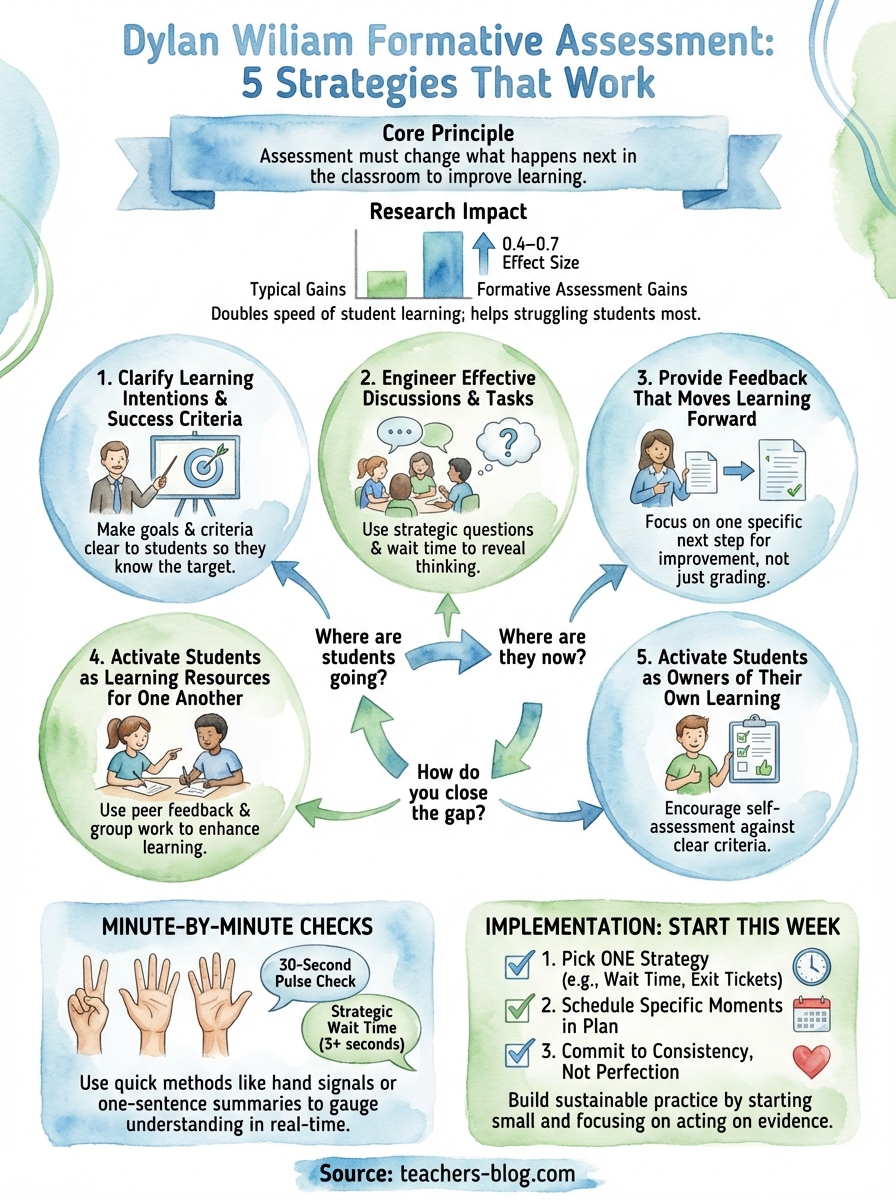
The five strategies break down into three key questions: Where are students going? Where are they now? How do you close the gap? The first strategy clarifies learning intentions and success criteria so students know the target. The second strategy uses classroom discussions and tasks to reveal what students actually understand. The third provides actionable feedback that helps students improve. The fourth activates peer learning as a resource. The fifth turns students into owners of their own progress.
What the five strategies actually look like
You don’t implement these strategies one at a time or in sequential order. They overlap and reinforce each other throughout every lesson. When you clarify success criteria at the start of class, you’re setting up strategy one. When you ask a question and use wait time to let students think, you’re engineering strategy two. When you have students compare their work to exemplars, you’re activating strategy five.
Here’s what matters most: these strategies don’t require dramatic changes to your teaching. You already ask questions, give feedback, and assign group work. Wiliam’s framework simply asks you to use those moments differently. Instead of asking a question to fill time, you ask it to reveal specific misconceptions. Instead of grading every assignment, you give feedback that tells students exactly what to do next.
"The quality of an educational system cannot exceed the quality of its teachers, and the only way to improve outcomes is to improve instruction." – Dylan Wiliam
The classroom moves within each strategy are practical and specific. You might use exit tickets to check understanding before planning tomorrow’s lesson. You could have students self-assess against clear criteria before turning in work. You might ask students to explain another student’s thinking during discussion. Each move serves the same purpose: gathering evidence and acting on it immediately to help students learn better.
How to run minute-by-minute checks for understanding
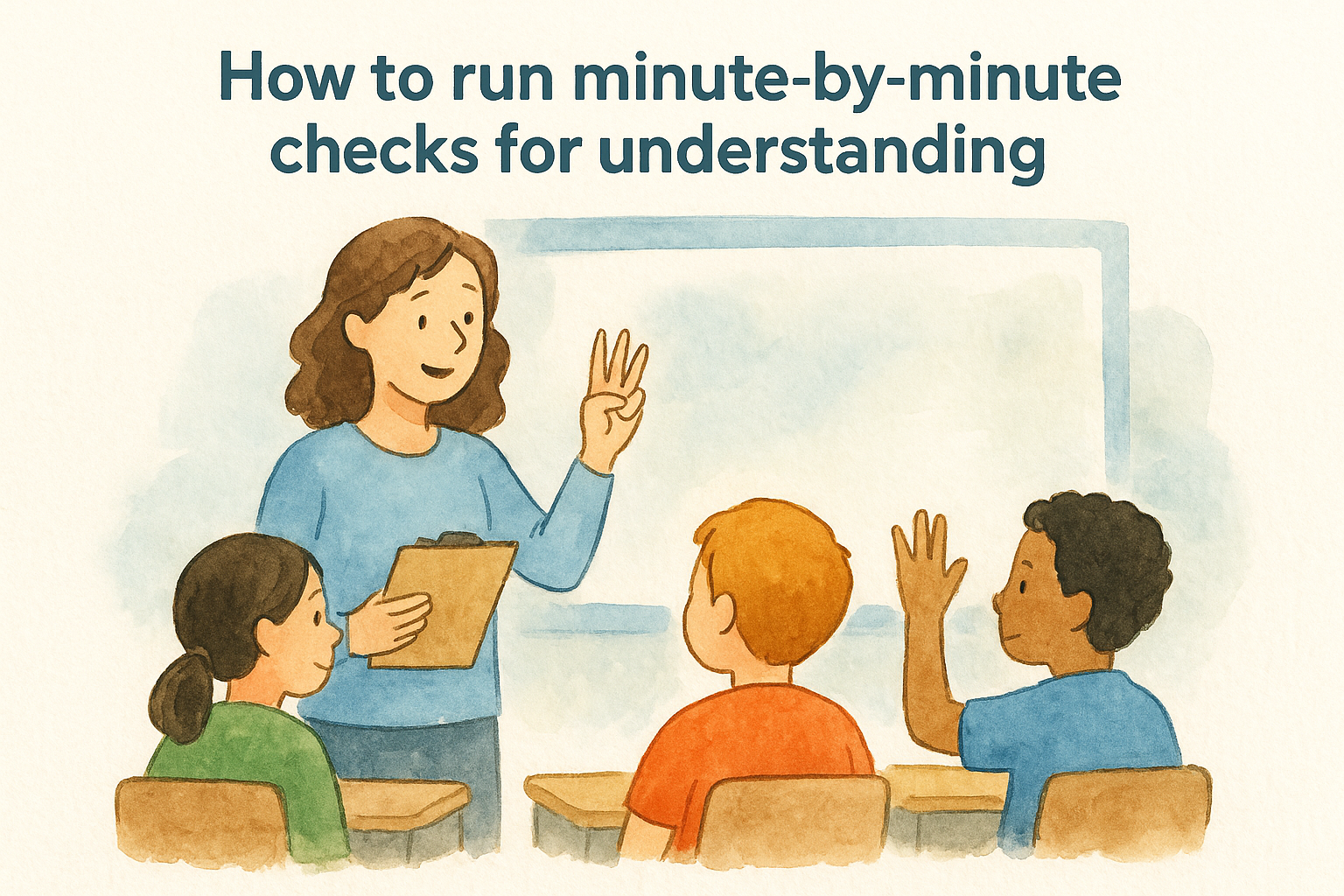
You can’t wait until the end of the lesson to discover half your class missed the main concept. Dylan Wiliam formative assessment relies on constant evidence gathering throughout instruction, not just at designated checkpoints. This means building quick assessment moves into every five to ten minutes of teaching so you know exactly where students are while you still have time to adjust.
The thirty-second pulse check
Stop mid-lesson and ask students to show you understanding with their hands. Hold up fingers for confidence levels (one finger means "I’m lost," five means "I could teach this"). You scan the room in seconds and immediately see who needs help. This isn’t about grading or recording anything. It’s about getting instant visual feedback that tells you whether to move forward, reteach, or provide more examples.
Another powerful move involves asking students to write one sentence summarizing what they just learned. You circulate while they write, reading over shoulders to spot patterns in confusion. When you see three students struggling with the same concept, you know exactly what to address before continuing. These checks cost almost no time but give you critical information you’d otherwise miss completely.
"If you know where learners are going and where they are now, then you are in a better position to close the gap." – Dylan Wiliam
Strategic questioning that reveals thinking
You need to ask questions that force students to explain their reasoning, not just state answers. Instead of "What’s the answer to number three?" try "Why did you choose that method?" or "How would you explain this to someone who’s confused?" These questions make student thinking visible so you can identify misconceptions immediately.
Build in deliberate wait time of at least three seconds after asking a question. Most teachers wait less than one second, which only allows the fastest thinkers to respond. When you wait longer, more students process the question deeply and you get better evidence of actual understanding across your whole class. You also avoid the trap of calling only on raised hands, which lets struggling students hide in the background while you assume everyone gets it.
Feedback that moves learning forward without burnout
You can’t grade everything, and you shouldn’t try. The biggest mistake teachers make with feedback is treating it like a grading marathon instead of a teaching tool. Dylan Wiliam formative assessment principles show that the most effective feedback isn’t about marking every detail on every assignment. It’s about giving students specific information they can actually use to improve their next attempt, which means you need a completely different approach to how and when you provide feedback.
Traditional feedback practices drain your energy without helping students much. You spend hours writing comments that students glance at, ignore, or misunderstand entirely. Meanwhile, you’re exhausted from late nights grading, and students just look at their score before moving on. Wiliam’s research proves that feedback works best when it tells students what to do next rather than just what they did wrong.
Focus feedback on the next step only
Pick one or two specific improvements for each student instead of listing everything wrong with their work. When you comment on fifteen different issues, students feel overwhelmed and don’t know where to start. They need clear direction about the single most important thing to work on right now. You might write "Add evidence from the text in paragraph two" instead of critiquing their thesis, organization, grammar, and citations all at once.
This approach saves you time because you’re writing less per assignment. Students benefit more because they can actually act on focused, specific guidance rather than drowning in corrections. You also avoid the burnout that comes from trying to be comprehensive on every single piece of student work.
"Feedback should cause thinking. It should be focused; it should relate to the learning goals that have been shared with the students; and it should be more work for the recipient than the donor." – Dylan Wiliam
Use feedback techniques that scale
Give feedback to small groups with similar issues instead of individualizing everything. When you notice five students struggling with the same concept, you gather them for a three-minute conference during class while others work independently. This multiplies your impact because you’re addressing the problem once instead of writing it five separate times.
Another powerful move involves having students identify their own next step using rubrics or exemplars before you even look at their work. They mark where they think they are, then you simply confirm or redirect. This reduces your workload while building student ownership of improvement, which makes your feedback far more effective when you do provide it.
Common pitfalls and how to start this week
Teachers often sabotage their own success with Dylan Wiliam formative assessment by making predictable mistakes that drain energy without improving results. The biggest trap involves trying to implement all five strategies perfectly from day one, which leads to burnout and abandonment within weeks. You need a different approach that builds sustainable practices over time instead of overwhelming yourself with impossible standards.
Confusing more assessment with better assessment
Adding quizzes every day doesn’t make your teaching more formative. You fall into this trap when you focus on collecting evidence without using it to change instruction. Students take the quiz, you record scores, then you move forward with your original lesson plan regardless of what the data shows. This creates busy work that wastes time for everyone involved.
The solution requires shifting from frequency to function. Ask yourself whether each assessment will actually change what you do next in your classroom. If the answer is no, you’re probably just checking boxes instead of gathering useful information. Real formative assessment means you adjust your next teaching move based on evidence of student thinking, not that you assess more often.
"Assessment becomes formative when the evidence is actually used to adapt the teaching work to meet the needs of the learners." – Dylan Wiliam
Your three-move starting plan for this week
Pick one single strategy and commit to using it three times this week. You might choose to give feedback without grades on tomorrow’s assignment, use exit tickets on Wednesday, or implement wait time during Friday’s discussion. Starting with one move lets you build confidence and skill without feeling overwhelmed by trying to overhaul everything simultaneously.
Schedule specific moments when you’ll use your chosen strategy. Write "three-second wait time" on your lesson plan for Tuesday’s opening question. Block five minutes at the end of Thursday’s class for students to self-assess their understanding using success criteria. These concrete commitments turn good intentions into actual classroom practice that sticks.
A simple way to bring it into your next lesson
You don’t need weeks of planning to start using Dylan Wiliam formative assessment strategies tomorrow. Choose one move from this article and commit to using it in your next class period. Pick the strategy that feels most natural to your teaching style, whether that’s building in three seconds of wait time after questions or having students self-assess against clear criteria before submitting work.
The power of formative assessment comes from consistency, not perfection. Start small, observe what happens with your students, and adjust based on what you see. When you gather evidence of student thinking and actually use it to change your instruction, you create the conditions for real learning growth.
Looking for more practical teaching strategies that work with real students? Explore the resources and AI-powered tools available at The Cautiously Optimistic Teacher. We focus on giving educators actionable frameworks that enhance classroom engagement without adding to your workload.