
Data Driven Differentiation: A Step-by-Step Classroom Guide
This article is part of our Differentiated Instruction resource hub, where you can find the core framework, classroom strategies, examples, assessment ideas, and subject-specific guides.
You already collect student data through assessments, exit tickets, and classroom observations. But if that data sits in a gradebook without shaping what happens next, it’s notdoing its job. Data driven differentiation bridges the gap between what you know about your students and what you do with that knowledge, and it’s one of the most practical ways to meet learners where they actually are, not where you hope they’ll be.
The problem isn’t a lack of data. Most teachers are drowning in it. The real challenge is turning numbers and patterns into actionable instructional decisions without burning out in the process. That’s exactly the kind of work we focus on here at The Cautiously Optimistic Teacher, giving educators clear, usable strategies (and AI-powered tools like our Differentiated Instruction Helper) that make meaningful teaching sustainable.
This guide walks you through a step-by-step process for collecting the right data, analyzing it efficiently, and designing differentiated lessons that respond to what your students need. No vague theory, just a concrete framework you can start using this week.
What data driven differentiation is and why it works
Data driven differentiation is the practice of using specific student performance evidence to guide how you group students, what tasks you assign, and how you pace instruction. Instead of making broad adjustments for everyone or relying on a general sense of who "gets it," you let actual evidence drive those decisions. That distinction matters because teaching based on assumptions often supports the students who least need extra help while leaving struggling learners in the same place they started. Every classroom generates enough data to make this work; the key is building a habit of using it before you move on to the next unit.
The core idea
At its core, this approach connects two things most teachers already do separately: collecting data and planning instruction. Data driven differentiation insists those two activities happen in the same conversation. You look at what a formative assessment reveals, identify patterns across your students, and adjust your next lesson before the gap widens. The process works with data you already collect every week: quiz scores, reading fluency rates, exit tickets, or anecdotal observation notes from class discussion.
When instruction responds directly to evidence, students stop repeating what they already know and start working in the zone where actual growth happens.
Why it outperforms gut instinct alone
Teacher intuition is genuinely valuable, but accurately tracking patterns across a full class is hard to do reliably in your head. Concrete numbers often reveal that a student you assumed was "almost there" scored significantly below your mental estimate, or that a quiet student already mastered the skill completely. Tying instructional decisions to clear data reduces that guesswork and cuts the mental load of constant improvising, because the evidence tells you exactly where your planning energy needs to go. This consistency is what separates responsive teaching from reactive teaching.
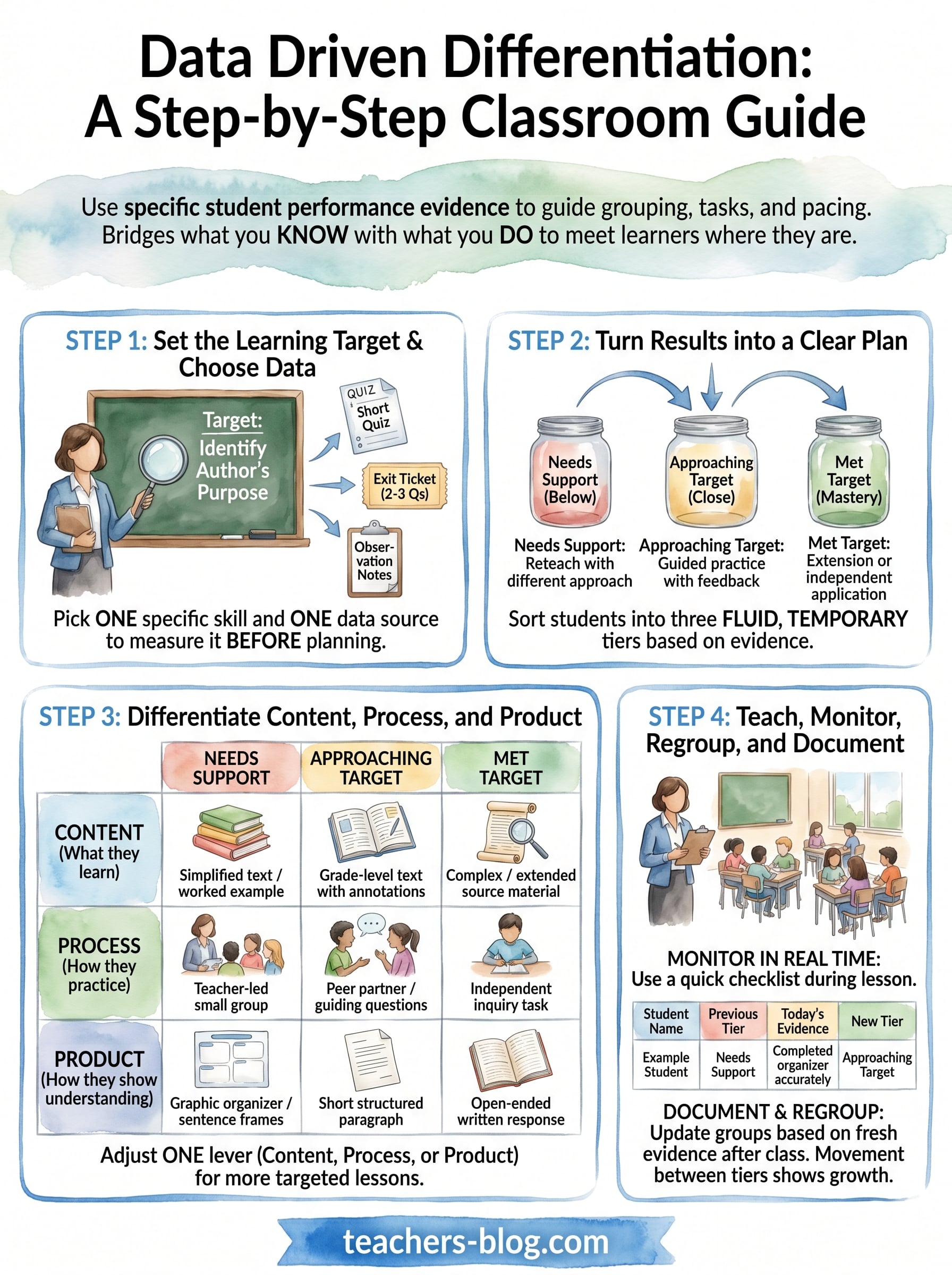
Step 1. Set the learning target and choose data
Before you can use data driven differentiation effectively, you need two things locked in: the specific skill you are targeting and the data source that actually measures it. Starting without both wastes your planning time, because vague targets produce vague data, which tells you nothing useful about where your students are struggling.
Pick a single, measurable learning target
Start with one specific skill, not a broad unit goal. "Students will identify the author’s purpose in an informational text" is usable. "Students will understand nonfiction" is not. A tight, measurable target lets you design a short assessment and read the results in minutes, not hours.
The narrower your learning target, the faster you can see exactly who needs what.
Match the right data source to that target
Not every data type fits every skill. Use this guide to match common targets to the right source:
| Learning Target Type | Useful Data Source |
|---|---|
| Foundational skill (decoding, computation) | Short quiz or timed fluency check |
| Comprehension or analysis | Exit ticket with 2-3 questions |
| Application or writing | Quick write or single-paragraph response |
| Vocabulary | Pre-assessment word sort |
Choose one data source per target and collect it before planning your next lesson, not after. Keeping this step focused is what makes the rest of the process manageable.
Step 2. Turn results into a clear plan
Once you have your data, the next move is sorting students into instructional groups based on what the evidence shows, not by ability label or past performance. Data driven differentiation works best when you treat these groups as fluid and temporary, reorganizing them each time new data comes in.
Groups built on recent evidence keep instruction targeted without locking any student into a fixed track.
Sort students into three instructional tiers
A simple three-tier sort gives you enough granularity to differentiate without creating an unmanageable number of lesson variations. After scoring your data source, place each student into one of these categories:
| Tier | Description | Next Instructional Move |
|---|---|---|
| Needs support | Below target threshold | Reteach with a different approach |
| Approaching target | Close but inconsistent | Guided practice with feedback |
| Met target | Demonstrated mastery | Extension or independent application |
This sort takes five minutes or less if your assessment is short and scored with a simple rubric. Once you have your three groups, map each group to a specific task before the next class. That is your plan, and it takes far less time than rebuilding a full lesson from scratch.
Step 3. Differentiate content, process, and product
Your three-tier groups are ready. Now you decide what to change for each group. Data driven differentiation gives you three levers to pull: content (what students learn), process (how they practice it), and product (how they show understanding). You do not need to change all three at once; adjusting even one creates a more targeted lesson.
Changing one lever thoughtfully beats changing all three haphazardly every time.
Map your adjustments to each group
Use this table to translate your tier data into specific classroom decisions:
| Lever | Needs Support | Approaching Target | Met Target |
|---|---|---|---|
| Content | Simplified text or worked example | Grade-level text with annotations | Complex or extended source material |
| Process | Teacher-led small group | Peer partner with guiding questions | Independent inquiry task |
| Product | Graphic organizer or sentence frames | Short structured paragraph | Open-ended written response |
A quick classroom example
Say your exit ticket reveals that eight students cannot identify an author’s claim, twelve are inconsistent, and five already do it accurately. Your "Needs Support" group reads a shorter, annotated article with you while the middle group works with a partner and a guiding-question sheet. Your "Met Target" group compares two sources independently. Same learning target, three practical paths.
Step 4. Teach, monitor, regroup, and document
Running your differentiated lesson is only half of this step. The other half is watching what happens while you teach and recording what you see, because data driven differentiation only stays effective when you treat monitoring as a built-in part of the lesson, not an afterthought.
Monitor in real time
During the lesson, circulate with a simple clipboard checklist that lists your three groups. Mark a plus, minus, or check next to each student’s name as you observe. You are not grading at this point; you are noting whether students are working at the right challenge level or need a quick adjustment before the lesson ends.
A five-second observation note beats trying to recall twenty students’ performance at the end of the day.
Document and regroup
After class, spend three to five minutes updating your groups based on what you observed. Use a simple tracking template like this:
| Student Name | Previous Tier | Today’s Evidence | New Tier |
|---|---|---|---|
| Example Student | Needs Support | Completed organizer accurately | Approaching Target |
Regrouping frequently based on fresh evidence is what keeps your instruction responsive. Students should move between tiers regularly, and that movement is a clear sign the system is working.
A simple way to start tomorrow
Pick one upcoming lesson and write a single, measurable learning target for it. Then choose the shortest assessment that tells you whether students hit that target; an exit ticket with two questions works fine. Score it using the three-tier sort from Step 2, assign each group a different task from the content, process, and product options in Step 3, and run the lesson. That one cycle is data driven differentiation in practice, and it takes less preparation time than rewriting an entire lesson from scratch.
You do not need a perfect system before you start. Starting small and repeating the cycle is what builds the habit. After a few rounds, grouping and adjusting will feel automatic rather than overwhelming. Each cycle gives you sharper data, better groups, and stronger student growth over time.
When you are ready to speed up the planning side, visit The Cautiously Optimistic Teacher for AI-powered tools and resources built specifically for educators who want practical, sustainable differentiation.