
Content Process And Product Differentiation in Teaching
This article is part of our Differentiated Instruction resource hub, where you can find the core framework, classroom strategies, examples, assessment ideas, and subject-specific guides.
Every student in your classroom processes information differently, works at a different pace, and demonstrates understanding in their own way. You already know this. The challenge has never been awareness, it’s execution. Content process and product differentiation gives you a concrete framework for meeting those diverse needs without reinventing your entire teaching practice. It’s the backbone of differentiated instruction, and once you understand how these three elements work together, planning for a mixed-ability classroom gets significantly less overwhelming.
Here at The Cautiously Optimistic Teacher, we build resources, from differentiated unit plans to AI-powered tools, specifically designed to help you adapt instruction without burning out. This topic sits at the core of everything we create because effective differentiation isn’t a bonus; it’s how good teaching actually works.
In this article, you’ll get a clear breakdown of what content, process, and product differentiation each mean, how they differ from one another, and, most importantly, practical examples you can use in your own classroom. Whether you’re new to differentiation or looking to sharpen your approach, this guide will give you a solid foundation to work from and concrete strategies to try this week.
Why content, process, and product differentiation works
Students don’t arrive in your classroom as blank slates. They carry different background knowledge, different processing speeds, and different ways of demonstrating what they’ve learned. When you teach one way to everyone, you optimize for a single type of learner who doesn’t actually exist in your room. Differentiated instruction gives you a structured, research-supported way to respond to the reality in front of you.
Teaching to the middle means you miss students at both ends of the learning spectrum every single day.
It starts with how students actually learn
Students retain information better when it connects to prior knowledge and when the level of challenge matches where they actually are. Too easy, and they disengage. Too hard, and they shut down. Cognitive load theory explains that working memory has real limits, and when you reduce unnecessary barriers to accessing material, you free up mental space for actual thinking. Adjusting content and process does exactly that.
Your students also differ in learning profile and readiness level, not just interest. Some need more scaffolding on foundational concepts. Others need extension opportunities to stay challenged. Treating these differences as problems to manage, rather than natural variation to plan for, leads to frustration on both sides of the desk.
The three elements reinforce each other
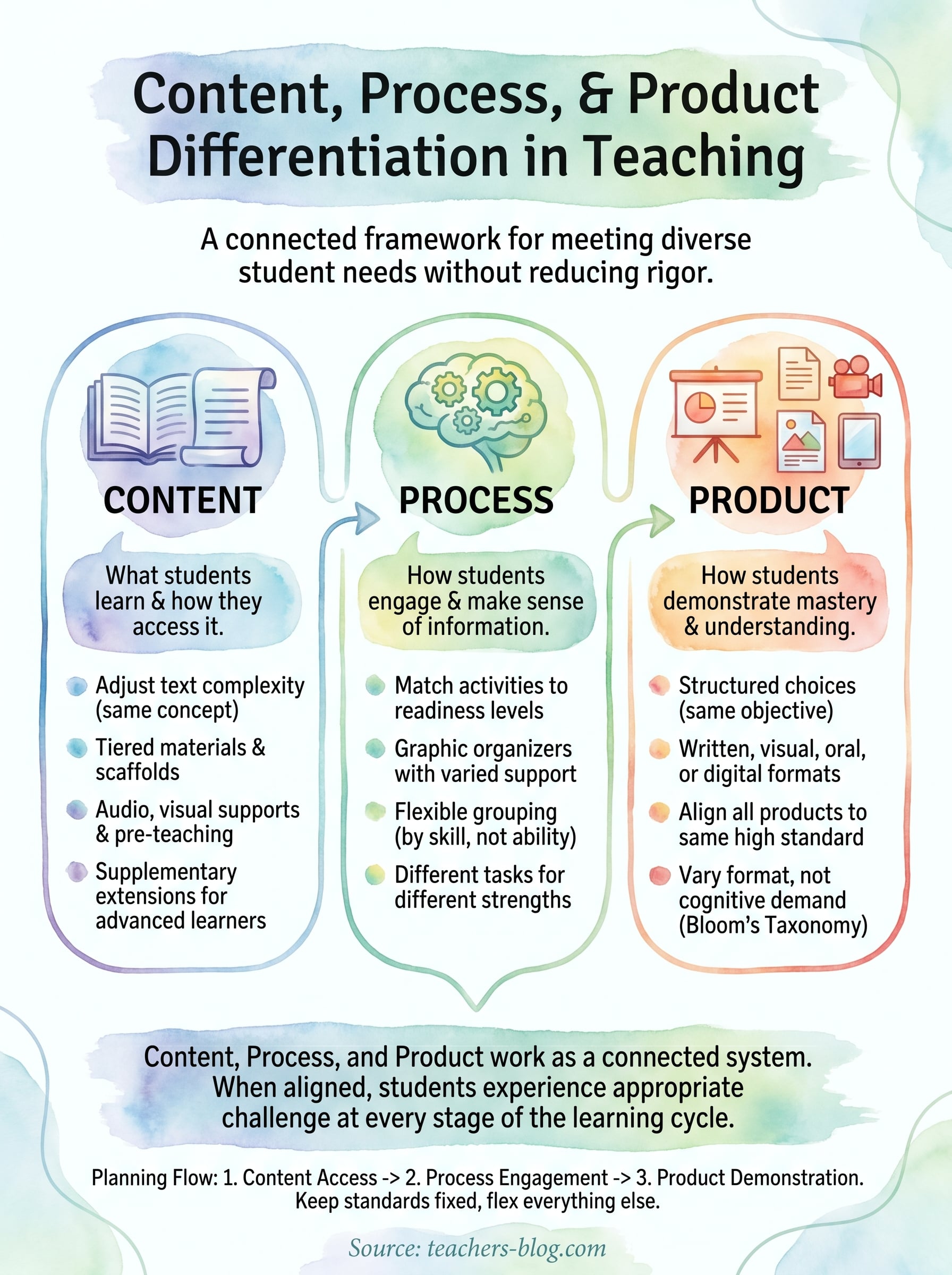
Content, process, and product differentiation aren’t three separate strategies you apply in isolation. They function as a connected system that covers the full learning cycle: what students take in, how they engage with it, and how they show understanding. Content process and product differentiation works because a gap in any one of the three creates a weak link in the chain.
When all three align, students move through your lesson with appropriate challenge at every stage. A student who reads below grade level can still engage with grade-level concepts through modified text complexity, work through material using a graphic organizer, and show mastery through a product format suited to their strengths.
How to differentiate content without lowering rigor
For a deeper guide focused only on this part of the framework, see how to differentiate content in diverse classrooms.
Differentiated content means adjusting how students access information, not reducing what they’re expected to learn. Every student should engage with the same core concepts and standards. What changes is the entry point, not the destination.
Adjust text complexity, not the concept
When students struggle with grade-level text, the instinct is to hand them simpler material on a simpler topic. Resist that. Instead, keep the central concept identical and modify the reading level of the source. A student reading two grade levels below can still analyze cause and effect in a historical event using a modified text version of the same primary source. The thinking skill stays the same; the barrier to access drops.
Differentiation is about removing obstacles to learning, not removing the learning itself.
Use audio versions, visual summaries, or vocabulary pre-teaching to give struggling readers the background knowledge they need before engaging with complex text. For advanced students, offer supplementary primary sources or perspectives that push the concept further.
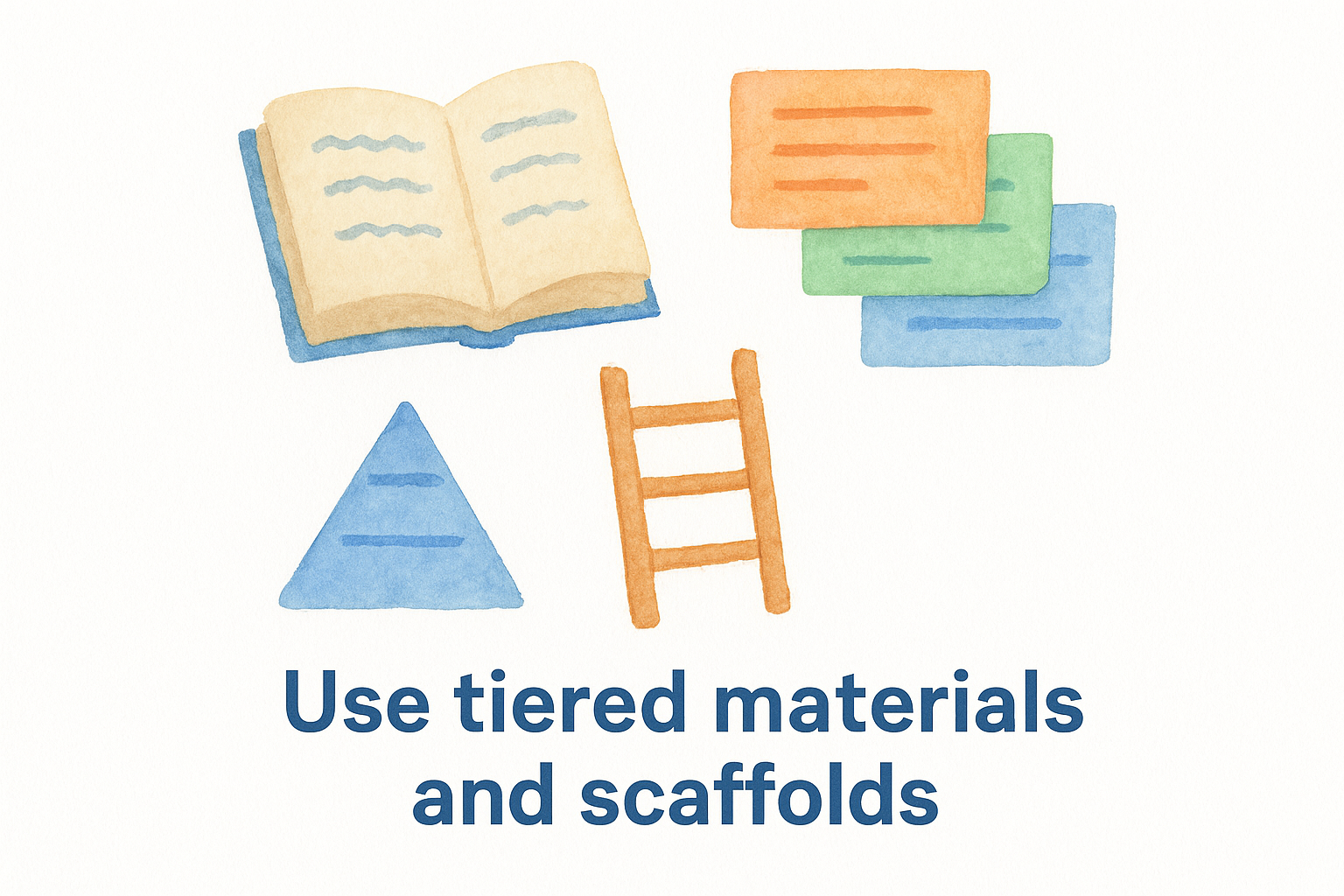
Use tiered materials and scaffolds
Tiered assignments let you run the same lesson objective at multiple complexity levels simultaneously. Build three versions of a reading or task: one with significant scaffolding, one at grade level, and one with extension built in. The content process and product differentiation framework depends on this kind of planning because tiered content creates the foundation every subsequent stage of your lesson builds on. You design once and reach everyone.
How to differentiate process during instruction
Process differentiation means adjusting how students engage with and make sense of the content you’ve already delivered. Two students working from the same tiered reading can still need very different supports to process what they’ve read. This is the stage where content process and product differentiation pays off most visibly, because what happens during instruction determines whether students actually internalize the concept or just move through the lesson.
Match Activities to Readiness Levels
Not every student needs the same scaffolding to work through a task. A graphic organizer with sentence starters helps a struggling learner organize their thinking without staring at a blank page. A student at grade level might use a standard graphic organizer with no prompts. An advanced student benefits from a open-ended analytical task that asks them to evaluate or synthesize rather than just organize.
The goal isn’t to give students easier work; it’s to give them the right cognitive entry point.
Use Flexible Grouping Strategically
Group students based on the specific skill you’re targeting that day, not by general ability. A student who struggles with inference might need a teacher-led small group for that task but could be your strongest voice in a discussion about theme. Flexible grouping keeps students from being permanently tracked and signals that different tasks demand different strengths. Rotate groupings regularly so students build relationships across the full classroom community and stay challenged in multiple ways.
How to differentiate products students create
Product differentiation means giving students choices in how they demonstrate mastery rather than requiring everyone to complete the same assignment. The product is the final output, and in the full content process and product differentiation framework, it’s how students prove they actually understood what you taught. When you limit products to one format, you often measure a student’s ability to perform that format rather than their grasp of the concept itself.
Varying the product format gives you a more accurate picture of what each student actually learned.
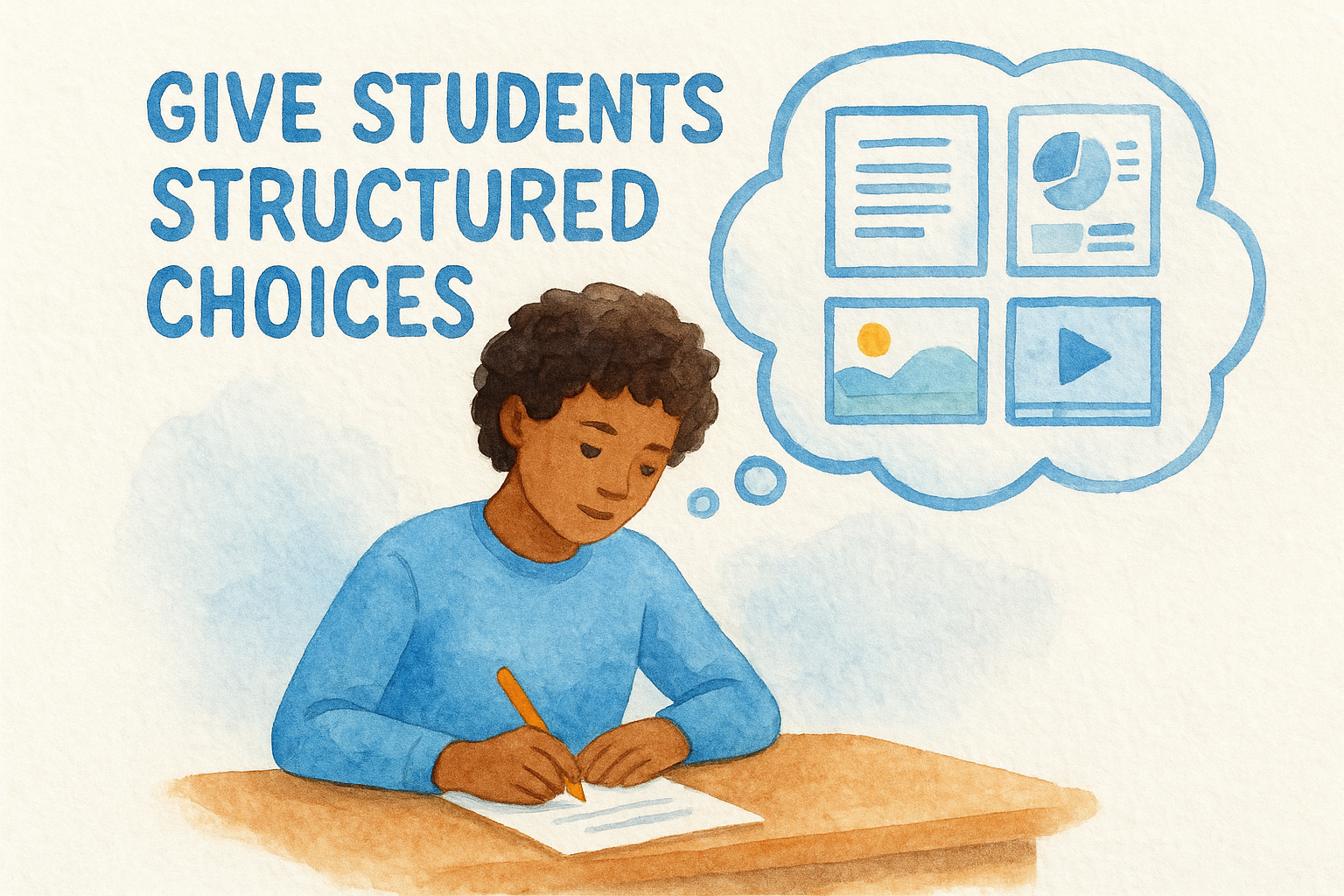
Give Students Structured Choices
Structured choice menus work well here. You give students a defined list of product options, all tied to the same learning objective, and they select the format that suits their strengths. A student who communicates better verbally might record a short explanation. A student who thinks spatially might create a visual diagram or model. The standard stays fixed; the format flexes.
Some product formats that work well across subject areas:
- Written explanation or short essay
- Visual diagram, infographic, or poster
- Recorded explanation or short video
- Annotated timeline or structured outline
Align Products to the Same Standard
The key is that every product option must require the same level of thinking. If one option asks students to list facts while another asks them to evaluate and argue a position, you’ve created an uneven assessment. Build your product options around Bloom’s Taxonomy at the level your lesson targets, and then vary the format, not the cognitive demand. That distinction keeps your differentiation rigorous and your assessment fair.
A quick planning flow and common pitfalls to avoid
Putting content process and product differentiation into practice gets easier when you work from a repeatable planning sequence. Before you open a blank lesson plan, spend five minutes identifying three student readiness levels in your class and note what each group needs to access the material, work through it, and prove understanding. That single habit keeps your planning focused and prevents you from over-engineering every lesson.
A simple three-step planning sequence
Start with your standard or learning objective, and lock that in first. Then ask yourself how each readiness group accesses the content, what activity structure supports their processing, and which product formats give them a fair shot at demonstrating mastery. Work through those three questions in order:
- Content: What scaffolds or extensions does each group need to access the material?
- Process: What activity structure best matches each group’s current readiness level?
- Product: What format lets each student show mastery without measuring the wrong skill?
Planning differentiation in this sequence keeps your standards fixed while flexing everything else.
Pitfalls that undermine your differentiation
The most common mistake is differentiating process but not content, which leaves some students stuck before the lesson even starts. Another is creating product options with unequal cognitive demands, which skews your assessment data and misrepresents what students actually know.
Avoid building permanent ability groups based on a single assessment. Readiness shifts, and flexible grouping reflects that reality far better than fixed tracks do.
Next steps for your next lesson
Start with your next lesson, not a complete unit overhaul. Pick one element of content process and product differentiation and apply it deliberately: adjust your content for two readiness levels, build one flexible process activity, or offer two product format choices. Small, focused adjustments compound over time and build your planning instincts without adding hours to your weekly prep work.
Your students will show you what’s working. Watch for who’s disengaging early, who’s finishing too fast, and who’s still stuck when the rest of the class has moved on. Those three signals tell you exactly where your differentiation approach needs the most attention next. Every lesson becomes data you can use to make your next plan sharper and more responsive to the room in front of you.
Ready to make the planning process faster? The Cautiously Optimistic Teacher offers AI-powered tools and ready-to-use resources built specifically to help you design differentiated lessons without starting from scratch every time.