5 Collaboration Teaching Strategies for Student Teamwork
Group work sounds great on paper, then you assign it and watch one student do all the work while three others scroll under the desk. If that’s your experience, you don’t need a pep talk about the value of teamwork. You need collaboration teaching strategies that actually distribute the effort and hold every student accountable for their piece of the task.
The strategies below aren’t theoretical. They’re structures you can drop into tomorrow’s lesson, built around clear roles and built-in accountability, so group work stops feeling like a gamble and starts producing real thinking from every kid in the room, not just your usual three volunteers.
This list walks through five approaches: from jigsaw-style task splitting to peer accountability checks, each one solving a specific breakdown in student teamwork. You’ll get the setup, the classroom management piece, and what to watch for when a group starts to stall. Pick one, try it this week, and see which students step up when the structure actually supports student engagement instead of just hoping for it.
1. Think-pair-share
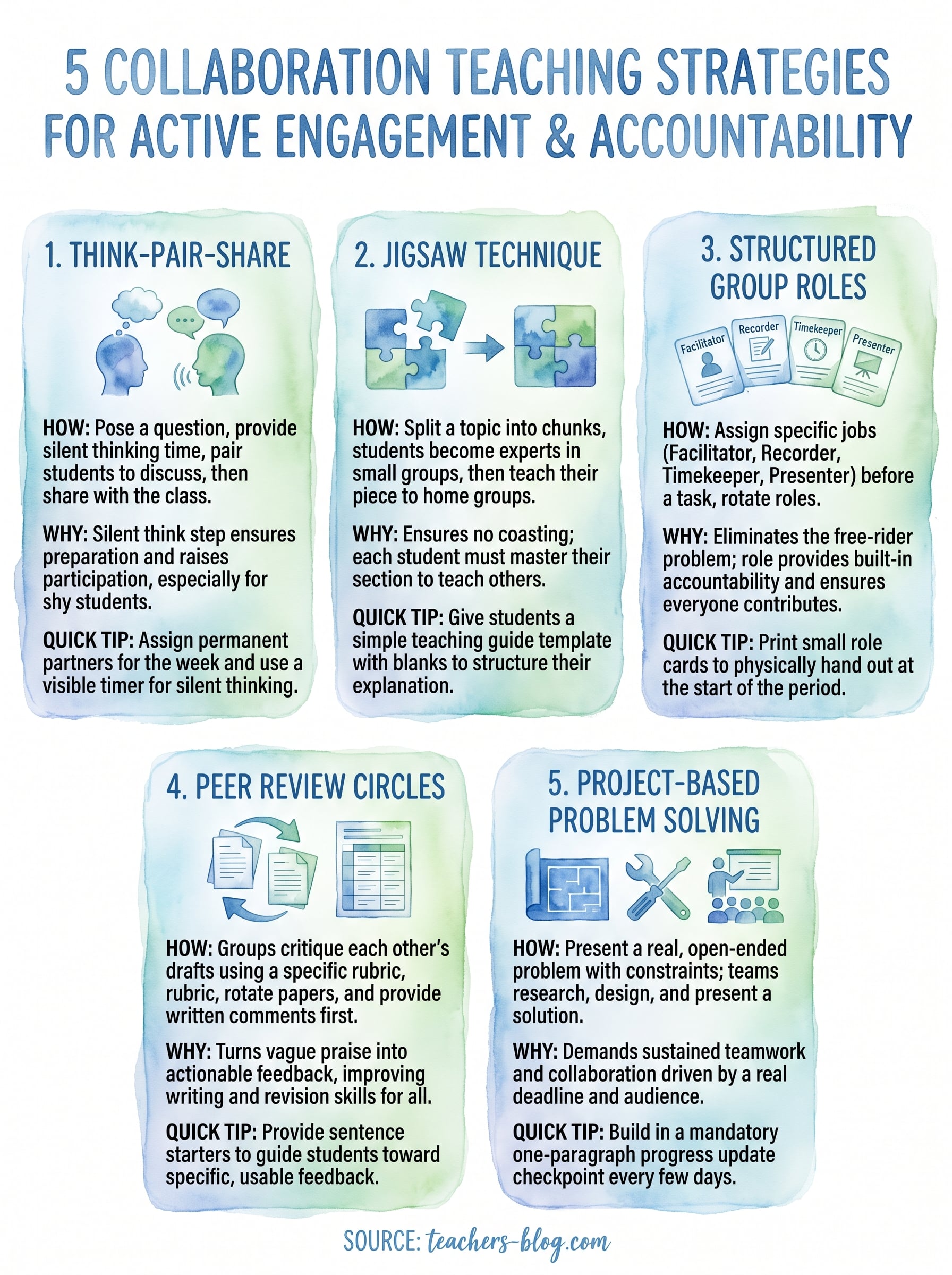
Think-pair-share is the simplest entry point into collaboration teaching strategies, and it’s the one most teachers already half-use without realizing how much structure it actually needs. You pose a question, give students silent time to form their own answer, pair them up to compare notes, then open the floor so pairs share with the whole class. The silent think step is the part everyone skips, and it’s the part that makes the rest work.
How it works
Start with a specific, answerable prompt, not "discuss the chapter." Give students 60 to 90 seconds to jot a written response alone, no talking. Pair them with a neighbor or an assigned partner and set a two-minute timer for comparing answers. Then call on a few pairs to report out, and require them to name what their partner said, not just their own idea.
Silent thinking time before talking is what turns think-pair-share from a chat break into real accountability.
Best for
This strategy suits quick comprehension checks, warm-ups, and any moment mid-lesson where you sense attention drifting. It works especially well for shy students who freeze when asked to speak cold in front of thirty peers. Giving them a written answer first and a low-stakes partner second means they arrive at the whole-class share already prepared, which raises participation rates without singling anyone out, one of the simplest ways to get more students talking in class.
Quick tip to try tomorrow
Assign permanent "think-pair-share partners" for the week instead of letting students grab whoever’s nearby. Predictable pairings cut down on the thirty seconds of social shuffling that eats into your think time, and quieter students stop dreading the scramble to find a partner.
- Post the prompt on the board before you say it out loud.
- Use a visible timer so the silent think phase actually stays silent.
- Cold-call one partner from a pair to report the other partner’s idea.
- Rotate weekly pairings so students eventually work with everyone in the room.
Once students trust the rhythm, you can stretch it into a full-class discussion starter, and it becomes the fastest way to get every voice into the room before you move to bigger group structures.
2. Jigsaw technique
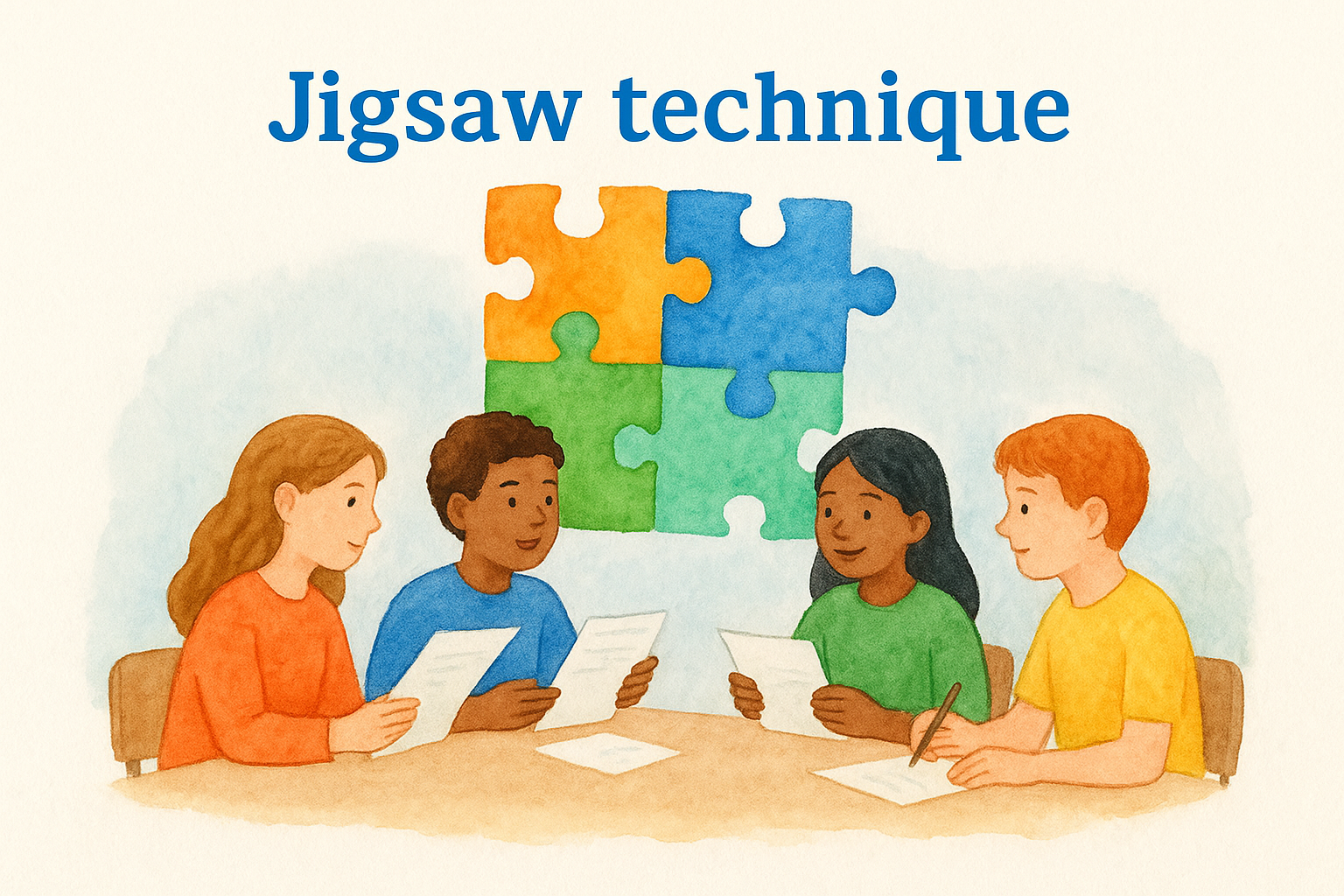
The jigsaw teaching strategy splits a big topic into chunks, hands each chunk to a small "home" group, then reshuffles students into "expert" groups where each person teaches their piece to strangers. It’s one of the strongest collaboration teaching strategies for making sure nobody can coast, because the whole activity depends on every student actually learning their assigned section well enough to explain it.
How it works
Divide your material into four or five distinct sections and assign one section to each member of a home group. Send students with the same section into temporary expert groups to master the content together and prepare how they’ll teach it. Then send everyone back to their home group, where each student teaches their piece in turn until the full picture comes together.
If a student can’t teach their piece, they haven’t learned it yet, and jigsaw exposes that gap before the test does.
Best for
Jigsaw fits dense reading material, multi-part historical events, or any unit with several subtopics that naturally divide, like the causes of a war or the systems in a human body. It’s especially useful when you want to cover more ground in less class time without lecturing straight through it.
Quick tip to try tomorrow
Give each student a simple one-page teaching guide template with three blanks: what I need to explain, one example to use, one question to check understanding. It forces prep before they hit the expert group and keeps the teaching phase focused instead of rambling.
3. Structured group roles
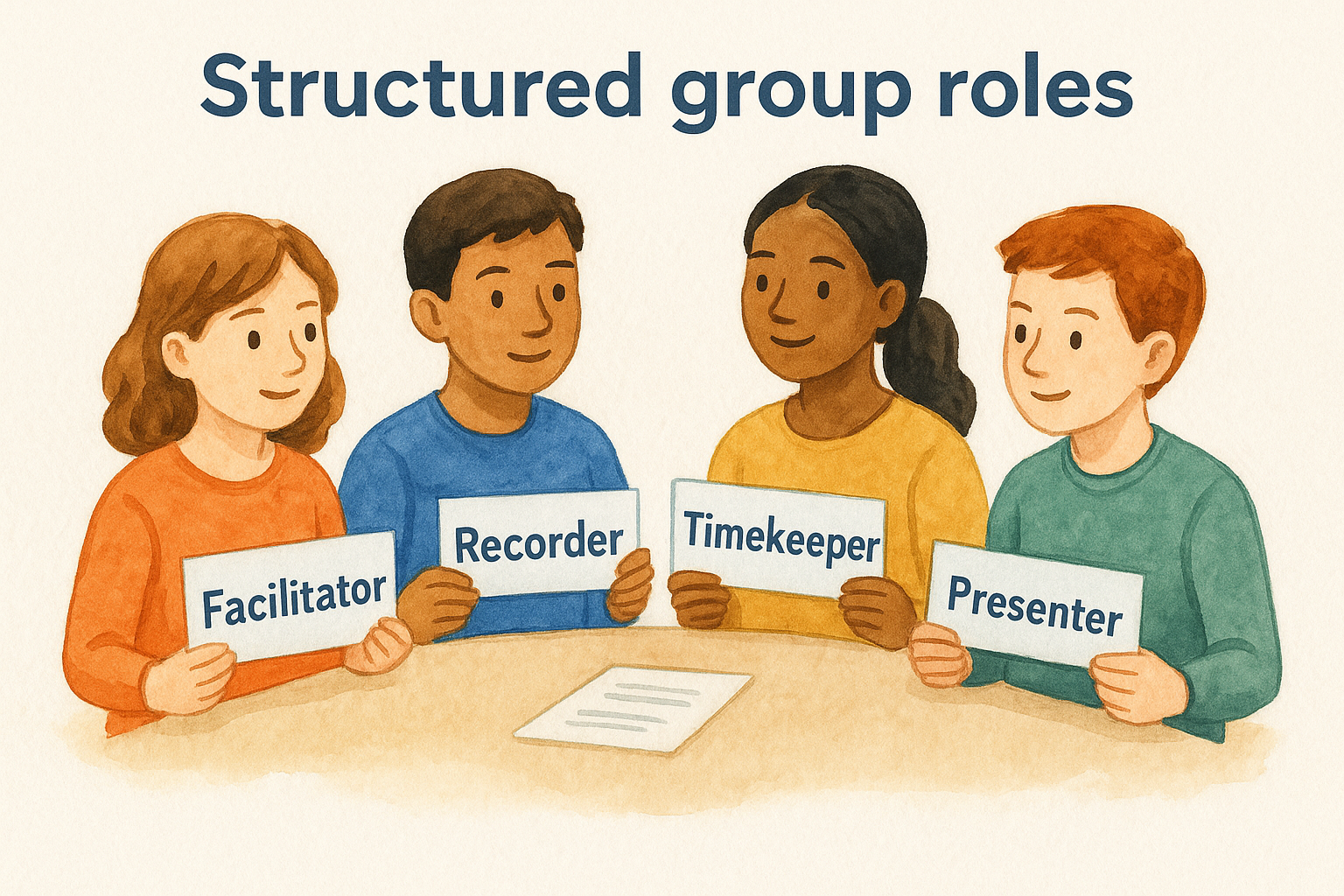
Structured group roles assign each student a specific job inside a team task, so nobody defaults to spectator mode while one classmate does the heavy lifting. This is one of the most direct collaboration teaching strategies for fixing the free-rider problem, because the role itself carries the accountability, not your hope that students will self-organize fairly.
How it works
Before the task starts, hand out four roles: facilitator, recorder, timekeeper, and presenter. Explain what each job requires in plain terms, then let students trade roles on the next assignment so everyone practices leading and everyone practices recording. Check in mid-task by asking each student to name their role and what they’ve done with it so far, which catches the kid who quietly opted out.
A defined role turns "work in your group" into a job every student can point to and defend.
Best for
This approach suits group projects that run over multiple days and any task where one dominant personality tends to take over discussion, which is exactly where the pros and cons of group work in high school show up most clearly. It also works well for mixed-ability teams, since you can match roles to strengths without labeling anyone as the weak link.
Quick tip to try tomorrow
Print small role cards and physically hand one to each student at the start of the period.
- Facilitator keeps the group on task and on topic.
- Recorder writes down decisions and final answers.
- Timekeeper announces when five minutes remain.
- Presenter reports the group’s work to the class.
Swap cards next time so roles rotate evenly.
4. Peer review circles
Peer review circles put students in small groups to critique each other’s drafts using a shared rubric, turning revision into a collaborative task instead of a solo chore. This is one of the more overlooked collaboration teaching strategies because teachers often treat peer feedback as an add-on rather than a structured activity with its own steps and expectations.
How it works
Give every group a specific feedback rubric with two or three criteria, like thesis clarity or evidence strength, so comments stay focused instead of vague praise, the same principle behind most peer and self assessment strategies. Rotate drafts around the circle so each student reads and responds to two or three classmates’ work in one sitting. Require written comments before verbal discussion, since writing first stops the loudest student from dominating the conversation.
A rubric turns "good job" into feedback a writer can actually use.
Best for
This strategy fits any writing-heavy unit, from opinion essays to lab reports, and works especially well once students have a full draft in hand, so a ready-made peer editing lesson plan can save you the setup. It also builds revision skills that transfer far beyond the assignment, since students start noticing the same gaps in their own writing that they flag in someone else’s.
Quick tip to try tomorrow
Hand out sentence starters like "I was confused when…" or "This part convinced me because…" so students skip generic comments and give feedback specific enough to actually act on.
5. Project-based problem solving
Project-based problem solving hands a team a real, messy problem with no single right answer, then asks them to research, design, and defend a solution together. Of all the collaboration teaching strategies on this list, it demands the most sustained teamwork, because students can’t fake their way through a multi-day build the way they might fake a five-minute discussion.
How it works
Present a problem with genuine constraints, like designing a low-cost water filter or planning a school event on a fixed budget. Groups research, propose a solution, build or draft it, then present to the class or an outside audience for feedback. Check in with structured milestones every few days so no team disappears into confusion until the deadline hits, one of several project based learning strategies that keep long builds on track.
A real deadline and a real audience push a group to actual teamwork faster than any lecture on cooperation ever will.
Best for
This strategy suits science, engineering, and social studies units where a cross-curricular project naturally fits, plus any class where you want students practicing planning and negotiation, not just content recall. It also works well paired with one of our subject-specific unit plans if you need a ready-made problem to start from.
Quick tip to try tomorrow
Build in one mandatory checkpoint where each team submits a one-paragraph progress update before moving forward. It surfaces stalled groups early, while there’s still time to redirect them.
Making collaboration a daily classroom habit
None of these five strategies work if you only pull them out once a semester for a special occasion. Collaboration teaching strategies stick when you rotate them often enough that students stop needing instructions and start expecting the structure, whether that’s a silent think step, an expert group, or a role card waiting on their desk. Once the routine feels normal, the accountability built into each strategy does the heavy lifting for you, and you spend less time chasing down the kid who checked out.
Overwhelmed by picking just one to start with? Don’t be. Grab think-pair-share this week, add structured roles next month, and layer in the rest as your students get comfortable working with each other instead of around each other. If you want more ready-to-use classroom structures like these, explore our 15 cooperative learning techniques for engaged classrooms and pull one into your next lesson plan.