Clear Classroom Expectations vs. Long Rule Lists
Most teachers don’t struggle because classroom expectations are unclear.
They struggle because expectations are buried.
Posters with 12–20 rules.
Syllabi that read like legal contracts.
Consequences charts no one remembers by October.
When behavior issues arise, the instinct is often to add another rule.
But here’s the uncomfortable truth:
Students don’t behave better because there are more rules.
They behave better because they understand what’s expected—and why.
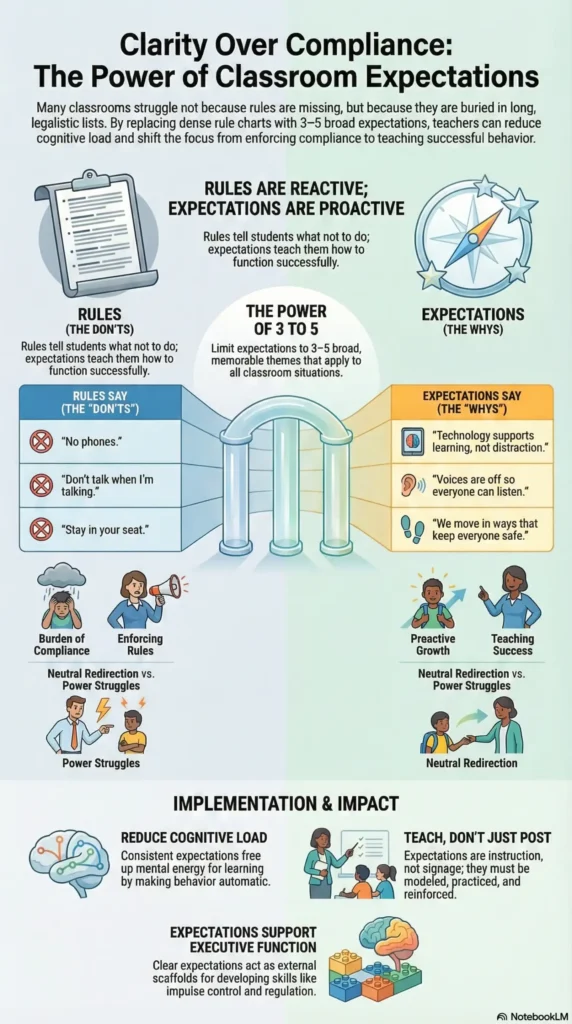
Clear expectations reduce confusion, lower cognitive load, and make self-regulation possible. Long rule lists do the opposite.
What’s the Difference Between Rules and Classroom Expectations?
Rules Say:
“Don’t talk when I’m talking.”
“No phones.”
“Stay in your seat.”
“Be respectful.”
Rules are often:
Reactive
Context-specific
Focused on compliance
Easy to break, hard to internalize
Expectations Say:
“During instruction, voices are off so everyone can listen.”
“Technology supports learning, not distraction.”
“We move in ways that keep everyone safe.”
“We treat people and materials with care.”
Expectations are:
Predictable
Transferable
Framed around purpose
Easier to remember and apply
Rules tell students what not to do.
Expectations teach students how to function successfully in the space.
The Science: Why Clear Classroom Expectations Improve Behavior
1. Fewer Expectations Reduce Cognitive Load
Students are constantly managing:
Academic demands
Social dynamics
Emotional regulation
A long rule list adds another thing to track.
Clear, consistent expectations:
Reduce decision fatigue
Make behavior more automatic
Free up mental energy for learning
When students know what normally happens here, regulation becomes easier.
2. Classroom Expectations Support Executive Function
Skills like:
Task initiation
Impulse control
Emotional regulation
are still developing—especially in adolescents.
Expectations act as external scaffolds:
“This is how we start class.”
“This is what to do when you’re stuck.”
“This is how we transition.”
Rules assume students already have these skills.
Expectations help build them.
3. Classroom Expectations Reduce Power Struggles
Many classroom conflicts aren’t about defiance—they’re about ambiguity.
When expectations are clear:
Corrections feel neutral, not personal
Redirection becomes instructional
Students save face
“You broke a rule” invites argument.
“This isn’t matching our expectation” invites adjustment.
Why Long Rule Lists Backfire
Long lists tend to:
Be ignored after the first week
Invite loopholes and debates
Encourage compliance over understanding
Position the teacher as enforcer, not guide
They also send an unintended message:
“I don’t trust you unless everything is spelled out.”
That erodes relationships—especially with students who already feel targeted.
What Effective Classroom Expectations Look Like
Most effective classrooms operate with 3–5 broad expectations that apply everywhere.
Examples:
Be ready to learn
Be respectful
Be responsible
Keep yourself and others safe
These work because they are:
Easy to remember
Applicable to many situations
Flexible across activities
Easy to revisit after issues
The key isn’t the wording—it’s the teaching.
Teaching Classroom Expectations (Instead of Posting Rules)
Clear expectations only work if they are:
Modeled
Practiced
Reinforced
Revisited
This looks like:
Narrating expectations during real moments
Practicing transitions early (and again after breaks)
Referring back to expectations during redirection
Reflecting after things go off track
Expectations are instruction, not signage.
What This Looks Like Across Grade Levels
Elementary
Use visuals and anchor charts
Act out expectations
Practice routines repeatedly
Middle School
Co-create examples with students
Use quick resets after disruptions
Connect expectations to fairness and community
High School
Keep expectations minimal and adult
Explain the “why”
Use private redirection tied to shared norms
The principle stays the same—the delivery shifts.
The Science: Why Clear Classroom Expectations Improve Behavior
1. Fewer Expectations Reduce Cognitive Load
Students are constantly managing:
Academic demands
Social dynamics
Emotional regulation
A long rule list adds another thing to track.
Clear, consistent expectations:
Reduce decision fatigue
Make behavior more automatic
Free up mental energy for learning
When students know what normally happens here, regulation becomes easier.
2. Expectations Support Executive Function
Skills like:
Task initiation
Impulse control
Emotional regulation
are still developing—especially in adolescents.
Expectations act as external scaffolds:
“This is how we start class.”
“This is what to do when you’re stuck.”
“This is how we transition.”
Rules assume students already have these skills.
Expectations help build them.
3. Expectations Reduce Power Struggles
Many classroom conflicts aren’t about defiance—they’re about ambiguity.
When expectations are clear:
Corrections feel neutral, not personal
Redirection becomes instructional
Students save face
“You broke a rule” invites argument.
“This isn’t matching our expectation” invites adjustment.
Why Long Rule Lists Backfire
Long lists tend to:
Be ignored after the first week
Invite loopholes and debates
Encourage compliance over understanding
Position the teacher as enforcer, not guide
They also send an unintended message:
“I don’t trust you unless everything is spelled out.”
That erodes relationships—especially with students who already feel targeted.
What Effective Classroom Expectations Look Like
Most effective classrooms operate with 3–5 broad expectations that apply everywhere.
Examples:
Be ready to learn
Be respectful
Be responsible
Keep yourself and others safe
These work because they are:
Easy to remember
Applicable to many situations
Flexible across activities
Easy to revisit after issues
The key isn’t the wording—it’s the teaching.
Teaching Expectations (Instead of Posting Rules)
Clear expectations only work if they are:
Modeled
Practiced
Reinforced
Revisited
This looks like:
Narrating expectations during real moments
Practicing transitions early (and again after breaks)
Referring back to expectations during redirection
Reflecting after things go off track
Expectations are instruction, not signage.
What This Looks Like Across Grade Levels
Elementary
Use visuals and anchor charts
Act out expectations
Practice routines repeatedly
Middle School
Co-create examples with students
Use quick resets after disruptions
Connect expectations to fairness and community
High School
Keep expectations minimal and adult
Explain the “why”
Use private redirection tied to shared norms
The principle stays the same—the delivery shifts.