
Classroom Management Workshops for Teachers: What to Know
You’ve got a class that talks over you, transitions that eat ten minutes of instruction time, and a nagging feeling that a single afternoon PD session isn’t going to fix any of it. That’s usually the moment teachers start searching for a real classroom management workshop for teachers, something with actual strategies instead of generic advice about "setting expectations."
A good workshop does three things: it gives you specific routines to try tomorrow, it lets you practice handling disruptions before they happen live in your room, and it connects management to your actual instruction instead of treating it as a separate problem. The best programs also address burnout and consistency, because most management breakdowns happen when teachers are tired, not when they lack knowledge, which is exactly how teacher exhaustion makes behavior harder to manage.
This article walks through what these workshops typically cover, how to tell a worthwhile training apart from a rehashed lecture, and what to look for whether you’re browsing district-offered PD or hunting for something on your own. We’ll also point you toward practical tools and resources you can pair with any workshop to make the strategies stick in your actual classroom.
Why classroom management workshops matter for teachers
Classroom management problems don’t stay contained. A noisy transition eats into your reading block, an off-task student pulls three others with them, and by October you’re spending more energy managing behavior than teaching content. That’s the pattern a solid classroom management workshop for teachers is designed to interrupt, not by handing you a poster of rules, but by rebuilding your daily routines from the ground up.
The real cost of skipping real training
New and veteran teachers alike report that behavior issues are one of the biggest drivers of teacher burnout, right alongside grading load and paperwork. Research from the National Center for Education Statistics has repeatedly flagged classroom disruption as a top reason teachers leave the profession within their first five years. Without structured training in this area, you end up reinventing management strategy alone, often through trial and error on real students, which is costly for everyone in the room, including you, and it forfeits the benefits of teacher professional development entirely.
A classroom that runs on routines you’ve practiced beats one that runs on rules you’ve only posted.
Workshops build skills you can’t learn from a memo
Reading an article about proximity control or positive reinforcement is not the same as practicing it with feedback. Workshops that include role-play, video review of real classroom footage, or coached practice sessions give you the chance to fail small before you fail big in front of thirty students. This kind of hands-on classroom management training also builds shared language among staff, so when a student moves from your room to another teacher’s, expectations feel consistent instead of jarring.
Ultimately, workshops matter because they treat classroom management as instruction, a teachable skill rather than a personality trait. You don’t have to be naturally strict or naturally charismatic to run an orderly room. You need practiced routines, a plan for de-escalation, and enough repetition that your responses become automatic under pressure. That’s exactly what separates a strong teacher professional development program from a one-off staff meeting.
How to choose the right workshop for your classroom
Before you register for anything, get honest about your specific pain point. A new teacher classroom management workshop built around basic routines won’t help a ten-year veteran struggling with a single disruptive class period, and a workshop built for high school won’t translate cleanly to a third-grade room. Match the workshop’s stated audience and grade band to your actual situation before you match anything else.
Vet the trainer, not just the topic
Check who’s actually running the session. Look for a classroom management trainer with recent, real classroom experience, not just a consultant who left teaching a decade ago. Ask whether the workshop offers follow-up support, because classroom management research on teacher coaching shows a single day of strategies without coaching afterward tends to fade by winter break.
The right workshop fits your grade level and your actual problem, not just your school’s PD budget.
Run it through a quick checklist
Before committing time or district funds, run any option through these questions:
- Does it include practice, not just lecture?
- Is the trainer a current or recent classroom teacher?
- Does it address your grade band and subject area?
- Is there follow-up coaching or a resource library afterward?
- Can you apply at least one strategy the next school day?
Answering yes to most of these means you’re likely looking at effective classroom management PD rather than a filler session designed to check a compliance box.
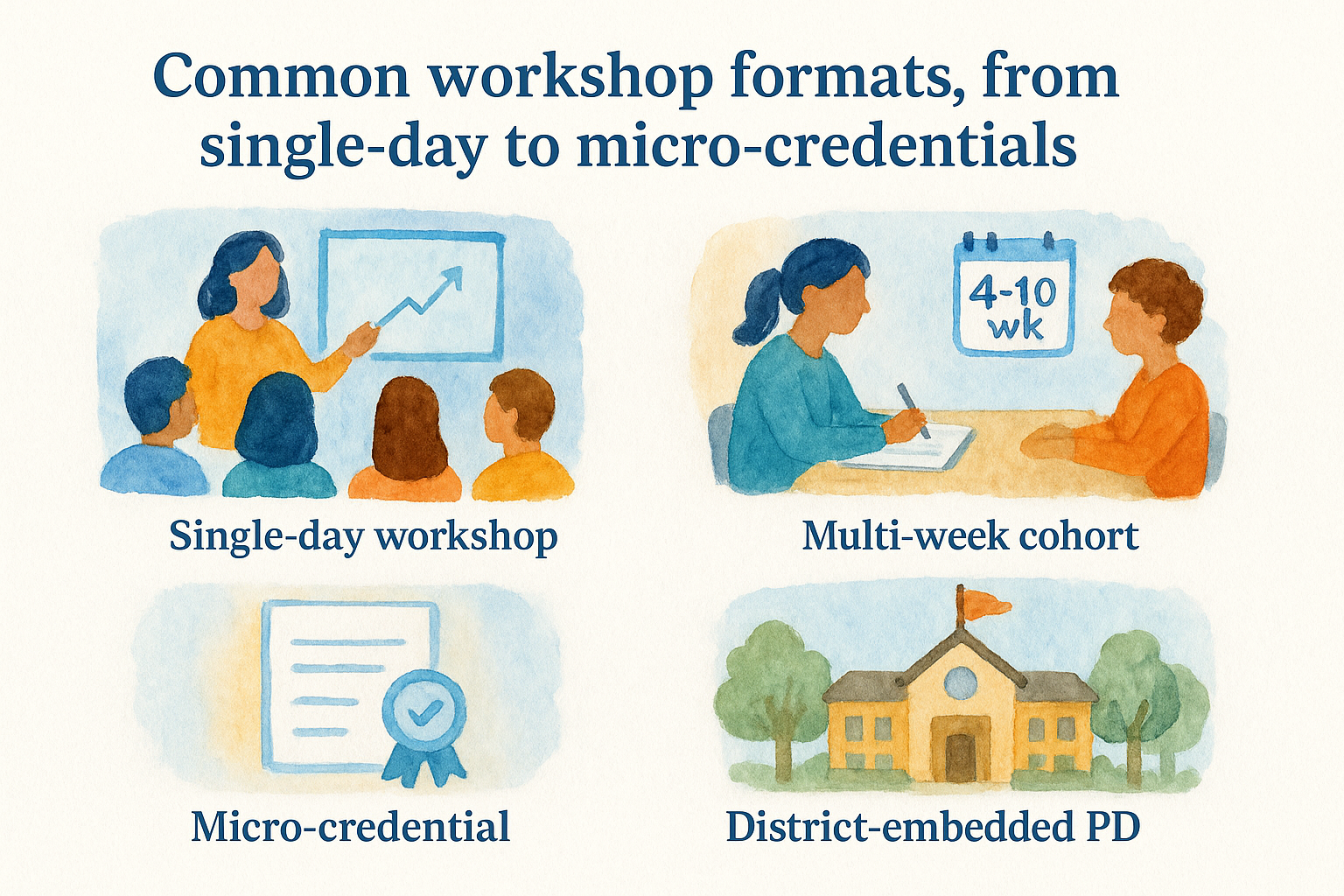
Common workshop formats, from single-day to micro-credentials
Workshops come in more shapes than most teachers realize, and picking the wrong format wastes a professional day you can’t get back. A single-day workshop works best for introducing a new routine or refreshing staff before the school year starts, but it rarely builds lasting habits on its own. Micro-credentials and multi-week cohorts, by contrast, spread practice over months, which matters because behavior change sticks better with repetition than with a single dose of information.
Matching format to your schedule and goals
Getting the format wrong usually means either wasted time or unfinished learning, so match the commitment level to what you actually need this semester.
| Format | Typical length | Best for |
|---|---|---|
| Single-day workshop | 4 to 8 hours | Quick refresh, new staff onboarding |
| Multi-week cohort | 4 to 10 weeks | Building new routines with coached feedback |
| Micro-credential | Self-paced, weeks to months | Documented growth tied to certification renewal |
| District-embedded PD | Ongoing throughout the year | School-wide consistency across grade levels |
Longer, coached formats beat one-day sessions when the goal is actual behavior change, not just attendance credit.
Hybrid options also exist, blending a live session with online coaching calls afterward. If you’re choosing between online professional development for teachers and an in-person session, weigh how much follow-up support each one actually offers before you commit.
Key strategies and topics covered in top workshops
Strong programs cluster around a handful of proven areas rather than trying to cover everything in one session. Most classroom management strategies for teachers taught in quality workshops fall into these categories:

- Proactive routines: entry procedures, transitions, and attention signals practiced until they run without instruction
- De-escalation techniques: scripted language for redirecting a student without stopping the whole class
- Positive reinforcement systems: point systems, class-wide incentives, and specific praise that doesn’t feel forced
- Restorative practices: conversations that repair relationships instead of just issuing consequences
- Data tracking: simple logs that show whether an intervention is actually working after two weeks, not just on day one
Quality trainers spend real time on de-escalation techniques for teachers, since most disruptions escalate not because a student breaks a rule, but because the adult response makes things worse. Role-play here matters more than any slide deck.
The strategies that stick are the ones you rehearse, not the ones you highlight in a handout.
Restorative approaches in the classroom deserve equal weight, especially for repeat behavior issues that suspension alone doesn’t fix. Session leaders who blend consequence-based systems with relationship repair tend to produce calmer rooms by the second semester. Topics like differentiated behavior plans for students with IEPs also show up in stronger workshops, since a one-size approach rarely holds up across a full roster of learners.
Growing your classroom management skills over time
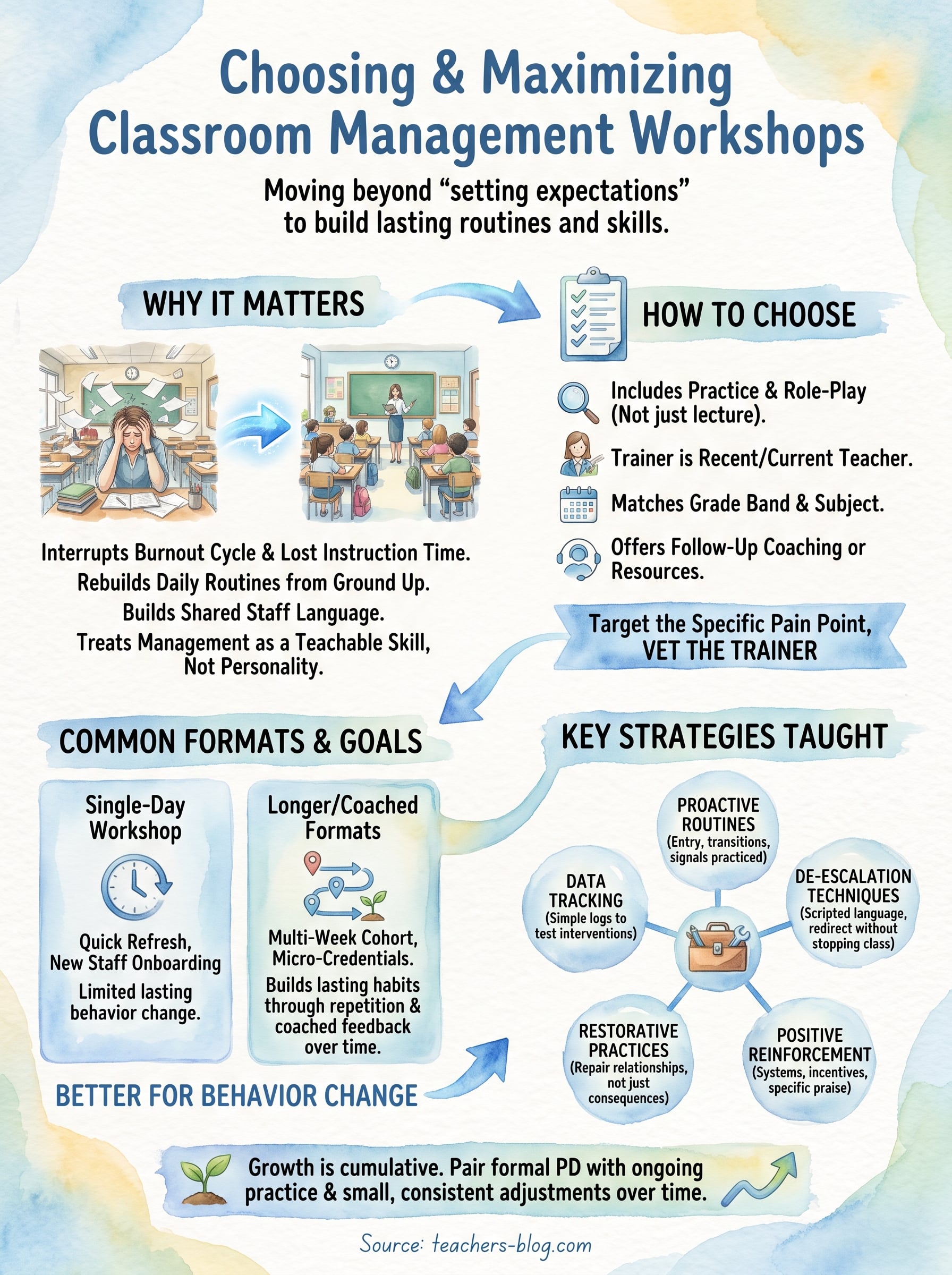
One workshop won’t fix everything, and that’s fine. Treat classroom management like any other skill you sharpen over a career, not a box you check once and forget. Revisit your routines each semester, ask a colleague to observe you cold, and keep testing small adjustments instead of waiting for the next big training to fix your room. Teachers who improve fastest tend to pair formal PD with ongoing practice: rewatching a rough class period, tweaking a transition that’s still slow, or trying a new de-escalation script until it feels natural under pressure.
Growth here is cumulative, not dramatic. Small, consistent adjustments beat any single classroom management workshop for teachers, no matter how good the trainer was that day. If you want ready-to-use strategies, worksheets, and AI tools to keep building on what you learn in a workshop, work through the free classroom management course for teachers and put it to use in your room this week.