ASCD Formative Assessment: Definition, Strategies, Examples
ASCD has shaped how teachers think about assessment for decades, and their work on formative assessment remains some of the most referenced in education. But if you’ve ever tried to dig into ASCD formative assessment resources, you know the information is spread across books, articles, and frameworks that can be tough to piece together into something you can actually use tomorrow morning.
That’s the gap this article fills. Here, we break down ASCD’s definition of formative assessment, the key researchers behind it (like Dylan Wiliam and Jay McTighe), and the specific strategies they recommend, translated into practical classroom examples you can adapt right away. Whether you’re new to formative assessment or looking to sharpen practices you’ve used for years, this is a single, organized reference point.
At The Cautiously Optimistic Teacher, we build resources that help educators work smarter, from AI-powered tools for differentiation to ready-to-use unit plans. This guide fits that same goal: giving you a clear, research-backed foundation for formative assessment so you can spend less time searching and more time teaching.
What ASCD means by formative assessment
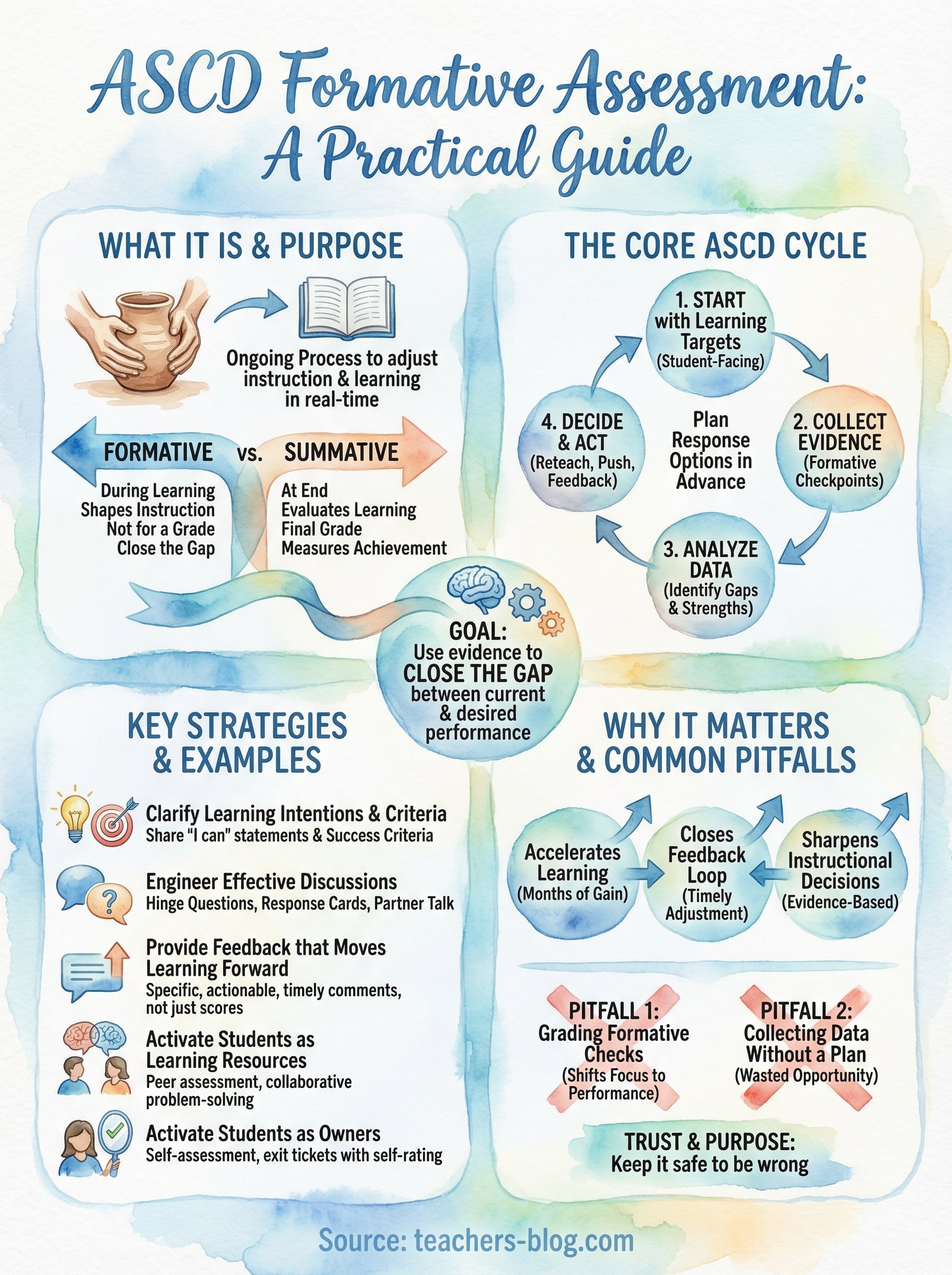
ASCD formative assessment isn’t a single test or checklist. According to ASCD’s body of work, formative assessment is an ongoing process where teachers and students use evidence of learning to adjust instruction and study habits in real time. The word "formative" points to the purpose: the assessment forms and shapes learning while it’s still happening, rather than measuring it after the fact.
The core definition from ASCD’s research
ASCD draws heavily on the work of Dylan Wiliam, whose research defines formative assessment as any activity that provides evidence you can use to close the gap between where a student currently is and where they need to be. Wiliam’s framing, widely cited in ASCD publications, emphasizes that five key strategies drive effective formative practice: clarifying learning intentions, engineering discussions that reveal thinking, providing feedback that moves learning forward, activating students as learning resources for each other, and activating students as owners of their own learning.
Formative assessment only works when both the teacher and the student act on the evidence it surfaces.
These five strategies show up repeatedly across ASCD books, articles, and professional development programs. They’re not decorative theory. Each one gives you a specific lever to pull inside your classroom.
How ASCD distinguishes formative from summative assessment
Many teachers use the terms interchangeably, but ASCD draws a clear line. Summative assessment measures what a student learned at the end of a unit, course, or grading period. It’s evaluative. Formative assessment happens during the learning, and its primary job is to inform your next instructional move, not to produce a grade.
Jay McTighe and Grant Wiggins, whose backward design framework ASCD publishes through Understanding by Design, reinforce this distinction. They argue that when you plan a unit, you should identify your summative goals first, then design formative checkpoints that tell you and your students whether you’re on track to reach those goals. The formative assessments you choose are not add-ons; they’re built into the learning sequence by design.
This also means frequency matters. A single exit ticket at the end of a Friday class is not a formative assessment practice. It becomes one when you use the data on Monday to group students differently, reteach a concept, or give targeted written feedback before the next lesson moves forward.
Why formative assessment matters in real classrooms
The research behind ASCD formative assessment isn’t just theoretical. Studies consistently show that frequent, well-designed formative checks produce measurable gains in student achievement. Dylan Wiliam’s synthesis of research found that strong formative assessment practices can accelerate learning by the equivalent of several months within a single academic year. That’s not a minor advantage you can set aside for later.
It closes the feedback loop for students
When students receive timely, specific feedback during a learning sequence, they can correct misunderstandings before those misunderstandings compound into bigger problems. This is the core mechanism formative assessment uses: the sooner a student knows they’re off course, the sooner they can adjust. Most students don’t realize they’ve misunderstood a concept until they fail a summative test, which is too late to do anything constructive with that information.
Feedback only improves learning when students have time and opportunity to act on it.
Your formative checkpoints give students that window. A quick written response, a partner discussion, or a short concept check mid-lesson tells each student where the gap is while there’s still time to close it before the unit ends.
It sharpens your instructional decisions
Formative assessment also changes what you do next as a teacher. Without regular checks, you rely on instinct or the pace of a textbook to decide when to move forward. With formative data in hand, you make decisions based on actual evidence from your students. You see which students need a second explanation, which ones are ready to push further, and which concepts need a different approach entirely. That level of responsiveness is what separates instruction that covers material from instruction that genuinely builds understanding.
How to plan an ASCD-style formative assessment cycle
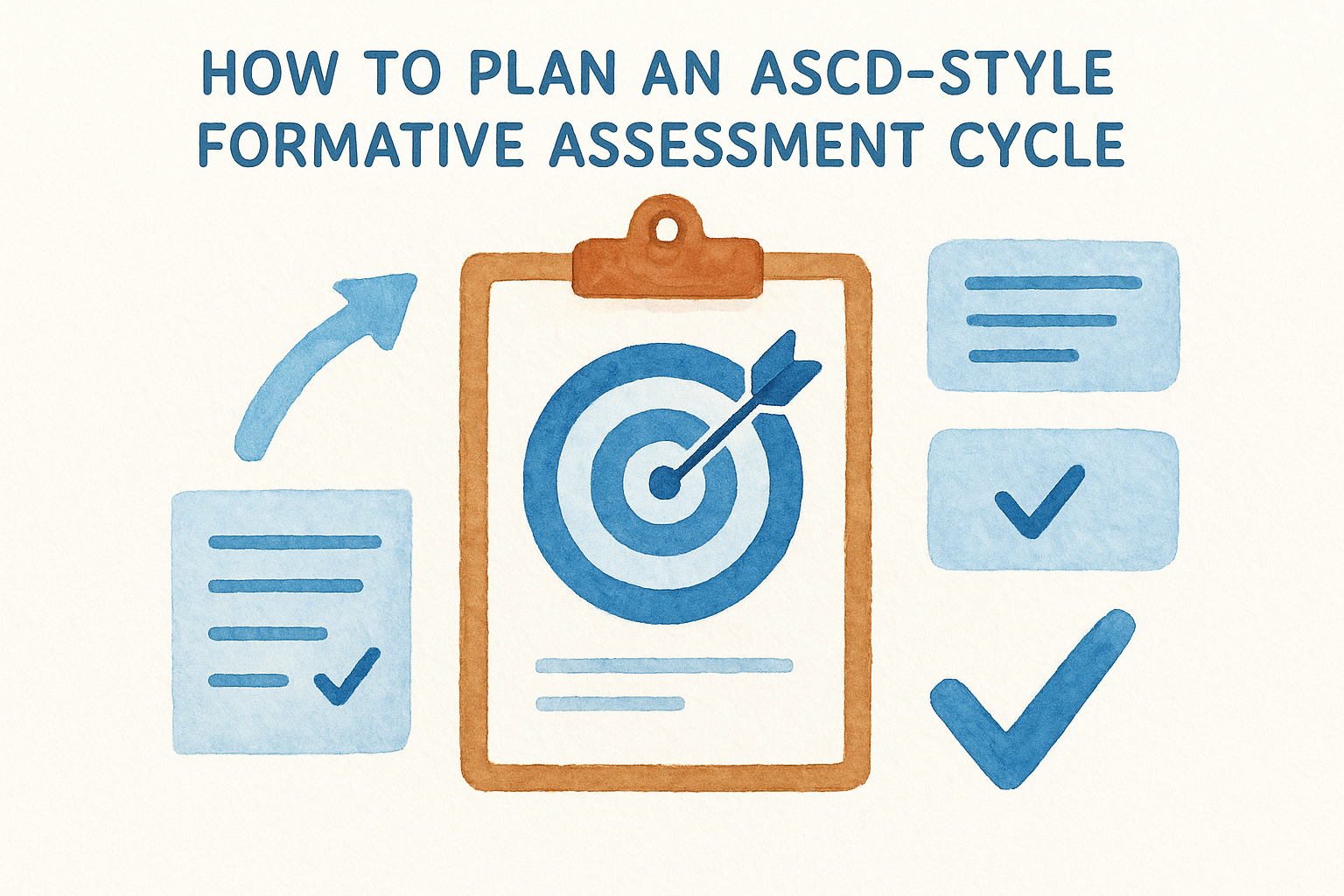
Planning a formative assessment cycle isn’t about adding more assessments to your unit. ASCD formative assessment frameworks ask you to work backward from your learning goals and build checkpoints into the sequence from the start, not patch them on later.
Start with your learning targets
Before you choose any strategy, you need to name what students should know and be able to do by the end of the unit. These targets come directly from your standards, but you need to translate them into student-facing language so learners can use them as a reference while they work. When students understand the target, they can self-assess against it, which is one of Wiliam’s five core strategies.
Clear learning targets do more for formative assessment than any specific technique you choose.
Once your targets are set, map out the key checkpoints in your unit where a formative check would tell you something useful. Aim for at least one check per lesson sequence, not one per day.
Decide what to do with the data
A checkpoint without a planned response is just busywork. Before you run any formative activity, decide what you will do if most students don’t understand the concept, what you will do if only a few struggle, and what you will do if the class is ready to move forward faster than planned. Write these response options down in your lesson plan before class starts.
This step is where most formative assessment cycles break down. You collect data, but without a pre-planned response, you end up moving on anyway. Building the response into the planning stage forces you to actually use what your students show you.
Formative assessment strategies and examples by format
ASCD formative assessment resources organize strategies by purpose, not just format. Knowing which tool fits which moment in your lesson helps you choose quickly and use the data well. The categories below give you a practical starting point sorted by how and when each strategy works best.
Quick checks during instruction
Mid-lesson checks give you real-time evidence of where students are before you move forward. Three formats work particularly well here:
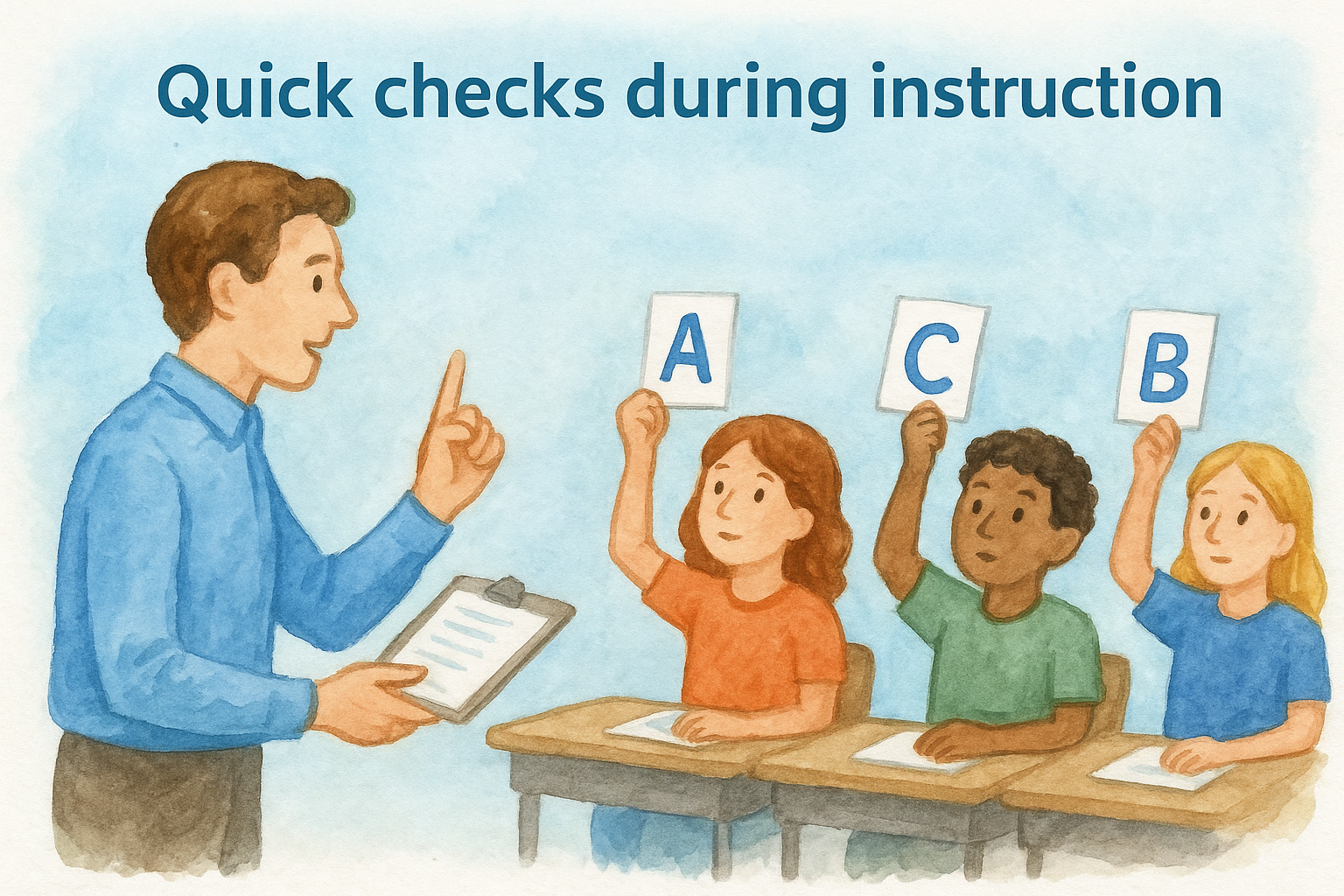
- Hinge questions: A single multiple-choice question designed so each wrong answer reveals a specific misconception. You read the responses and decide whether to reteach or continue.
- Response cards or mini whiteboards: Students write a short answer and hold it up simultaneously, giving you a visual scan of the whole room at once without letting faster students anchor everyone else’s thinking.
- Fist to five: Students hold up fingers to signal their confidence level on a concept, letting you spot clusters of confusion in seconds.
The goal of any quick check is to change what you do next, not just to see who already knows the answer.
Written and discussion-based formats
Exit tickets are the most commonly used written format, and for good reason. A single focused prompt at the end of class, tied directly to your learning target, gives you sortable data you can act on before the next lesson starts. Keep the prompt to one or two questions so you can actually read and respond to every paper.
Discussion-based checks like structured partner talks reveal thinking that written work often hides. When you listen strategically during a partner discussion, you hear the specific language students use to explain concepts, which tells you far more about their actual understanding than a correct answer on paper ever could.
Common pitfalls and how to fix them
Even teachers who understand ASCD formative assessment principles fall into predictable traps when they try to put the practice into action. Knowing these patterns in advance helps you sidestep them before they undermine the whole process.
Treating formative checks as grades
One of the most common mistakes is attaching a grade to formative activities. The moment you grade an exit ticket or a hinge question, students shift their focus from demonstrating honest understanding to performing for a score. That shift produces misleading data and defeats the purpose of checking for understanding entirely. Keep formative work ungraded and frame it explicitly as a learning tool, not an evaluation.
When students trust that formative checks are safe to be wrong in, the evidence you collect becomes far more reliable.
Students also need to know why you’re running these checks. If they see an exit ticket as busywork at the end of class, they’ll rush through it. When you connect the activity to a clear learning target they understand, they engage with it differently, and so do you.
Collecting data without a planned response
You can run the most well-designed quick check in your school and still waste it if you have no plan for what to do next. Many teachers collect formative data and then follow the lesson plan they already wrote anyway. The fix is simple: before each formative activity, write down at least two possible instructional responses in your planning notes. One for widespread confusion, one for isolated gaps.
Skipping student self-assessment is part of the same problem. Dylan Wiliam’s framework, which ASCD references consistently, places students as owners of their own learning. Add a brief self-rating step to your exit tickets so students build the habit of tracking their own progress rather than waiting for you to tell them where they stand.
Next steps for your classroom
You now have a working foundation in ASCD formative assessment: the research behind it, the planning cycle, specific strategies, and the pitfalls to avoid. The next move is to pick one strategy from this guide and use it in your next lesson. Not five. One. Run it, look at what students show you, and decide what to do differently before your next class session starts.
From there, build the habit layer by layer. Add a student-facing learning target first, then fold in the self-assessment step once that feels routine. Each addition makes the formative cycle more complete without overwhelming your planning process.
If you want tools that make this faster, The Cautiously Optimistic Teacher offers AI-powered resources built for educators, including question generators and differentiation helpers that cut planning time at every stage. Start with one change, stay consistent, and let the evidence your students give you guide each next step.