9 Checks for Understanding Strategies to Use in Any Lesson
You just finished explaining a concept, and twenty-five faces stare back at you. Some nod. Some look confused. Most give you absolutely nothing to work with. Without reliable checks for understanding strategies, you’re essentially teaching blind, moving forward and hoping the lesson stuck. That’s a gamble no teacher can afford to take regularly.
The good news is that checking for understanding doesn’t have to mean stopping everything for a formal quiz. Quick, low-stakes techniques woven into your lesson can tell you exactly who’s got it and who needs another pass, all without killing the momentum. That’s the kind of practical, classroom-ready approach we focus on here at The Cautiously Optimistic Teacher: strategies that actually work between the bell rings.
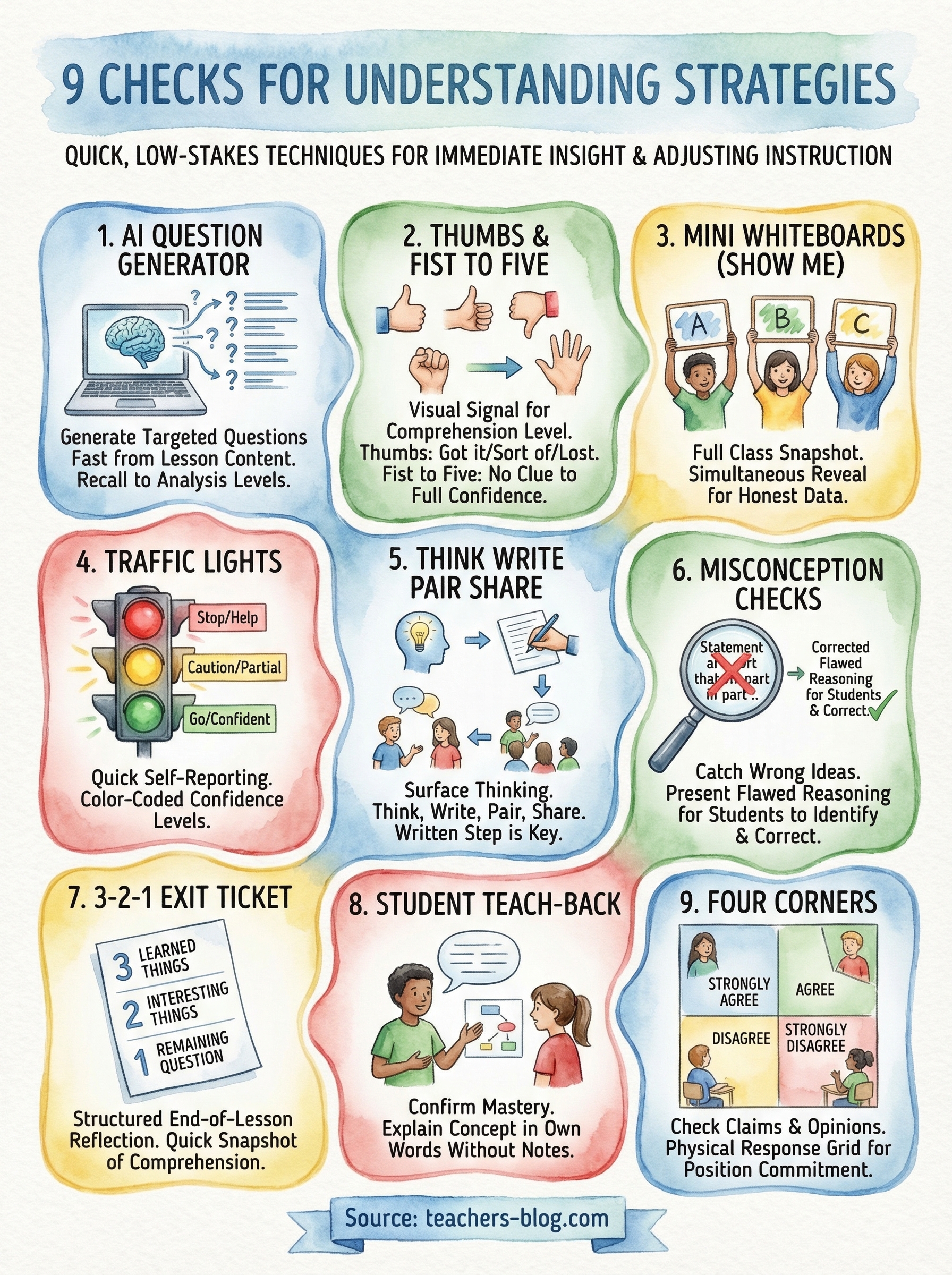
In this article, you’ll find nine specific strategies you can drop into any lesson, any subject, any grade level. Each one is easy to implement, gives you immediate insight into student thinking, and helps you adjust instruction before misunderstandings take root.
1. Use an AI question generator for CFU prompts
An AI question generator takes your lesson content and produces targeted questions in seconds. Instead of scrambling to write fresh prompts on the fly, you paste in a paragraph, a learning objective, or a key vocabulary list, and the tool returns a ready-to-use set of questions at different cognitive levels. This makes it one of the most efficient checks for understanding strategies you can add to your toolkit right now.
What it is
An AI question generator is a tool that uses a large language model to create questions from any content you provide. You give it your lesson material or standard, and it produces questions that range from basic recall all the way up to analysis and evaluation. Most tools let you specify the number of questions, the format, and the difficulty level, so the output matches exactly what you need.
When to use it
Use an AI question generator before the lesson starts, ideally the night before or during your prep period. Having your CFU questions ready before students walk in means you never pause to think of a good question mid-explanation. It also works well when you’re teaching a unit you’re less confident in, since the tool can quickly surface angles you might have missed.
How to run it fast
Copy a short passage or your lesson objective directly into the tool. Set the question type (multiple choice, open-ended, true/false) and hit generate. Skim the output, cut anything weak, and keep the three to five questions that match your lesson goal. The whole process takes under two minutes once you’re familiar with it.
The faster you can generate quality questions, the more consistently you’ll actually use them.
What to look for
Check whether the generated questions target your actual learning goal rather than surface-level details. A question about a minor fact tells you very little. Prioritize questions that reveal whether students understood the core concept, not just whether they read the page.
Easy variations and tips
- Generate one recall question, one application question, and one opinion or analysis question for built-in cognitive variety.
- Save strong questions in a shared doc so you can reuse them next year without starting from scratch.
- Ask the tool to write common misconceptions as wrong answer choices if you’re building multiple choice options.
2. Use thumbs and fist to five
Thumbs and fist to five are signal-based checks for understanding strategies that give you an instant visual read on the whole class. Students hold up a hand signal to show their comprehension level, and you scan the room in seconds without stopping the lesson flow.
What it is
This method comes in two versions: thumbs up means got it, sideways means sort of, thumbs down means lost. Fist to five adds more range, where a fist means no understanding and five fingers means full confidence. Both options require zero materials and work in any classroom setup.
When to use it
Use these signals right after a key explanation or when transitioning between lesson segments. They give you a quick read on whether the class is ready to move forward or needs another pass at the concept before you continue.
A room full of sideways thumbs tells you more in three seconds than five minutes of guessing.
How to run it fast
Tell students to show their signal on your count so no one copies peers before revealing. Count to three, say "show me," and scan immediately. The whole check takes under thirty seconds from start to finish.
What to look for
Watch for students who hesitate or change their signal after looking around the room. Those students often aren’t confident and need a follow-up. A cluster of low signals in one area can point to a group comprehension gap worth addressing directly before moving on.
Easy variations and tips
Small tweaks can give you better data with minimal effort. Switch to fist to five when you need more granular information than a basic thumbs check provides, or cold call a student showing three fingers to explain their thinking aloud for richer insight.
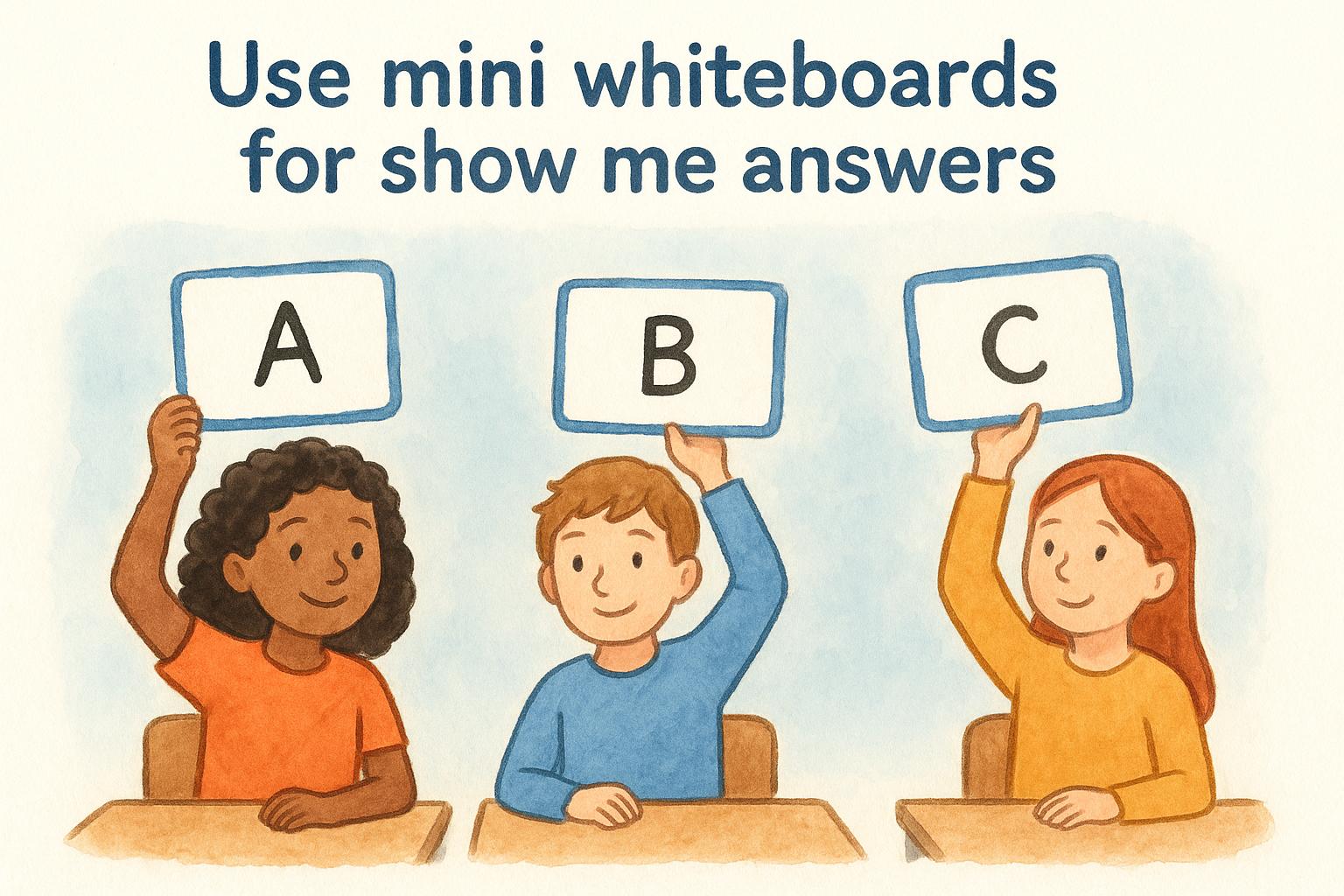
3. Use mini whiteboards for show me answers
Mini whiteboards turn every student into an active participant at the same time. Each student writes their answer, holds it up on your signal, and you get a full-class snapshot of understanding in one glance. Among the most tactile and visual checks for understanding strategies, this one works especially well for math, vocabulary, and short-answer tasks where you need to see actual student thinking.
What it is
A mini whiteboard is a small erasable surface where students write responses and hold them up simultaneously. The key word is simultaneously: everyone reveals at once, which removes the pressure of being the only wrong answer in the room and gives you honest data from every student, not just the most confident ones.
When to use it
Pull out mini whiteboards mid-lesson after a worked example or during practice to catch errors before they become habits. They work well in both whole-group instruction and small-group rotations.
Seeing thirty boards at once tells you far more than calling on three students ever could.
How to run it fast
Give a clear, single-question prompt, set a short timer if students need it, and say "show me" to trigger the reveal. Students erase and reset in under ten seconds, keeping the pace tight.
What to look for
Look for patterns across the room rather than individual errors. If a cluster of students writes the same wrong answer, that points to a gap in your explanation, not a student problem.
Easy variations and tips
- Use sentence starters on the board to help students who struggle with open-ended prompts.
- Substitute mini whiteboards with a sheet protector over white cardstock if your budget is tight.
4. Use traffic lights for quick self-reporting
Traffic lights give students a simple, color-coded way to report their understanding without speaking in front of the class. Each student displays red, yellow, or green to signal where they stand: green means confident, yellow means uncertain, and red means lost. This is one of the most student-friendly checks for understanding strategies because it removes the awkward dynamic of admitting confusion out loud.
What it is
Students use three colored cards to communicate their confidence level on your signal. Green means ready to move on, yellow means partially there, and red means they need more support before continuing. It’s a self-reporting system, so the data reflects how students actually perceive their own understanding.
When to use it
Use traffic lights at natural pause points, such as after explaining a multi-step concept or right before independent practice. It works well when you expect uneven understanding across the class and want to group students quickly for targeted support.
A room full of red cards is useful data, not a failure, it tells you exactly where to spend your next five minutes.
How to run it fast
Pre-cut sets of colored cardstock and laminate them for repeated use. Prompt students to hold up their card at the same time so responses stay honest and no one copies their neighbor.
What to look for
Watch for students who always default to green regardless of actual performance. Cross-reference their self-reports with the work they produce right after the check to catch gaps between confidence and mastery.
Easy variations and tips
- Stack colored plastic cups on each desk for a hands-free, always-visible version.
- Allow students to switch cards during independent work so the check becomes continuous rather than a single snapshot.
5. Use think write pair share to surface thinking
Think-write-pair-share takes the classic think-pair-share and adds a writing step that forces every student to commit to an answer before talking with a partner. That commitment is what makes it one of the more reliable checks for understanding strategies: you get honest individual thinking before peer influence can muddy the water.
What it is
The strategy runs in four steps. Students think silently about a prompt, write their response independently, pair with a partner to compare answers, then share key ideas with the class. The written step is the critical piece because it creates a record you can collect or scan quickly.
When to use it
Use this strategy mid-lesson or right before a transition to a new concept. It works especially well when you’ve just introduced an abstract idea and want to see how students are processing it before you move forward.
The written step turns a conversation into data you can actually use.
How to run it fast
Give students a focused, single-sentence prompt and set a one-minute timer for the write step. Keep pair conversations to ninety seconds so the whole check stays under four minutes total.
What to look for
Scan the written responses while students talk with their partners. Look for recurring errors or gaps in reasoning that point to a concept you need to reteach before the lesson moves on.
Easy variations and tips
- Collect written responses as an informal exit ticket if you want a record without running a separate check at the end of class.
- Assign pairs strategically so stronger students can model clear thinking for those who are still working through the concept.
6. Use misconception checks to catch wrong ideas
A misconception check flips the typical CFU approach. Instead of asking students to confirm correct understanding, you present a wrong statement or flawed reasoning and ask them to identify the error. This makes it one of the sharpest checks for understanding strategies you have because it forces students to engage with a concept deeply enough to recognize and correct faulty thinking.
What it is
A misconception check gives students a deliberately incorrect answer or flawed explanation tied to your lesson content. Students identify what’s wrong and explain why, which reveals whether they understand the concept well enough to catch an error rather than just recall a definition.
When to use it
Use this check after direct instruction, especially when students historically struggle with a specific idea. If you’ve taught the topic before and noticed recurring errors, those exact errors make ideal source material for this activity.
How to run it fast
Write one wrong statement on the board and give students sixty seconds to write their correction. Keep it to a single misconception so the whole check wraps up in under three minutes.
Watching students correct a wrong answer reveals more about their thinking than watching them confirm a right one.
What to look for
Look for students who agree with the wrong statement rather than flagging the error. Those students need targeted reteaching before the class moves on.
Easy variations and tips
- Pull misconceptions from previous student work so they reflect real errors rather than invented ones.
- Present two statements, one correct and one wrong, and ask students to identify which is which and explain their reasoning.
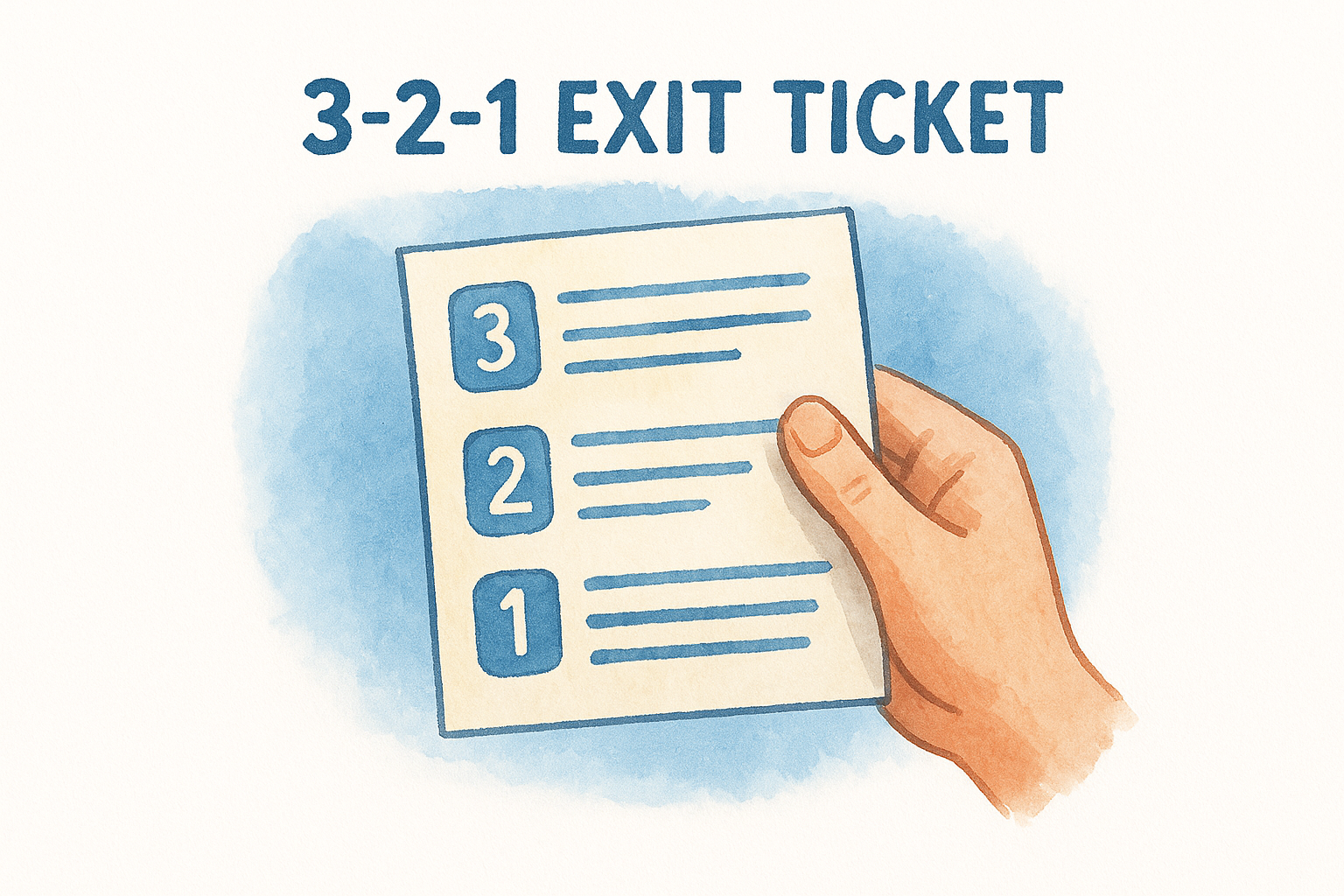
7. Use a 3-2-1 exit ticket to close the lesson
A 3-2-1 exit ticket gives you structured student reflections at the end of class in a format that’s fast to run and easy to read through afterward. Students write three things they learned, two things they found interesting, and one question they still have, handing you a clean snapshot of comprehension right before they walk out the door. This makes it one of the most reliable checks for understanding strategies for wrapping up a lesson with real data.
What it is
The 3-2-1 format is a written reflection tool students complete on a half-sheet of paper or a sticky note. The three-part structure pushes students to process content at different levels: recall, personal connection, and remaining confusion, all in a single quick task.
When to use it
Pull out this check during the final five minutes of class when you need both a comprehension read and a head start on planning the next day. It works especially well at the end of a new concept introduction before students move into independent practice.
How to run it fast
Put the three prompts on the board before class ends, give students three minutes to write, and collect at the door. You need no extra materials beyond whatever students are already writing on.
The questions students still have at the end of class are your clearest guide for what to address next.
What to look for
Look for repeated questions across multiple exit tickets. One confused student is an individual issue, but five students asking the same thing points to a gap in your instruction worth addressing before the next lesson begins.
Easy variations and tips
- Adjust the prompts to fit your content: try three key terms, two examples, one connection for vocabulary-heavy lessons.
- Collect responses digitally using a simple form if you want answers sorted automatically without shuffling paper.
8. Use a student teach-back to confirm mastery
A teach-back puts a student in the teacher’s seat for a few minutes and asks them to explain a concept back to you or to the class in their own words. Among all checks for understanding strategies, this one gives you the clearest evidence of real mastery because restating information in your own words requires deeper processing than simply recognizing a correct answer.
What it is
A student teach-back is exactly what it sounds like: a student explains a concept, process, or skill to you, a partner, or a small group without looking at notes. The explanation itself becomes your data point, revealing where their understanding holds and where it breaks down.
When to use it
Use this check at the end of a lesson or after a student finishes independent practice. It works especially well before a major assessment when you want to confirm that specific students have moved past surface-level recall.
If a student can explain it clearly, they own it. If they stumble, you know exactly where the gap is.
How to run it fast
Pick one focused concept and give the student sixty to ninety seconds to explain it. Keep the scope tight so the teach-back stays quick and produces useful feedback rather than a rambling summary.
What to look for
Listen for gaps, vague language, or circular reasoning that signal incomplete understanding. A student who explains only the steps without explaining the why likely needs one more pass at the concept before moving on.
Easy variations and tips
- Pair students and have them teach each other simultaneously to maximize participation without extending class time.
- Ask the listening partner to give one piece of specific feedback after the teach-back for built-in peer accountability.
9. Use four corners to check claims and opinions
Four corners turns your classroom into a physical response grid. You post four labels in the corners of the room, strongly agree, agree, disagree, and strongly disagree, then read a statement aloud and ask students to move to the corner that matches their position. As one of the more kinesthetic checks for understanding strategies, it works particularly well for lessons involving interpretation, argument, or critical thinking.
What it is
This is a movement-based check where students physically commit to a position by standing in the corner that matches their response. Requiring a physical move forces every student to make a decision rather than passively observe.
When to use it
Use four corners when your lesson involves claims, evidence, or opinions, such as after reading a persuasive text or analyzing a historical event. It’s especially useful when you want to expose a range of thinking across the class before a discussion.
Watching where students stand tells you immediately who’s confident in their position and who’s still working it out.
How to run it fast
Label the four corners before students arrive so you lose no class time on setup. Read the statement, give students ten seconds to move, then cold call one student from each corner to explain their reasoning briefly.
What to look for
Watch for students who drift toward the majority rather than their genuine position. Those students often need more confidence in defending their own reasoning.
Easy variations and tips
- Swap opinion statements for content-based claims tied directly to your lesson objective to make the check more analytical.
- Ask students to switch corners if a peer’s explanation changes their thinking, turning the check into a mini debate.
Next step for tomorrow’s lesson
You now have nine checks for understanding strategies you can plug into any lesson without overhauling your plans. Each one gives you real information about student thinking in under five minutes, which means you spend less time guessing and more time actually addressing gaps before they compound into bigger problems.
Pick one strategy from this list and commit to using it in your very next lesson. Don’t try to layer in all nine at once. Start with the check that fits your lesson structure most naturally, run it consistently for a week, and pay attention to the data it gives you. Once that check feels routine, add a second one and build from there.
For more practical tools and teaching strategies you can use right away, visit The Cautiously Optimistic Teacher. You’ll find resources built specifically for educators who want to improve their classroom practice without adding hours to their week.