
6 Classroom Management Best Practices For Any Class In 2026
You can have the best lesson plan ever written, but if students are talking over you, zoning out, or derailing every transition, none of it matters. That’s why classroom management best practices aren’t just “nice to have”, they’re the foundation that makes everything else in your classroom possible.
Here’s the thing, though: management doesn’t mean control. It doesn’t mean silence. It means building a classroom where students know what’s expected, feel respected, and can actually focus on learning. That’s a goal worth being cautiously optimistic about, and it’s exactly the kind of practical, teacher-first thinking we build everything around at The Cautiously Optimistic Teacher. Whether you’re a first-year teacher white-knuckling your way through period six or a veteran looking to refresh your classroom management approach, these strategies apply.
Below, you’ll find six practices that work across grade levels, subject areas, and teaching styles. No gimmicks, no theory-heavy fluff, just actionable techniques you can start using this week to create a classroom that runs smoother and feels better for everyone in it.
1. Plan engaging, differentiated lessons with AI support
Most behavior problems don’t start with bad kids. They start with boredom and confusion. When students don’t understand what they’re doing or can’t see why it matters, they fill that gap with disruption. One of the most reliable classroom management best practices is designing lessons so engaging and well-matched to your students that off-task behavior simply has less room to grow.
Why engagement and differentiation prevent behavior issues
When a student finishes early with nothing to do, or falls behind because the task is too hard, you get behavior. It’s almost automatic. Differentiated lessons close that gap by giving every student a clear, appropriately challenging task at all times. Research consistently links student engagement to reduced disruptive behavior because engaged students aren’t looking for an exit from the lesson.
The most effective prevention strategy isn’t a consequence system. It’s a lesson students actually want to work through.
A simple workflow using The Cautiously Optimistic Teacher AI tools
You don’t need to rebuild every lesson from scratch. The Differentiated Instruction Helper on this site lets you input your existing lesson content and generate tiered versions quickly for different learning needs. Pair that with the Question Generator to create critical thinking prompts that stretch advanced students while the core task anchors the rest of your class.
This workflow keeps your prep time short and your lesson quality high. Spend ten minutes adapting one lesson instead of two hours writing three separate ones.
Where teachers overcomplicate this and how to simplify
The biggest trap is treating differentiation as all-or-nothing. You don’t need individualized tasks for every student every day. A task with two levels, a core version and a stretch version, covers most of your class without overwhelming your planning time. Keep your pacing and learning goal consistent and let the task complexity handle the differentiation.
Quick examples for middle and high school classes
For a middle school reading class, assign the same text but different annotation tasks based on readiness. For a high school argument unit, give all students the same prompt but vary the scaffolding level, with some students receiving a sentence frame and others working independently. Same lesson, same objective, far less chaos.
2. Teach routines and procedures like you teach content
Students don’t arrive knowing how your classroom works. They need explicit instruction on routines just as much as they need instruction on content. Skipping this step is one of the most common classroom management best practices teachers overlook, and it costs weeks of disruptions later.
The routines that eliminate the most disruptions
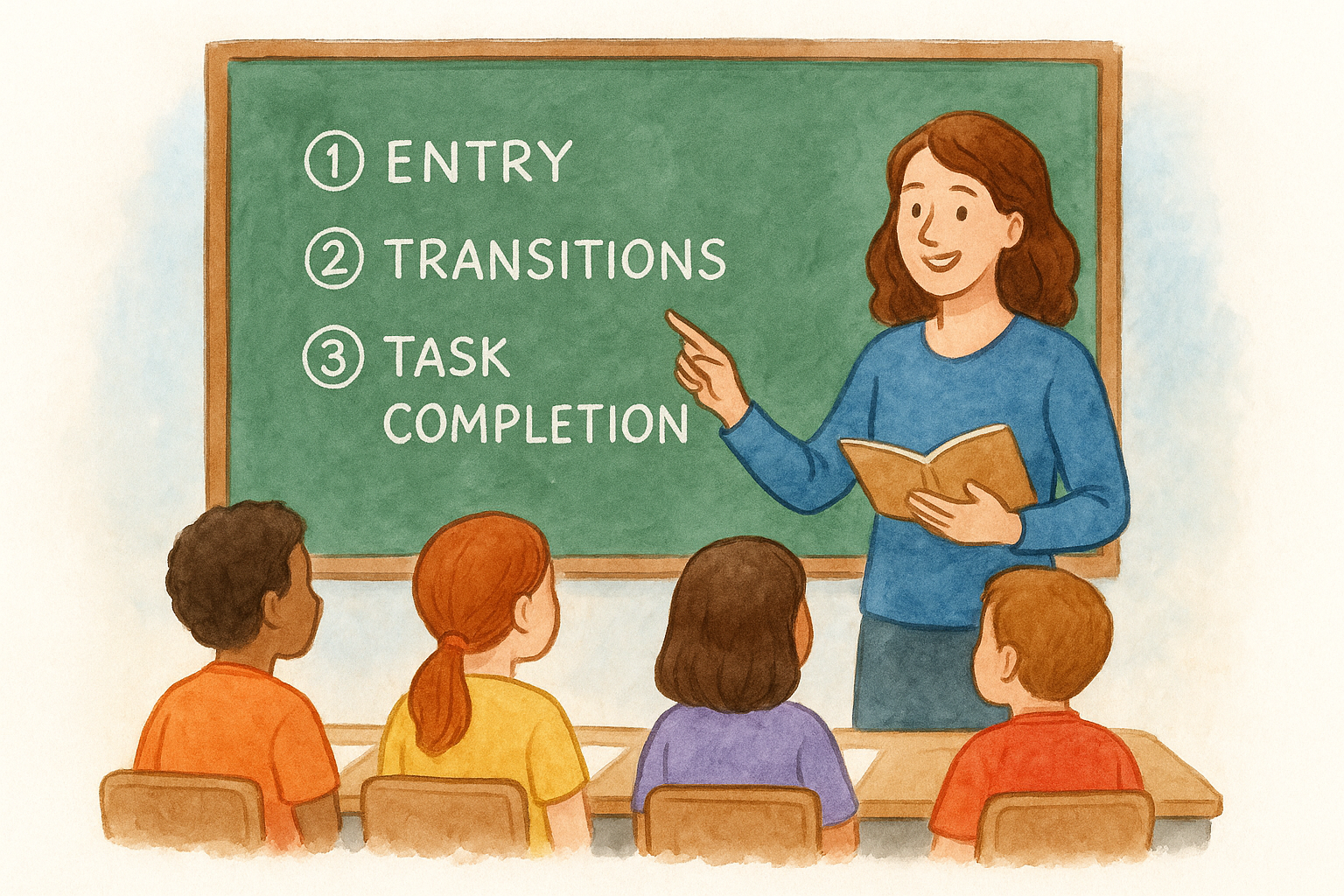
The highest-impact routines cover entry procedures, transitions, and task completion. When students know exactly what to do the moment they walk in, you eliminate the five minutes of unstructured noise that sets the wrong tone for the rest of class.
How to explicitly teach, practice, and re-teach procedures
Treat every procedure like a mini-lesson: model it, have students practice it, and give feedback. Don’t assume one demonstration is enough. Repetition builds automaticity, and automaticity is what keeps your class running smoothly when things get busy.
The more time you invest in teaching routines during the first two weeks, the less time you spend managing behavior for the rest of the year.
Transition routines that protect learning time
Transitions become time sinkholes when you leave them unstructured. Give students a specific, timed process for moving between activities, packing up, or switching groups. A clear signal and a defined sequence removes the ambiguity that turns two-minute transitions into ten-minute ones.
What to do when routines start slipping midyear
When routines break down after a break or a rough week, re-teach them directly rather than just increasing consequences. A quick, low-drama reset using the original procedure is faster and more effective than escalating your response.
3. Set clear expectations and reinforce them consistently
Vague expectations create behavioral gray areas, and students will fill those gaps in the worst possible ways. One of the most overlooked classroom management best practices is making your expectations specific, visible, and genuinely consistent, so students always know exactly where the line is before they cross it.
How to write expectations students can actually follow
Skip broad statements like “be respectful” and write observable, behavioral expectations instead. “One person speaks at a time” is something students can actually measure. Limit your list to three to five expectations so students can remember them without needing a reference sheet every class.
How to introduce expectations on day one and after breaks
Walk through each expectation on the first day of class with concrete examples of what it looks like and what it does not look like. After long breaks, run a brief review, not as a punishment but as a reset. Students need that reorientation to get back into your classroom’s rhythm.
Expectations only work when you revisit them consistently, not just post them on a wall and assume students remember.
Positive reinforcement that does not feel cheesy or unfair
Specific, verbal acknowledgment works better than reward systems that pit students against each other. Saying “I noticed you stayed focused during the whole work block” costs nothing and lands far more effectively than generic praise like “good job.”
Consequences that stay logical, calm, and predictable
When a student crosses a line, your response should feel inevitable, not personal. A calm, consistent consequence delivered without frustration keeps your authority intact and reduces the chance of power struggles gaining momentum.
4. Build relationships that reduce power struggles
Strong relationships are one of the most underrated classroom management best practices because they prevent conflict before it starts. When students feel seen and respected, they’re far less likely to push back, shut down, or test your limits.
Small relationship moves that pay off every day
You don’t need to know every student’s life story. Brief, consistent check-ins at the door, remembering a detail from last week’s conversation, or acknowledging a student’s effort builds trust faster than any formal program. Small, genuine moments compound over time into a classroom where students feel like they belong.
How to use presence, proximity, and names to keep focus
Moving through your classroom and positioning yourself near off-task students redirects behavior without a single word. Using a student’s name calmly and directly, rather than as a warning, signals that you notice them and expect them to stay on track. Physical presence and proximity are two of your quietest and most effective management tools.
De-escalation language that protects student dignity
The goal in a tense moment is not to win. It’s to get the student back on task without making things worse.
When a student is frustrated, lower your voice rather than raise it, offer a choice instead of a demand, and give them a moment to reset. Calm, neutral language keeps the situation from escalating in front of the whole class.
How to handle disrespect without taking the bait
Address public disrespect privately whenever possible. A quiet conversation after class, rather than a confrontation in the moment, preserves your authority and the student’s dignity at the same time. Respond to the behavior itself, not the attitude behind it, and keep your tone factual and even.
5. Respond to misbehavior with low-drama systems
How you respond to misbehavior shapes your classroom culture more than almost anything else. Overreacting to minor issues burns your authority on the wrong battles, while underreacting signals that your expectations are optional. The goal of this classroom management best practice is to have a calm, pre-decided system so you never have to improvise a response mid-class.
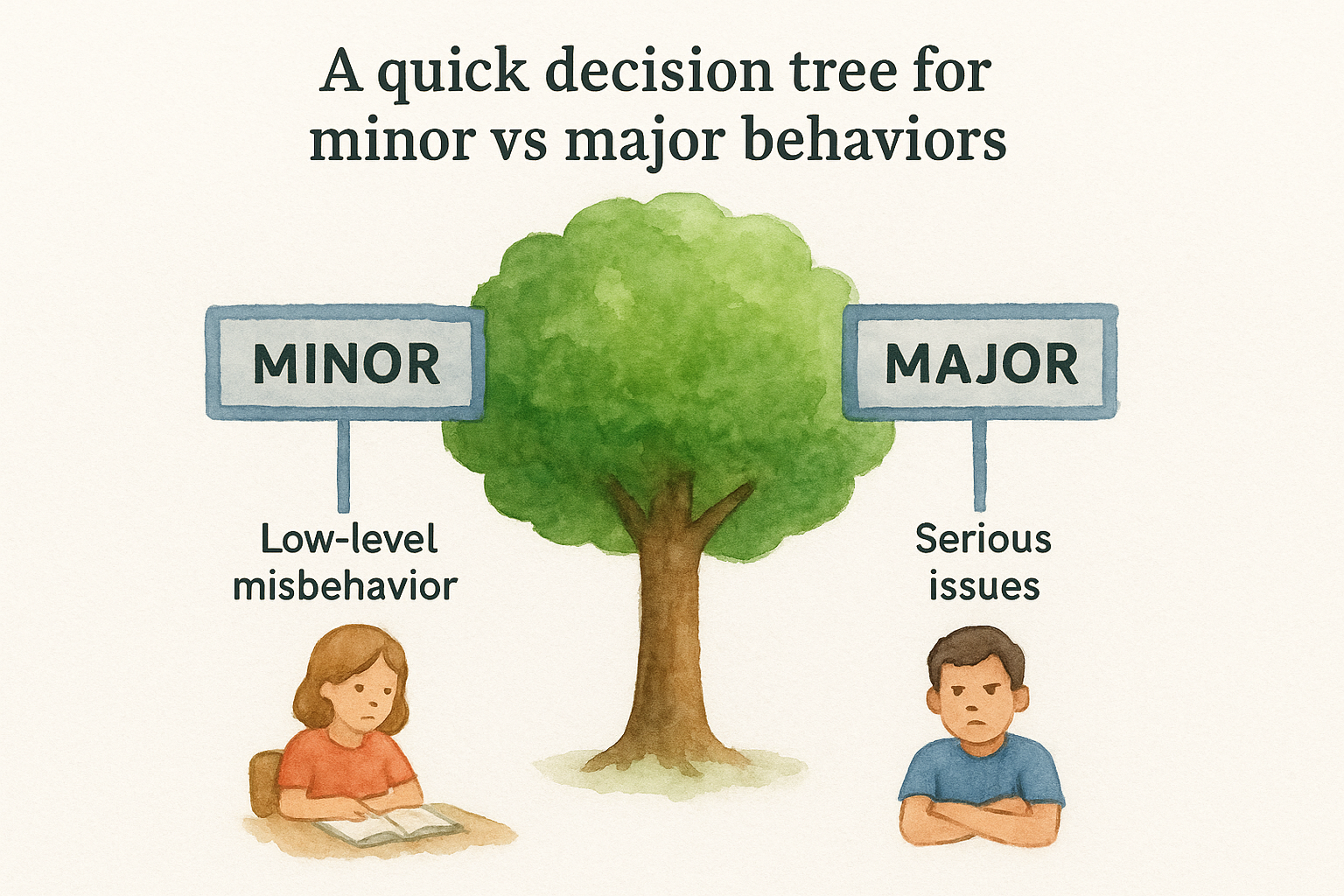
A quick decision tree for minor vs major behaviors
Not every behavior deserves the same response. Minor behaviors like off-task chatting or phone use get a quiet, non-verbal redirect first. Major behaviors like defiance, harassment, or safety issues require immediate, direct action and administrative involvement. Deciding this in advance keeps your response proportional and consistent every time.
Private redirections that stop repeat disruptions
When a student repeats low-level misbehavior, a private conversation works far better than a public callout. Step close, speak quietly, and state the specific behavior and what you need instead. Quiet, direct redirections cut off the audience dynamic that often fuels further disruption.
The moment you make a correction public, you risk turning a small issue into a performance.
Restorative follow-ups that actually change behavior
After addressing an incident, a brief restorative conversation gives the student a chance to understand the impact of their behavior and re-commit to your expectations. This follow-up is what separates a consequence that stings from one that actually shifts behavior going forward.
Documentation and family contact that stays factual
Keep your records specific and behavioral: date, time, what was observed, and what action you took. When you contact families, stick to observable facts and avoid interpretive language that puts parents on the defensive before the conversation even starts.
6. Set up the room and tech norms for smooth flow
Your physical environment and technology rules are part of your classroom management best practices toolkit, not an afterthought. When your room layout and tech norms are well-designed, students spend less time confused and more time working.
Layout choices that improve visibility, movement, and teamwork
Arrange your seating so you can reach every student within a few steps and make eye contact with the full room from multiple positions. Group configurations work well for collaboration, but make sure traffic lanes stay clear so transitions don’t turn into bottlenecks.
Materials and pacing that reduce downtime
Downtime is where disruption lives. Keep materials pre-staged and accessible so students aren’t waiting on you to distribute supplies mid-lesson. Build your pacing with a visible timer or agenda on the board so students always know what’s coming next and transition without prompting.
A student who knows exactly what to do next is a student who isn’t looking for trouble.
Phone, laptop, and AI-use norms students understand
Write your device expectations in behavioral terms: phones face-down during instruction, laptops open only for assigned tasks. Teach students specifically when AI tools are permitted and what responsible use looks like in your class, rather than banning everything or leaving it undefined.
Online and hybrid management basics that keep participation high
For virtual or hybrid settings, camera norms, chat protocols, and breakout room expectations need the same explicit teaching you’d give any in-person procedure. Assign clear roles during group work and use structured response formats to keep every student accountable and engaged.
Next steps for a calmer class
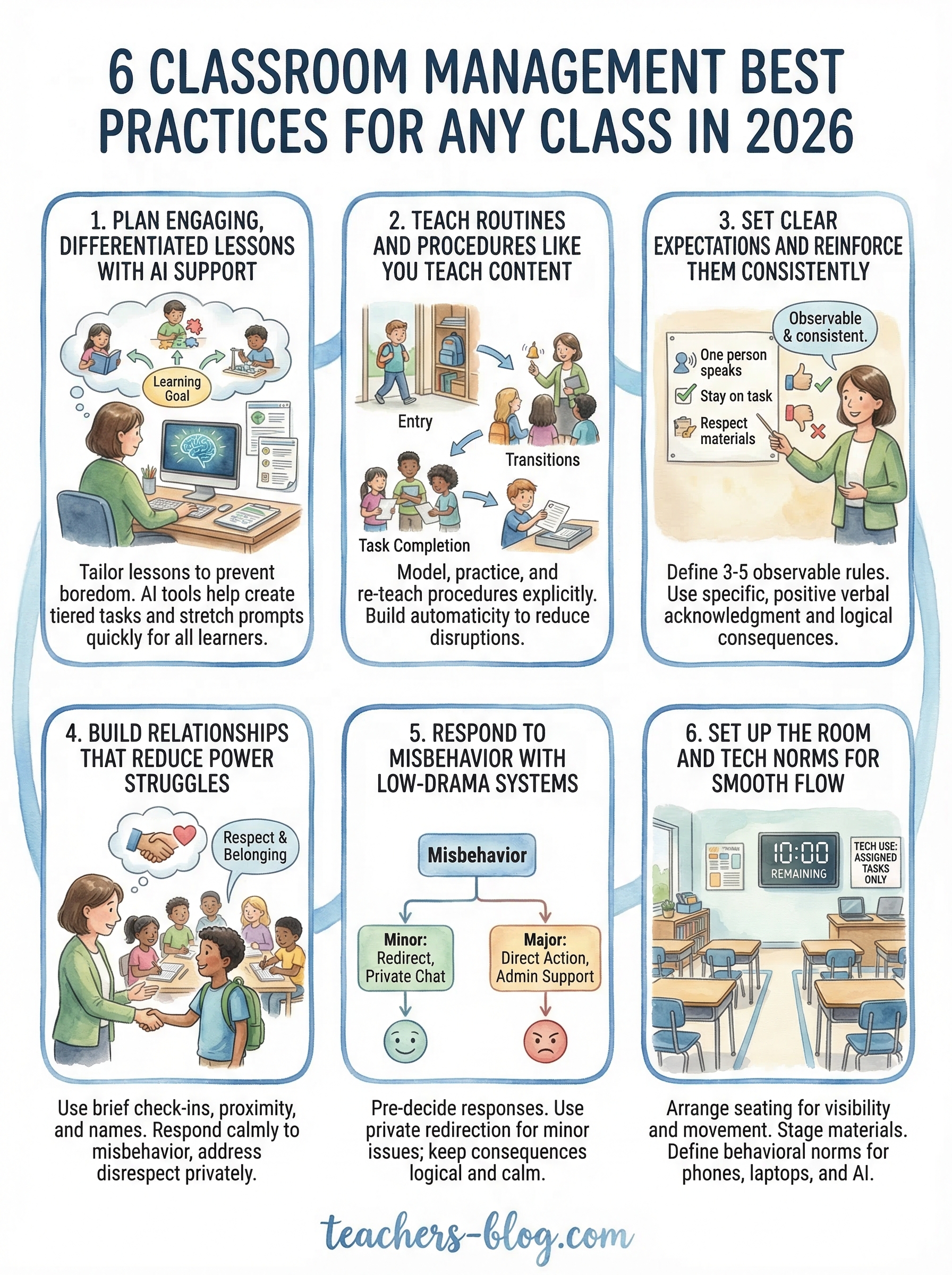
These six classroom management best practices work because they target the actual causes of classroom chaos, not just the surface symptoms. When your lessons engage every learner, your routines run on autopilot, and your relationships with students are solid, most behavior problems stop before they start.
Pick one practice from this list and apply it this week. Start with whatever feels most urgent in your classroom right now. Small, consistent changes compound into a classroom culture that runs smoothly month after month. You don’t need to overhaul everything at once to see real results.
Your next move doesn’t have to be complicated. Head over to The Cautiously Optimistic Teacher for AI-powered tools, lesson resources, and practical strategies built specifically to help educators work smarter and spend more time doing what actually matters in the classroom.