
Carol Ann Tomlinson Differentiated Instruction Explained
Explore more in our Differentiated Instruction resource hub. Find related strategies, examples, assessment ideas, learner supports, and subject-specific guides.
Every student in your classroom learns differently, that’s not a revelation, it’s a daily reality. But turning that reality into actionable teaching practice? That’s where Carol Ann Tomlinson differentiated instruction comes in. Tomlinson, a former middle school teacher turned researcher at the University of Virginia, built a framework that gives educators a structured way to respond to learner variance without burning out or reinventing the wheel every period.
Her model centers on four pillars, content, process, product, and learning environment, and it’s shaped how schools across the country think about meeting diverse student needs. Whether you’re new to differentiation or looking to sharpen your approach, understanding Tomlinson’s framework gives you a common language and a practical blueprint for reaching more learners. That’s exactly the kind of work we focus on here at The Cautiously Optimistic Teacher: helping educators find strategies and tools that actually work in real classrooms.
This article breaks down Tomlinson’s core principles, explains the reasoning behind them, and walks through concrete ways to implement differentiated instruction in your own practice. You’ll also find connections to resources, including our AI-powered Differentiated Instruction Helper, designed to make the process less overwhelming and more sustainable.
Meet Carol Ann Tomlinson and her big idea
Before Tomlinson became one of the most recognized names in education, she spent 21 years teaching in public schools, including time working with students who had both learning disabilities and gifted designations in the same room. That firsthand experience shaped everything she would later research and publish. When she joined the faculty at the University of Virginia’s Curry School of Education, she brought the perspective of someone who had stood in front of 30 students with 30 different needs and asked, "What do I actually do with this?"
From classroom teacher to published researcher
Her years in the classroom gave her a real problem to solve, and her academic career gave her the tools to solve it. Tomlinson developed differentiated instruction through years of working directly with teachers, studying learning theory, and synthesizing research on how students develop at different rates and in different ways. Her landmark book, The Differentiated Classroom: Responding to the Needs of All Learners, first published in 1999, gave educators a framework they could apply immediately. It was not abstract theory. It was built on practical classroom observation and grounded in decades of collaboration with real teachers facing real instructional challenges.
Tomlinson’s framework carries weight because it came from the classroom first, not from a theory textbook written in isolation.
The idea that reshaped how teachers think about learners
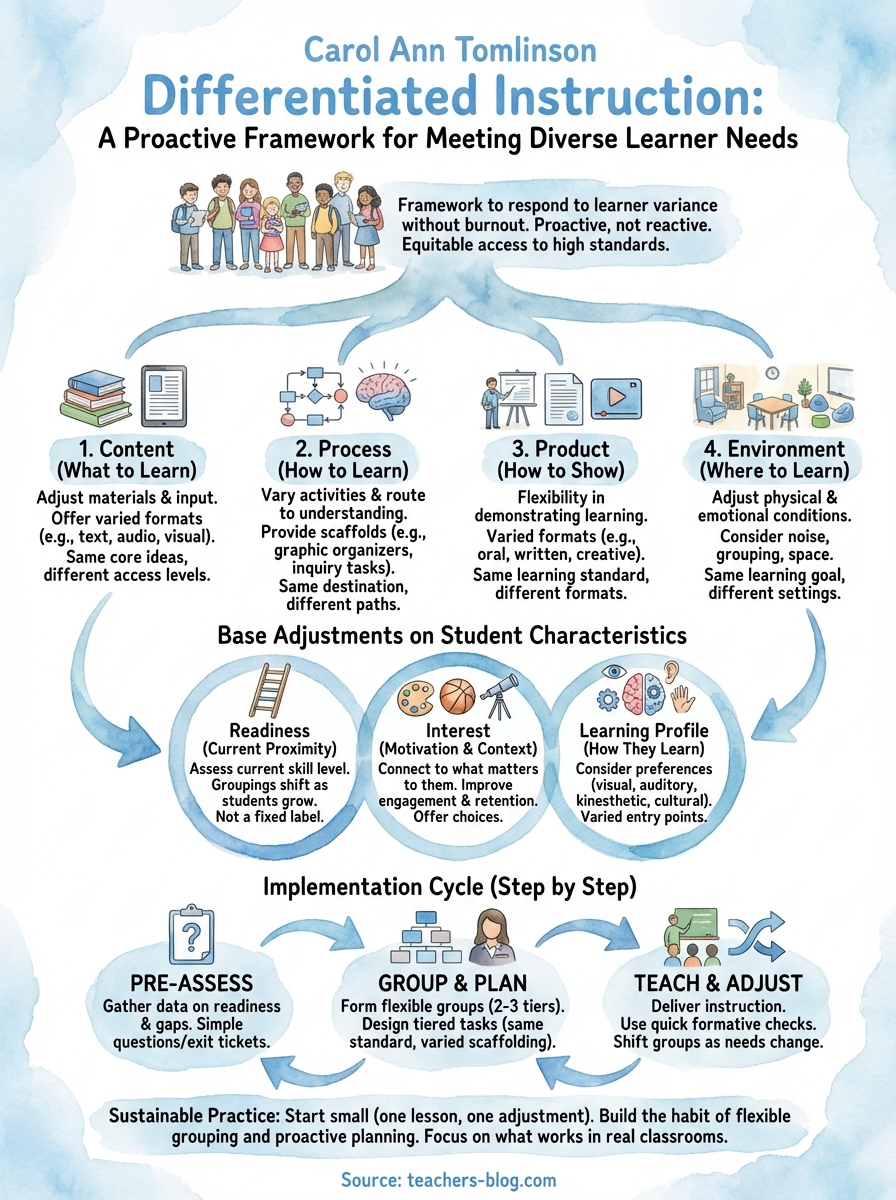
At its core, Carol Ann Tomlinson differentiated instruction argues that a one-size-fits-all approach to teaching fails most students most of the time. Tomlinson identified that students differ in readiness, interest, and learning profile, and that effective teachers respond to those differences proactively rather than waiting for failure to signal a need for change. Instead of designing a single lesson and hoping it lands for everyone, differentiation asks you to build flexibility into your instruction from the start.
Her framework does not ask you to write 30 individual lesson plans. Instead, it gives you structured ways to modify what students learn, how they learn it, how they demonstrate understanding, and the environment in which they work. That shift from reactive to proactive, from uniform to flexible, is what makes Tomlinson’s thinking so durable and widely applied. Teachers have used her principles in kindergarten classrooms, Advanced Placement courses, and special education settings because the core logic holds wherever students bring different strengths and needs into the same room.
Understand what DI is and what it is not
Differentiated instruction gets misread often, and that misreading leads teachers to either dismiss it as too complicated or misapply it in ways that do not help students. Before you can use Tomlinson’s framework effectively, you need a clear mental model of what it actually means and what it does not mean. Getting this distinction right will save you time, reduce frustration, and keep your implementation grounded in what the research actually supports.
What differentiated instruction actually is
Carol Ann Tomlinson differentiated instruction is a proactive teaching approach, not a reactive one. You design lessons that build in flexible pathways from the start, rather than adjusting after students have already struggled or mentally checked out. The goal is not equal treatment; it is equitable access to challenging, meaningful learning for every student in the room, regardless of where they are starting from.
Differentiation means giving students what they need to reach high standards, not lowering the bar for some and raising it for others.
What differentiated instruction is not
Many teachers hear "differentiation" and picture 30 separate lesson plans, one for each student. That is not what Tomlinson describes, and it is not realistic. Differentiation is also not the same as tracking students into fixed ability groups where lower-performing students consistently receive watered-down content. That approach reinforces gaps rather than closing them.
It is also not a free-for-all where students pick whatever they want with no guidance or structure. Tomlinson’s model keeps the teacher in a clear leadership role, making deliberate decisions about when and how to adjust instruction based on ongoing assessment data. Structure and flexibility work together in this framework, not against each other.
Differentiate content, process, product, and environment
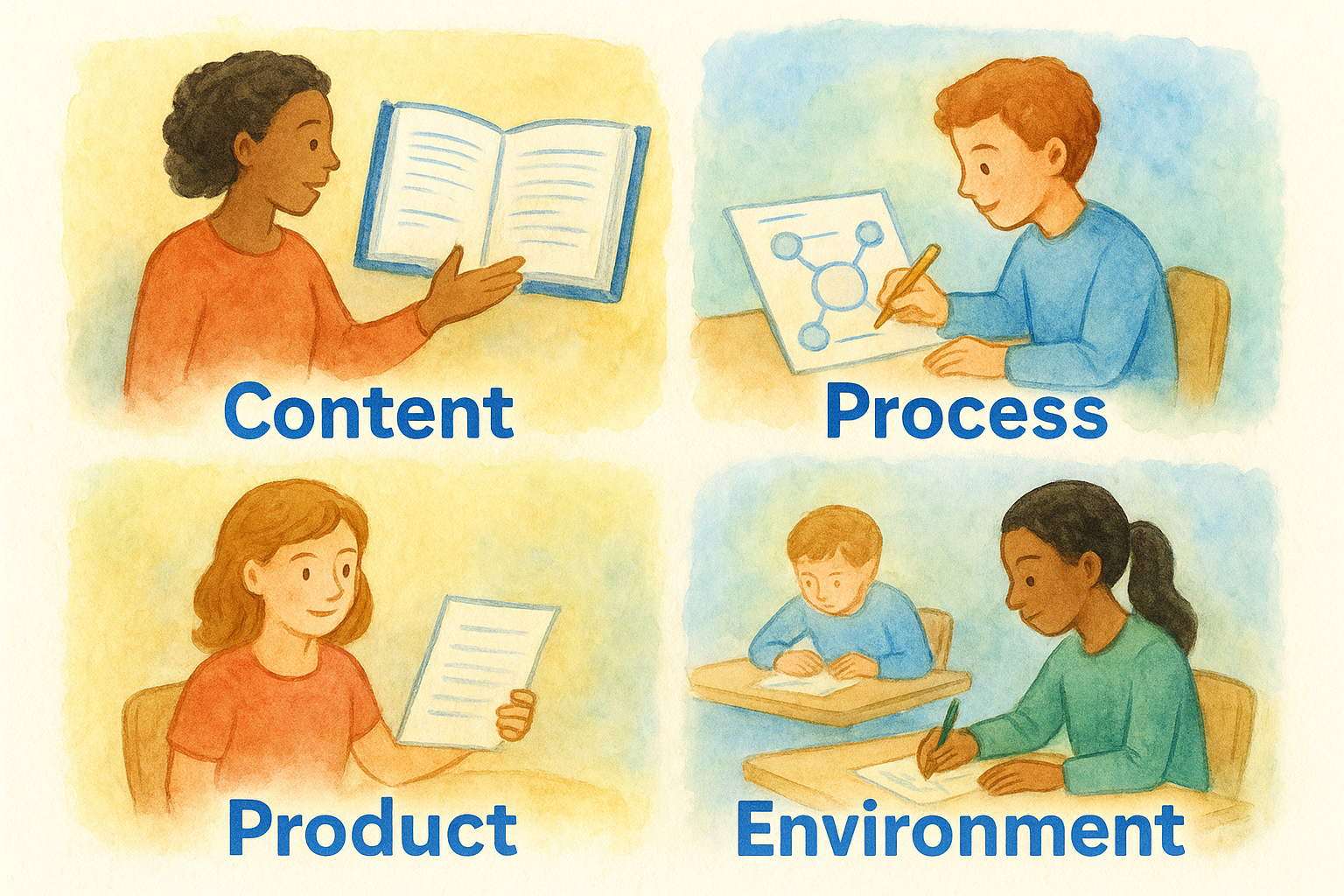
The four elements of Carol Ann Tomlinson differentiated instruction give you a practical framework for deciding exactly where and how to adjust your teaching. You do not need to change all four in every lesson, but understanding each one helps you make deliberate, targeted decisions about where flexibility will have the most impact for your students.
Content and process
Content refers to what students learn and the input materials you use to deliver it. You can differentiate content by adjusting text complexity, providing vocabulary support in advance, or offering an audio recording alongside the print version. The goal is to give every student access to the same core ideas at a level of challenge that fits where they are right now.
Process describes the activities students use to make sense of new information. You might give some students a graphic organizer while others work through an open-ended inquiry task, depending on their current understanding. Differentiating process means varying the route to understanding, not the destination.
Adjusting process does not mean giving easier work to struggling students; it means giving every student the activity that moves their thinking forward.
Product and environment
Product is how students demonstrate what they have learned. A student who struggles with writing but communicates well verbally might record an explanation rather than submit a written report, while still meeting the same learning standard as everyone else. You keep the bar consistent and vary the format.
Environment covers the physical and emotional conditions in your classroom. Some students work best with quiet individual space, while others thrive in collaborative settings. Small adjustments like seating arrangements, noise levels, or grouping structures can significantly affect how well students engage with and retain new learning.
Plan for readiness, interest, and learning profile
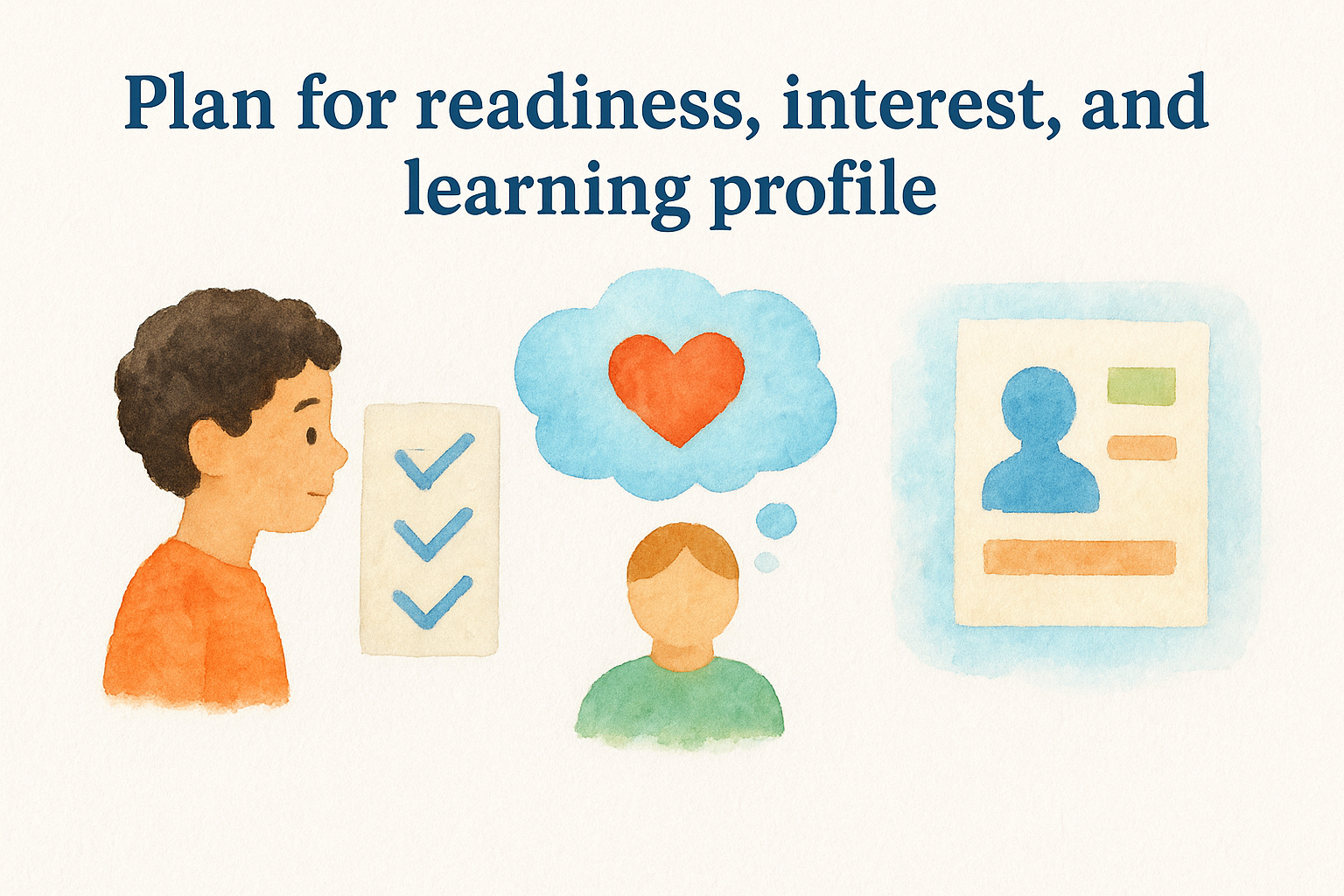
When you apply Carol Ann Tomlinson differentiated instruction, you base your adjustments on three specific student characteristics: readiness, interest, and learning profile. These are not guesses you make on day one. You gather data through pre-assessments, observations, and conversations, then use that information to make deliberate instructional decisions that meet students where they actually are, not where you hope they are.
Readiness
Readiness refers to a student’s current proximity to the learning goal, and it is probably the variable you already think about most often. When you adjust for readiness, you are not placing students into permanent ability groups. You are responding to where a student stands right now on a specific skill or concept, which means groupings can and should shift as students grow.
Readiness is not a fixed label. It changes with every new unit, and your instruction should reflect that.
Quick pre-assessments before each unit give you accurate, timely readiness data. Exit tickets, short written responses, or a few targeted questions at the start of class all give you enough information to adjust task complexity and grouping before students struggle.
Interest and learning profile
Interest tells you what topics, questions, or contexts will pull a student into the work. When you connect learning to something a student already cares about, engagement and retention both improve. Small choices, like the examples you use or the topic options available for a project, can make a meaningful difference without requiring a full redesign of every lesson.
Learning profile covers how a student learns best, including preferred modality, cultural background, and environmental preferences. Some students process information better through visual formats while others need to talk through ideas. Attending to learning profile helps you offer varied entry points without lowering expectations for anyone in the room.
Implement DI step by step in a real classroom
Knowing the theory behind Carol Ann Tomlinson differentiated instruction matters, but the real work happens when you translate it into a concrete, repeatable cycle. You do not need to overhaul every lesson at once. Build this sequence into your unit planning and apply it consistently until it becomes routine.
Start with a pre-assessment
Before you teach anything, find out what your students already know and where their gaps are. A short pre-assessment, five to ten questions or a brief written response, gives you accurate data to form flexible groups and set your instructional starting point. Without this step, you are guessing, and that wastes time for everyone.
Your pre-assessment does not have to be graded. Its only job is to give you actionable information before instruction begins.
From there, sort your students into two or three readiness tiers rather than individual categories. That keeps your planning workload manageable while still letting you target instruction where it matters most.
Group, teach, and adjust
Once you have your data, design two or three versions of the core task rather than one uniform assignment. Keep the learning standard identical across all versions and vary only the level of scaffolding or complexity. Assign students to groups based on your pre-assessment results, not on assumptions.
After the lesson, use a quick formative check, an exit ticket or a short discussion, to see whether your groupings still make sense. Readiness shifts quickly, and your groups should shift with it. Reassess at the start of the next lesson and adjust before students fall behind.
A simple way to start tomorrow
Carol Ann Tomlinson differentiated instruction does not require a full classroom overhaul before your next class period. Pick one upcoming lesson and write three to five questions that tell you where your students currently stand on the main concept. Use those answers to split the class into two readiness groups and design two versions of the core task, one with more scaffolding and one with more complexity. Keep the learning standard identical for both groups.
That single adjustment, done consistently, builds the habit that makes differentiation sustainable over time. Pre-assessment becomes faster, flexible grouping starts to feel natural, and your students begin experiencing instruction that fits where they actually are. The framework grows as your practice does.
When you’re ready to move faster, the Differentiated Instruction Helper at The Cautiously Optimistic Teacher can generate tiered tasks and scaffolded materials in minutes, so you spend less time planning and more time actually teaching.