
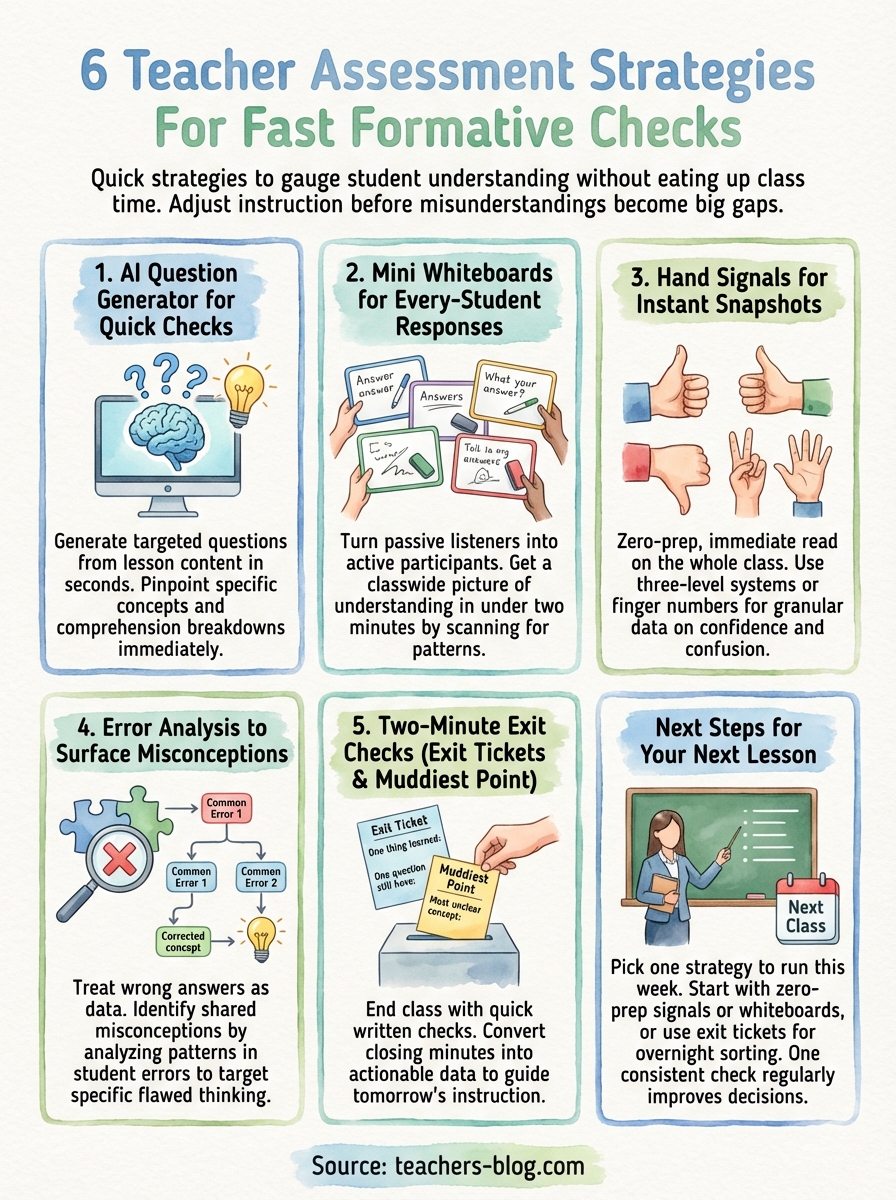
6 Teacher Assessment Strategies For Fast Formative Checks
You just taught a lesson you spent an hour planning. Students nodded along. A few even asked questions. But when you look at their exit slips the next day, half the class missed the point entirely. Sound familiar? The gap between what we think students understood and what they actually retained is where teacher assessment strategies matter most, specifically, the quick formative ones you can run without eating up your entire class period.
At The Cautiously Optimistic Teacher, we build resources that help educators work smarter in real classrooms with real constraints. That includes knowing when and how to check for understanding on the fly, not just at the end of a unit when it’s too late to course-correct. Formative assessment isn’t about adding more to your plate. It’s about getting clearer signals from students so you can adjust instruction before small misunderstandings become big ones.
Below, you’ll find six practical assessment strategies you can start using this week. Each one is designed for speed and clarity, no lengthy rubrics, no elaborate setups. Just straightforward techniques that tell you what your students know right now.
1. Use an AI question generator for quick checks
Writing questions from scratch takes time you don’t have between lessons. An AI question generator solves this by producing a targeted set of questions in seconds, giving you a ready-made formative check without extra prep work. This is one of the most practical teacher assessment strategies available to modern educators because it removes the bottleneck between identifying what to check and actually checking it.
What this strategy helps you measure fast
A question generator lets you pinpoint specific concepts from your lesson and immediately test whether students understood them. Instead of relying on vague impressions or a show of hands, you get concrete responses that reveal where comprehension breaks down before the next lesson begins.
How to run it in under 5 minutes
Paste your lesson content, a paragraph from a textbook, or a list of key terms into the tool. Within seconds, you have five to ten questions ready to drop into a Google Form, a quick verbal poll, or a paper slip. Students answer, you scan the results, and you know exactly what to address next.
Question types that reveal real understanding
Not all questions give you the same data. Multiple-choice questions catch surface-level errors quickly, but short-answer and explanation prompts reveal whether students actually understand the reasoning behind a concept. Mixing both types into a single check gives you two layers of insight without taking up more than a few minutes of class time.
Asking students to explain their answer in one sentence exposes more about their thinking than a correct multiple-choice selection ever will.
How to respond to results in the moment
When you spot a pattern of wrong answers, resist the urge to reteach the entire lesson. Instead, target the specific misconception directly with one clear example or a short pair-and-share. Your class keeps moving forward while you still fix the gap you identified in real time.
When to use The Cautiously Optimistic Teacher question generator
The Question Generator at The Cautiously Optimistic Teacher is built for exactly this kind of fast formative check. Paste in your material, choose your question type, and get classroom-ready questions in under a minute. It works especially well when you want to assess understanding of complex reading passages or multi-step concepts without spending your planning period writing questions by hand.
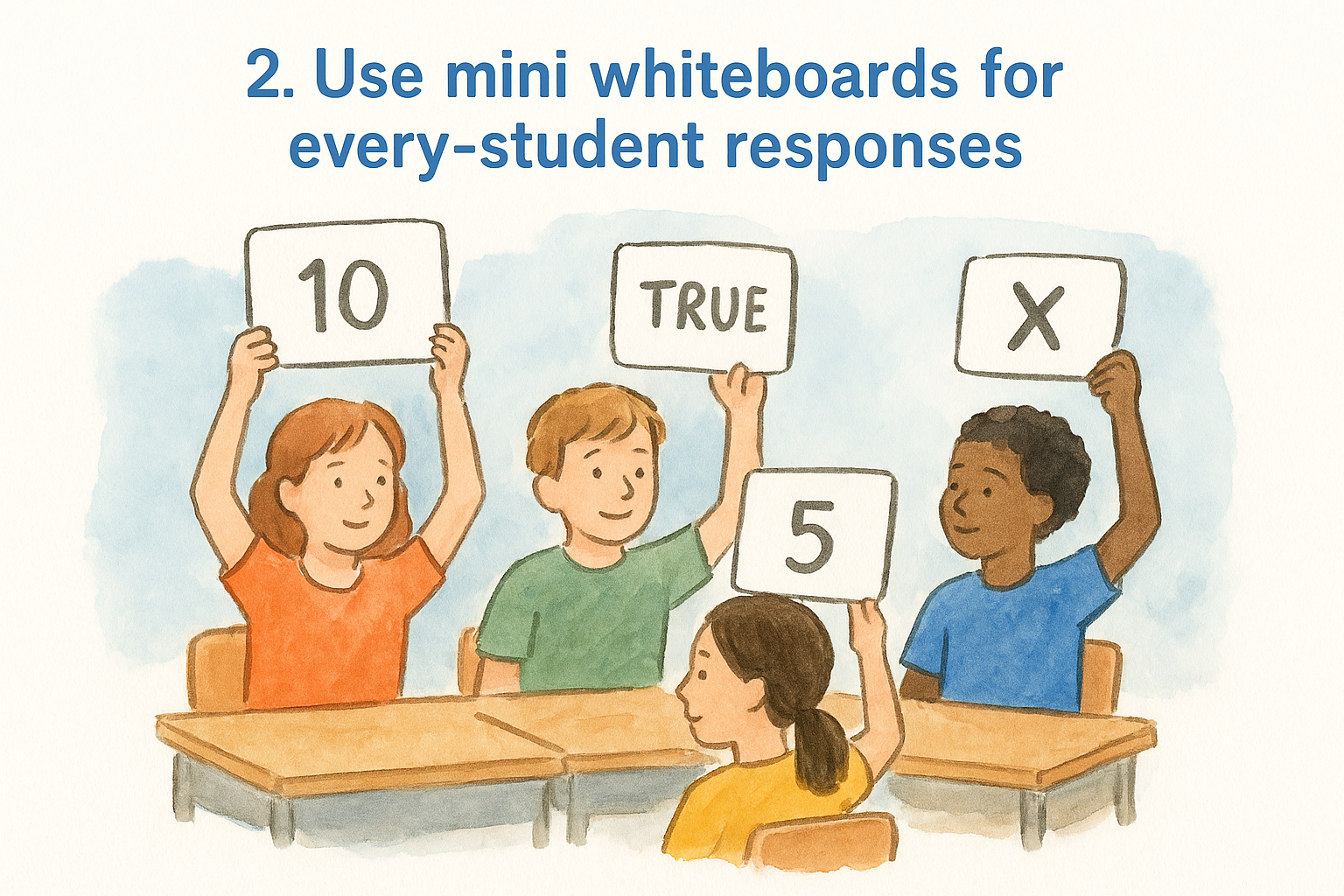
2. Use mini whiteboards for every-student responses
Mini whiteboards turn passive listeners into active participants by requiring every student to produce a visible response at the same time. This makes them one of the most efficient teacher assessment strategies for getting a classwide picture in under two minutes.
Why whiteboards beat calling on volunteers
When you call on volunteers, you hear from the same few students who already understand the material. Whiteboards force every student to commit to an answer simultaneously, so you see the full range of understanding rather than just the confident few.
How to set routines that stay fast and focused
Keep it simple: students write, hold boards up on your signal, then erase. Practicing this routine in the first week of school saves you significant time later. A consistent signal, like a raised hand or a countdown, keeps the pace tight.
The fastest formative checks work because students know exactly what to do before you even ask.
What to scan for and how to sort misconceptions
You’re not grading every board. You’re looking for patterns in wrong answers that point to a shared misconception. Group boards mentally into "got it," "close," and "needs reteaching" as you scan the room.
Low-prep prompts that work in any subject
Ask students to write one key term, solve a single problem, or draw a quick diagram. These prompts require zero preparation and work across every subject area.
Variations for different ages and classroom setups
Younger students respond well to true/false prompts or drawing responses. For older students or 1:1 device classrooms, digital tools like shared Google Slides can replicate the same whiteboard effect.
3. Use hand signals for instant classwide snapshots
Hand signals give you an immediate read on the whole class without stopping your lesson. As one of the simplest teacher assessment strategies available, they take zero materials, zero prep, and less than thirty seconds to run. Students show you where they stand, and you get a classwide picture in real time.
Best signals for confidence vs confusion
A simple three-level system works best: thumbs up for "I’ve got it," thumbs sideways for "I’m not sure," and thumbs down for "I’m lost." You can also use finger numbers where one means confused and five means fully confident. These systems give you more granular data than a binary yes or no ever will.
Three-level signals separate the students who are partly there from the ones who need immediate support.
How to avoid social pressure and copycat answers
Ask students to close their eyes or look down before showing their signal. This small step breaks the instinct to copy the confident students in front of them, so your data reflects actual understanding rather than social conformity.
When to switch from signals to a deeper check
If more than a quarter of your class signals confusion, a quick pair-share or targeted question will give you better data than signals alone. Signals tell you that a problem exists; a follow-up tells you exactly what the problem is.
Ways to track signals without breaking flow
Do a quick mental tally as you scan the room: roughly how many thumbs up, sideways, and down. You do not need exact numbers, just a directional sense of where your class stands.
Inclusive options for students who prefer privacy
Some students feel exposed by public signals, especially in middle or high school. Offering a private option like writing the number on a sticky note or showing a signal below desk level keeps those students honest without putting them on the spot.
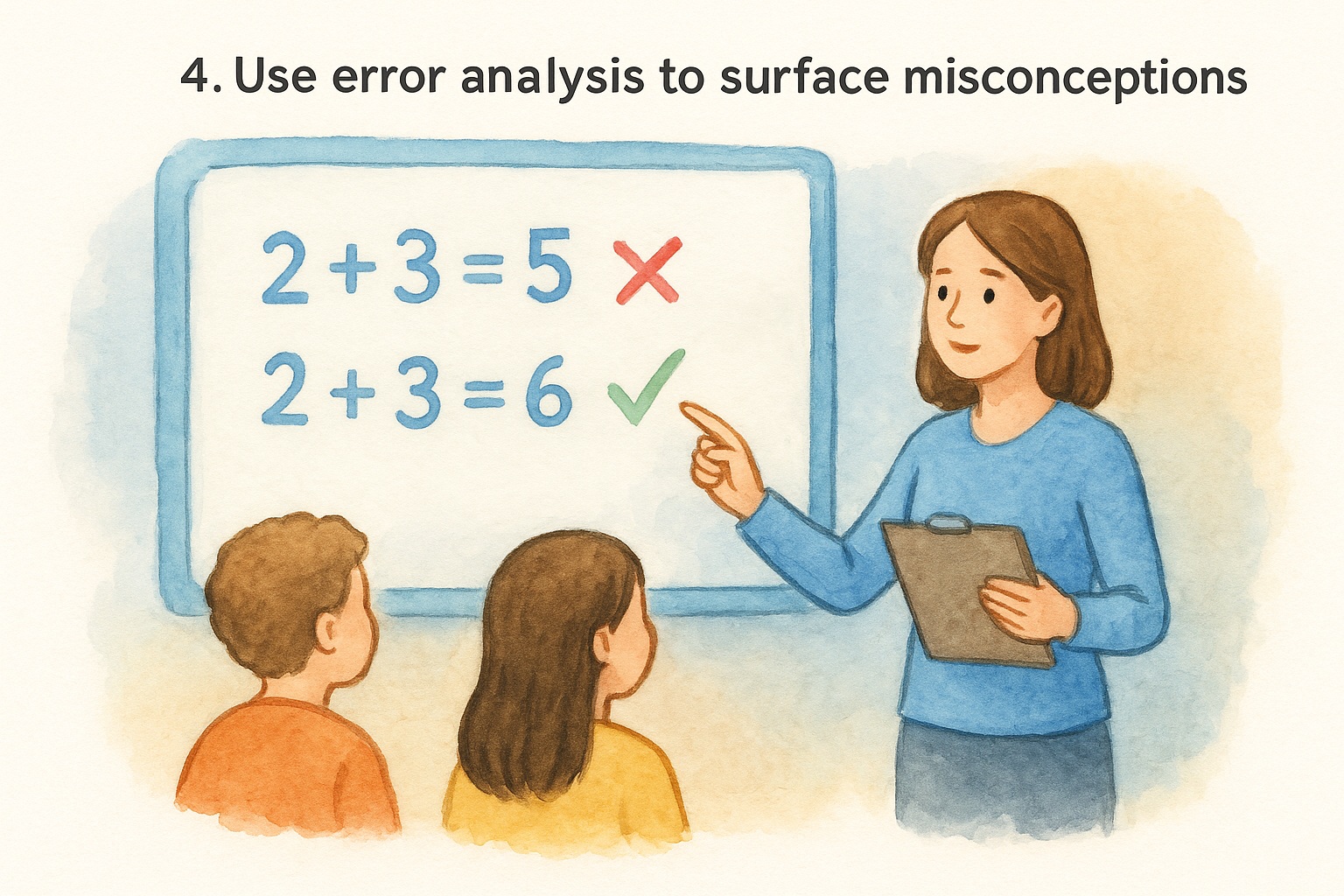
4. Use error analysis to surface misconceptions
Error analysis flips the script on traditional assessment by treating wrong answers as data, not failures. Among teacher assessment strategies, this one consistently gives you the clearest picture of what students actually believe, which is often more useful than knowing who got the right answer.
Why wrong answers give you better data than right ones
A correct answer tells you a student arrived at the right place. A wrong answer tells you exactly where their thinking broke down. When multiple students make the same error, you have found a shared misconception worth addressing directly.
Wrong answers are the most specific feedback your class can give you.
How to build a fast misconception check
Pull two or three common errors from previous assessments or from your own experience teaching the concept. Present them as examples and ask students to identify and explain what went wrong. This takes less than five minutes to set up and generates immediate, targeted discussion.
What to listen for during partner explanations
When students talk through an error with a partner, listen for circular reasoning or restated definitions that avoid explaining the actual concept. These are signs a student cannot yet connect the idea to their existing understanding.
How to follow up without reteaching everything
Target the misconception directly with one concrete example that isolates the error. You do not need to restart the lesson; you just need to close the specific gap your analysis revealed.
Common pitfalls and how to prevent them
Avoid presenting errors without context, since students may memorize the wrong answer instead of understanding why it fails. Always pair the error with a clear correct comparison.
5. Run two exit checks that take 2 minutes
Two minutes at the end of class can tell you more than an entire quiz. Exit tickets and muddiest point checks are among the most efficient teacher assessment strategies because they convert closing minutes into actionable data you can use before the next lesson starts.
Exit tickets that give you usable data tomorrow
Ask students to write one thing they learned and one question they still have on a sticky note or index card. This format forces retrieval practice and surfaces real confusion before it compounds overnight.
The best exit tickets produce data you can sort and act on before your next class begins.
Muddiest point for quick clarity checks
At the end of a lesson, ask students to write down the muddiest point, meaning the concept that still feels unclear. Keep the prompt simple and open-ended so students write what they actually mean, not what they think you want to hear.
How to sort responses quickly and spot patterns
Flip through cards and sort them into two or three piles based on the type of confusion each card shows. Look for repeated themes across the pile, not individual quirks, and the whole sort takes under three minutes.
Next-day instructional moves based on what you find
If most students flagged the same point, open the next class by addressing it directly before anything else. Scattered confusion calls for a brief pair-share in the first five minutes rather than a full reteach.
Variations for digital, paper, and no-prep days
On digital days, use a Google Form with two fields to collect responses instantly. On no-prep days, ask students to verbally name their muddiest point as they walk out the door.
Next steps for your next lesson
You now have six teacher assessment strategies that fit inside a normal class period without requiring extra materials or elaborate setup. Each one gives you real-time data on where students stand so you can adjust your instruction before misunderstandings take hold.
Pick one strategy from this list and run it in your next class. Start with hand signals or mini whiteboards if you want zero prep, or use an exit ticket if you want something you can sort and act on overnight. You do not need to implement all six at once; one consistent check used regularly will improve your instructional decisions far more than six strategies used once.
For more classroom tools and resources that help you teach smarter, visit The Cautiously Optimistic Teacher and explore what we have built for educators who want practical, proven strategies that actually work in real classrooms.