
Restorative Circles in the Classroom: Reflection, Accountability, and Repair
Restorative circles in the classroom are structured group conversations designed to build community, address harm, and clarify responsibility. By moving from a “rules-based” to a “relationship-based” model, circles allow students to understand the collective impact of their actions. This collaborative approach fosters behavioral fluency by teaching students how to navigate social conflict and restore trust within a group setting without the use of shame or forced apologies.
This is Lesson 3 of Module 8: Restorative Approaches to Classroom Management | Full Course Outline
Mindset Shift: From Lecture to Listening
| The Traditional Lecture | The Restorative Circle |
| Teacher Role: The Judge/Speaker. | Teacher Role: The Facilitator/Listener. |
| Student Role: Passive recipient of a lecture. | Student Role: Active participant in repair. |
| Communication: One-to-many (top-down). | Communication: Many-to-many (circular). |
| Goal: Obedience to the teacher. | Goal: Accountability to the community. |
| Result: Compliance (Temporary). | Result: Behavioral Fluency (Long-term). |
If you’ve ever tried to “fix” a classroom conflict with a quick hallway conversation, you already know this: tt often doesn’t stick.
The apology is rushed.
The resentment lingers.
The behavior resurfaces two weeks later.
That’s because most discipline addresses the rule — not the relationship.
Restorative circles in the classroom are different. They slow things down just enough to create reflection, rebuild trust, and restore the learning community.
This isn’t about being soft.
It’s about being strategic.
What Restorative Circles in the Classroom Actually Do
Restorative circles are structured conversations that:
Center voice and listening
Focus on impact rather than punishment
Create shared understanding
Clarify responsibility
Lead to meaningful repair
They are not group therapy.
They are not public shaming sessions.
They are not forced apologies.
They are structured, predictable conversations designed to protect community.
Where Restorative Circles in the Classroom Come From
Restorative practices in schools are influenced by community-based justice traditions, including Indigenous circle processes and contemporary restorative justice frameworks developed by organizations such as the International Institute for Restorative Practices.
The key principle:
When harm happens, the question is not “What rule was broken?”
It’s “Who was affected, and how do we repair it?”
That shift alone changes classroom culture.
When to Use Restorative Circles in the Classroom
Use circles for:
Ongoing peer conflict
Disrespect that impacts group climate
Hurtful comments
Exclusion or social tension
Minor to moderate behavioral incidents
Re-entry after suspension
Resetting the tone after a tough week
Do not use circles:
In moments of active escalation
As a substitute for safety procedures
When a student is not regulated enough to participate
Circles require emotional readiness.
Three Types of Restorative Circles in the Classroom Every Teacher Should Know
1. Proactive Community-Building Circles
These happen before problems.
Short weekly circles build trust and belonging.
Examples:
“What helps you focus in class?”
“What’s one strength you bring to this group?”
“What does respect look like here?”
The more you build connection early, the easier repair becomes later.
2. Reflection Circles (After Minor Harm)
These address incidents without singling out one student publicly.
Structure:
What happened?
Who was affected?
How did it impact learning?
What needs to happen to move forward?
Keep tone neutral.
Stay focused on impact, not character.
3. Repair Circles (After Clear Harm)
These involve:
The person who caused harm
The person affected
Possibly a few trusted peers
Structure:
What happened?
What were you thinking at the time?
What have you thought about since?
Who has been affected?
What needs to happen to make things right?
Notice:
No lecturing.
No sarcasm.
No public humiliation.
Just clarity and responsibility.
The Essential Elements of Effective Restorative Circles in the Classroom
1. Predictable Structure
Students must know:
How it works
That everyone gets a turn
That interruptions aren’t allowed
That listening matters
Predictability creates safety.
2. A Physical Signal of Turn-Taking
Many teachers use:
A talking piece
A small object passed around
A visible cue
The rule is simple:
You speak when you hold it.
You listen when you don’t.
This alone reduces interruptions dramatically.
3. Clear Norms
Before your first circle, establish norms:
Listen without interrupting.
Speak from your own experience.
Assume positive intent.
What’s shared stays here (within safety boundaries).
Teach these norms explicitly.
4. Emotional Regulation Before Participation
If a student is dysregulated, wait.
Circles are not tools for calming someone mid-meltdown.
They are tools for reflection after regulation.
This aligns with trauma-informed approaches and nervous-system awareness.
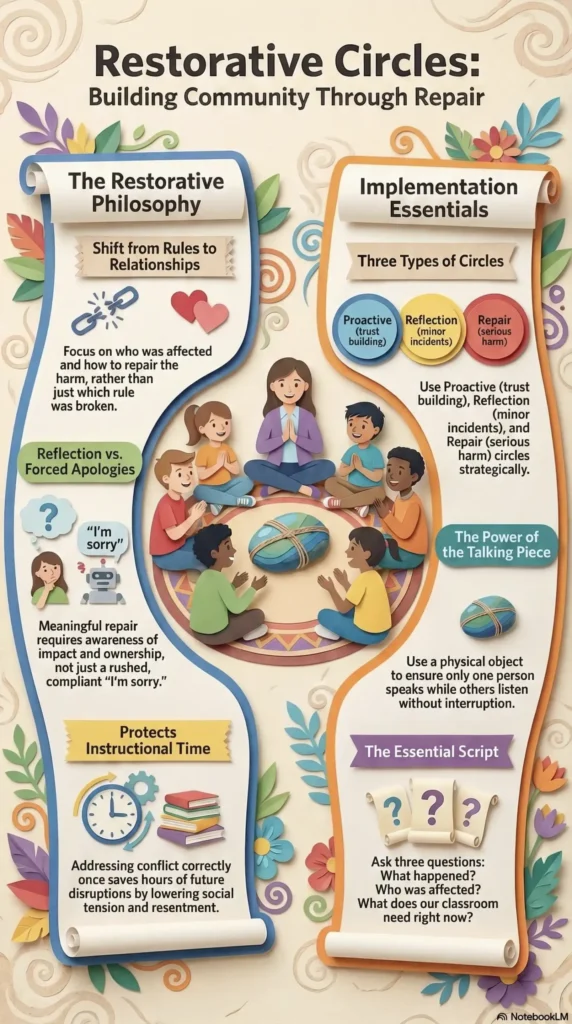
Reflection vs. Forced Apology
Here’s where many teachers go wrong:
“Say sorry.”
An apology without reflection is compliance.
Reflection without repair is incomplete.
Repair without accountability is hollow.
A restorative circle integrates all three:
Awareness of impact
Ownership of behavior
Agreement on repair
What Repair Actually Looks Like
Repair may include:
A verbal apology
Replacing damaged materials
Writing a reflection
Helping restore classroom space
Checking in with a peer
Creating a plan to prevent recurrence
The key:
Repair must connect directly to the harm.
Logical consequences and restorative repair can coexist beautifully when aligned.
How Restorative Circles in the Classroom Protect Instructional Time
Ironically, slowing down once often saves hours later.
When students:
Feel heard
Understand impact
See consistent follow-through
Behavior improves.
Resentment decreases.
Side comments drop.
Social tension lessens.
You regain teaching time.
Common Mistakes to Avoid During Restorative Circles in the Classroom
Running circles only after problems (build proactively first).
Turning it into a lecture.
Allowing cross-talk.
Rushing the process.
Forcing participation.
Silence is allowed. Reflection still happens.
A Simple Starter Script You Can Use Tomorrow
“Today we’re going to reset as a community.
We’re not here to blame.
We’re here to understand impact and decide how we move forward.”
Then ask:
What happened?
How did it affect you?
What does our classroom need right now?
Keep it simple.
Try This Tomorrow
Run a 5-minute proactive circle with this prompt:
“What helps you feel respected in a classroom?”
Listen carefully.
Write common themes on the board.
Refer back to them during the week.
You’ve just laid the foundation for future repair.
Restorative Circles in the Classroom FAQ
What are restorative circles in the classroom? Restorative circles are structured group discussions where students and teachers sit in a circle to build relationships or resolve conflict. They focus on the impact of behavior on the community and work together to find a way to make things right.
What are the three types of restorative circles? The three main types are: 1. Proactive/Community-building circles (to build trust), 2. Reflection circles (to address minor group issues), and 3. Repair circles (to resolve specific incidents of harm between individuals).
Do restorative circles replace consequences? No. Restorative circles make consequences meaningful. Instead of a detached penalty, the ‘consequence’ in a circle is the act of listening to those affected and taking specific actions to repair the relationship and the classroom environment.
Reflection
I remember using a short reflection circle with my class after a tense week where small frustrations kept building between students. Instead of addressing each incident separately, the circle gave everyone a chance to speak, listen, and reset expectations together, and the tone in the room shifted almost immediately afterward. It reminded me that sometimes the fastest way forward is to slow things down and repair the community as a group.
- When conflict affects more than one student, how often do you address the impact on the group rather than focusing only on individual behavior?
- How comfortable would you feel guiding a short reflection circle after a week when classroom energy feels unsettled?
- What is one situation in your classroom where a structured circle could help rebuild trust instead of relying on repeated reminders or consequences?
Continue the Classroom Management Course
In the next lesson, you will learn how explicitly teaching responsibility and empathy helps students understand the impact of their actions, take ownership of mistakes, and repair harm as part of a stronger classroom community.
Next Lesson: Teaching Responsibility and Empathy
Module 8 Progress:
- What Restorative Practices Are (and Aren’t)
Circles, Reflection, and Repair
Back to Module 8 Overview
Return to Full Course Outline