Lesson Planning for Special Education: Align Lessons to IEPs
You’ve got a stack of IEPs on your desk, each with unique goals, accommodations, and modifications. Now you need to translate all of that into lesson planning for special education that actually works for every student in your room. It’s a lot.
The challenge isn’t just creating engaging lessons, it’s making sure those lessons align with each student’s IEP goals while managing different accommodations simultaneously. Many teachers spend hours trying to piece together age-appropriate materials that meet legal requirements and genuinely support student growth.
This guide breaks down the process into manageable steps. You’ll find practical strategies for aligning activities with IEP objectives, handling accommodations efficiently, and locating resources that save you time. At The Cautiously Optimistic Teacher, we believe effective special education planning shouldn’t require reinventing the wheel, it should give you a clear framework to build on.
What makes special education lesson planning different
General education teachers plan for a class. You plan for individual students with legal documents that define their learning targets. Every activity you design must connect back to specific IEP goals while meeting state standards, and that dual requirement fundamentally changes how you approach lesson planning for special education.
Legal obligations drive every decision
Your lesson plans aren’t just instructional tools, they’re evidence of compliance. Each IEP includes measurable goals that you’re legally required to address, and your plans need to show how students access those goals during instruction. If a student’s IEP lists a reading comprehension goal, your lesson must explicitly incorporate opportunities for that student to practice comprehension strategies at their level.
You can’t rely on generic lesson templates because each student’s IEP creates unique instructional requirements.
District administrators and parents can request your plans during IEP meetings or reviews. Documentation matters because you need to demonstrate that you’re providing appropriate services as outlined in each student’s plan. This level of accountability doesn’t exist in general education settings.
Multiple learning profiles in one room
You might have five students working on five different grade-level standards simultaneously. One student needs third-grade math content while another tackles sixth-grade material, both sitting in the same classroom during the same lesson block. General education teachers differentiate for student interests or readiness, but you’re managing completely different curricula for different learners.
Your materials need to reflect this reality. Consider a typical reading lesson:
- Student A reads a modified text at second-grade level with picture supports
- Student B accesses the same story through an audio version with comprehension checks
- Student C reads grade-level text independently with graphic organizers
- Student D works on sight word recognition using the same story’s vocabulary
Each student pursues distinct IEP goals through variations of the same lesson theme. This requires intentional planning structures that general education templates don’t accommodate.
Step 1. Read IEPs and map goals to routines
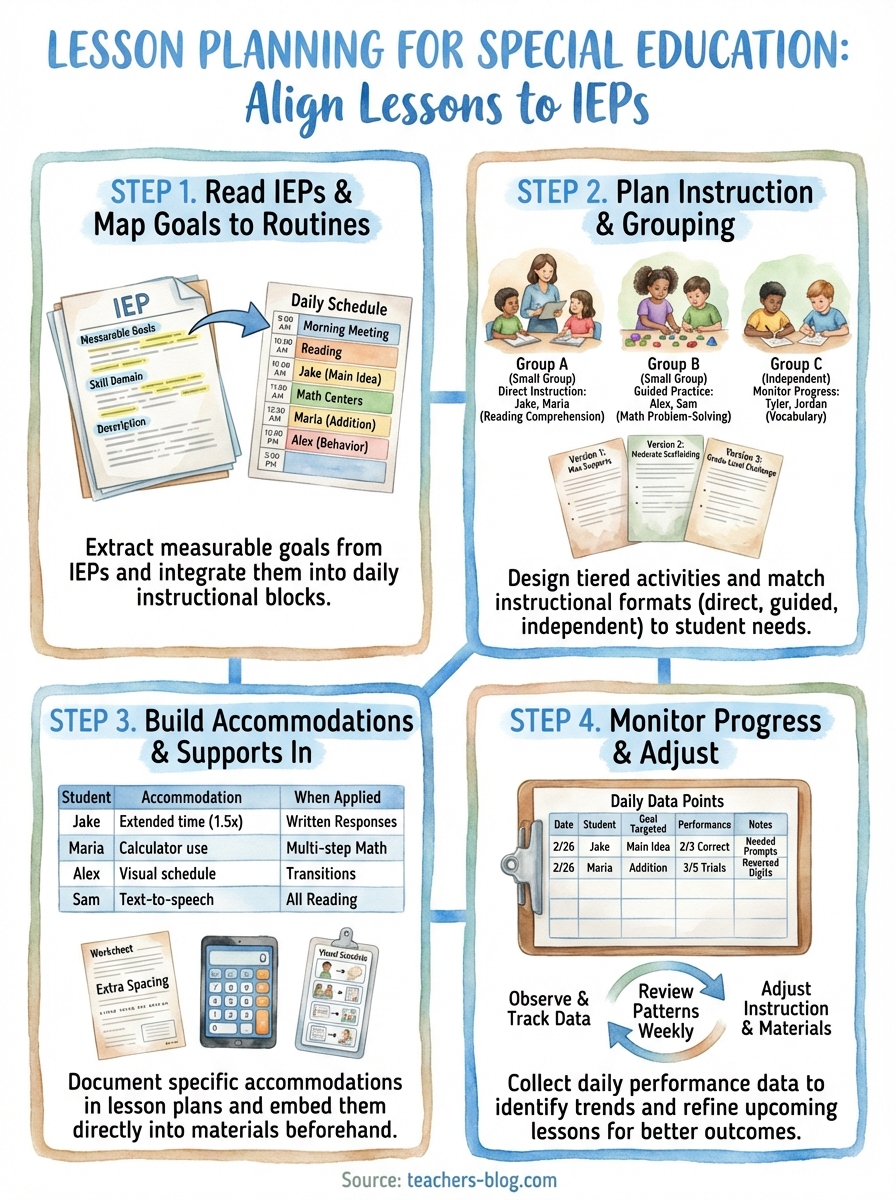
Start by creating a goals inventory for each student before you touch a lesson plan template. You need to extract every measurable goal from each IEP and organize them by skill domain (reading, math, behavior, communication). This inventory becomes your master reference for lesson planning for special education.
Pull out measurable goals
Open each IEP and highlight the present levels of performance and the annual goals. Skip the legal jargon and focus on what students need to demonstrate. Write each goal in plain language on a tracking sheet:
| Student | Goal Domain | Specific Target | Current Level |
|---|---|---|---|
| Jake | Reading | Identify main idea in 3rd grade text with 80% accuracy | 45% accuracy |
| Maria | Math | Solve 2-digit addition with regrouping, 4/5 trials | 2/5 trials |
| Alex | Behavior | Request breaks using words, 8/10 opportunities | 3/10 opportunities |
Map goals to your schedule
Look at your daily routine and identify natural opportunities for each goal. Morning meeting works for communication goals. Independent reading time targets literacy objectives. Math centers address computation skills. Write the student’s initials next to the routine where you’ll address their specific goal.
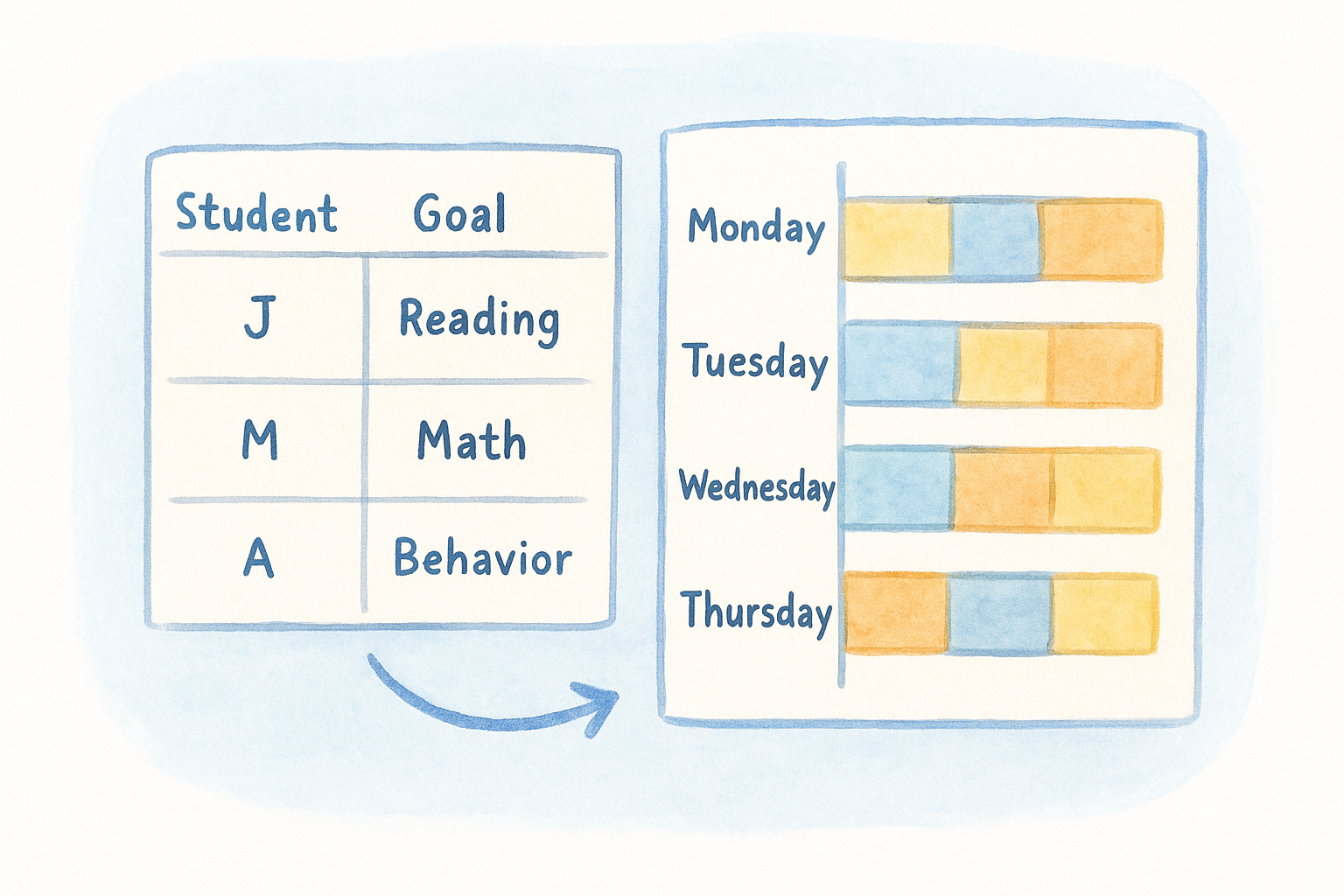
Your schedule should show which goals get practiced during each instructional block.
This mapping prevents goals from getting lost in busy lesson plans. You’ll know exactly when Jake works on main idea, when Maria practices addition, and when Alex rehearses requesting breaks.
Step 2. Plan instruction and grouping
Once you know which goals you’re targeting, decide how students will access the content. Your grouping decisions directly impact whether students can practice their IEP objectives during the lesson. Effective lesson planning for special education requires matching instructional formats to each student’s needs rather than defaulting to whole-group instruction.
Determine your grouping structure
Start by asking which goals require direct teacher support versus independent practice. Students working on foundational skills (decoding, number sense, behavioral cues) typically need you present. Those practicing application skills can work in peer groups or independently while you circulate.
Create a simple grouping chart for your lesson:
| Group | Students | Focus Skill | Teacher Role |
|---|---|---|---|
| Small Group A | Jake, Maria | Reading comprehension strategies | Direct instruction |
| Small Group B | Alex, Sam | Math problem-solving | Guided practice |
| Independent | Tyler, Jordan | Vocabulary review | Monitor progress |
This structure lets you provide intensive support where needed while other students practice at their level.
Design tiered activities
Build three versions of the same core activity. Version one includes maximum supports (visual aids, sentence frames, manipulatives). Version two offers moderate scaffolding. Version three challenges students ready for grade-level work.
All three versions target the same content standard but allow students to engage at their instructional level.
Your lesson plan should specify which version each student receives based on their IEP goals and current performance data.
Step 3. Build accommodations and supports in
Your lesson plan needs to specify exactly which accommodations each student receives and when they access them during instruction. This step transforms IEP requirements into actionable classroom practice. Generic notes like "provide accommodations as needed" won’t work because you need clear guidance for yourself, paraprofessionals, and substitutes about what supports each student requires.
Document accommodations in your template
Create a quick-reference column in your lesson plan where you list accommodations by student name. Include the specific support and the activity where it applies. This documentation keeps you accountable and ensures consistent implementation across all lessons.
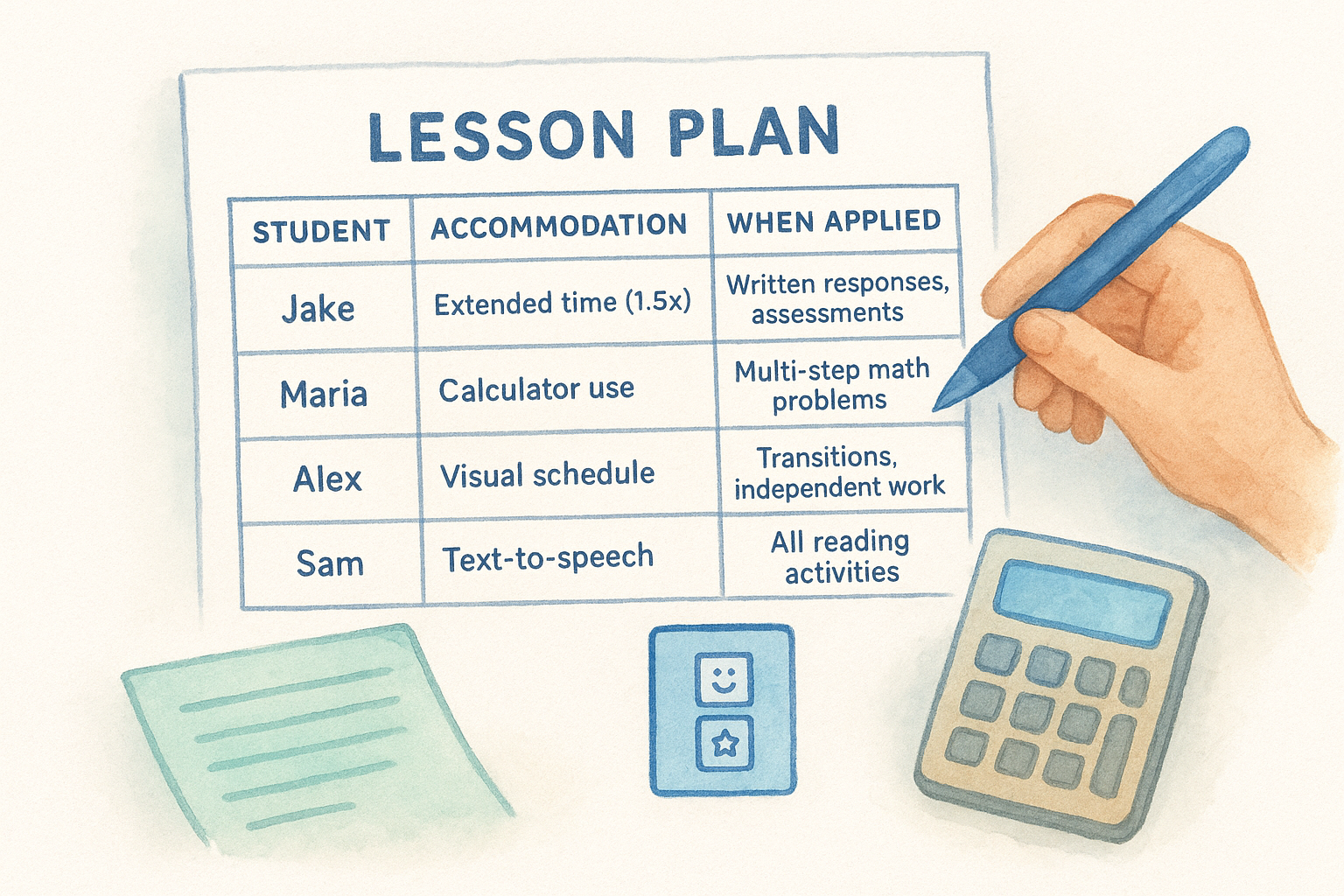
| Student | Accommodation | When Applied |
|---|---|---|
| Jake | Extended time (1.5x) | Written responses, assessments |
| Maria | Calculator use | Multi-step math problems |
| Alex | Visual schedule | Transitions, independent work |
| Sam | Text-to-speech | All reading activities |
This table sits at the top of your daily plan where you can reference it quickly during instruction.
Prepare materials with supports embedded
Build accommodations directly into student materials rather than adding them during the lesson. Print Jake’s worksheet with larger fonts and extra spacing. Pre-load Maria’s tablet with the calculator app. Laminate Alex’s visual schedule and place it at his desk before class starts.
Embedded supports eliminate the scramble to modify materials while students wait.
Your lesson planning for special education becomes more efficient when accommodations are prepared in advance rather than applied on the fly.
Step 4. Monitor progress and adjust
Your lesson plan becomes a living document once you start collecting student performance data. Tracking progress against IEP goals requires systematic observation during instruction and regular adjustments based on what the data reveals. This monitoring cycle ensures your lesson planning for special education remains responsive to actual student needs rather than assumptions about what should work.
Track daily data points
Record specific observations during each lesson tied to IEP goal targets. Note whether students met the criteria, needed additional prompts, or struggled despite supports. Keep a simple tracking sheet that captures this information immediately after instruction:
| Date | Student | Goal Targeted | Performance | Notes |
|---|---|---|---|---|
| 2/26 | Jake | Main idea | 2/3 correct | Needed rereading prompts |
| 2/26 | Maria | Addition | 3/5 trials | Reversed digits twice |
| 2/26 | Alex | Request breaks | 7/10 uses | Improved with visual cue |
This data informs your next lesson decisions. If Jake consistently scores below target, his materials need adjustment or his goal requires revision.
Review patterns weekly
Look at your tracking sheet every Friday and identify trends across the week. Students who show consistent growth might be ready for reduced supports or more challenging content. Those plateauing need modified instruction strategies or different materials.
Weekly reviews prevent you from continuing ineffective approaches for too long.
Adjust your upcoming lesson plans by changing groupings, swapping materials, or increasing support levels based on the patterns you observe.
Wrap up and plan tomorrow
Effective lesson planning for special education starts with IEP goals as your foundation and builds instruction around those specific targets. You’ve learned to map goals to your daily routines, design tiered instruction, embed accommodations directly into materials, and monitor progress systematically. These steps create a planning framework that respects both legal requirements and student learning needs.
Set aside fifteen minutes tonight to prep tomorrow’s materials. Pull the IEPs for students in your first lesson block, identify which goals you’ll address, and prepare three versions of your core activity with supports already built in. Track student responses during instruction and note what works so you can refine your approach throughout the week.
Looking for more strategies to support your classroom? The Cautiously Optimistic Teacher offers practical resources, tools, and teaching techniques designed specifically for educators managing diverse student needs. You’ll find templates, AI-powered planning assistants, and proven methods that save time while improving outcomes.