15 Proven De-Escalation Strategies for the Classroom That Actually Work
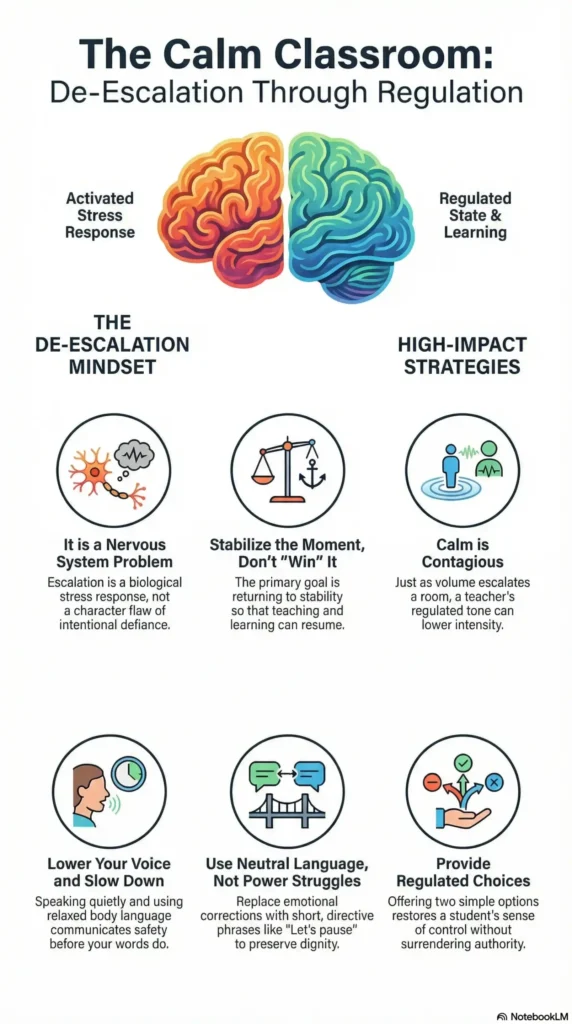
De-escalation strategies for the classroom are neurological interventions designed to move a student from a “fight-or-flight” stress response back to a state of emotional regulation. By prioritizing strategic stillness, neutral language, and the preservation of dignity, teachers can stop a behavioral spiral before it disrupts the entire learning environment. De-escalation is not about “giving in”; it is about stabilizing the nervous system so that logical thinking—and eventually, behavioral fluency—can resume.
This is Lesson 1 of Module 6: Responding to Disruptions Without Escalation | Full Course Outline
Mindset Shift: From Winning to Stabilizing
| The Power Struggle Lens (Winning) | The De-Escalation Lens (Stabilizing) |
| Goal: To prove who is in charge. | Goal: To bring the student’s brain back “online.” |
| Logic: “I cannot let them talk to me like that.” | Logic: “They cannot process logic right now.” |
| Teacher Action: Increasing volume and proximity. | Teacher Action: Lowering volume and giving space. |
| Focus: Immediate compliance and punishment. | Focus: Immediate safety and regulation. |
| Result: Escalated conflict and broken trust. | Result: De-escalated tension and preserved dignity. |
When a student is escalating, they are not thinking clearly. Their stress response is activated. Their reasoning skills are offline. Their ability to process consequences is limited. The part of the brain responsible for logic, impulse control, and flexible thinking is not in charge. And that’s why de-escalation strategies for the classroom are important.
In that moment, you are not dealing with “defiance.”
You are dealing with a dysregulated nervous system.
And here’s the hard truth:
If we escalate with them — even subtly — we make it worse.
A sharper tone.
A public correction.
A sarcastic comment.
A visible sigh.
Even small reactions can intensify a stress response that is already rising.
That’s why de-escalation strategies for the classroom are not about “letting students win,” lowering standards, or avoiding accountability. They are about stabilizing the moment so the brain can come back online. They are about reducing threat, preserving dignity, and protecting instructional time.
When the nervous system regulates, thinking returns.
When thinking returns, learning becomes possible again.
In this module, I’ll walk you through 15 practical, proven de-escalation strategies you can use immediately — strategies that protect your authority, strengthen relationships, and help your classroom stay calm even when emotions run high.
De-Escalation Strategies for the Classroom
1. Lower Your Voice — Don’t Raise It
When a student raises their volume, our instinct is often to match it.
Instead:
Slow down.
Lower your voice.
Speak more quietly than usual.
Students must calm themselves to hear you. Volume is contagious — calm can be contagious too.
2. Slow Your Body Language
Escalation is not just verbal.
Avoid:
Pointing
Standing over students
Fast movements
Sharp gestures
Instead:
Relax your shoulders
Keep hands visible and open
Move slowly
Your body communicates safety before your words do.
3. Use Neutral, Non-Emotional Language
Instead of:
“That is disrespectful.”
“You need to stop.”
“What is wrong with you?”
Try:
“Let’s pause.”
“We’ll talk in a moment.”
“Right now, I need you seated.”
Neutral language prevents ego battles.
4. Offer Regulated Choices
Escalation increases when students feel trapped.
Try:
“You can start here or move to the back table.”
“Would you like two minutes, or would you prefer to step into the hall?”
Choice restores a sense of control without surrendering authority.
5. Move the Audience
Peer attention fuels escalation.
If possible:
Redirect the class into independent work.
Change the physical arrangement.
Remove the audience, not the student.
Sometimes the fastest way to calm a student is to reduce social pressure.
6. Avoid Public Power Struggles
If correction is needed, do it privately whenever possible.
Public correction activates:
Shame
Defensiveness
Posturing
Private correction preserves dignity — and dignity reduces escalation.
7. Give Processing Time
When students are escalated, they process language more slowly.
After giving a direction:
Pause.
Wait.
Resist repeating yourself rapidly.
Silence can prevent escalation.
8. Acknowledge Emotion Without Agreeing
You can validate emotion without validating behavior.
Try:
“I can see you’re frustrated.”
“This feels unfair to you.”
“You’re upset.”
Recognition lowers intensity.
It does not mean you’re excusing behavior.
9. Remove the Immediate Demand (Temporarily)
In some situations, the task itself is the trigger.
Try:
“Let’s step away from this for two minutes.”
“We’ll come back to it.”
Temporary removal of pressure can prevent a full disruption.
10. Control Your Facial Expression
Students read micro-expressions instantly.
Avoid:
Eye rolls
Smirks
Exasperated sighs
Practice:
Neutral face
Calm eyes
Controlled breathing
Your face sets the emotional tone.
11. Use Physical Proximity Strategically
Sometimes calm proximity reduces disruption.
Other times, space is needed.
Ask yourself:
Does this student need closeness?
Or do they need room?
Intentional positioning is a powerful de-escalation strategy for the classroom.
12. Don’t Over-Talk
The more escalated a student is, the shorter your language should be.
Think:
Clear.
Brief.
Directive.
Long lectures escalate. Short clarity stabilizes.
13. Reset With a Small Task
When emotions are high, redirect into action.
Examples:
“Hand out these papers.”
“Grab the markers.”
“Wipe the board.”
Small physical tasks can interrupt emotional spirals.
14. Separate the Behavior From the Relationship
Say:
“This isn’t like you.”
“We’ll figure this out.”
“You’re still part of this class.”
Students calm faster when they know the relationship is secure.
15. Follow Up Later — Not Now
Some conversations do not belong in the moment.
In escalation:
Stabilize.
Continue instruction.
Revisit privately later.
Reflection works best when the nervous system is calm.
What De-Escalation in the Classroom Is Not
It is not:
Ignoring behavior
Avoiding consequences
Lowering standards
Being permissive
It is strategic regulation.
Consequences can still happen — just after stability returns.
The Science Behind De-Escalation Strategies for the Classroom
From a neuroscience perspective, escalation in the classroom is closely tied to activation of students’ stress-response systems, which can interfere with attention, emotional regulation, and learning. Research on trauma-informed school practices shows that when teachers use strategies that restore safety, predictability, and calm interaction, they can prevent and de-escalate disruptive behavior by helping students regain regulatory control rather than react defensively.
When a student is in a stress response:
Cortisol rises.
Working memory decreases.
Impulse control drops.
Emotional reactivity increases.
If a teacher responds with:
Sarcasm
Threats
Public confrontation
The student’s stress increases — and behavior intensifies.
De-escalation strategies for the classroom work because they:
Lower threat perception
Restore a sense of control
Reduce audience pressure
Preserve dignity
Keep instruction moving
This is nervous system science — not softness.
Try This Tomorrow
Pick just one strategy:
Lower your voice intentionally during your next minor disruption.
Notice:
Does the room quiet?
Does the student mirror your tone?
Does escalation decrease?
Often the smallest shifts create the biggest changes.
Final Thought
The most powerful classroom managers are not the loudest.
They are the calmest.
De-escalation strategies for the classroom protect:
Your authority
Your relationships
Your instructional time
Your emotional energy
And over time, they create something even more powerful:
A classroom where students learn to regulate themselves.
De-Escalation Strategies for the Classroom FAQ
What is the most effective de-escalation strategy for the classroom? The most effective strategy is ‘Strategic Silence and Processing Time.’ When a student is escalated, their brain processes language slowly. Giving them 10-20 seconds of silence after a direction prevents them from feeling ‘pushed’ and allows their nervous system to begin regulating.
How do you de-escalate a student without losing authority? De-escalation preserves authority by demonstrating total self-control. By staying calm and neutral, the teacher remains the ‘alpha’ in the room—the regulated person. Authority is not lost; it is reinforced through composure rather than volume.
When should you follow up after a classroom disruption? Never attempt a deep ‘teaching moment’ while the student is still in a stress response. Wait until both the student and teacher are fully calm—often 20 minutes to an hour later—to discuss consequences and reflections. This ensures the student is in a state of behavioral fluency where they can actually learn from the mistake.
Reflection
Earlier in my teaching, I sometimes tried to correct behavior immediately when a student was escalating, thinking clarity and firmness would solve the problem. Instead, I often made the situation worse because the student wasn’t ready to think yet. Over time, I learned that slowing down, lowering my voice, and stabilizing the moment first made later conversations far more productive.
- When a student escalates in your classroom, do your first responses lower the emotional temperature—or raise it without you noticing?
- Which de-escalation move (tone, proximity, choice, or timing) feels most natural for you to try consistently this week?
- How might your classroom change if your goal during conflict shifted from immediate compliance to restoring regulation first?
Continue the Classroom Management Course
In the next lesson, you will learn how classroom de-escalation strategies help teachers respond to student stress responses calmly and deliberately.
Next Lesson: Neutral Language and Emotional Regulation
Module 6 Progress:
De-escalation Strategies for the Classroom
Back to Module 6 Overview
Return to Full Course Outline