
Physical Space, Seating, and Flow: Classroom Layout That Supports Behavior
Your classroom layout is a silent co-teacher that either facilitates focus or triggers friction. By intentionally designing for clear sightlines, defined learning zones, and smooth traffic flow, you reduce the “behavioral load” on students. When the physical environment is predictable and supports student needs rather than just compliance, off-task behaviors decrease and independence rises.
This is Lesson 4 of Module 4: Classroom Environment and Management | Full Course Outline
Mindset Shift: Surveillance vs. Support
| The Control Lens (Surveillance) | The Functional Lens (Support) |
| Goal: Arranging desks to catch students “being bad.” | Goal: Arranging desks to help students “be successful.” |
| View: Seating is a reward or a punishment. | View: Seating is a regulation and learning tool. |
| Logic: “I need to see everyone so they don’t talk.” | Logic: “I need to see everyone so I can support them.” |
| Flow: Teacher-centered; students stay put. | Flow: Student-centered; movement is purposeful. |
| Result: High friction; students feel “watched.” | Result: High flow; students feel “supported.” |
Designing a Classroom That Manages Itself
When classroom management struggles, teachers often look first at rules, consequences, or student motivation. But one of the most powerful—and overlooked—tools is already in the room: the classroom layout and physical environment.
Classroom space doesn’t just hold learning.
It shapes behavior.
Poorly designed space creates friction, confusion, and constant low-level disruptions.
Well-designed space quietly supports focus, movement, and regulation—often without a word spoken.
This module breaks down how to use physical space, seating, and flow as preventative classroom management tools.
Why Physical Space and Classroom Layout Affects Behavior (The Science)
Students are constantly scanning their environment for cues about:
Where to sit
How to move
What’s expected
When to talk
How to participate
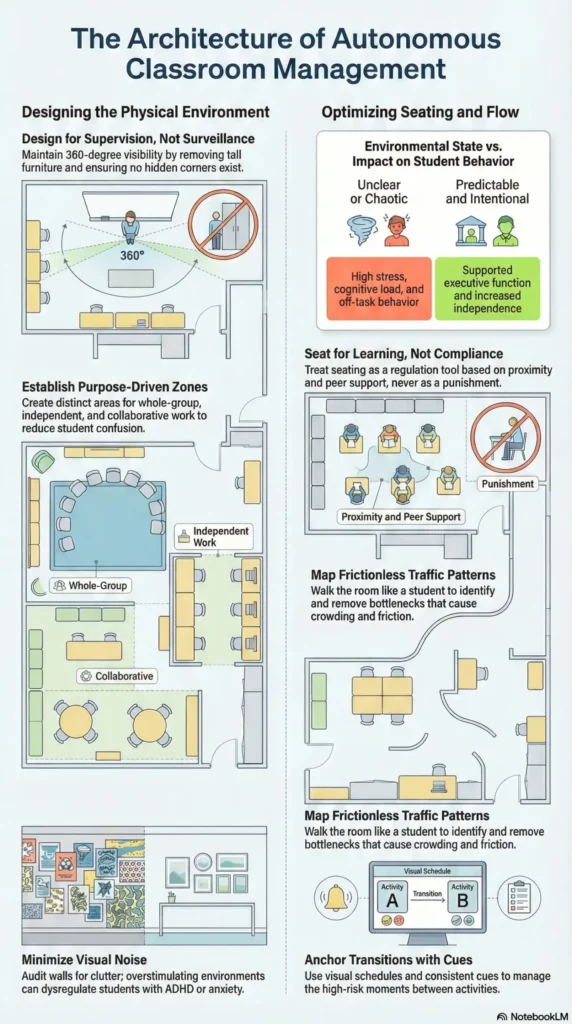
When space is unclear or chaotic:
Cognitive load increases
Stress rises
Self-regulation drops
Off-task behavior increases
In contrast, predictable and intentional environments:
Reduce decision fatigue
Support executive function
Increase independence
Decrease unnecessary teacher correction
In short:
Well-designed classrooms do some of the managing for you.
Part 1: Using Physical Space in Your Classroom Layout Intentionally
Click here for the Free Classroom Layout Audit
1. Design for Supervision, Not Surveillance
You should be able to see every student quickly without pacing constantly.
Try this:
Avoid tall furniture that blocks sightlines
Keep pathways clear between desks or tables
Ensure no “hidden corners” where disengagement grows
If you can’t see students easily, behavior problems multiply quietly.
2. Create Clear Zones in the Room
Students regulate better when spaces have clear purposes.
Examples:
Whole-group instruction zone
Independent work zone
Small-group or collaboration area
Materials / supplies area
Zones don’t need walls—just consistency.
If everything happens everywhere, confusion rises.
3. Minimize Visual Noise as Part of Your Classroom Layout Plan
Overstimulating classrooms can dysregulate students—especially those with anxiety, ADHD, or trauma histories.
Audit your room:
Are walls filled with unused posters?
Are anchor charts visible only when relevant?
Is student work intentional, not cluttered?
Calm spaces support calm brains.
Part 2: Seating That Supports Behavior (Not Punishes It)
Seating is not a reward or consequence—it’s a regulation tool.
1. Seat for Learning, Not Compliance
Ask:
Who needs proximity to instruction?
Who needs fewer distractions?
Who benefits from peer support?
Avoid seating decisions based on:
“They deserve it”
“They earned it”
“They always sit there”
Behavior improves when seating supports needs, not fairness optics.
2. Use Flexible Seating Strategically in Your Classroom Layout
Flexible seating works when expectations are taught.
Best practices:
Teach how to use each option
Practice transitions explicitly
Remove options temporarily if regulation breaks down
Flexible seating is about choice within structure, not freedom without guidance.
3. Revisit Seating Regularly
Students change. So do dynamics.
Set a routine:
Review seating every 4–6 weeks
Adjust after major incidents or unit shifts
Frame changes as normal—not punitive
“This is about helping everyone learn better” keeps dignity intact.
Part 3: Flow—The Invisible Manager
Flow is how students move, transition, and shift attention.
When flow breaks, behavior spikes.
1. Design Clear Traffic Patterns in Your Classroom Layout
Students should know:
Where to line up
How to access supplies
Where to turn in work
How to enter and exit the room
Crowding creates friction.
Friction creates behavior.
Walk your room like a student—and notice bottlenecks.
2. Reduce Transition Time
Most disruptions happen between activities.
Support flow by:
Posting visual schedules
Using consistent transition cues
Practicing transitions like content
Transitions are procedures—not common sense.
3. Anchor Entry and Exit Routines
The beginning and end of class shape everything in between.
Strong flow includes:
Clear entry task
Predictable settling routine
Calm, structured dismissal
If entry is chaotic, regulation never fully recovers.
Putting Your Classroom Layout All Together
A well-managed classroom doesn’t feel tight or controlling.
It feels:
Predictable
Calm
Purposeful
Supportive
Physical space, seating, and flow don’t replace relationships—but they protect them.
When the environment works, teachers correct less, connect more, and teach longer.
Classroom Layout FAQ
How does classroom layout affect student behavior? Classroom layout shapes behavior by providing environmental cues. A cluttered or poorly spaced room increases cognitive load and stress, leading to more disruptions. A well-organized room with clear pathways and ‘zones’ reduces friction and helps students self-regulate.
What is the best seating arrangement for classroom management? There is no single ‘best’ arrangement; the best seating is one that matches the instructional goal. Rows support individual focus, while groups or U-shapes support collaboration. The key for management is ensuring clear sightlines for the teacher and enough ‘flow’ to prevent bottlenecks.
How do you minimize visual noise in a classroom? Minimize visual noise by removing outdated posters, keeping anchor charts visible only when currently relevant, and using neutral colors where possible. A ‘calm’ visual environment helps students with ADHD, anxiety, or trauma histories stay focused and regulated.
Classroom Layout Reflection
I used to treat the classroom layout as something I set up once in September and rarely revisited. Over time, I noticed that adjusting seating to improve sightlines made a noticeable difference in student focus and how easily I could support them. Now I see classroom layout as something I refine continuously rather than something I finish.
- How does your current classroom layout support—or limit—your ability to move easily and connect with every student?
- Which area of your classroom might be unintentionally creating distraction or uncertainty for students?
- What small change to your layout could make learning feel more structured and accessible for students this week?
Continue the Classroom Management Course
In the next lesson, we will see how visual anchors and cognitive supports improve classroom management by reducing cognitive load, lowering uncertainty and stress, and helping students regulate themselves independently.
Next Lesson: Visual Anchors and Cognitive Supports
Module 4 Progress:
Back to Module 4 Overview
Return to Full Course Outline