Transitions, Entry Routines, and Exit Routines: How Classrooms Stay Calm
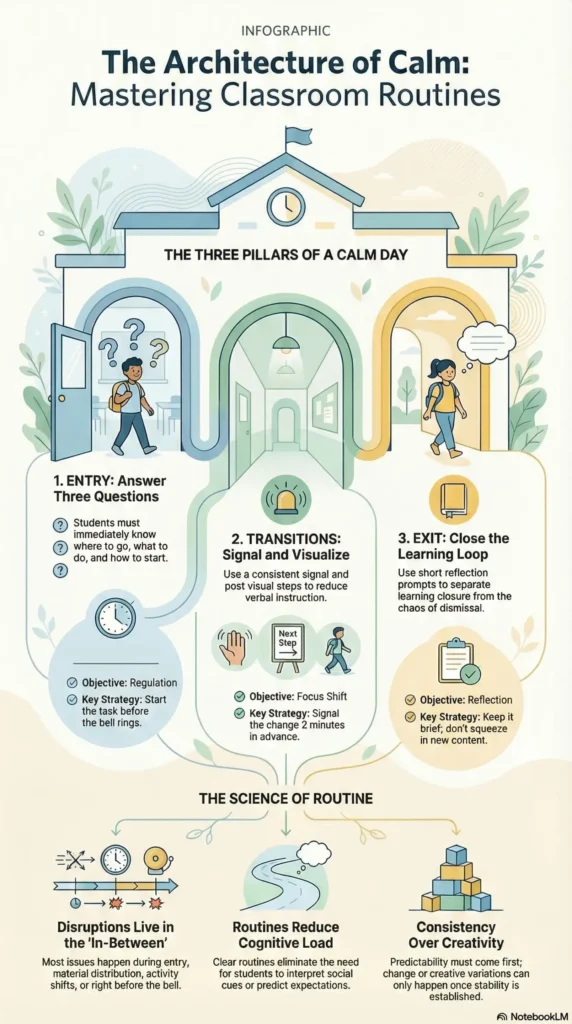
Most disruptions occur during classroom routines, transitions, and exits rather than during instruction. These “in-between” moments are cognitively demanding for students, often triggering stress or social anxiety. By implementing predictable, automated routines for entering, shifting activities, and dismissing, teachers can reclaim lost instructional time and maintain a regulated, calm classroom environment.
This is Lesson 3 of Module 4: Classroom Environment and Management | Full Course Outline
Mindset Shift: Chaos vs. Flow
| The Reactive Lens (Chaos) | The Proactive Lens (Flow) |
| View: Transitions are an annoying break in learning. | View: Transitions are a vital part of the learning cycle. |
| Teacher Role: Shouting instructions over the noise. | Teacher Role: Using a consistent, non-verbal signal. |
| Student Experience: Confusion about what to do next. | Student Experience: Automated habits that require no “guessing.” |
| Reaction to Noise: Adding more noise to get attention. | Reaction to Noise: Waiting for the established signal to work. |
| Result: Lost time and elevated heart rates. | Result: Seamless movement and emotional regulation. |
Most classroom disruptions don’t happen during instruction. They happen between instruction, making classroom routines and transitions an important part of classroom management. Disruptions happen:
When students are entering
When materials are being handed out
When activities are shifting
When the bell is about to ring
These moments are cognitively demanding. Students must:
Interpret expectations
Regulate movement and emotion
Read social cues
Predict what’s coming next
When routines are unclear, the brain fills the gap with stress—and stress shows up as talking, wandering, resistance, or shutdown.
Routines aren’t about control. They’re about reducing decision-making and uncertainty so students can regulate themselves.
Entry Classroom Routines: How Learning Actually Begins
The 3 Questions Every Entry Routine Must Answer
A strong entry routine answers three questions immediately:
Where do I go?
What do I do?
How do I start?
When students don’t have to ask those questions, behavior settles on its own.
Best Practices for Entry Routines
1. Make it identical every day (at first)
Consistency matters more than creativity.
Change can come later—predictability comes first.
2. Start the routine before the bell
Students should be engaged as the bell rings, not waiting for instructions after.
3. Keep it quiet and independent
The goal is regulation, not discussion (yet).
4. Tie it to learning, not compliance
Examples:
A short reflection prompt
A retrieval question from yesterday
A low-stakes writing task
A visual problem to solve
5. Teach it explicitly
Explain it. Model it. Practice it.
If you don’t teach it like content, students won’t treat it like content.
Transitions: The Most Common Source of Disruptions For Classroom Routines
Transitions are where classrooms either hum—or unravel.
Why Transitions Are Hard
Transitions require students to:
Stop one task
Shift attention
Manage movement
Anticipate the next expectation
That’s a lot of executive function.
Best Practices for Transitions
1. Signal the transition before it happens
Use advance warnings:
“Two minutes left.”
“One more sentence.”
“Finish the thought you’re on.”
Surprise transitions create stress. Predictable ones reduce it.
2. Use the same signal every time
Whether it’s a phrase, a visual cue, or a sound—consistency matters more than volume.
3. Reduce verbal instructions
The more you talk, the more students miss.
Post steps visually:
Close laptop
Stand behind chair
Wait silently
4. Practice transitions when things are calm
Don’t wait for chaos to fix transitions.
Practice them like drills—brief, neutral, repeated.
5. Time them (but don’t weaponize time)
Tracking transition time can build awareness—but avoid shaming or pressure.
Exit Classroom Routines: How Learning Ends (and Sticks)
Exit routines are often rushed—but they’re powerful.
They:
Signal closure
Reinforce learning
Regulate dismissal energy
Best Practices for Exit Routines
1. Make the ending predictable
Students should always know:
When packing up happens
What they must complete before leaving
2. Use short reflection, not long tasks
Examples:
One takeaway from today
One question you still have
Rate your focus today (1–5)
3. Separate learning from dismissal
The bell dismisses students—not you.
Build the routine so learning ends before the bell chaos.
4. Keep it calm and brief
Exit routines aren’t about squeezing in more content.
They’re about closing the loop.
Common Classroom Routine Mistakes (and How to Fix Them)
Mistake: Changing routines frequently
Fix: Keep routines stable for weeks before adjusting
Mistake: Assuming students “should know this by now”
Fix: Re-teach without sarcasm or frustration
Mistake: Explaining routines only once
Fix: Model and practice repeatedly, especially after breaks
Mistake: Correcting publicly during transitions
Fix: Address patterns privately, not moments emotionally
What This Looks Like Across Grades
Elementary: Visual cues, movement practice, clear physical pathways
Middle School: Short routines, tight transitions, predictable signals
High School: Calm entry tasks, structured transitions, clear end-of-class closure
Different ages, same principles.
Try This Today To Improve Classroom Routines (5 Minutes, No Prep)
Pick one transition tomorrow. Just one.
Before it happens:
Write the steps on the board
Say them once
Practice them once
Then say nothing—observe what changes.
Most teachers are shocked by how much calmer the room feels when students know exactly what’s next.
Classroom Routines FAQ
Why do transitions cause behavior problems? Transitions require high levels of executive function, including shifting attention and regulating movement. When these shifts are unpredictable or lacks clear steps, students experience ‘cognitive overload,’ which often manifests as talking, wandering, or defiance.
What are the best entry routines for middle and high school? Effective secondary entry routines answer three questions: Where do I go? What do I do? How do I start? Best practices include a ‘bell-ringer’ task that is consistent, independent, and tied to previous learning, allowing the teacher to greet students and take attendance without interruption.
How do you make classroom transitions faster? The fastest transitions are non-verbal and predictable. Use a consistent signal (like a chime or a visual cue), give a 2-minute warning before the shift, and post the steps of the transition visually on the board so students don’t have to rely on verbal instructions.
Reflection
Over time, I’ve learned that strong classroom routines don’t appear all at once—they develop gradually as I notice what works and where students still need more clarity. Each year, I refine transitions, expectations, and small daily procedures so the class runs more smoothly and students can focus more on learning instead of figuring out what to do next. Even now, I’m still adjusting a few routines and smoothing out rough edges as I learn more about what my students need.
- Which classroom routine has improved the most for you over time—and what helped it become stronger?
- Where do small moments of confusion still appear during your day that might signal a routine needs refining?
- What is one procedure you could adjust this week to make your classroom feel more predictable for students?
Continue the Classroom Management Course
In the next lesson, you will learn how a thoughtfully designed classroom layout supports student regulation, independence, and focus while preventing many behavior problems before they start.
Next Lesson: Physical Space, Seating, and Flow
Module 4 Progress:
- Why Routines Reduce Behavioral Load
- Teaching Procedures Like Academic Content
- Transitions, Entry Routines, and Exit Routines
- Physical Space, Seating, and Flow
- Visual Anchors and Cognitive Supports
Back to Module 4 Overview
Return to Full Course Outline