
Teaching Classroom Procedures Like Academic Content (Practical Lesson Plans)
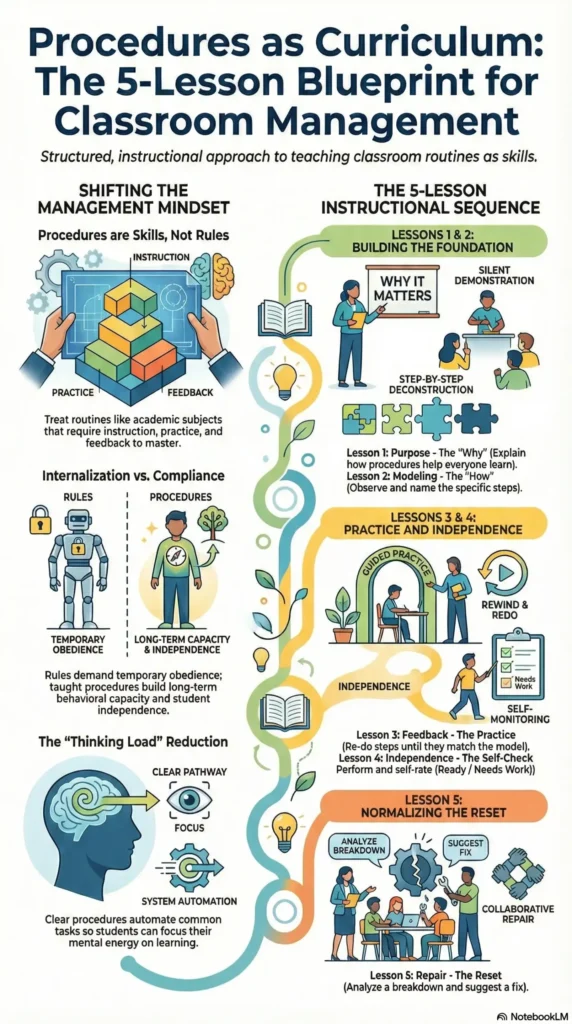
Effective classroom management requires teaching classroom procedures with the same rigor as academic subjects. Instead of assuming students know how to navigate the room, teachers should treat procedures as skills to be modeled, practiced, and refined. By using a sequential 5-lesson approach—moving from explicit instruction to independent use—you can automate classroom flow and significantly reduce behavioral disruptions.
This is Lesson 2 of Module 4: Classroom Environment and Management | Full Course Outline
Mindset Shift: Expectations vs. Instruction
| The Expectation Lens (Compliance) | The Instructional Lens (Fluency) |
| View: Students should already know how to behave. | View: Procedures are skills that must be taught. |
| Method: Giving a verbal reminder or a lecture. | Method: Modeling, practicing, and providing feedback. |
| Reaction to Failure: Frustration or a consequence. | Reaction to Failure: A “reset” and more practice. |
| Teacher Role: The enforcer of the “How.” | Teacher Role: The coach of the “How.” |
| Result: Compliance that breaks under stress. | Result: Internalized habits and independence. |
Most classroom management struggles don’t come from students unwilling to behave. They come from students being unclear about the rules. As teachers, we can avoid this by teaching classroom procedures explicitly.
We assume students know how to:
Enter a classroom
Transition between tasks
Ask for help
Work independently
Recover after mistakes
But if we wouldn’t assume students know how to write a paragraph or solve an equation without instruction, practice, and feedback… why do we assume they know how to operate inside a classroom?
When procedures are treated like rules, students comply temporarily.
When procedures are taught like academic content, students internalize them.
This module reframes classroom procedures as:
Skills, not expectations
Lessons, not lectures
Practice-based, not compliance-based
Below are five sequential lesson plans that build on one another—designed to work across elementary, middle, and high school—and designed to reduce behavior issues by teaching classroom procedures.
The 5-Lesson Sequence for Teaching Classroom Procedures
Each lesson builds cognitive and behavioral capacity for the next. Think of this as a procedural unit, not one-off mini-lessons. For a free PDF that you can use with your class for setting expectations, click here.
Lesson 1: What Procedures Are (and Why They Matter)
Purpose:
Students understand that procedures exist to support learning—not control behavior.
Core Idea:
Procedures are tools that reduce thinking load so students can focus on learning.
Learning Objective
Students will be able to explain:
What a classroom procedure is
Why procedures exist
How procedures help everyone learn
Teacher Language (Key Move)
“In this class, we don’t just have procedures—we learn them, practice them, and get better at them. Just like any skill.”
Lesson Flow
Activate Prior Knowledge
Ask:“What routines do you follow outside school without thinking?”
“What happens when routines aren’t clear?”
Explicit Teaching
Define procedures as:Predictable ways we do common things
Designed to reduce confusion and stress
Adjustable as we learn what works
Class Discussion
Compare procedures to:Paragraph structure
Lab safety steps
Game rules
Anchor Chart (Co-Created)
Procedures help us:Save time
Feel safe
Learn more
Assessment
Exit Ticket:
“One way procedures help learning is…”
Lesson 2: Modeling Procedures Step by Step
Purpose:
Students learn that procedures are taught through demonstration, not explanation alone.
Core Idea:
If students can’t see it, they can’t reproduce it.
Learning Objective
Students will observe, describe, and name the steps of a classroom procedure.
Focus Procedure Example
Entry routine OR materials distribution
(Choose something students do daily.)
Lesson Flow
Name the Skill
“Today, we’re learning the entry routine like a skill.”
Teacher Model (Silent First)
Model the procedure without explanation
Ask students to notice what they saw
Student Deconstruction
Ask:“What did I do first?”
“What came next?”
“What details mattered?”
Second Model (With Thinking Aloud)
Narrate decisions:“I’m placing my bag here so the aisle stays clear.”
Create a Step List Together
Assessment
Students write or verbalize the steps in order.
Lesson 3: Guided Practice and Feedback for Teaching Classroom Procedures
Purpose:
Students practice procedures with coaching, not correction.
Core Idea:
Mistakes during practice are part of learning—not misbehavior.
Learning Objective
Students will practice a procedure and respond to feedback.
Lesson Flow
Set the Norm
“Practice is where we learn. No one gets it perfect yet.”
Whole-Group Practice
Run the procedure
Pause when needed (neutral tone)
Feedback Language
“Let’s rewind that part.”
“Try it again, slower.”
“What went well?”
Second Attempt
Emphasize improvement over perfection.
Reflection Prompt
“One thing our class did well today was…”
“One thing we’ll improve tomorrow is…”
Assessment
Teacher observation checklist (informal).
Lesson 4: Independent Use and Self-Monitoring
Purpose:
Students begin managing procedures without teacher prompting.
Core Idea:
Independence is taught—not demanded.
Learning Objective
Students will independently follow a procedure and self-assess their performance.
Lesson Flow
Preview Independence
“Today, I’ll say less. You’ll do more.”
Run the Procedure
No interruption unless safety or learning is compromised.Self-Assessment
Students rate themselves:Ready / Almost / Needs Work
Peer Reflection (Optional)
Low-stakes discussion:“What helped us stay on track?”
Assessment
Self-reflection quick write or discussion.
Lesson 5: Repairing and Resetting Procedures
Purpose:
Students learn that procedures can be revisited, repaired, and improved.
Core Idea:
Needing a reset is normal—not a failure.
Learning Objective
Students will analyze a procedure breakdown and suggest improvements.
Lesson Flow
Normalize Breakdown
“Every system needs tuning.”
Problem-Solve Together
Ask:“Where did this break down?”
“What part needs more practice?”
Re-Teach One Step
Focus on the procedure, not people.Re-Practice
Short, focused repetition.
Assessment
Class agreement on next steps.
Why This Sequence Works for Teaching Classroom Procedures
This progression mirrors how the brain actually learns skills:
Explicit instruction
Modeling
Practice with feedback
Gradual release
Reflection and revision
It also reframes classroom management as:
Instructional
Predictable
Humane
Sustainable
When procedures are taught like content, teachers spend less time correcting—and more time teaching.
Try This Tomorrow
Pick one routine students struggle with.
Don’t correct it tomorrow.
Teach it.
Model it.
Practice it.
Reflect on it.
That shift alone changes everything.
Teaching Classroom Procedures FAQ
How do you teach classroom procedures effectively? To teach classroom procedures effectively, treat them like academic content. Use a gradual release model: explicitly define the procedure, model it (both correctly and incorrectly), provide guided practice with neutral feedback, and allow for independent practice until the behavior becomes a habit.
Why should I treat procedures like academic lessons? Treating procedures like lessons reduces cognitive load. When students don’t have to ‘guess’ how to turn in papers or enter the room, they have more mental energy available for learning. It shifts classroom management from a punitive system to an instructional one.
What do I do when a classroom procedure breaks down? When a procedure breaks down, avoid punishment. Instead, ‘reset’ the routine. Briefly explain where the breakdown occurred, model the correct steps again, and have the class practice the specific part that failed until they can perform it successfully.
Reflection
Early in my teaching, I explained procedures once and assumed students would remember them, but I kept getting interruptions about where to put work or what to do next. I eventually realized the problem wasn’t student behavior—it was my lack of explicit teaching and practice. When I started modeling procedures step by step and rehearsing them with the class, everything ran more smoothly and I spent far less time redirecting.
- Which classroom procedure have you explained—but not actually taught and practiced with students?
- Where in your day do repeated interruptions signal that expectations might still be unclear?
- What routine could you model and rehearse this week to make your classroom run more automatically?
Continue the Classroom Management Course
In the next lesson, you will learn about teaching consistent classroom routines and transitions from the start of the year creates predictable structure that reduces disruptions.
Next Lesson: Transitions, Entry Routines, and Exit Routines
Module 4 Progress:
- Why Routines Reduce Behavioral Load
- Teaching Procedures Like Academic Content
- Transitions, Entry Routines, and Exit Routines
- Physical Space, Seating, and Flow
- Visual Anchors and Cognitive Supports
Back to Module 4 Overview
Return to Full Course Outline