
Repairing Teacher-Student Relationships After Conflict: Strategies That Work
Repairing teacher-student relationships after a conflict is the most effective way to prevent a downward spiral of defiance. Conflict is an inevitable part of classroom life, but it doesn’t have to be a permanent bridge-burner. By taking a “cool-down” period, addressing the issue privately, and using restorative apologies, teachers can transform a moment of discord into a powerful opportunity for growth and long-term trust.
This is Lesson 5 of Module 3: Building Teacher-Student Relationships | Full Course Outline
Mindset Shift: Punishment vs. Restoration
| The Punitive Lens (Compliance) | The Restorative Lens (Repair) |
| Primary Goal: To make the student “pay” for the rule-break. | Primary Goal: To repair the harm caused to the relationship. |
| Focus: What rule was broken and what is the penalty? | Focus: Who was harmed and how do we make it right? |
| Teacher Role: The judge and enforcer of consequences. | Teacher Role: The facilitator of accountability and healing. |
| Aftermath: Resentment, shame, and future defiance. | Aftermath: Growth, mutual respect, and lowered tension. |
| Result: A “win-lose” power struggle. | Result: A “win-win” resolution. |
A teacher takes time to talk calmly one-on-one with a student, an approach that helps rebuild trust after a conflict. Conflicts between teachers and students are bound to happen occasionally, but how you handle the aftermath can make all the difference in your classroom. Repairing teacher-student relationships after conflict is essential for maintaining a positive learning environment. Research consistently shows that strong teacher-student relationships lead to better behavior and academic outcomes, whereas a broken or negative relationship can undermine even the best teaching strategies. Whether you teach elementary, middle, or high school, knowing how to rebuild trust and respect with students after an incident is a critical classroom management skill.
Understand the Impact of Conflict on Trust
When a serious conflict or incident occurs, it often damages the trust between teacher and student. In fact, classroom management problems are frequently relationship problems in disguise. If a student feels misunderstood or unfairly treated, they may shut down or act out, thinking “Why behave if I’m going to get in trouble no matter what?”. On the flip side, teachers under stress can become more reactive or punitive, which only deepens the disconnect. As one educator put it, “No amount of detentions, raised voices, or reward charts can fix a broken relationship. To move forward, we have to stop managing and start rebuilding.” In other words, after a conflict, the priority should shift from doling out punishment to rebuilding the relationship and classroom culture of respect.
A damaged teacher-student relationship can lead to a downward spiral in behavior and engagement. Students who feel disrespected or resentful are less likely to participate or put effort into class. And without trust, even effective instructional techniques may “mute or negate” their impact. That’s why taking steps to repair the relationship is not “extra” work – it’s fundamental to restoring a productive learning environment. By addressing the fallout of a conflict head-on, you show students that the heart of teaching has always been about relationships and that it’s never too late to rebuild them.
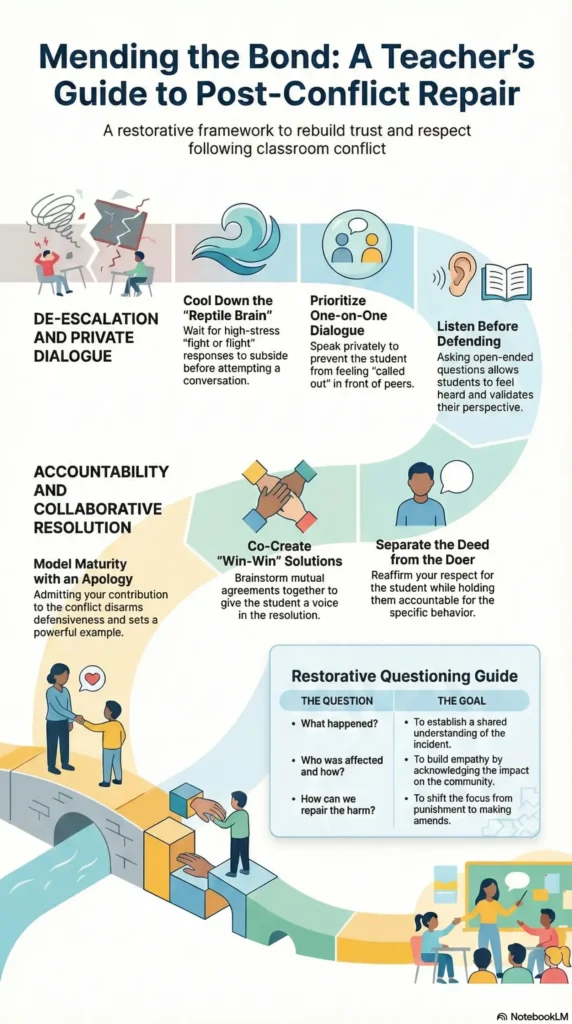
Take Time to Cool Down Before Repairing Teacher-Student Relationships
Before jumping into any resolution with a student, it’s important for both parties to cool down. High-stress conflicts can trigger our “fight, flight, or freeze” responses – what psychologists call the “reptilian brain” taking over. In the heat of the moment, neither the teacher nor the student is in the best state to have a constructive talk. If tempers have flared or emotions are running high, hit the pause button. Ensure everyone has a chance to calm down physically and emotionally. This might mean taking a few deep breaths, giving the student a brief break or a walk, or waiting until later in the day to revisit the issue.
Staying calm and composed as the adult is crucial. Students take cues from our behavior. By modeling a cool-headed, regulated response, you help create a sense of safety. “Only when students feel safe can they access the parts of their brain needed for learning, empathy, and self-regulation,” one classroom management expert notes. Speak in a steady, respectful tone and avoid rehashing the conflict in the moment. Once the “reptile brain” is no longer in charge and everyone’s thinking brain is back online, you can productively address what happened.
Repairing Teacher-Student Relationships in a Private Conversation
After both you and the student have cooled off, plan to address the incident directly with the student in a one-on-one conversation. It’s usually best to speak privately – perhaps in the hallway during a free moment, after class, or another quiet setting – so the student doesn’t feel called out in front of peers. Start by calmly acknowledging what you’ve noticed. For example, you might say, “I noticed you’ve been quieter and avoiding eye contact since our conflict yesterday,” or “Things felt tense between us after what happened.” Opening the dialogue in a non-accusatory way shows the student you genuinely care about fixing things, not punishing them further.
Give the student a chance to share their perspective. Ask open-ended questions like “Is there anything going on that I should be aware of?” or “How did you feel about what happened?” and then truly listen. Sometimes, just giving a student the opportunity to be heard is “the lion’s share of working towards repair,” as one teacher-author notes. Avoid jumping to defend your actions or immediately insisting on your side of the story. The goal of this initial talk is to listen and validate. You might learn that the student misunderstood your intention, or that outside factors were contributing to their behavior. By hearing them out, you demonstrate respect and set the stage for mutual understanding.
Importantly, acknowledge the rift openly. A simple statement taking responsibility for the strained relationship can go a long way. For instance, telling a student “I can see that the way we’ve been dealing with each other isn’t working, and I take responsibility for my part in that. I’d like us to have a fresh start.” models maturity and accountability. This kind of honesty from a teacher is powerful – it shows the student that you’re aware of the problem and invested in fixing it, not just moving on as if nothing happened. It also signals that you care about them and the relationship enough to address it head-on.
Take Accountability and Apologize Sincerely
One of the most powerful tools for repairing a relationship is a sincere apology. If upon reflection you realize that you contributed to the conflict – maybe you were having a bad day, raised your voice, or handled a situation harshly – be willing to say “I’m sorry.” Admitting fault isn’t a sign of weakness; it’s a sign of integrity. As veteran educators observe, “Saying ‘I’m sorry’ can go a long way to repairing a relationship,” and it’s an excellent example to set for students. By apologizing, you show that teachers are not perfect and that owning up to mistakes is the right thing to do.
When apologizing, be specific about what you’re sorry for and what you’ll do differently. For example: “I want to apologize for how I spoke to you in class. I realized I sounded angry and that wasn’t fair to you. I’m going to work on staying calm even when I’m frustrated.” This kind of statement shows the student that you have reflected on your behavior and taken responsibility for your part. It also opens the door for the student to share any hurt they felt. In many cases, just hearing a teacher acknowledge, “I don’t feel good about the way I handled that and I’m sorry,” can significantly defuse the tension and start the healing process.
Taking accountability when repairing teacher-student relationships does not mean the conflict was entirely your fault; it simply means you’re willing to own your contribution to what went wrong. This humility can disarm a student’s defensiveness. It sends the message that you see them as a partner in improving the situation, rather than an adversary or a “problem” to punish. By contrast, if a teacher refuses to admit any fault and demands the student alone change, the student may continue to feel resentful or misunderstood. So even if you believe the student’s behavior was mostly to blame, think about what you, as the adult, could have done better (even if it’s just your tone or timing) and apologize for that piece. It’s a classic case of modeling the behavior we expect: if we want students to take responsibility for mistakes, we must be willing to do the same.
Work Together on a “Win-Win” Solution When Repairing Teacher-Student Relationships
Once apologies have been made and the student knows you’re coming from a place of respect, shift the focus to problem-solving together. The goal is to prevent similar conflicts in the future by collaboratively developing a plan or mutual understanding. You might say something like, “I think we can put our heads together and figure out how to avoid this kind of misunderstanding going forward. What do you think would help us not repeat this conflict?”. This invites the student to be part of the solution, rather than passively accepting a lecture or punishment.
Brainstorm with the student what each of you can do differently when repairing teacher-student relationships. Perhaps you agree to give the student a discreet signal (instead of a public call-out) when they are off-task, as a reminder (a strategy some teachers use to avoid power struggles). Or the student might say, “It helps me if I can step outside for a minute when I feel angry,” and you work that into your class routine. By finding a win-win approach, you show that you value the student’s input and are willing to adjust your own behavior too. For example, a student could agree to try a strategy for controlling their impulses, and you agree to provide positive feedback when they do so.
If the conflict involved a specific academic issue (like the student refusing to do work due to frustration), collaborate on solutions for that as well. Maybe you can offer alternative assignments occasionally, or the student can identify when they need help rather than acting out. Problem-solving as a team helps the student feel respected and heard. It also increases their commitment to the resolution, since they had a voice in creating it. This collaboration turns a negative incident into a learning experience in communication and compromise – valuable skills beyond just your classroom.
Throughout this process, make sure the student understands that you’re not interested in “winning” a power struggle, but rather in finding a better way forward for both of you. Emphasize that whatever happened, it “didn’t work for either side,” and you want to fix that together when repairing teacher-student relationships. This reframing can reduce the adversarial tension and reinforce that you ultimately have the same goal – a positive, respectful classroom environment.
Reaffirm and Restore Respect While Repairing Teacher-Student Relationships
As you conclude the conversation, take time to reaffirm your respect and positive regard for the student. Students (especially adolescents) might worry that a single incident has permanently ruined how their teacher sees them. Many young people assume adults “hold grudges” or will label them as a “bad kid” after a mistake. It’s critical to dispel this fear by explicitly letting the student know you’re ready to let go of the incident and start fresh. You might say, “I want you to know I’m not holding this against you. What’s done is done – I believe in you and I know we can move past it.” This must be said sincerely; authenticity is key for the student to trust that you mean it.
At the same time, make it clear that you separate the deed from the doer. The student’s behavior might have been unacceptable, but that doesn’t mean you think they are a bad person. Communicate that you still value them as an individual with potential and good qualities. For example: “I was upset by your behavior yesterday, but I still care about you and I know that behavior isn’t the whole you.” By separating the behavior from the student, you reinforce that they have intrinsic value and redeemable qualities, regardless of the misstep. As one expert noted, “We’re going to still hold students accountable for the behavior, but we don’t want the student to lose sight of who they are.”. This approach preserves the student’s dignity and encourages a growth mindset – they learn that a mistake doesn’t define them, and they are capable of doing better.
Finally, reaffirm your commitment to the student’s success. Let them know you’re still on their side and looking forward to repairing teacher-student relationships. Something as simple as, “I’m glad we talked. I’m here for you, and I’m excited to have a good rest of the year together,” can reinforce the repaired relationship. The student walks away knowing that the teacher-student bond is intact or healing, not broken beyond repair. For a young person, that reassurance from a caring adult can make a world of difference.
Use Restorative Practices Instead of Punitive Measures
In addition to these interpersonal steps, consider incorporating restorative practices in your classroom discipline approach, especially after conflicts. Traditional discipline often focuses on what rule was broken and delivering a punishment. Restorative practices, on the other hand, focus on repairing the harm and restoring relationships. Research shows that taking a restorative approach can significantly improve classroom culture and reduce behavior issues, all while building students’ empathy and accountability. In essence, it shifts discipline from something you do to students into something done with students, engaging them in the process of making amends.
One simple restorative strategy is to guide the student (or students involved) through a reflective conversation after an incident. Ask three key questions: What happened? Who was affected and how? How can we repair the harm?. These questions prompt the student to think beyond just their own perspective and consider the impact of their actions. For example, if a student disrupted class, who did it affect? Perhaps other students’ learning or the teacher’s ability to teach. How can they make it right? Maybe by apologizing to the class, helping clean up, or committing to a specific positive behavior change. Such conversations turn a conflict into a “powerful learning experience” in empathy and responsibility.
Depending on the situation, you might use tools like restorative reflection sheets (where students write about the incident and how to fix it) or facilitate a brief restorative circle discussion if multiple students were involved. For instance, in a circle, each person (including the teacher, if appropriate) can share how they felt about what happened and what they need going forward. This collective approach can be especially useful in peer-to-peer conflicts or a whole-class fallout. It gives everyone a voice and helps rebuild the sense of community. Remember, the aim is not to avoid consequences, but to make consequences more meaningful by linking them to repairing the relationship or damage done. Instead of a detention that might breed resentment, a restorative consequence could be the student actively working to regain trust – which is far more constructive in the long run.
By integrating restorative practices, you not only resolve the immediate issue but also empower students with conflict resolution skills. They learn that mistakes can be addressed in a way that repairs teacher-student relationships. Over time, this contributes to a classroom culture where students feel respected and responsible for their actions. In fact, schools that use restorative methods often see improved behavior and a stronger sense of community, as students develop greater empathy and learn to hold themselves accountable.
Support Peer-to-Peer Relationship Repair
While our focus is on teacher-student conflicts, conflicts between students are also common – and teachers can play a key role in helping students repair those peer relationships. In a classroom that fosters peer mediation and conflict resolution skills, students learn how to work through disagreements in a healthy way. You can teach and model basic conflict resolution steps: calming down, listening to each other’s side, using “I” statements instead of blaming, and brainstorming solutions together. When two students have a falling-out or fight, consider facilitating a mediated conversation between them similar to a restorative talk. Have each student describe what happened and how they felt, encourage them to see the other’s perspective, and then guide them to come up with ideas to make amends or avoid future issues. Often, just like adults, kids feel better when they’ve had a chance to air their feelings and be heard by their peer.
Many schools successfully implement peer mediation programs where trained student mediators help classmates resolve disputes. These programs can significantly improve school climate. Studies have found that peer mediation can reduce discipline problems and bullying incidents, while also empowering students with confidence and conflict-resolution skills. Even if you don’t have a formal program, you can incorporate elements of it in your class. For example, you might designate certain trustworthy students as “class mediators” during group work, or simply encourage a norm where students try talking out minor conflicts with each other (with respectful language) before escalating to the teacher. By coaching students in mediation, you not only solve the immediate peer conflict but also equip them with lifelong interpersonal skills.
Of course, always supervise and step in when needed – some conflicts (like bullying or serious incidents) require firm adult intervention. But for everyday squabbles or misunderstandings, guiding students to resolve things among themselves can be very effective. It builds a supportive peer culture and takes some conflict-resolving burden off the teacher over time. Plus, when students see their teacher consistently handle conflicts – whether teacher-student or student-student – through dialogue and restoration, they learn by example. They see that your classroom values communication, understanding, and forgiveness over blame. This ultimately leads to a more harmonious environment for everyone.
Be Patient and Consistent Moving Forward
Repairing a relationship, whether with a student or between students, takes time. Don’t expect that one conversation will magically erase all hard feelings or mistrust. After a conflict, it’s normal to have some awkwardness or to see the student test boundaries to see if things really have changed. Stay consistent and patient. Continue to greet the student warmly, uphold fair expectations, and look for small opportunities to rebuild positive interactions. Trust grows in small moments, not grand gestures. A student who feels seen and respected in those everyday moments will gradually act more respectful in return.
There may be setbacks. You might have a good week and then a bad day where the student regresses into old behavior (or you slip into a frustrated reaction). Change often comes two steps forward, one step back – “some days will feel like progress; others will feel like relapses… That’s normal.” The key is to not give up or fall back into the old cycle of blame and anger. If things flare up again, remember the strategies: stay calm, talk it through, re-clarify the plan, and keep showing you care. Consistency and compassion are “the tools of real transformation” in the classroom.
As you work to maintain the repaired relationship, focus on positives. Find reasons to praise the student for any improvements, even minor ones (“I noticed you really tried to stay on task today, thank you”). Show them that you recognize their efforts. Also, try to start each day fresh – as one teacher recommends, “Every day is a new day,” which means not holding yesterday’s issues against a student. By coming in each morning with a smile and giving that student a clean slate, you demonstrate that you truly have let go of the past incident. This consistency can “ultimately win them over,” or at the very least, it maintains your own positivity and sanity as a teacher.
If the relationship was severely damaged, sometimes additional support can help. Don’t hesitate to involve counselors, administrators, or parents as allies in the process, if appropriate. For example, a school counselor might facilitate a mediation meeting for you and the student, or you might have a friendly colleague sit in as a neutral party. Letting the student see that multiple adults care and are willing to help can reinforce the message. Similarly, communicating with parents – not just to report problems, but to share positive steps and ask for their insights – can create a support network around the student. Just be sure any involvement of others is framed around helping the student succeed, not piling on more blame.
Above all, keep perspective. One conflict doesn’t define your relationship with a student. Even the most challenging student can come around when they feel a teacher’s genuine respect and persistence. As the saying goes, students may test you because they want to see if you’ll give up on them. By tirelessly working to repair and maintain the connection, you show that you won’t give up – and that can be profoundly meaningful to a young person. It’s often said that the teacher who never gives up on a student is the one they remember for life. Every effort you invest in repairing a relationship contributes to that student’s sense of belonging and motivation in school.
Conclusion: Turning Conflict into Growth
Conflict in the classroom, while uncomfortable, can ultimately lead to stronger relationships if handled thoughtfully. By calmly addressing issues, listening to students, taking responsibility, and working with them to make things right, teachers can transform a negative incident into an opportunity for growth. This process not only repairs the teacher-student bond but also teaches by example. Students learn that mistakes can be forgiven, that communication can resolve problems, and that respect is a two-way street.
Remember that repairing relationships is an ongoing practice, not a one-time event. Be proactive in scanning for “relational weeds” – subtle signs of strain – and address them before they grow. If you sense a student withdrawing or acting out more after a confrontation, don’t ignore it. A simple check-in and a genuine apology, if needed, can prevent a small tear from becoming a large rift. It’s far better to mend a minor misunderstanding now than to rebuild from a major breakdown later.
In the end, focusing on relationships pays off for everyone. Classrooms with a foundation of trust and respect tend to have fewer behavioral issues and more engaged learners. Teachers in such environments also experience a more satisfying and peaceful professional life. By prioritizing relationship repair after conflict, you are investing in a positive classroom climate where students feel safe, valued, and ready to learn. Even after a conflict, it truly is “never too late to rebuild” the connection with a student. With patience, humility, and the strategies above, you can turn a moment of discord into a stepping stone toward deeper mutual respect and a stronger, more resilient classroom community.
Repairing Teacher-Student Relationships FAQ
How do you repair a relationship with a student after a big argument? The repair process starts with a cool-down period for both parties, followed by a private, one-on-one conversation. Acknowledge the rift without blame, listen to the student’s perspective, and offer a sincere apology for your part in the escalation to model accountability.
Should a teacher apologize to a student? Yes. If a teacher loses their temper or handles a situation unfairly, a sincere apology is a powerful management tool. It does not undermine authority; rather, it builds integrity and teaches students how to take responsibility for their own mistakes.
What are the 3 restorative questions to ask after a conflict? To move from punishment to repair, ask: 1. What happened? 2. Who was affected and how? 3. What can be done to make things right? These questions build empathy and encourage students to take active ownership of their actions.
Reflection
Earlier in my teaching, I sometimes assumed that once a consequence was given, the situation with a student was finished. Over time, I noticed those students often stayed distant afterward, and the tension quietly affected their participation. I learned that taking a moment to reconnect—even briefly—made a noticeable difference in restoring trust and engagement.
- After a conflict with a student, do you intentionally create space to reset the relationship—or do you move on once the behavior stops?
- Which student in your class might benefit most from a simple “fresh start” conversation this week?
- What routines could you build into your practice so relationship repair becomes automatic rather than occasional?
Continue the Classroom Management Course
In the module, we will focus on the classroom’s physical environment, transitioning between activities, and how visual anchors can help support your classroom management goals.
Next Module: Classroom Environment and Management
Module 3 Progress:
Back to Module 3 Overview
Return to Full Course Outline