Why Students Are Defiant and Why Teachers Often Misread It
Understanding why students are defiant requires looking past the outward behavior to the internal cause. In the classroom, defiance is rarely a calculated choice to disrespect authority; instead, it is typically a biological response to stress, a perceived threat to dignity, or a lack of self-regulation skills. By reframing defiance as a “stress response” rather than a “moral failure,” teachers can de-escalate conflicts and restore a productive learning environment.
This is Lesson 5 of Module 2: The Science Behind Student Behavior | Full Course Outline
Mindset Shift: Disrespect vs. Dysregulation
| The Old Lens (Defiance as Disrespect) | The New Lens (Defiance as Data) |
| View: The student is trying to “win” or “be the boss.” | View: The student is trying to “survive” or “save face.” |
| Response: Increasing the level of authority/consequence. | Response: Lowering the emotional temperature/pressure. |
| Internal Dialogue: “I need to show them who is in charge.” | Internal Dialogue: “What is making this student feel unsafe?” |
| Method: Public correction and immediate compliance. | Method: Private check-ins and delayed repair. |
| Result: Escalation, power struggles, and resentment. | Result: De-escalation, preserved dignity, and trust. |
Most “defiant” students aren’t trying to challenge you. They’re trying to survive something. This module will focus on the perception of why students are defiant–and the truth, that we are often misreading it. Defiance is one of the most common—and most misunderstood—labels in classrooms.
When a student refuses to work, ignores instructions, talks back, or shuts down, it’s easy to conclude:
“They’re choosing not to cooperate.”
But the science of behavior tells a different story.
What we often call defiance is more accurately:
Dysregulation
Threat response
Cognitive overload
Loss of autonomy
Fear of failure
Protection of dignity
This final module in Section 2 is about unlearning the reflex to personalize behavior—and replacing it with a lens that actually helps students (and teachers) succeed.
Defiance Is a Label, Not a Diagnosis
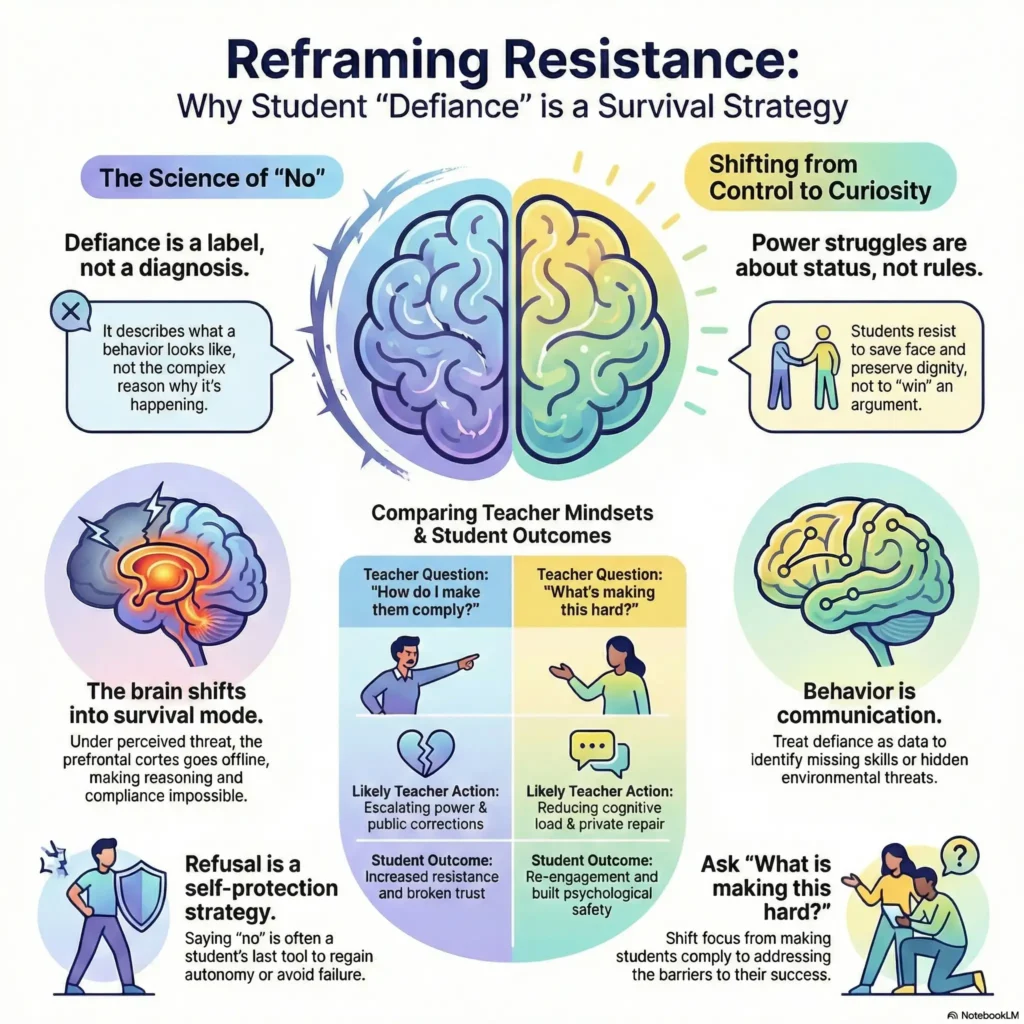
“Defiance” describes what behavior looks like—not why it’s happening.
Two students may display the same behavior (refusing to work), but for entirely different reasons:
One is overwhelmed and frozen
One feels publicly embarrassed
One is protecting peer status
One doesn’t understand the task
One feels unsafe asking for help
When we label all of these as defiance, we collapse complex human responses into a single moral judgment.
And once behavior is moralized, teachers are pushed toward control instead of curiosity.
The Brain Doesn’t Do “Compliance” Under Threat
From earlier modules, we know this already:
When a student perceives threat—social, emotional, or academic—the brain shifts into survival mode.
In that state:
Working memory drops
Language processing weakens
Emotional regulation collapses
The prefrontal cortex goes offline
So when a teacher says:
“They know the rule. They’re choosing not to follow it.”
What may actually be happening is:
“Their brain cannot access the skills we’re asking for right now.”
You cannot reason a student out of a threat response—especially by escalating power.
“No” Is Often a Regulation Strategy in Why Students are Defiant
For many students, refusal is not rebellion—it’s self-protection.
Saying “no” can mean:
I don’t understand and I’m afraid to ask
I don’t want to fail publicly
I feel controlled and need autonomy
I’m already overwhelmed
In this sense, refusal is often the last tool a student has to regain a sense of control.
Punishing that response doesn’t teach regulation—it teaches avoidance and mistrust.
Power Struggles Are Usually About Status, Not Rules
Most classroom power struggles are not about the task.
They’re about:
Saving face
Preserving dignity
Avoiding humiliation
Testing psychological safety
When a student feels cornered, public compliance can feel like social death.
So they resist—not to win, but to not lose.
This is why:
Public corrections escalate behavior
Neutral tone matters more than words
Private repair is more effective than public consequences
Defiance often disappears when students no longer feel threatened by compliance.
What Changes When Teachers Shift the Lens
When teachers stop asking:
“How do I make them comply?”
and start asking:
“What’s making this hard right now?”
Everything changes.
Teachers begin to:
Address task clarity before behavior
Reduce cognitive load
Offer structured choices
Preserve student dignity
Respond with calm instead of control
Students, in turn, are more likely to:
Re-engage
Accept redirection
Repair mistakes
Build trust
This isn’t being permissive. It’s being precise.
Reframing Why Students are Defiant as Information
Instead of seeing defiance as disrespect, try reading it as data.
Ask yourself:
What demand is being placed right now?
What skill is being assumed?
What threat might the student be experiencing?
What would lower the emotional temperature in this moment?
Behavior is communication—especially when students lack safer ways to express what they need.
Why Students are Defiant FAQ
What is the primary cause of defiance in the classroom? Most classroom defiance is a stress response triggered by a perceived threat to a student’s safety, dignity, or autonomy. When a student feels cornered or overwhelmed, their brain’s survival mechanism takes over, leading to ‘fight or flight’ behaviors that look like defiance.
Why do students talk back or refuse to work? Refusal is often a self-protection strategy. It can be a way to avoid public failure, a response to cognitive overload, or a desperate attempt to regain a sense of control in an environment where they feel powerless.
How should a teacher respond to a defiant student? The most effective response is to stay neutral and avoid power struggles. Focus on de-escalation first by providing space, offering a private check-in later, and identifying the underlying skill gap or stressor once the student is calm.
Reflection
I once had a student I quietly labeled as defiant because he refused to start work and pushed back whenever I redirected him. When I shifted my thinking from “How do I make him comply?” to “What’s making this hard right now?” I realized he was overwhelmed by multi-step tasks and afraid of getting things wrong in front of peers. Once I began breaking tasks into smaller steps and checking in privately, the tension disappeared—and what had looked like defiance turned into steady participation.
Think of a student you’ve previously labeled as “defiant.”
How might your response change if you viewed their behavior as a stress or protection response rather than a choice?
Continue the Classroom Management Course
In Module 3, Building Teacher-Student Relationships, we will learn to build teacher-student relationships to create a foundation of trust that prevents disruptions before they start.
Next Module: Building Teacher-Student Relationships
Module 2 Progress:
Back to Module 2 Overview
Return to Full Course Outline