How Student Motivation and Engagement Lead to Managed, Autonomous Classes
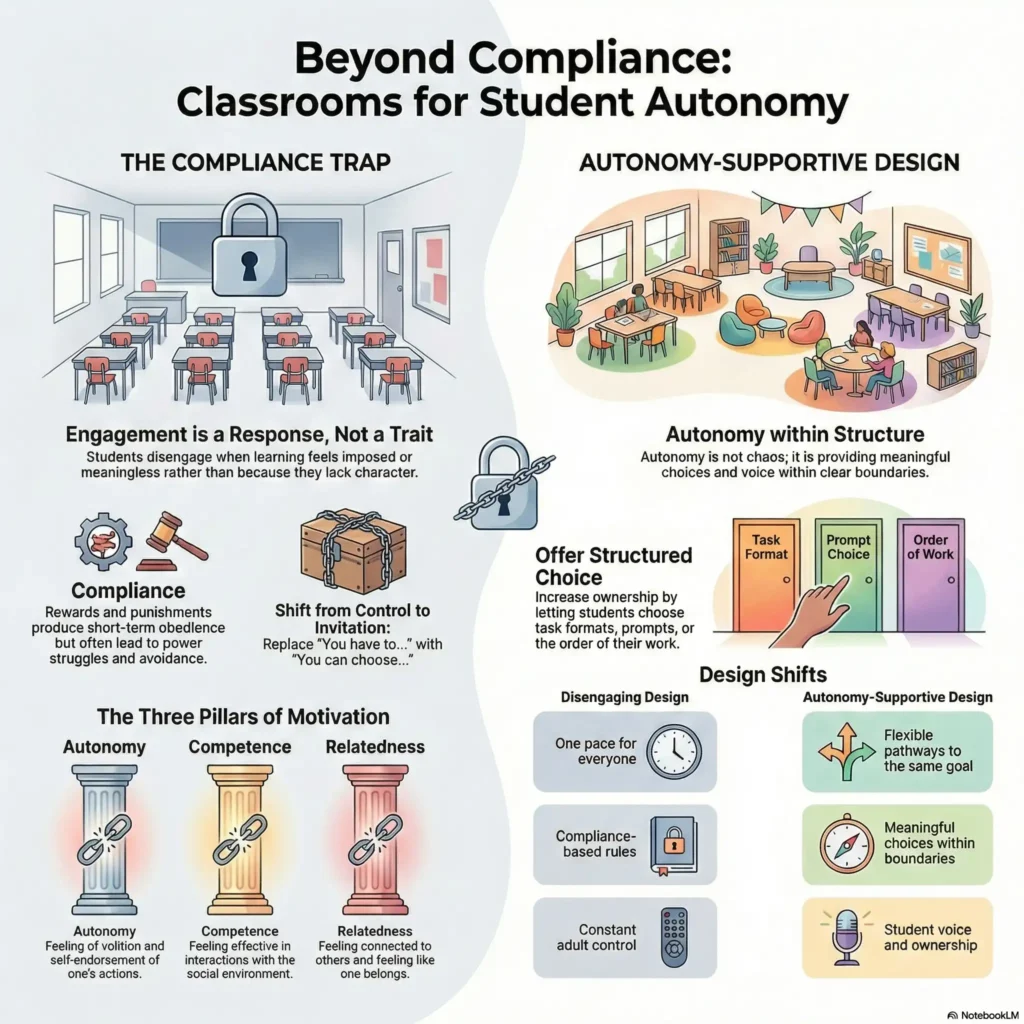
Student motivation and engagement is not a fixed student trait; it is a design response to the classroom environment. High-impact classroom management shifts the focus from external compliance (rewards/punishments) to internal motivation by meeting three psychological needs: Autonomy, Competence, and Relatedness. When students feel they have a say in their learning (autonomy), they no longer need to use defiance to regain a sense of control.
This is Lesson 4 of Module 2: The Science Behind Student Behavior | Full Course Outline
The Mindset Shift: Compliance vs. Autonomy
| The Compliance Lens (Control) | The Autonomy Lens (Engagement) |
| View: Engagement is something students “bring” or “lack.” | View: Engagement is a response to classroom design. |
| Strategy: Using rewards or threats to force “buy-in.” | Strategy: Providing structured choices to build ownership. |
| Goal: Quiet, obedient students who follow directions. | Goal: Active, self-directed learners who take risks. |
| Teacher Role: The enforcer of “How” and “When.” | Teacher Role: The architect of “Why” and “What if.” |
| Behavioral Result: Passive participation or power struggles. | Behavioral Result: Persistent effort and voluntary cooperation. |
We often talk about student motivation and engagement as if it’s something students bring to the classroom.
They’re either motivated… or they aren’t.
They care… or they don’t.
They’re engaged… or they’re checked out.
But decades of research tell a different story.
Engagement is not a student trait. It’s a classroom response.
Students don’t disengage because they lack character or work ethic. Students disengage when learning feels imposed, meaningless, or unsafe.
When students experience autonomy, motivation increases—and behavior improves as a result.
The Motivation Problem in Student Motivation and Engagement
Many management systems unintentionally undermine motivation by relying on:
External rewards
Compliance-based rules
Threats of punishment
Public correction
Constant adult control
These approaches may produce short-term compliance, but they often lead to:
Passive participation
Power struggles
Avoidance behaviors
Learned helplessness
Chronic disengagement
The question isn’t “How do I make students behave?”
It’s “Why would a student choose to engage here?”
The Science: Why Autonomy Fuels Student Motivation and Engagement
Motivation is not driven by rewards, consequences, or personality traits.
It is driven by psychological need fulfillment.
Across decades of research in educational psychology, motivation consistently increases when three core needs are met:
1. Autonomy – “I have some control here.”
Autonomy refers to a student’s sense that their actions are self-directed, not imposed.
This does not mean students get to do whatever they want.
It means they feel they have agency—that their choices, voice, and preferences matter.
When autonomy is supported:
Students feel less controlled
Resistance decreases
Engagement becomes voluntary rather than forced
When autonomy is denied:
The brain interprets learning as a threat to personal control
Students may push back, shut down, or disengage
Behavior becomes about regaining power, not avoiding work
Importantly, autonomy is about perception, not total freedom.
Even small choices—when framed authentically—can significantly increase motivation.
2. Competence – “I believe I can succeed.”
Students are more motivated when they believe success is possible.
When tasks feel:
Too vague
Too difficult
Too fast
Publicly risky
students often disengage—not because they don’t care, but because failure feels inevitable.
Competence grows when:
Expectations are clear
Steps are visible
Support is predictable
Progress is acknowledged
Without a sense of competence, autonomy doesn’t help.
Choice without support often leads to overwhelm.
That’s why structure is essential to motivation—not as control, but as scaffolding.
3. Relatedness – “I feel connected and respected.”
Students are more motivated when they feel:
Seen
Valued
Safe to participate
Respected as people
Learning is a social act.
When students feel disconnected from the teacher or the classroom community, engagement drops—even if tasks are well designed.
Relatedness increases when:
Students feel their voice matters
Mistakes don’t lead to embarrassment
Correction is private and respectful
Teachers communicate belief in students’ ability to grow
Without relatedness, autonomy can feel risky—and competence can feel irrelevant.
What Happens When These Needs Are Met
When autonomy, competence, and relatedness are present together, students are more likely to:
Invest genuine effort
Persist through frustration
Accept redirection without escalation
Repair mistakes
Regulate emotions
Engage without external pressure
This is not because students suddenly become “better behaved.”
It’s because their brains are no longer defending against threat.
What Happens When These Needs Are Denied
When classrooms rely heavily on:
Control
Compliance
Surveillance
Public correction
Rigid procedures
students often disengage as a form of self-protection, not defiance.
Disengagement may look like:
Avoidance
Humor or disruption
Silence
Refusal
Apathy
These behaviors are often attempts to regain:
Control
Dignity
Safety
Understanding this reframes misbehavior as a signal, not a moral failure.
Autonomy Does Not Mean “Anything Goes”
Autonomy is one of the most misunderstood concepts in classroom management.
Autonomy is not:
Lack of structure
Chaos
Students deciding everything
Teachers giving up authority
Classrooms without structure often increase anxiety, not engagement.
Autonomy is:
Meaningful choice within clear boundaries
Voice without loss of expectations
Ownership within structure
Participation in decision-making where appropriate
In effective classrooms:
The teacher sets the destination
Students have some say in the path
Structure provides safety.
Autonomy provides motivation.
They are not opposites—they are partners.
How Autonomy Improves Student Motivation and Engagement
When students experience genuine autonomy:
Compliance shifts into cooperation
Redirection feels less threatening
Power struggles decrease
Engagement increases
Emotional regulation improves
Why?
Because students no longer feel trapped in a system that acts on them instead of with them.
When students feel controlled:
Behavior becomes oppositional
Redirection feels personal
Correction triggers defensiveness
When students feel agency:
Feedback feels informational
Expectations feel fair
Rules feel purposeful
Autonomy doesn’t eliminate the need for boundaries—it changes how boundaries are experienced.
Engagement Is a Design Problem, Not a Motivation Problem
Students disengage when classrooms are designed around:
One way to show learning
One pace for everyone
One voice in the room
One definition of success
These designs unintentionally communicate:
“Adapt to the system—or fail.”
Engagement increases when classrooms include:
Choice in topics, texts, or formats
Flexible pathways toward the same learning goal
Opportunities for student voice
Clear purpose for tasks
When students understand why they’re doing something—and feel some control in how—behavior improves naturally.
Not because students are easier.
But because the environment is smarter.
Practical Ways to Increase Autonomy Without Losing Control
1. Offer Structured Choice
Examples:
Choose between two prompts
Pick from three task formats
Decide the order of tasks
Select a partner or work solo
Choice doesn’t need to be big to be powerful.
2. Shift Language from Control to Invitation
Instead of:
“You have to…”
“If you don’t…”
“Because I said so…”
Try:
“You can choose…”
“Here’s the goal—how do you want to approach it?”
“Let’s figure out a plan.”
Language shapes whether students feel coerced or respected.
3. Design Tasks Worth Engaging With
Students disengage when work feels:
Pointless
Overly rigid
Publicly risky
Disconnected from their lives
Engagement rises when tasks:
Solve real problems
Allow creativity
Connect to identity or interest
Respect cognitive limits
4. Normalize Struggle Without Removing Responsibility
Autonomy increases motivation when students feel safe to struggle without being rescued.
That means:
Encouragement without lowering expectations
Support without micromanaging
Feedback without shame
Why Student Motivation and Engagement Matters for Classroom Management
Motivated students require less behavioral correction.
Not because they’re easier—but because:
They feel invested
They feel respected
They feel capable
They feel ownership
When autonomy is present, teachers spend less time enforcing rules and more time teaching.
Key Takeaway
Students are not unmotivated.
They are often over-controlled, under-trusted, and disconnected from purpose.
When classrooms are designed to support autonomy:
Engagement increases
Resistance decreases
Behavior improves
Learning deepens
Classroom management becomes less about control—and more about design.
Student Motivation and Engagement FAQ
Does student autonomy mean a lack of structure? No. Autonomy is not chaos; it is meaningful choice within clear boundaries. While the teacher sets the learning destination (structure), students are given agency over the path they take to get there (autonomy).
How does autonomy reduce power struggles in the classroom? Power struggles often occur when students feel over-controlled and attempt to regain dignity. By offering structured choices, teachers remove the ‘threat’ to a student’s agency, making cooperation feel like a choice rather than a surrender.
What are the three pillars of student motivation? According to self-determination theory, motivation is driven by Autonomy (having a voice), Competence (believing success is possible), and Relatedness (feeling connected and respected).
Reflection
I remember teaching a class where I had planned what I thought was a strong lesson, but participation was low and students seemed passive throughout the activity. Instead of assuming they just weren’t motivated, I adjusted the lesson the next day by adding clearer choices, short discussion checkpoints, and opportunities for students to connect the topic to their own ideas, and engagement improved noticeably. That experience helped me see that motivation isn’t something students either have or don’t have—it’s something the classroom environment can actively support.
- When students appear disengaged, how often do you adjust the structure of the lesson rather than assuming motivation is the problem?
- Which parts of your lessons currently give students opportunities to make choices, contribute ideas, or connect learning to their experiences?
- What is one small change you could make this week to increase active participation during a typical lesson?
Continue the Classroom Management Course
In the next lesson, learn how student defiance is often a stress response rather than intentional misbehavior, showing teachers how emotional overload, reduced working memory, and loss of control can trigger resistance—and how regulation-first classroom strategies reduce escalation and improve behavior.
Next Lesson: Why Defiance Is Often Misread
Module 2 Progress:
Back to Module 2 Overview
Return to Full Course Outline