The Role of Belonging and Psychological Safety in the Classroom
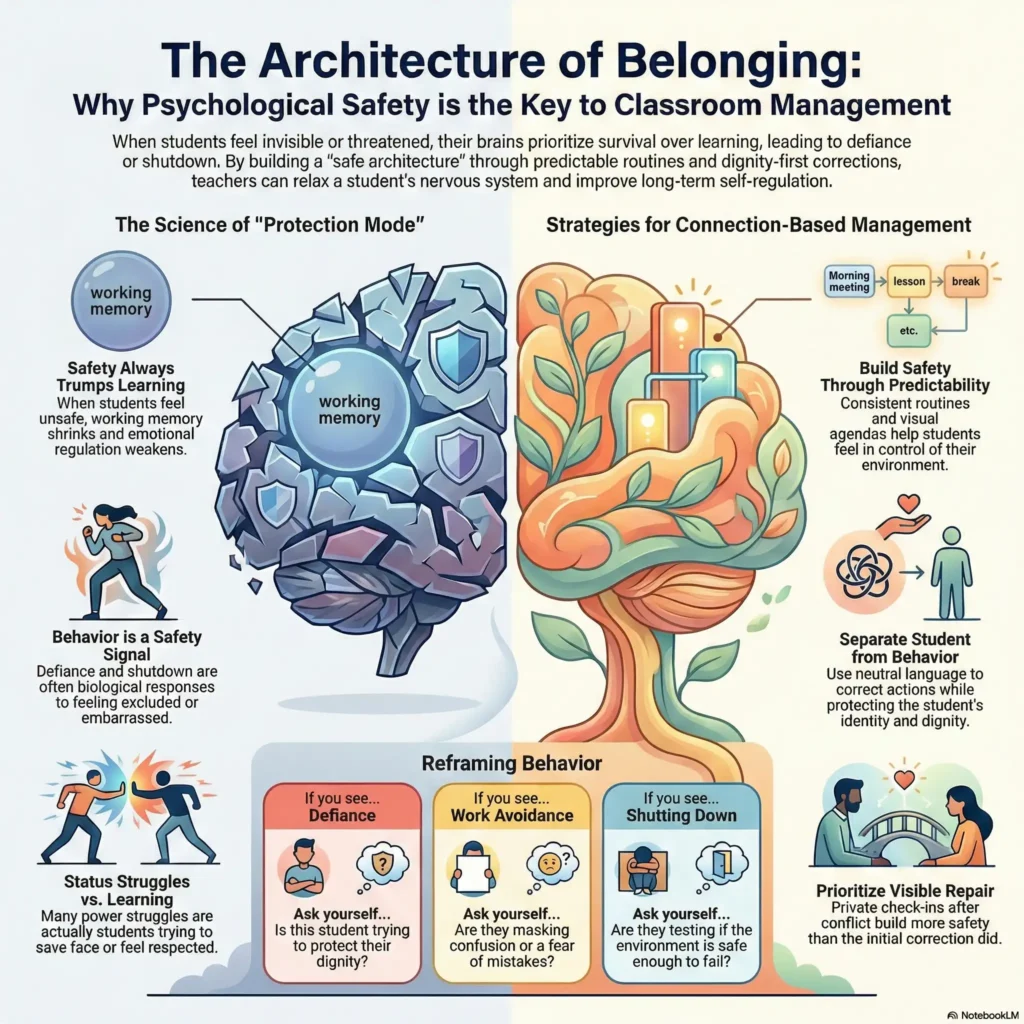
Psychological safety in the classroom is the foundation of effective classroom management. When students feel unsafe or excluded, their brains enter a “protection mode” that disables high-level learning and self-regulation. By prioritizing belonging and predictability, teachers can shift from a control-based model to a connection-based model that naturally reduces defiance and disengagement.
This is Lesson 3 of Module 2: The Science Behind Student Behavior | Full Course Outline
Mindset Shift Chart: Control vs. Connection
| The Control Lens (Managing Behavior) | The Connection Lens (Managing Safety) |
| Assumption: Students are choosing to be difficult. | Assumption: Students are reacting to a perceived threat. |
| Focus: Immediate compliance through pressure. | Focus: Regulation through psychological safety. |
| Method: Public correction and consequences. | Method: Private repair and neutral language. |
| Teacher Role: The enforcer of rules. | Teacher Role: The architect of belonging. |
| Long-term Result: Increased anxiety and burnout. | Long-term Result: Increased student autonomy and trust. |
Introduction to Psychological Safety in the Classroom
There needs to be psychological safety in the Classroom because when students feel unsafe, their brains shift into protection mode.
That “unsafe” feeling doesn’t always come from trauma or crisis. In classrooms, it often comes from much quieter things:
Not knowing what’s expected
Feeling singled out or embarrassed
Feeling invisible
Feeling like mistakes are dangerous
Feeling like the teacher is “against” them
From the outside, this looks like:
Defiance
Avoidance
Disruption
Shutdown
From the inside, it feels like:
“I don’t belong here—or I don’t feel safe enough to try.”
This module argues a core idea of the course:
Classroom management improves when students feel psychologically safe enough to learn.
Psychological Safety in the Classroom Learning Goals for Teachers
By the end of this module, teachers will be able to:
Explain how belonging and psychological safety affect student behavior
Identify classroom practices that unintentionally undermine safety
Design routines and interactions that increase belonging for all students
Respond to misbehavior through a safety-first lens
Shift from control-based management to connection-based management
What Is Psychological Safety in the Classroom?
Psychological safety is the belief that you can participate without being punished, humiliated, or excluded.
In classrooms, this means students feel safe to:
Ask questions
Make mistakes
Disagree respectfully
Try challenging work
Show parts of who they are
It does not mean:
No expectations
No accountability
No discomfort
It means:
“Even when I struggle or mess up, I am still valued here.”
What Is Belonging?
Belonging is the felt experience of being:
Seen
Known
Accepted
Needed
Students experience belonging when:
Their presence matters
Their identity isn’t something to hide
Their contributions are noticed
Their mistakes don’t exile them
Belonging is not a poster.
It’s not a slogan.
It’s a pattern of daily interactions.
Why Belonging Changes Behavior (The Science)
1. The Brain Prioritizes Safety Over Learning
The human brain is designed to answer one question before anything else:
“Am I safe right now?”
Only when the answer is yes does the brain fully engage in learning.
When students don’t feel safe—socially, emotionally, or psychologically—the brain shifts into survival mode. This is not a conscious choice. It is an automatic neurological response.
When safety feels uncertain:
The stress response activates
The brain diverts energy away from higher-order thinking
The body prepares for protection, not reflection
In the classroom, this means:
Working memory shrinks
Students struggle to hold instructions, remember steps, or follow multi-part tasks. What looks like “not listening” is often cognitive overload.Impulse control drops
The brain’s regulatory systems are compromised. Students react faster than they can think—blurting, leaving seats, snapping at peers, or refusing directions.Emotional regulation weakens
Small frustrations feel enormous. Minor corrections feel personal. Neutral feedback can feel like a threat.
This is why students who feel unsafe often:
Overreact to small triggers
Shut down and disengage
Act out to regain control or attention
Avoid work that feels risky or exposing
Crucially, this is not a motivation issue.
It is a biology issue.
When a student’s nervous system is activated, logic, consequences, and lectures lose their effectiveness. You cannot reason a student out of a threat response—because the part of the brain needed for reasoning is temporarily offline.
This is why classroom management strategies that rely on pressure, embarrassment, or public correction often backfire. They increase perceived threat and push students further away from regulation.
2. Belonging Increases Self-Regulation
Self-regulation is often treated as a skill students either have or lack. In reality, self-regulation is deeply influenced by context.
Students who feel a sense of belonging are more likely to:
Persist through frustration
Accept redirection without escalation
Repair mistakes instead of defending them
Regulate emotions more effectively
Why does belonging make such a difference?
Because belonging reduces the brain’s social survival workload.
Students who don’t feel they belong are constantly managing questions like:
“Do I look stupid right now?”
“Am I about to be embarrassed?”
“Is the teacher against me?”
“How do I protect myself?”
That mental effort consumes cognitive resources.
When students do feel they belong:
They are not scanning for social danger
They are not guarding their identity
They are not bracing for humiliation
This frees up mental space for:
Focus
Persistence
Reflection
Emotional control
In other words, belonging doesn’t just make students feel better—it makes self-regulation neurologically easier.
This is why students may regulate well in one class and struggle in another. The difference is often not the student—it’s the level of safety and belonging embedded in the environment.
3. Psychological Safety Reduces Power Struggles
Many classroom power struggles are not about rules.
They are about status and dignity.
Underneath resistance, refusal, or pushback are often unspoken questions:
“Do I matter here?”
“Am I respected?”
“Am I safe to save face?”
When students feel psychologically unsafe, correction can feel like:
A public threat
A loss of status
A personal attack
In those moments, behavior becomes about self-protection, not compliance.
This is when teachers see:
Arguing
Defensiveness
Refusal
Escalation
Psychological safety changes this dynamic.
When safety is present:
Students don’t need to defend themselves
Correction feels instructional, not personal
Mistakes don’t threaten identity
Teachers don’t need to escalate to maintain authority
Redirection becomes easier because it is not perceived as a challenge to the student’s worth or belonging.
Importantly, this does not mean lowering expectations.
In psychologically safe classrooms:
Expectations are clear
Boundaries are firm
Accountability still exists
But students experience correction as:
“This is about the behavior—not who I am.”
That distinction is everything.
Bottom Line for Teachers
Belonging and psychological safety are not “extras” or “soft skills.”
They are regulation supports.
When students feel safe and valued:
Their brains are more available for learning
Their behavior is more flexible
Their recovery from mistakes is faster
This is why the most effective classroom management often looks calm, relational, and predictable—not because students are controlled, but because their nervous systems are supported.
Common Practices That Undermine Psychological Safety in the Classroom Unintentionally
Even strong teachers can unintentionally erode psychological safety through:
Public correction
Sarcasm or humor at a student’s expense
Inconsistent expectations
Calling out before clarifying
Treating confusion as laziness
Using shame as motivation
Ignoring quiet students while managing loud ones
These don’t make teachers “bad.”
They make classrooms human.
But awareness gives us options.
What a Psychologically Safe Classroom Looks Like
A safe classroom is not silent or chaotic—it’s predictable and humane.
You’ll notice:
Clear routines
Calm correction
Neutral language
Warm but firm boundaries
Mistakes treated as information
Students willing to try again
Students may still misbehave—but recovery is faster.
Practical Strategies to Build Belonging and Safety
1. Predictability Is Safety
Students feel safer when they can answer:
What happens when I walk in?
What happens if I mess up?
What happens if I don’t understand?
Strategies:
Consistent entry routines
Clear transitions
Visual agendas
Rehearsed “what if” plans
2. Separate the Student from the Behavior
Language matters.
Instead of:
“You’re being disrespectful.”
Try:
“That behavior doesn’t match our expectation.”
This protects:
Dignity
Identity
Relationship
3. Normalize Struggle Publicly
Students feel safer when teachers:
Admit mistakes
Think out loud
Model regulation
Share learning struggles
This sends a powerful message:
“You don’t lose belonging when you struggle.”
4. Make Repair Visible
Repair builds safety more than perfection.
After conflict:
Check in privately
Name what went wrong
Reaffirm expectations
Reaffirm connection
Students remember repair longer than correction.
5. Widen the Circle of Belonging
Belonging isn’t just teacher-student.
It grows through:
Structured peer interaction
Group roles
Shared goals
Cooperative routines
Design belonging into the day.
When Belonging Is Missing: Reframing “Defiance”
Before labeling behavior as defiance, ask:
Is this student protecting dignity?
Are they masking confusion?
Are they avoiding embarrassment?
Are they testing safety?
Often, “defiance” is a signal, not a stance.
Try This Tomorrow
In my twenty-plus years of teaching, I have found the following to work very well. As dull as it might sound, keeping a predictable routine has become the most reliable classroom management method.
Add a predictable opening routine
Change one corrective phrase to neutral language
Privately repair after a minor disruption
Publicly normalize a mistake — yours or the class’s — while remaining respectful
Small changes compound.
Belonging and Psychological Safety in the Classroom FAQ
What is psychological safety in a classroom setting? Psychological safety is the belief that a student can participate, make mistakes, and take risks without fear of being punished, humiliated, or excluded. It is the neurological prerequisite for learning.
How does belonging affect student behavior? When students feel they belong, their brains stop scanning for social danger. This reduces the ‘social survival’ cognitive load, freeing up mental resources for focus, persistence, and emotional regulation.
Does psychological safety mean there is no accountability? No. In a safe classroom, boundaries remain firm and expectations are high. However, accountability is handled through an instructional lens rather than a punitive or shaming one.
Reflection
I remember a discussion in my Grade 9 English class where students were hesitant to share ideas about a difficult text, and the silence in the room made it clear they were worried about giving the “wrong” answer. Instead of moving on, I paused the lesson and reminded them that trying ideas out loud—even imperfect ones—was part of how we learn together, and I modeled that by sharing my own uncertainty about a passage. After that moment, participation increased noticeably, which helped me see how psychological safety changes not just behavior, but students’ willingness to think publicly.
- How comfortable do your students seem taking risks such as asking questions, sharing tentative ideas, or admitting confusion in your classroom?
- What signals—intentional or unintentional—might students be reading from you about whether it is safe to make mistakes?
- What is one routine or response you could adjust this week to make participation feel safer for hesitant students?
Continue the Classroom Management Course
In the next lesson, we will learn about how student motivation and engagement increase when classrooms support autonomy, competence, and belonging, showing teachers how giving structured choice and ownership reduces resistance and improves behavior and learning.
Next Lesson: Motivation, Autonomy, and Engagement
Module 2 Progress:
The Role of Belonging and Psychological Safety
Back to Module 2 Overview
Return to Full Course Outline