
To Kill a Mockingbird Chapter 1: High School Lesson Plan
Use this To Kill a Mockingbird Chapter 1 lesson plan to introduce Maycomb, Scout’s narrative voice, and the rumours surrounding Boo Radley. Students read in an accessible format, build vocabulary, map character relationships, and distinguish facts from stories in the community.
← All To Kill a Mockingbird unit lessons
Learning Goals
- I will be able to interpret and define specific vocabulary and idiomatic expressions from Chapter 1, like ‘assuaged’ and ‘flivver,’ thereby improving my language skills and comprehension of the text.
- I will be able to analyze and map the relationships between Scout and other characters introduced in Chapter 1, aiding in my understanding of character dynamics and development.
- I will be able to distinguish between factual information and fictional legends surrounding Boo Radley, promoting my critical thinking and analysis of narrative techniques used in the novel.
Materials
Vocabulary Builder
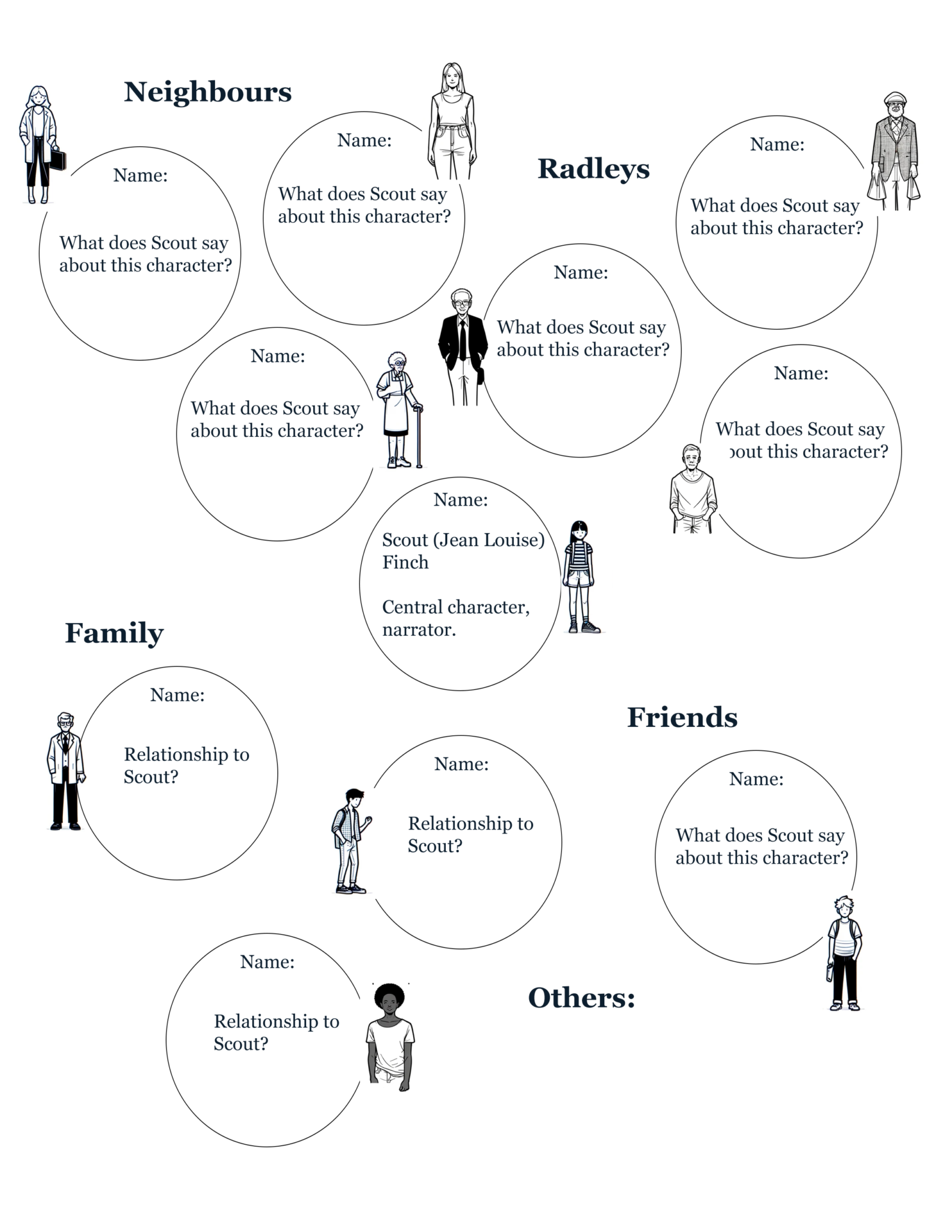
Scout and Other Characters in Chapter 1
Boo Radley: Myth vs. Fact
Different versions of the book
Electronic devices for research
A FREE CLASSROOM GAME FOR ENGLISH TEACHERS
Make your next English review a Plot Twist!
Bring some unexpected fun to your next lesson. Get a free game of Plot Twist!, the ultimate classroom review game, and discover fresh ideas for teaching English.
Subscribe for English teaching ideas and occasional resource updates, plus your free Plot Twist! game. You can unsubscribe from emails at any time.
Process
- Let students choose which version of the book they want to read. Students who are listening should also read along.
- OR Read chapter 1 with students.
- After reading the chapter, have students complete the following tasks:
- Must Do: Vocabulary Builder: Either before reading or as students come across each term in the novel, they should pause to define the terms.
- Must Do: Scout and Other Characters in Chapter 1: Complete the map showing the relationships between Scout and other characters mentioned in Chapter 1.
- Should Do: Boo Radley: Myth vs. Fact: Read through the Boo Radley section of chapter 1 closely and place the different statements about him in either the myth of fact column.
- Bonus: Enriching Chapter 1 With Historical Context: Create one slide for each of the following topics. Include an overview of why it is historically relevant and why it is important in To Kill a Mockingbird.
- Slide 1: The Battle of Hastings
- Slide 2: The meaning of “General Jackson ran the Creeks up the creek.”
- Slide 3: The Methodist denomination
- Slide 4: A Hoover Cart
Assessment
Collect student work to provide feedback.
Curriculum Connections
Ontario Grade 9 English (ENL1W): This lesson supports Strand C and Strand D through close reading, characterization, point of view, and evidence-based response.
Common Core: RL.9-10.1, RL.9-10.3, RL.9-10.6, and SL.9-10.1.
Differentiation and Extensions
Differentiation: Let students access the chapter through print, audio, or graphic-text support where appropriate, and use a character/setting organizer to reduce working-memory demands.
Extension: Ask students to explain how Scout’s narration shapes what readers understand about Maycomb in the opening chapter.
Frequently Asked Questions
What should students understand after Chapter 1?
Students should be able to identify the main setting and characters, explain Scout’s role as narrator, and recognize early conflicts and social relationships in Maycomb.
Can students use different versions of the text?
Yes. The lesson is designed to accommodate print, audio, and graphic-text supports while keeping the same comprehension and analysis goals.
How can I support students who need help tracking characters?
Use a simple character chart with names, relationships, first impressions, and one supporting detail from the chapter.
Continue the Unit
← Previous: Historical Context | Unit Plan | Next: Chapter 2 →