
THE TEACHERS’ BLOG / ASSESSMENT RESOURCE LIBRARY
Literacy Assessment Resources for Teachers
Understand literacy tests, identify learning needs and plan targeted instruction before the next assessment.
Explore U.S. state and Canadian provincial assessment systems alongside practical classroom strategies for reading, writing and the wider literacy skills students need.
Start with the purpose of the assessment
Literacy assessment resources for teachers should help answer a practical question: what can students do now, and what should they learn next? State and provincial tests provide one type of evidence. Classroom assessments can give teachers more immediate information before and after a period of instruction.
Find your assessment
Browse the regional index to locate your state or province. Named guides are added individually as they are published.
Plan your next steps
Use skill-level results to choose targeted review rather than treating a single total score as the whole picture.
Open LiteracyCheck classroom assessments to gather your own evidence before an upcoming test.
U.S. state literacy and ELA assessments
Under federal law, states assess reading or language arts each year in Grades 3–8 and at least once in Grades 9–12. The program names, tested standards, schedules, and graduation rules vary. Use the federal assessment requirements and your own state education agency for official details.
Find your state by region. This is a growing guide index. State names without article links identify planned coverage, not published guides. New articles will be linked here as they go live.
Northeast
- New England: Connecticut, Maine, Massachusetts (MCAS ELA), New Hampshire, Rhode Island, Vermont.
- Middle Atlantic: New Jersey, New York (Grades 3–8 ELA), Pennsylvania (PSSA ELA).
Midwest
- East North Central: Illinois, Indiana, Michigan (M-STEP), Ohio, Wisconsin.
- West North Central: Iowa, Kansas, Minnesota, Missouri, Nebraska, North Dakota, South Dakota.
South
- South Atlantic: Delaware, Florida (FAST ELA Reading), Georgia, Maryland, North Carolina, South Carolina, Virginia, West Virginia.
- East South Central: Alabama ACAP ELA test guide, Kentucky, Mississippi, Tennessee.
- West South Central: Arkansas, Louisiana, Oklahoma, Texas (STAAR RLA).
West
- Mountain: Arizona, Colorado, Idaho, Montana, Nevada, New Mexico, Utah, Wyoming.
- Pacific: Alaska, California (CAASPP ELA/Literacy), Hawaii, Oregon, Washington.
Official resources to use while the guide library grows
For current schedules, test blueprints and score interpretation, start with the Florida FAST assessment page, the New York State assessment overview, or the U.S. Department of Education state report card directory. Regional groupings follow the U.S. Census geography.
Use assessment evidence before the next test
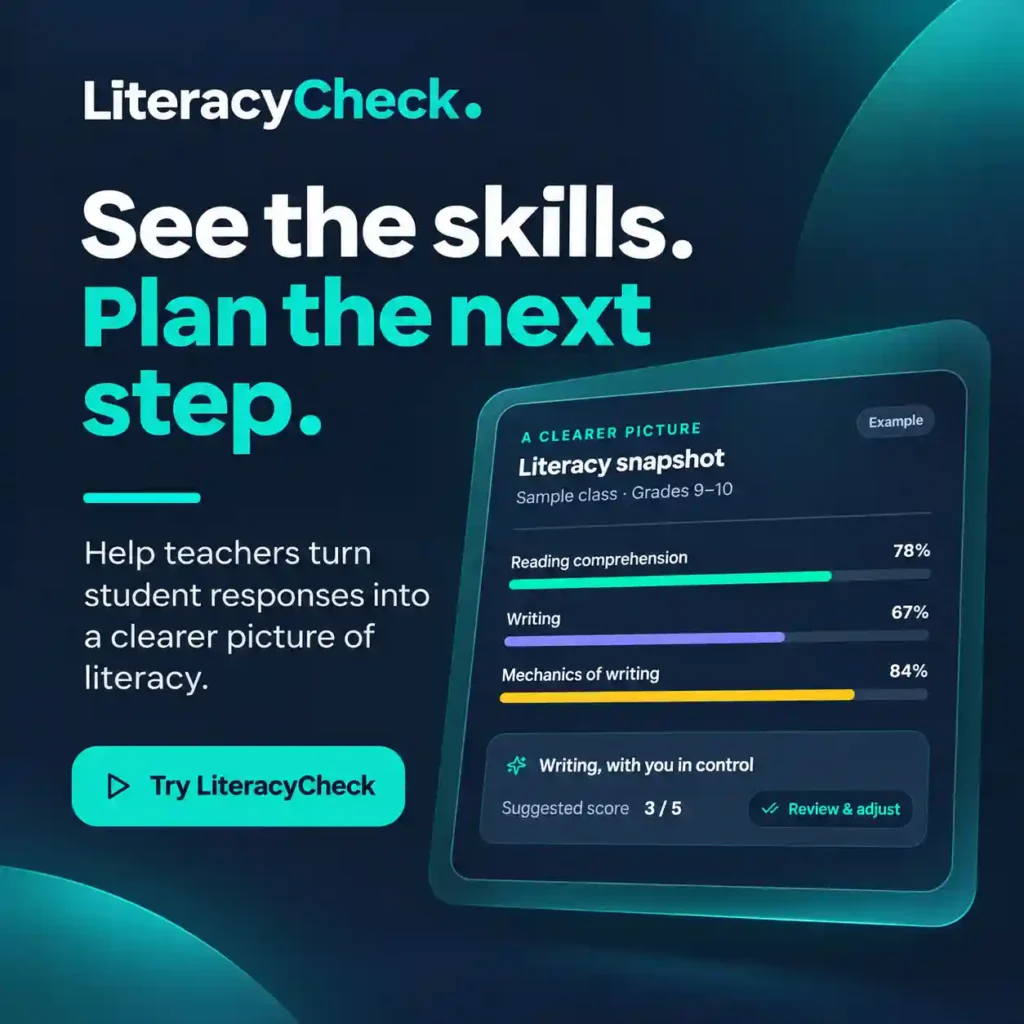
LiteracyCheck is ready for teachers in Grades 2–12. Choose classroom assessments, invite students with one access code, and review individual and class-level results. Use it to identify literacy strengths and gaps, plan targeted instruction and reassess after review.
Students do not need accounts. Objective items are scored automatically, and teachers retain control of written-response scoring.
Learn more about LiteracyCheck literacy assessment software for teachers.
Canadian provincial literacy assessments
Education and assessment policies are set by provincial and territorial authorities. Some programs assess literacy at specified grades; others address graduation or early reading screening. Consult the Council of Ministers of Education, Canada and the relevant ministry for current requirements.
Canadian assessment guides will follow the U.S. series. Entries are listed geographically so each guide can be linked in its permanent location when published.
Western Canada
- British Columbia — graduation literacy assessments and Foundation Skills Assessment
- Alberta — English Language Arts provincial assessments
- Saskatchewan — provincial ELA assessments and reading screening
- Manitoba — provincial reading and literacy assessments
Central Canada
- Ontario — Ontario Secondary School Literacy Test (OSSLT) and EQAO reading and writing assessments
- Quebec — English Language Arts ministerial examinations
Atlantic Canada
- New Brunswick — provincial reading and English language proficiency assessments
- Newfoundland and Labrador — provincial reading assessments and screening
- Nova Scotia — provincial literacy assessments
- Prince Edward Island — assessment program to be reviewed before coverage
Using provincial results
Check the official grade-level expectations and the actual reporting categories before selecting classroom assessments. A classroom score should not be treated as a provincial test prediction.
Six core literacy areas to assess in the classroom
General Literacy is the broad, combined view of performance. More focused assessments help teachers examine six distinct areas, depending on the grade band and assessment selected.
Reading Comprehension
Check understanding of explicit information, central ideas, inference, text structure and evidence. A student who retrieves details but misses implied meaning may need guided inference practice.
Writing
Examine organization, clarity, development of ideas and use of evidence. Use a common rubric to distinguish a weak explanation from a mechanics error.
Mechanics of Writing
Look at grammar, punctuation, capitalization and sentence construction. Record recurring error patterns to plan focused mini-lessons.
Vocabulary and Word Knowledge
Explore word meanings, context clues, word relationships and word parts. Check whether unfamiliar vocabulary is interfering with text comprehension.
Media and Information Literacy
Examine purpose, audience, perspective, credibility and interpretation of information in different formats. Ask students to justify which evidence makes a source useful.
Foundational Literacy
Examine age-appropriate basic reading and word-level skills. Combine classroom assessment results with observation and any required early reading screening.
General Literacy: connect the evidence
Use a broad literacy assessment to identify initial patterns, then select focused assessment tasks and examine student work to understand what may be contributing to those patterns. General Literacy is not counted as a seventh distinct skill domain.
How to use classroom literacy assessment for test preparation
A useful diagnostic assessment informs teaching. Use this cycle before a state assessment, provincial literacy test, classroom test or end-of-term exam.
1. Establish a baseline
Select tasks that assess the skills you intend to teach. Check the relevant official test framework where appropriate.
2. Plan focused review
Look for recurring errors, group students by instructional need where appropriate, and teach or model the relevant skills.
3. Reassess and reflect
Compare evidence on the same skills after instruction, taking account of differences in task difficulty and student circumstances.
Related classroom resources
- Nonfiction and media literacy review games for English class
- Teaching students to question AI: critical AI literacy
These are related teaching resources, not official test preparation materials. More dedicated literacy assessment guides will be added after the state and provincial series.
Frequently asked questions about literacy assessment
What is the difference between diagnostic and standardized literacy assessment?
Classroom diagnostic assessment provides evidence to guide the next instructional steps. Standardized assessments follow defined administration and scoring procedures for a specific purpose. LiteracyCheck supports classroom decisions; it is not a validated clinical diagnostic or a replacement for official tests.
How often are state and provincial literacy tests administered?
Schedules vary by jurisdiction and program. Some use an annual window while others have multiple testing periods. Check the official assessment calendar for the current school year.
Which literacy areas should teachers assess?
Reading comprehension, writing, mechanics of writing, vocabulary and word knowledge, media and information literacy, and foundational literacy are useful areas to examine. The appropriate tasks depend on the students’ grade and learning needs.
How can teachers track literacy improvement?
Gather a baseline, review skill-level results, teach targeted lessons and collect follow-up evidence. Consider assessment difficulty and the amount of evidence available before drawing conclusions.
Find the next step for your students
Use LiteracyCheck to gather classroom diagnostic evidence, plan focused review and monitor progress before the next literacy assessment.