
Alphabetizing a Works Cited Page: 6 Rules Students Get Wrong
A student can format every entry correctly and still hand in a Works Cited page that is hard to use, because the entries are out of order. When a reader sees (Golding 42) in an essay, they turn to the last page and look among the G’s. If the list is in the order the student found the sources, or a book is filed under “The,” the reader has to search the whole page.
Most students know how to alphabetize single words. What they haven’t been taught are the exceptions, like a title that starts with “The” or an author with two books on the list, and those are where they lose marks. This post covers the six rules students miss most often and how MLA and APA differ. It ends with a 20-minute activity for practising them.
The Basic Rule: Alphabetize by the First Word of the Entry
In both MLA and APA, an entry starts with the author’s last name, and that first element decides where the entry goes. If a source has no author, the title moves into first position and decides its place instead.
Two habits to break early:
- No numbers or bullets. A Works Cited page is not a numbered list.
- No “order of appearance.” Some citation styles used in science and engineering number sources in the order they are cited. MLA and APA do not. Every entry goes in alphabetical order, whatever page of the essay it was used on.
If your students are still learning what goes into each entry, start with the MLA Works Cited lesson and the follow-up lesson on MLA in-text citations. Sorting the list makes sense once each entry matches a citation in the essay.
Six Alphabetizing Rules Students Get Wrong
1. Skip “A,” “An,” and “The” at the start of a title
When a title comes first in an entry, ignore an opening article for sorting. The Epic of Gilgamesh goes under E. The article stays in the entry; it just doesn’t count for the order.
Wrong: The Epic of Gilgamesh filed with the T’s.
Right: The Epic of Gilgamesh filed with the E’s.
The same rule applies to titles inside an author’s group of works (rule 3). Students tend to forget it there.
2. Go letter by letter, and “nothing comes before something”
Compare last names one letter at a time. When a shorter name matches the start of a longer one, the shorter name comes first: Brown comes before Browning, because “Brown” runs out of letters first.
Mac and Mc follow the same rule. Sort them exactly as they are spelled. MacLachlan comes before McCarthy because the second letters are a and c.
3. Two or more works by the same author
MLA and APA handle this differently:
- MLA: put the works in alphabetical order by title, skipping A, An, and The. Write the author’s name in the first entry only. In each entry after it, replace the name with three hyphens and a period (
---.). - APA: put the works in date order, earliest first, and repeat the author’s name in every entry.
In MLA, two Steinbeck novels look like this. The Grapes of Wrath comes first because it files under G, which comes before the O of Of Mice and Men:
Steinbeck, John. The Grapes of Wrath. Viking Press, 1939.
—. Of Mice and Men. Covici-Friede, 1937.
Students often put Of Mice and Men first, either because it is the earlier book (the APA rule) or because they sorted the other title under T.
4. Sources with no author
When there is no author, the title goes first and the entry is sorted by its first important word. Anonymous works like Beowulf sort under B, and an unsigned web page sorts by its title, skipping any opening A, An, or The.
Students sometimes fill the empty author spot with the website’s name, like “BBC” or “History.com.” A website is not an author. An organization can be an author when it wrote the source, but MLA and APA treat that case differently, so check the style guide. If no person or organization is named as the author, start with the title.
5. Names with prefixes: de, van, von, O’
Where a prefix goes depends on the language a name comes from and on how the person writes it. The French author of The Little Prince is listed as Saint-Exupéry, Antoine de and sorted under S. The American author of Jumanji keeps the capitalized “Van” as part of his surname, so he is listed as Van Allsburg, Chris and sorted under V.
Students can’t memorize every naming tradition. Have them look the author up in a library catalogue and copy the form of the name used there.
6. Entries that start with a number
MLA guides file a title that begins with a numeral as if the number were spelled out, so a web article called “5 Ways to Read a Poem” goes under F, for “five.” Students tend to put numbers at the very top of the list, which is also where most computer sorting puts them. If your course uses APA, check the manual for this case.
MLA vs. APA at a Glance
| MLA (9th edition) | APA (7th edition) | |
|---|---|---|
| Page title | Works Cited | References |
| Sorted by | Author’s last name; title if no author | Author’s last name; title if no author |
| Same author, several works | By title (skip A, An, and The) | By year, earliest first |
| Repeated author name | Three hyphens and a period (---.) | Name repeated in full |
| No author | Title first, sorted by first important word | Title moves into author position, sorted by first important word |
| Mac and Mc | Sorted as spelled | Sorted as spelled |
Classroom Activity: The Scrambled Works Cited (20 Minutes)
In this activity, pairs sort a scrambled list by hand, check it against a computer sort, and then work out where the computer got it wrong.
Before class
Use the eleven entries below. Eight of them test a rule: an opening “The,” a Mac and a Mc, two works by one author, two anonymous works, and two prefix names. The other three are ordinary entries.
Steinbeck, John. Of Mice and Men. Covici-Friede, 1937.
Beowulf. Translated by Seamus Heaney, Farrar, Straus and Giroux, 2000.
McCarthy, Cormac. The Road. Alfred A. Knopf, 2006.
The Epic of Gilgamesh. Translated by N. K. Sandars, Penguin Books, 1960.
Hinton, S. E. The Outsiders. Viking Press, 1967.
Saint-Exupéry, Antoine de. The Little Prince. Translated by Katherine Woods, Reynal and Hitchcock, 1943.
MacLachlan, Patricia. Sarah, Plain and Tall. Harper and Row, 1985.
Steinbeck, John. The Grapes of Wrath. Viking Press, 1939.
Golding, William. Lord of the Flies. Faber and Faber, 1954.
Van Allsburg, Chris. Jumanji. Houghton Mifflin, 1981.
Lee, Harper. To Kill a Mockingbird. J. B. Lippincott, 1960.
Both Steinbeck entries carry his full name on purpose. Students replace the second one with hyphens after the list is in order.
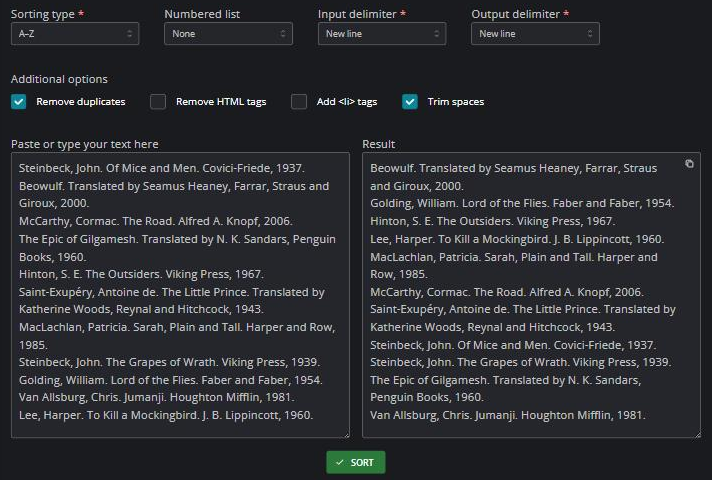
To give each class period a different scramble, paste the list into a free online alphabetizer and set both delimiters to New line. Choose Random as the sorting type, then print the result. Each click gives a new order, so your second period can’t copy the first period’s answer.
Round 1: Sort by hand (8 minutes)
In pairs, students put the list in MLA order using the six rules. Beside each entry that needed a rule, they write which one, for example “skip The” or “Mac before Mc.”
Round 2: Check against the computer (5 minutes)
Students paste the same list into the alphabetizer, switch the sorting type to A to Z, and compare its order with their own. Most pairs will assume the computer is right.
Round 3: Who’s right? (7 minutes)
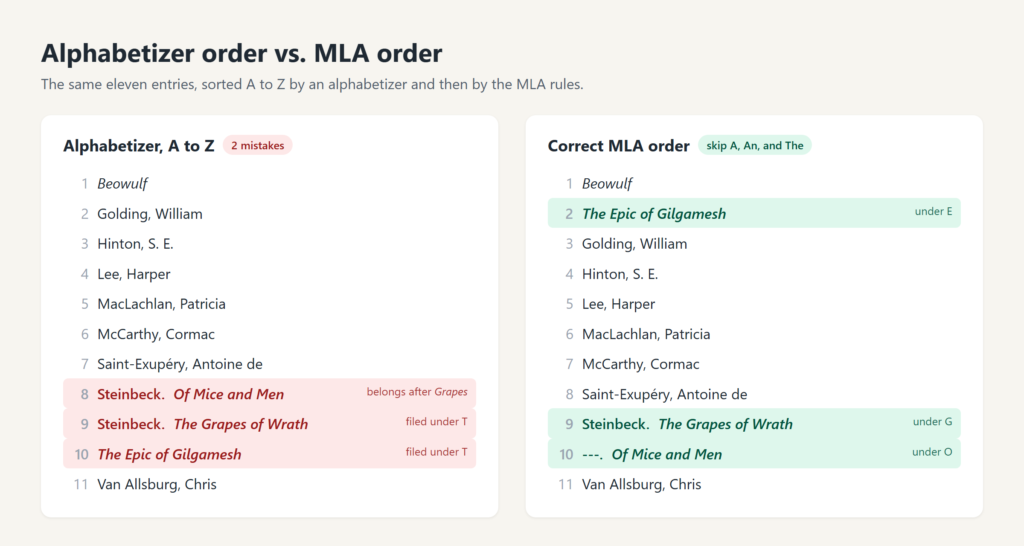
The computer sorts the Mac and Mc entries correctly, and the prefix names land in the right place because they were typed correctly. It still makes two mistakes. Ask students to find them:
- It files The Epic of Gilgamesh under T. MLA files it under E, between Beowulf and Golding.
- It puts Of Mice and Men before The Grapes of Wrath, because it reads the “The.” MLA puts Grapes first.
A sorting tool only compares letters, so it can’t apply the article rule. It is useful on a long list, but students still need to check its order against the six rules.
This is also why the Steinbeck entries keep the full name. If students type ---. before sorting, the computer moves that entry to the top of the list, because punctuation sorts before letters. Have them write every name in full, sort, fix the exceptions, and replace repeated names with hyphens last.
Answer key (MLA order):
- Beowulf
- The Epic of Gilgamesh (E)
- Golding, William
- Hinton, S. E.
- Lee, Harper
- MacLachlan, Patricia
- McCarthy, Cormac
- Saint-Exupéry, Antoine de
- Steinbeck, John. The Grapes of Wrath (G)
- —. Of Mice and Men (O)
- Van Allsburg, Chris
The numbers are only for the key. The Works Cited page itself is not numbered.
The Final Check Before Students Submit
Post this list, or add it to the essay checklist students already use for their drafts:
- Every entry starts with a last name or, if there is no author, a title.
- No entry is filed under “A,” “An,” or “The.”
- Mac and Mc names are sorted as spelled.
- Works by the same author are in title order (MLA) or date order (APA).
- Repeated author names are replaced with
---.in MLA and written out in APA. - No numbers or bullets in front of the entries.
- Hanging indent and double spacing throughout. This is formatting rather than order, but it is easy to check at the same time.
For the page layout itself (margins and header), see the guide to MLA formatting.
When to Teach It
Run the activity on the day the first draft of the Works Cited page is due. Students can sort their own lists right after the practice one, while the six rules are fresh, and you get drafts that are already in order.