
10 Grammar Review Games for Middle and High School
Grammar review games for middle and high school should help students make better choices in their own writing, not merely spot punctuation marks on a screen. The ten activities below turn sentence structure, commas, colons, semicolons, agreement, and editing into quick collaborative challenges for Grades 6–12. Each one includes a way to check reasoning so that excitement leads to stronger sentences.
The sweet spot is a short round of notice, correct, explain, and apply. Ask students to rewrite a complete sentence and describe the rule or intended effect. When more than one correction is defensible, reward both accuracy and an explanation of why it works. For other literature and writing activities, visit the English Review Games hub.
Before the first round: set one grammar learning target
Choose one or two skills rather than mixing every punctuation rule into a single game. For instance, a lesson might focus on identifying independent clauses and fixing comma splices. Another might emphasize the effect of using a semicolon versus a period. Tell students what success looks like: “I can revise a sentence correctly and explain my revision.”
A useful scoring method is one point for a grammatically defensible correction and one point for a clear explanation. Ask students to write their corrections before revealing a possible answer. This avoids the common problem of one student shouting a punctuation mark while teammates remain passive.
10 engaging grammar review games
1. Comma Splice Courtroom
Time: 10–15 minutes. Give each team a sentence with two independent clauses joined incorrectly by a comma: “The rain stopped, we went outside.” Teams present a corrected version and defend the punctuation. Accept “The rain stopped; we went outside,” “The rain stopped. We went outside,” or “The rain stopped, and we went outside.” A second team acts as the jury and checks whether the rule supports the revision.
Teacher tip: Do not demand a single answer when several syntactically correct revisions exist. Purdue OWL’s run-on and comma-splice guide is a handy answer-key reference.
2. Punctuation Choice: colon, semicolon, or comma?
Time: 12 minutes. Display a sentence with a blank: “We needed three supplies___ paper, scissors, and glue.” Teams insert a colon and explain that a complete clause introduces a list. Then try “The library was closing___ we had not finished our research.” A semicolon or period works between the independent clauses; a comma alone does not.
Challenge round: Give an opening fragment such as “Including three things___ paper, scissors, and glue” and ask why a colon cannot rescue an incomplete lead-in. The point is to recognize sentence structure, not guess a mark.
3. Sentence Surgery Relay
Time: 15 minutes. Give teams three sentences containing different errors. Each learner performs one step: diagnose, rewrite, explain, and read the edited sentence aloud. Example: “Although the speaker was nervous.” Students could revise it to “Although the speaker was nervous, she delivered the speech.” Require full-sentence rewrites so the correction becomes usable writing.
4. Clause Detective
Time: 10 minutes. Present short sentence strips: “Because the ending surprised us,” “The final chapter changed everything,” and “Although the setting seemed peaceful, the tension grew.” Students label independent and dependent clauses, combine a fragment with a complete thought, and explain where a comma belongs.
Stretch: Let older students explore how moving an introductory dependent clause to the end can alter emphasis and sometimes punctuation.
5. Sentence-Type Switch
Time: 10–15 minutes. Start with “The narrator hesitated.” Ask students to transform it into a compound sentence and a complex sentence without changing its core meaning: “The narrator hesitated, but the door opened anyway,” and “Because the narrator hesitated, the door closed.” Teams explain the clauses they added and why each resulting sentence qualifies.
6. Subject–Verb Agreement Ambush
Time: 10 minutes. Prepare sentences in which intervening phrases distract from the subject: “Each of the students ___ a copy of the novel.” Students choose “has,” identify the singular subject “each,” and explain why “students” does not control the verb. Provide an additional round with compound subjects and collective nouns, discussing regional conventions where appropriate.
7. Active or Passive? Choose the emphasis
Time: 10 minutes. Show “The committee approved the proposal” and “The proposal was approved by the committee.” Ask groups to identify each voice and decide which version better suits a stated purpose. The passive voice is not automatically a mistake; writers may choose it when the receiver of an action matters more than the actor.
8. Dialogue Punctuation Editors
Time: 10–12 minutes. Present a dialogue draft: ‘Maya said “We should leave now”.’ Teams rewrite it using the quotation and punctuation conventions taught in your class, for example: ‘Maya said, “We should leave now.”’ Then ask students to write another sentence in which a dialogue tag follows the quotation.
Adaptation: Different national style guides use different conventions. Make your school’s expected style clear instead of treating a stylistic difference as universal error.
9. Error-Category Bingo
Time: 10–15 minutes. Fill a bingo card with labels such as comma splice, fragment, agreement error, unnecessary comma, semicolon misuse, and correctly punctuated sentence. Read teacher-written examples; students mark a category only after writing a brief explanation. Include several correct sentences so students cannot assume every prompt has a problem.
10. Grammar Auction: bid on the best revision
Time: 15–20 minutes. Provide each team with ten paper tokens. Display three possible revisions of a weak sentence and ask teams to bid on the option they believe is most effective. Some rounds have one clearly correct answer; others contain two grammatical options with different effects. Teams earn tokens back when their explanation connects the choice to clarity, emphasis, or the writing purpose.
Six ready-to-use grammar review questions and answers
1. Correct the sentence: “I reread the ending, it finally made sense.” Acceptable answers: “I reread the ending; it finally made sense,” or “I reread the ending, and it finally made sense.” Reason: Two independent clauses cannot be joined by a comma alone.
2. Insert punctuation: “I packed the following items paper a notebook and a pencil.” Possible answer: “I packed the following items: paper, a notebook, and a pencil.” Reason: A complete introductory clause leads into a list.
3. Correct the fragment: “When the final bell rang.” Possible answer: “When the final bell rang, the class applauded.” Reason: An introductory dependent clause needs an independent clause.
4. Fix agreement: “Every one of the characters have a secret.” Answer: “Every one of the characters has a secret.” Reason: “Every one” is the singular head of the subject.
5. Find the two independent clauses: “The review ended, but the discussion continued.” Answer: “The review ended” and “the discussion continued.” Reason: Each can stand on its own; the coordinating conjunction links them.
6. Choose the most effective sentence: For a report focusing on the discovery rather than the researcher, compare “A student discovered the error” with “The error was discovered by a student.” Answer: The passive may better foreground the error. Reason: Good grammar teaching includes choices about emphasis, not only correctness.
A 40-minute grammar review lesson plan
Minutes 0–5 — Bell ringer: Students independently correct a comma splice, rewrite the entire sentence, and explain the rule. Invite two valid approaches.
Minutes 5–12 — Mini-lesson: Review dependent versus independent clauses. Model why the mark depends on sentence structure rather than the length of a pause.
Minutes 12–27 — Team games: Play Comma Splice Courtroom and Punctuation Choice. Teams discuss, record complete answers, and earn points for explanations. Collect one misconception to revisit.
Minutes 27–35 — Application: Run a Sentence Surgery Relay. Use two sentences from a class writing sample only after removing any student identifiers and obtaining appropriate permission.
Minutes 35–40 — Exit ticket: Give each learner a new sentence containing two independent clauses and ask for two acceptable revisions plus one sentence explaining the difference.
Differentiation for Grades 6–12
Grades 6–7: Reduce the number of grammar categories, display clauses in different colours, and provide a short rule reference during the first practice round. Focus on recognizing complete sentences before introducing competing revisions.
Grades 8–9: Add comma splices, introductory clauses, semicolons, and colons. Require students to explain corrections with grammatical vocabulary. Connect examples to the narrative and academic writing students are currently producing.
Grades 10–12: Introduce purposeful stylistic choices, sentence rhythm, parallelism, and complex sentence structures. Instead of assuming every unusual construction is wrong, ask whether a revision improves clarity for the intended audience.
For multilingual learners, let groups rehearse a rule explanation together, display example patterns, and reward an accurate edit even when the oral explanation is developing. Avoid using reading speed as the scoring criterion.
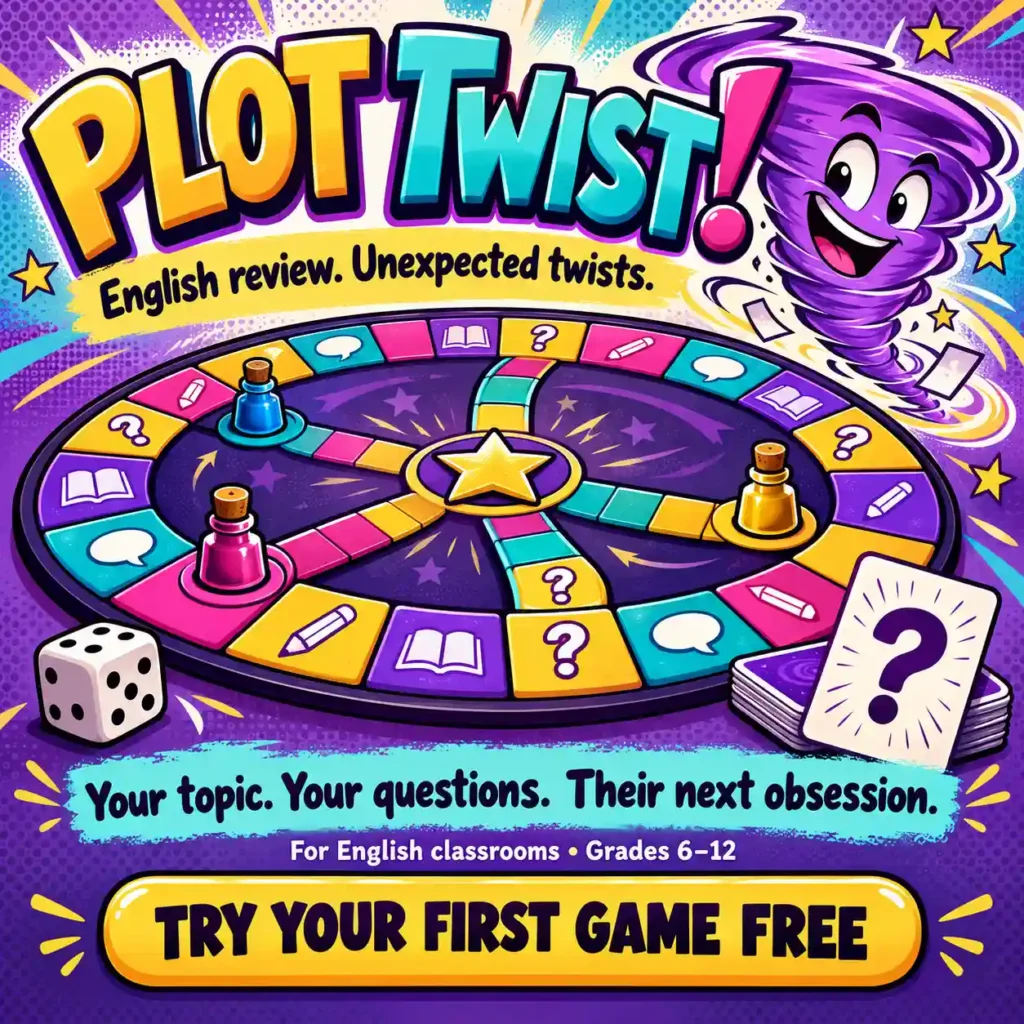
Using Plot Twist! for a digital grammar review
To use the same content in a teacher-led, shared-screen team game, open Plot Twist! and specify the focus: “Grades 8–9 English. Review comma splices, semicolons, colons, and independent and dependent clauses. Include original sentences requiring full corrections and a brief explanation. Allow multiple valid corrections where appropriate.”
The game is designed for two to seven teams. Teachers can enter a topic or upload permitted lesson materials, and choose how answers are evaluated. For grammar exercises with multiple defensible rewrites, teacher marking can protect the distinction between an actual error and a stylistic preference. The first game is free.
Keep grammar games connected to writing
After the game, invite students to return to a current paragraph and revise one real sentence. Ask them to annotate the improvement: “I changed the comma splice because both clauses could stand alone,” or “I chose a passive construction to emphasize the result.” This transfer activity turns the game from a one-day reward into writing instruction.
For additional material, explore the grammar lessons collection, commas lesson, semicolon lesson, and our English Review Games hub. The Purdue OWL explanation of commas and semicolons is a reliable reference for reviewing answer keys.
Frequently asked questions
What is the easiest grammar review game to prepare?
Comma Splice Courtroom needs only four or five teacher-written sentences and a two-part scoring rule: revise the sentence and explain the change. It works with mini-whiteboards or paper.
How do I stop grammar review games from becoming guessing competitions?
Require every team to write the full corrected sentence, identify the relevant clauses or rule, and allow a brief discussion before scoring. Award points for explaining why the revision is correct.
Can I use grammar review games without devices?
Absolutely. Sentence Surgery, Clause Detective, and Grammar Auction work with cards, paper, or the classroom board. Digital tools are optional, not necessary for effective review.
How should I assess learning after the game?
Use one unseen sentence as an individual exit ticket and, ideally, ask students to edit a sentence from their own writing. A correct response in a team does not guarantee each student understands the rule.
The takeaway
Good grammar games make the writer’s decision visible. When students diagnose, correct, and explain sentences—and then apply the skill to their own drafts—they are practising grammar as a tool for meaning rather than a collection of isolated rules.