Fixed vs Growth Mindset Chart: The Full Comparison
You need a fixed vs growth mindset chart that actually helps students see the difference, not just a poster that looks nice on the wall. Most charts floating around online repeat the same three examples and skip the nuance that makes the concept stick. If you’re prepping a bulletin board, a slide deck, or a handout for advisory period, you need something clearer and more complete than what a quick image search turns up.
This article gives you exactly that: a full growth mindset vs fixed mindset chart comparing language, beliefs about ability, and reactions to failure, side by side, trait by trait. You’ll see the specific phrases students use in each mindset, so you can teach them to recognize their own self-talk instead of just memorizing a vocabulary word.
Beyond the chart itself, we’ll break down where these categories come from, how to use the comparison in a real lesson, and how it connects to the kind of student motivation work we cover in our Brain Builders Workshop resources. Whether you teach middle school or high school, you’ll walk away with a printable reference, including a fixed vs growth mindset PDF comparison guide, ready for tomorrow’s class.
Why the fixed vs growth mindset chart matters for teaching
Psychologist Carol Dweck spent decades studying why some students bounce back from a bad grade while others shut down completely. Her research at Stanford found the difference wasn’t talent or IQ. It was belief. Students who saw ability as fixed treated a failed quiz as proof they weren’t smart. Students who saw ability as something built through effort treated mistakes as information they could use. That’s the entire reason a fixed vs growth mindset chart exists in classrooms: it turns an abstract psychological theory into something a twelve-year-old can point to and say, "that’s me right now."
Teachers reach for a chart instead of a lecture because mindset isn’t taught through explanation, it’s taught through recognition. A student rarely announces "I have a fixed mindset." Instead, you hear "I’m just bad at math" or "I’ll never get this." A well-built growth mindset vs fixed mindset chart gives you a fast way to hold up a mirror to that language without singling anyone out. You point to the chart, not the student.
A chart works because it lets students catch their own thinking without feeling caught.
What the chart actually breaks down
The categories matter more than the slogans. A chart that only says "growth mindset good, fixed mindset bad" teaches nothing useful. The version worth printing separates specific, observable traits so students can self-diagnose in real time, much like a fixed vs growth mindset quiz does.
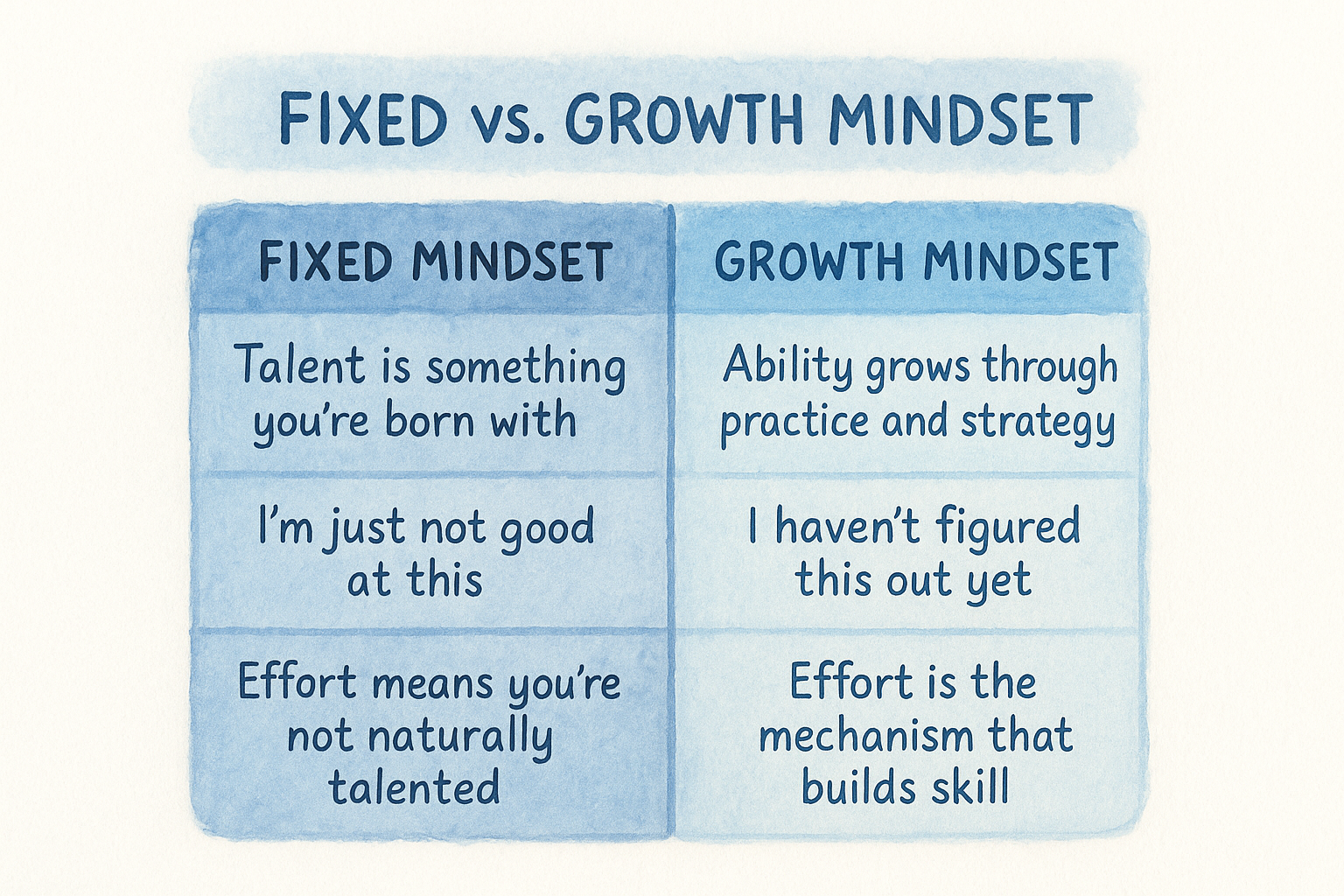
| Category | Fixed Mindset | Growth Mindset |
|---|---|---|
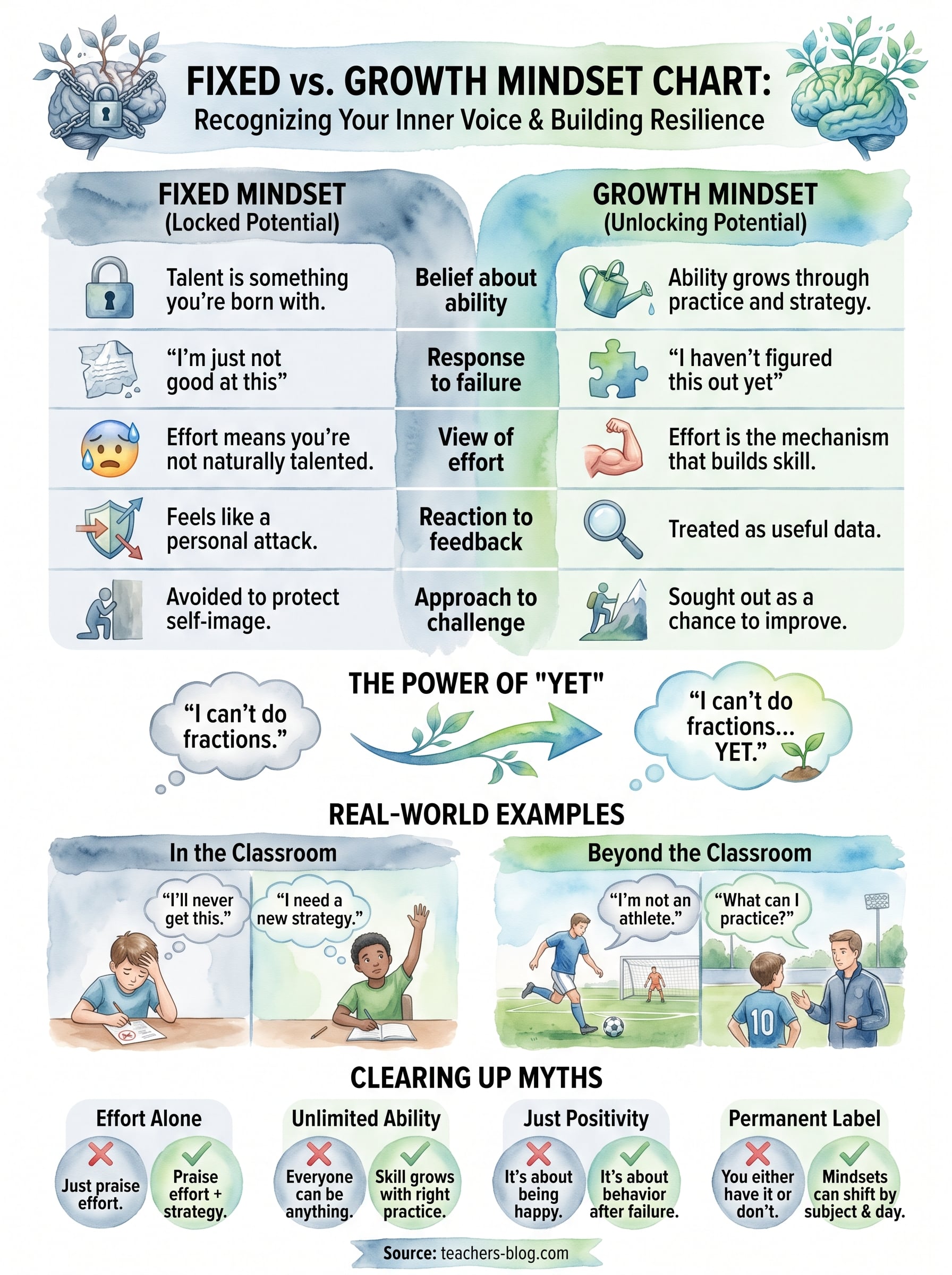
| Belief about ability | Talent is something you’re born with | Ability grows through practice and strategy |
| Response to failure | "I’m just not good at this" | "I haven’t figured this out yet" |
| View of effort | Effort means you’re not naturally talented | Effort is the mechanism that builds skill |
| Reaction to feedback | Feels like a personal attack | Treated as useful data |
| Approach to challenge | Avoided to protect self-image | Sought out as a chance to improve |
Why side-by-side comparison beats a single definition
Defining growth mindset in isolation doesn’t stick, because students need a fuller comparison of the two mindsets to notice the pattern. Without the fixed column sitting right next to it, "effort builds skill" is just a nice sentence on a poster. With the contrast, a student reading "I’m just not good at this" next to "I haven’t figured this out yet" can catch themselves mid-sentence during a real assignment, which is why a lesson built around the word "yet" pairs so well with the chart.
Middle and high schoolers especially respond to this format because it respects that they already have both voices in their head. You’re not asking them to adopt a foreign belief system. You’re helping them notice which voice is talking and giving them language to switch columns on purpose. That’s the real payoff of building the comparison into your student motivation work, since motivation is what actually drives learning, rather than treating it as a one-off poster you hang in August and never mention again.
How to use the chart to shift a student’s mindset
Posting the fixed vs growth mindset chart on a wall does nothing by itself. The chart only works when you use it as a tool for language replacement, not decoration. Students need repeated practice catching a fixed-mindset phrase and swapping it for the growth-mindset version before the switch becomes automatic.
Introduce the chart with real examples, not hypotheticals
Skip made-up scenarios and start with something that just happened in your room. If a student groaned "I can’t do fractions," stop the class for ten seconds and ask them to find that phrase’s row on the chart, then read the growth version out loud. This works because the example is immediately relevant instead of abstract, so the connection sticks rather than evaporating by lunch.
Students remember the chart when it responds to something they just said, not when it’s copied from a textbook.
Turn it into a five-minute weekly routine
Consistency beats a single big lesson. Try this simple sequence during an advisory period or homeroom slot:
- Monday check-in: Ask students to name one fixed-mindset phrase they caught themselves using over the weekend.
- Wednesday flip: Have them rewrite that phrase using the growth column, out loud, on a sticky note, or on a mindset sorting and flipping worksheet.
- Friday share-out: Let three volunteers read their flipped phrase to the class.
Running this weekly builds a habit that a single poster never will, especially when it sits inside a repeatable plan for teaching growth mindset. Teachers who pair this routine with the Brain Builders Workshop resources report faster buy-in, because students start treating the language shift as a skill they’re practicing rather than a rule they’re following.
Five minutes a week is enough once the routine is established, and it compounds over the semester. By October, most classes start correcting each other’s language without prompting, which is the actual goal of putting the chart in front of them in the first place.
Fixed vs growth mindset examples in the classroom and beyond
Charts stay abstract until you connect them to moments students actually recognize. The clearest way to make a fixed vs growth mindset chart land is to walk through real scenes, one from your classroom and one from outside it, so students see the pattern isn’t just a school rule but a way of thinking that follows them everywhere.
Classroom scenarios that show the split
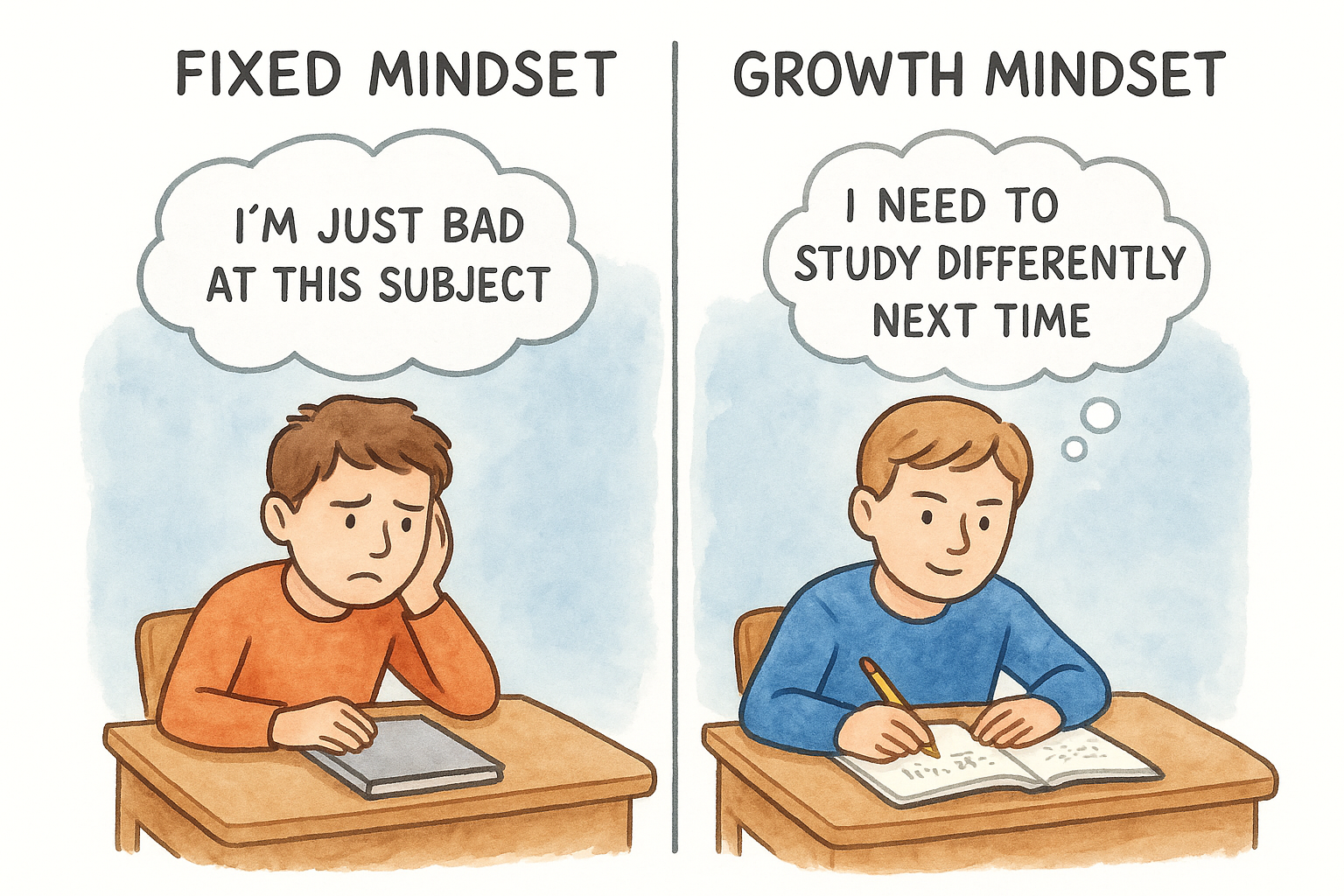
Grab a subject and picture two students hitting the same wall. One says the algebra problem is impossible and closes the notebook. The other says the method they tried didn’t work and tries a different one. Same obstacle, opposite response, and that gap is the entire chart in miniature. Here’s how it plays out across common classroom moments:
| Situation | Fixed Mindset Response | Growth Mindset Response |
|---|---|---|
| Failing a quiz | "I’m just bad at this subject" | "I need to study differently next time" |
| Getting corrected in class | Stops raising their hand | Asks a follow-up question |
| Peer finishes first | "They’re just smarter than me" | "What strategy did they use?" |
| Hard writing assignment | Copies a safe, simple structure | Attempts a riskier argument |
The same setback produces two completely different students, depending only on which column they’re reading from in their head.
Examples beyond the classroom
Outside school, the same growth mindset vs fixed mindset chart applies to sports tryouts, job interviews, and even video games, and these mindset examples outside of school make the pattern obvious. A student cut from the soccer team either decides they’re not an athlete, or they ask the coach what to work on before next season. An athlete who misses a shot either blames bad luck forever or studies the replay. Point this out explicitly, because students often assume mindset only matters for grades, and seeing it apply to a basketball court or a part-time job application makes the concept feel less like homework and more like a life skill.
Tying classroom language to these outside examples also gives quieter students an easier entry point. Not everyone wants to discuss a bad test grade out loud, but most kids will talk about a missed goal or a tough level in a game, and that’s still the exact same chart at work.
Common myths about growth mindset the chart clears up
Growth mindset got popular enough in schools that it picked up a lot of baggage along the way. A fixed vs growth mindset chart helps because it forces the concept back into specifics, which is exactly where these myths fall apart.
"Just praise effort and mindset improves"
Teachers heard "praise effort, not talent" and ran with it, but empty praise doesn’t teach anything. Telling a student "good try" after a wrong answer without discussing strategy just rewards busywork. The chart’s effort row specifically pairs effort with a method, not effort alone, which is the part most classroom posters leave out, so it belongs on any fixed vs growth mindset poster you print.
Praising effort without praising strategy just teaches kids to work hard at the wrong thing.
"Growth mindset means every student can do anything"
No chart claims a struggling reader will become a concert pianist by trying harder. Growth mindset describes how ability develops, not that ceilings don’t exist. Confusing the two sets kids up to feel like failure again when unlimited effort doesn’t produce unlimited results. The honest version, the one worth printing, says skill can grow with the right practice, not that talent is irrelevant.
"It’s just about staying positive"
Positivity and growth mindset get treated as synonyms, but they aren’t. A student can stay upbeat while still avoiding every hard problem, which is textbook fixed-mindset behavior dressed up in a good mood. The chart cares about behavior after failure, not tone of voice, so a cheerful student who quits at the first wrong answer still lands in the fixed column.
"You either have it or you don’t"
Some teachers treat mindset like a fixed label itself, sorting kids into "growth kids" and "fixed kids" early in the year. That’s backwards. Most students shift columns depending on the subject, the day, or who’s watching. A kid with a growth mindset in soccer can have a fixed one in algebra. Using the growth mindset vs fixed mindset chart as a snapshot instead of a permanent label keeps you from writing off a student too early.
Making the chart part of daily classroom language
A fixed vs growth mindset chart only earns its wall space when it changes what students say out loud, not just what they read silently. You’ve seen the categories, the phrases, and the weekly routine that turns recognition into habit. The next step is small: pick one class period this week and try the Monday-Wednesday-Friday sequence, even if it feels clunky the first time.
Students won’t flip their language overnight, but they will start catching themselves mid-sentence, which is the entire point of building a growth mindset vs fixed mindset chart in the first place. That small catch, "I haven’t figured this out yet" instead of "I’m bad at this," is the whole shift happening in real time.
If you want ready-made routines and printables to pair with the chart, browse these growth mindset resources for real classrooms, built to make this stick past September.