Fixed vs Growth Mindset PDF: The Complete Comparison Guide
You’ve got a class full of kids who say "I’m just bad at math" or shut down the second an assignment gets hard, and you know the fix starts with how they think about their own ability. That’s why so many teachers go searching for a fixed mindset vs growth mindset pdf they can print, project, or hand straight to students without spending a prep period building one from scratch.
This guide gives you exactly that. Below you’ll find a clear, side-by-side breakdown of fixed versus growth mindset grounded in Carol Dweck’s original research, plus a free downloadable comparison chart you can use in a staff meeting, a homeroom lesson, or a parent newsletter.
We’ll walk through how the two mindsets differ, how they show up in real classroom moments, and what the research actually says (not just the oversimplified version that gets passed around on posters). You’ll also get practical ways to teach the difference to students, tying directly into the kind of growth mindset work we cover in our Brain Builders resources for building motivation and a positive attitude toward learning.
Why the fixed vs growth mindset distinction matters
The research behind the two mindsets
Stanford psychologist Carol Dweck spent decades studying why some students bounce back from failure while others crumble. Her research found that students who believe intelligence is fixed treat every low grade as proof of a permanent limit, while students who believe ability can grow treat the same grade as information about where to focus next. That single belief, more than IQ or starting skill level, predicted how kids handled setbacks in her studies. If you’re searching for a carol dweck fixed vs growth mindset pdf, it’s usually because you want that research distilled into something you can actually use with real students, not just cited in a textbook. You can read more about the original studies through Stanford University’s overview of Dweck’s work, which still holds up as the clearest primary source on the topic.
What happens when students believe ability is fixed
Believing you’re "just not a math person" changes behavior in predictable ways. Kids with a fixed mindset avoid challenges because a wrong answer feels like a verdict on their identity, not a normal part of learning. They give up faster, get defensive about feedback, and often cheat rather than risk exposing a mistake in front of peers.
A fixed mindset turns every mistake into a threat; a growth mindset turns every mistake into data.
Growth-oriented students, by contrast, treat effort as the thing that builds skill, so a hard problem becomes a puzzle instead of a threat.
The classroom payoff of teaching growth mindset
Once you see the pattern, the stakes become obvious in day-to-day teaching. Students who resist a challenge because they’re afraid of looking dumb aren’t lazy, they’re protecting a fragile self-image, and no amount of extra worksheets fixes that on its own.
| Belief | Typical student behavior | Classroom impact |
|---|---|---|
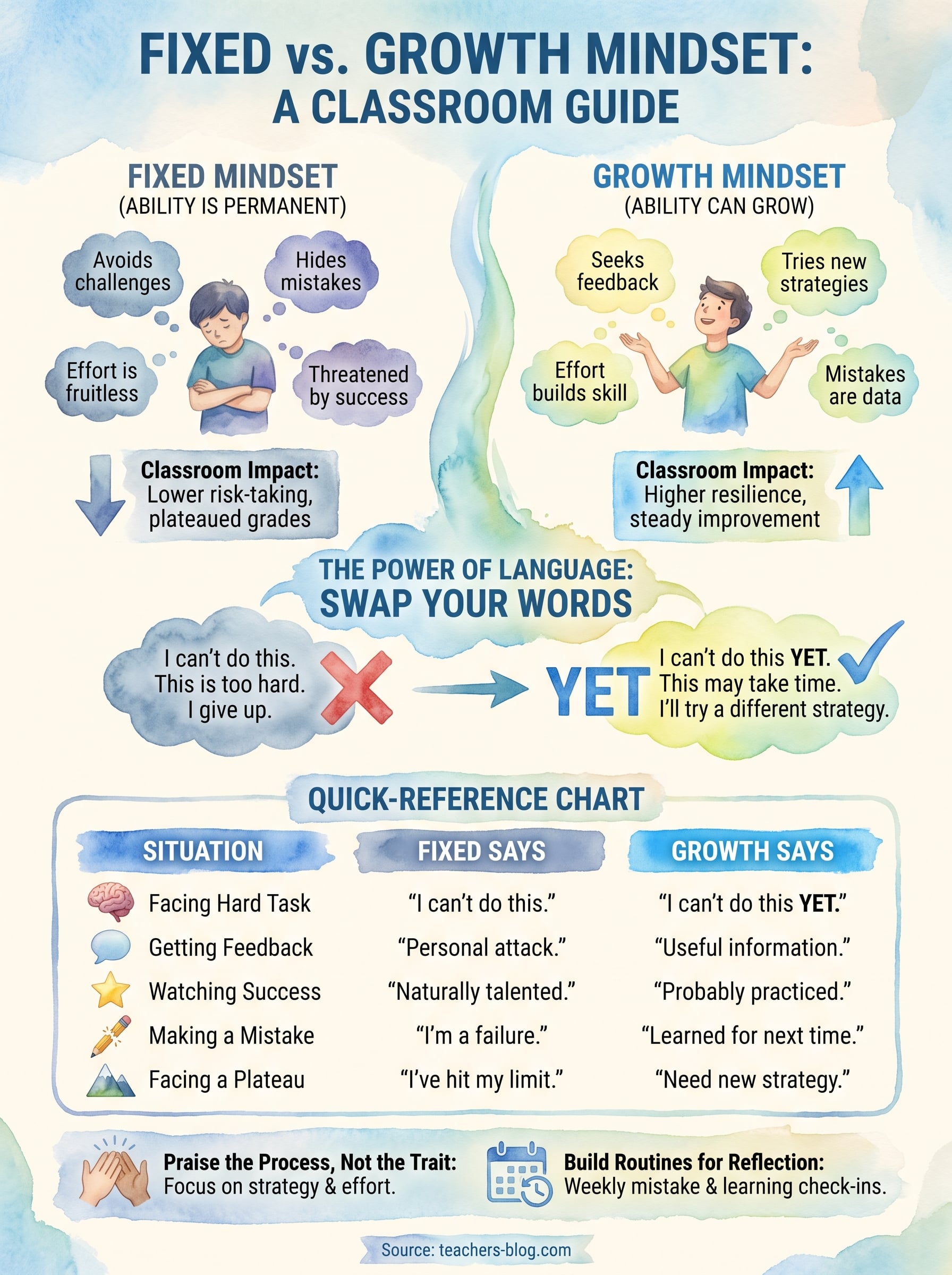
| Fixed mindset | Avoids hard tasks, hides mistakes | Lower risk-taking, plateaued grades |
| Growth mindset | Seeks feedback, tries new strategies | Higher resilience, steady improvement |
Sharing this comparison openly, whether through a printed handout or a quick homeroom discussion, gives students language for what’s happening in their own heads. That’s exactly the groundwork we build on in our Brain Builders Workshop, where the goal is turning this research into daily habits rather than a one-time poster on the wall.
How to shift from a fixed mindset to a growth mindset
Shifting a mindset isn’t about chanting affirmations. It’s a set of concrete moves you repeat until they become habit, both for you and for your students. The word "yet" does more work here than any poster ever will, and a full lesson built around the power of yet, paired with specific, actionable feedback, is what actually moves the needle.
Language swaps that rewire self-talk
Start with the words students already say to themselves. Give them a fixed phrase and a growth replacement, then practice saying the replacement out loud until it feels less awkward.
- "I’m not good at this" becomes "I’m not good at this yet"
- "This is too hard" becomes "This may take time and effort"
- "I give up" becomes "I’ll try a different strategy"
- "I made a mistake" becomes "Mistakes help me learn"
Changing one word, from "can’t" to "can’t yet," is often the fastest way to shift a fixed mindset toward a growth mindset.
Feedback that reinforces effort over ability
How you respond to a struggling student matters more than what you say when things go well. Praise the process, not the trait, so a comment like "you found three ways to solve that" lands differently than "you’re so smart." Point at the specific strategy a student used, name the effort involved, and ask what they’d try next time something goes wrong.
Routine matters just as much as language, which is why it helps to teach growth mindset through routines, feedback, and goals. Build weekly reflection into your class, even five minutes, where students name one mistake and one thing they learned from it, since what mistakes mean to a growth-minded student is the whole hinge of this work. Over a semester, that habit does more to shift a fixed vs growth mindset pattern than any single lecture on Dweck’s research ever will.
Fixed vs growth mindset examples in the classroom and beyond
Picture two students getting the same B-minus on a quiz. One crumples the paper and mutters "I always fail these," while the other circles the missed problems and asks you which chapter to review. That’s the fixed vs growth mindset split playing out in real time, not a theory from a textbook. You’ll spot it in smaller moments too, and in plenty of other real-life mindset comparisons: who raises a hand for the harder bonus problem, who rewrites a rough draft instead of turning in the first attempt, who asks a classmate for help versus who copies an answer to avoid looking stuck.
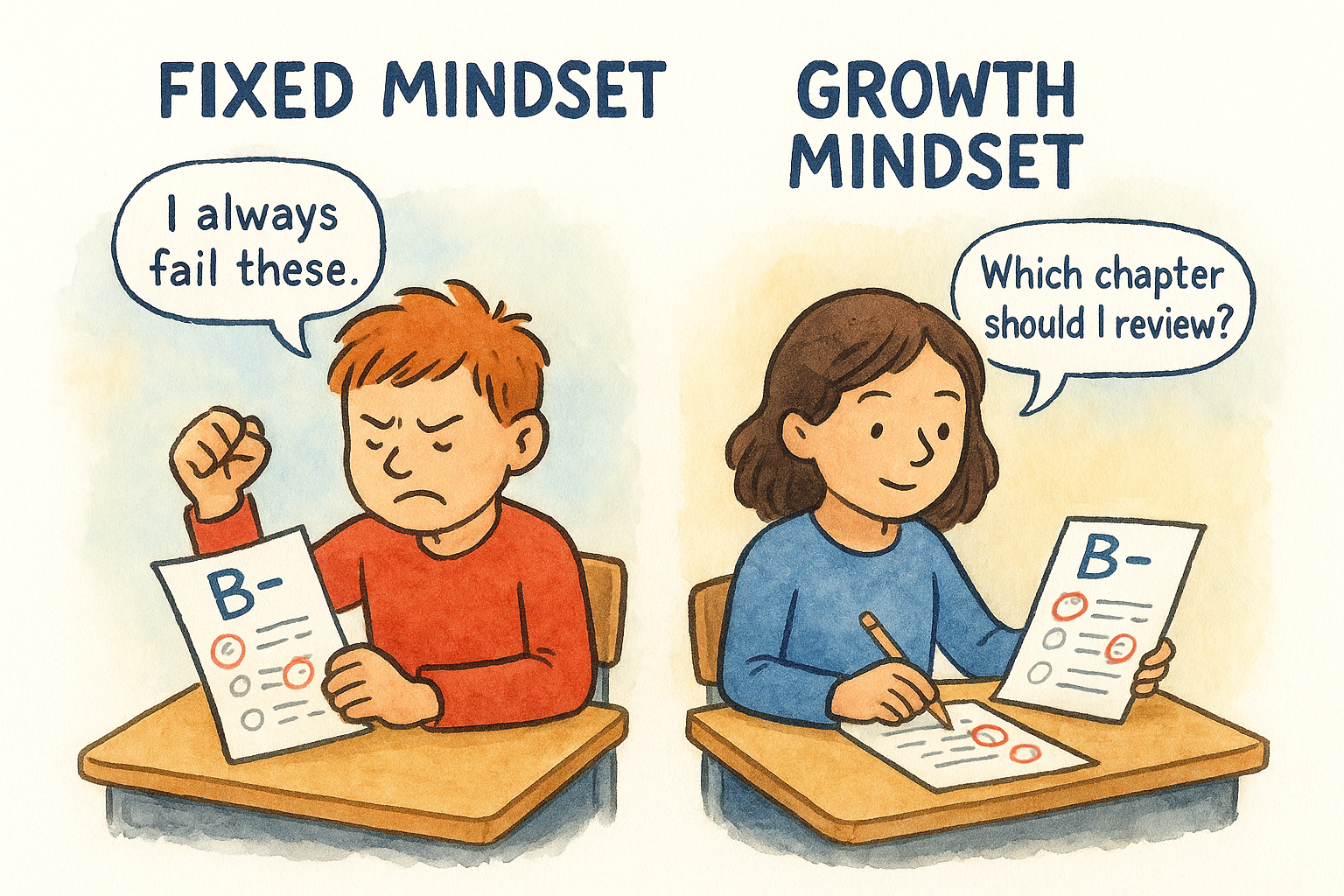
The clearest sign of a growth mindset isn’t confidence, it’s a willingness to look temporarily incompetent while learning something new.
Outside your classroom, the same patterns show up in ways students actually recognize once you point them out:
- Sports: A fixed-mindset athlete blames a loss on bad luck; a growth-mindset athlete studies game film to fix a specific weakness.
- Music: One student quits piano after a rough recital; another asks the teacher for a harder piece next time.
- Job interviews: A candidate with a fixed mindset avoids applying for anything above their comfort zone; a growth-minded one treats a rejection as feedback for the next application.
Using examples from outside school helps students see this isn’t just "teacher talk." It’s a pattern that follows them into every skill they’ll ever try to build, which is exactly why the comparison deserves more than a five-minute mention buried in a single lesson.
A quick-reference chart for fixed vs growth mindset language
Sometimes you just need the whole comparison in one glance, especially if you’re printing this as a fixed vs growth mindset pdf for a bulletin board or a parent handout. Below is the exact breakdown teachers use most often, organized by the situation a student is in rather than abstract theory.
The core comparison table
Keep this chart visible during independent work time, since students rarely remember mindset language unless they see it repeatedly in context. Print size matters here too, and so does what you put on a fixed vs growth mindset poster, since a full page taped near the door gets used far more than a half-sheet buried in a folder.
| Situation | Fixed mindset says | Growth mindset says |
|---|---|---|
| Facing a hard task | "I can’t do this." | "I can’t do this yet." |
| Getting critical feedback | "That’s a personal attack." | "That’s useful information." |
| Watching someone succeed easily | "They’re just naturally talented." | "They probably practiced this a lot." |
| Making a mistake | "I’m a failure." | "I learned something for next time." |
| Facing a plateau | "I’ve hit my limit." | "I need a new strategy." |
If a student only memorizes one row of this chart, make it the "yet" row, it does more mindset work than the rest combined.
Turning the chart into a routine
Posting the chart is step one, but it only sticks when students practice using it out loud. Try opening class with a quick round where each student picks one fixed-mindset phrase from their week and rewrites it using the growth column, or hand out a mindset sorting activity so they practice on paper first. Repetition, not memorization, is what actually rewires the growth vs fixed mindset habit over a semester, so revisit this chart monthly rather than hanging it once and forgetting it exists.
Putting mindset knowledge into practice
Knowing the difference between a fixed mindset and growth mindset only matters if it changes what happens in your classroom tomorrow morning. Print the chart, tape it near your door, and start naming the language shift out loud every time a student gets stuck. Small, repeated moments, not one big lesson, are what actually move a class from dreading mistakes to learning from them.
Remember that this work never really finishes. Every new unit, every hard quiz, every group project gives students another chance to practice catching a fixed thought and swapping in a growth one. You don’t need a perfect script, just consistency and the willingness to model "I don’t know this yet" yourself.
If you want ready-made growth mindset lessons organized by grade that build on everything covered here, they turn this exact research into activities you can run this week.