
Inference Lesson Plan: Teaching Students to Make and Support Inferences
Teaching inference can be surprisingly tricky.
Most students already make inferences constantly. They notice a friend acting differently and wonder what is wrong. They watch the first few minutes of a movie and start figuring out which characters can be trusted. They hear a tone of voice and understand something that was never actually said.
The problem comes when we ask students to do the same thing deliberately with a text—and then explain how they know.
That is where an effective inference lesson plan needs to go beyond simply telling students to “read between the lines.”
Students need a repeatable process.
The one I like to use is:
Inference → Evidence → Explanation
Students make a reasonable conclusion, identify the strongest evidence that supports it, and explain how that evidence leads to the conclusion.
That last part is especially important.
A student who can find a quotation has not necessarily demonstrated inference. The real analytical thinking happens when students explain the connection between the textual clue and their interpretation.
This lesson structure is designed to help students make that connection.
Learning Goals and Standards
By the end of the lesson, students should be able to:
- distinguish between an explicit detail and an inference;
- make a reasonable inference based on multiple clues;
- select relevant textual evidence;
- explain how evidence supports an inference; and
- recognize when a conclusion goes beyond what the evidence actually supports.
For Grades 9–10, this type of lesson connects particularly well with CCSS.ELA-LITERACY.RL.9-10.1, which asks students to support analysis with strong textual evidence, including analysis of inferences drawn from a text.
Student-Friendly Learning Goals
I would present the goals to students more simply:
I can make a reasonable inference using details from a text.
I can choose evidence that supports my inference.
I can explain how my evidence led me to my conclusion.
These three goals also provide a useful framework for assessing student responses.
Why Students Struggle With Inference
One of the biggest misconceptions students have is that making an inference means guessing.
It doesn’t.
An inference does involve reaching a conclusion that is not directly stated, but that conclusion must still be limited by the available evidence.
Suppose students read this:
Marcus entered the classroom carrying an umbrella. Water dripped from the sleeves of his jacket, and he immediately walked toward the box of tissues.
Students can reasonably infer that Marcus has recently been outside in wet weather.
They probably cannot infer that Marcus walked three
kilometers
to school because his bus was
canceled
.
That might be possible, but nothing in the evidence supports it.
This distinction between possible and supported is one of the most important ideas to establish early.
I often tell students:
A good inference isn’t just something that could be true. It is something the evidence gives you a reason to believe.
Step 1: Begin With a Mystery
I like to introduce inference without using a literary passage at all.
Instead, give students a situation containing several clues.
For example, describe a classroom before students arrive:
- one chair has been pushed away from a desk;
- several sheets of paper are scattered on the floor;
- a pencil has rolled beneath another desk;
- a water bottle is lying on its side; and
- the classroom window is open.
Then ask:
What might have happened here?
Students will immediately start making inferences.
The important part comes next.
Ask:
What evidence made you think that?
As students explain their ideas, record their thinking in two categories:
Inference
and
Evidence
You will probably get several different interpretations.
That is useful.
It demonstrates one of the most important features of inference: two people can reach different conclusions and both can be reasonable if they can support their thinking with evidence.
Step 2: Teach Detail vs. Inference vs. Guess
Before moving into longer reading, make the distinction explicit.
Explicit Detail
Something the text directly tells us.
Example:
The character looked at the clock three times.
Inference
A logical conclusion based on that detail and other clues.
Example:
The character may be worried about being late.
Guess
A conclusion without sufficient evidence.
Example:
The character is late for a dentist appointment.
Students often blur the last two categories.
A helpful question is:
Can you point to something in the text that gave you a reason to think that?
If the answer is no, the conclusion is probably a guess rather than a defensible inference.
Step 3: Introduce Inference → Evidence → Explanation
Once students understand what an inference is, introduce the full analytical process.
1. Inference
Answer the question with a reasonable conclusion.
2. Evidence
Choose the detail—or combination of details—that most strongly supports the conclusion.
3. Explanation
Explain why those details point toward that conclusion.
The explanation is where many students need the most instruction.
Consider this basic response:
Inference: Riley is nervous.
Evidence: Riley keeps looking toward the door.
Explanation: This shows that Riley is nervous.
Technically, the student has included all three pieces.
But the explanation does no new analytical work.
Instead, encourage something like:
Repeatedly watching the door suggests that Riley is anticipating someone’s arrival or worried about what will happen next. That restless attention supports the inference that Riley is anxious.
Now the reasoning is visible.
Step 4: Model Your Thinking Out Loud
Inference is often invisible thinking.
That is why modeling it matters.
Give students a very short situation such as:
Elena closed her laptop when her group members approached. She moved her notebook over the screen and asked whether everyone wanted to work somewhere else.
Instead of immediately asking students for an answer, model the thinking process.
You might say:
“I notice that Elena doesn’t simply close the laptop. She also covers it with her notebook. Those two details seem connected. Covering the screen suggests she doesn’t want the other students to see something. I don’t know exactly what is on the laptop, so saying she is cheating or hiding a message would go beyond the evidence. But I can reasonably infer that Elena wants to keep something on the screen private.”
That type of think-aloud shows students how strong readers:
- notice details first;
- look for patterns;
- consider possible interpretations; and
- reject conclusions that are too specific.
Step 5: Move Into Guided Practice
Next, give students a short passage or use a paragraph from a story you are already studying.
Don’t immediately ask, “What can you infer?”
Start with facts.
Have students identify three or four things the author tells them directly.
Then ask:
What pattern do these details create?
This small change can make a big difference.
Students are much less likely to produce random guesses when they have already identified the clues they must use.
A guided discussion might follow this sequence:
- What do we know for certain?
- Which details seem connected?
- What could those details suggest?
- Which inference is best supported?
- Which evidence is strongest?
- What conclusion would go too far?
That final question is especially useful.
Learning to recognize an unsupported inference can sometimes be easier than learning to produce a strong one.
Step 6: Make Students Explain the Connection
Once students can make reasonable inferences, increase the emphasis on explanation.
One strategy is to temporarily ban the phrase:
“This shows that…”
Students often write something like:
The character avoids looking at his teacher. This shows that he feels guilty.
The sentence merely repeats the inference.
Instead, ask:
What does avoiding eye contact suggest? Why?
Now the student has to articulate the reasoning:
Avoiding eye contact can suggest that the character is uncomfortable being questioned and does not want the teacher to examine his behaviour closely. This supports the inference that he may feel guilty.
This is the beginning of real literary analysis.
Students aren’t just retrieving evidence anymore. They are interpreting it.
Step 7: Let Students Work With Ambiguity
Once students understand the basic process, deliberately give them situations that can support more than one interpretation.
Ask students to develop two plausible inferences from the same details.
Then ask:
Which inference is stronger?
Students must now evaluate evidence rather than simply locate it.
They can consider:
- Which interpretation explains more of the details?
- Does one require assumptions that aren’t supported?
- Is one piece of evidence especially important?
- Could the same detail reasonably support both interpretations?
This is an excellent bridge from basic reading comprehension into the type of analysis students will need when discussing character, motivation, conflict, theme, and symbolism.
A Simple Inference Lesson Structure
For a typical 60–75 minute ELA period, I would structure the lesson something like this.
Bell Ringer – 5–10 Minutes
Give students a mysterious situation and ask them to make one inference supported by two observations.
Discuss several possibilities as a class.
Mini-Lesson – 10–15 Minutes
Teach the difference between:
explicit detail → inference → unsupported guess
Introduce:
Inference → Evidence → Explanation
Model one complete response.
Guided Practice – 15–20 Minutes
Read a short passage together.
Have students identify facts before making an inference.
Students can then compare answers with a partner before discussing them as a class.
Independent Practice – 20–25 Minutes
Students apply the complete process to a new passage or a text already being studied.
Require them to:
- state an inference;
- identify strong evidence; and
- explain their reasoning.
Exit Ticket – 5 Minutes
Finish with a very short passage that requires students to complete all three stages independently.
This gives you a quick indication of who understands the process and who will need more support during the next reading activity.
Common Mistakes to Watch For
There are a few patterns I tend to watch for when teaching inference.
Students Restate the Text
If the text says a character is pacing and the student writes, “I infer that the character is pacing,” they have identified a detail rather than made an inference.
Ask:
What does the pacing suggest?
Students Make a Huge Leap
Students sometimes create an entire story from a tiny clue.
Keep returning to:
What does the evidence actually allow us to say?
Students Choose Evidence That Is Technically Related but Weak
Not every quotation is equally useful.
Ask students to find the strongest evidence rather than simply “some evidence.”
Students Repeat Their Inference as Their Explanation
This may be the most common problem.
Ask:
Why does that detail make your inference more likely?
That question usually forces the missing reasoning to appear.
Differentiating an Inference Lesson
Inference can be challenging because students are simultaneously reading, interpreting, selecting evidence, and writing.
Breaking those tasks apart can help.
For Students Who Need More Support
Have students identify clues before asking them to make an inference.
You can also provide a structure such as:
I infer that ______ because the text indicates ______. This detail suggests ______ because ______.
Color coding can also work well:
- inference in one color;
- evidence in another;
- explanation in a third.
For English Language Learners
Pre-teach words such as:
- inference;
- explicit;
- evidence;
- reasonable;
- relevant; and
- explanation.
Allow students to discuss an inference orally before writing it.
For Students Ready for a Challenge
Ask students to develop two competing interpretations.
Then have them determine which is more convincing and explain why.
That changes the task from simply making an inference to evaluating interpretations.
Why I Teach Evidence Alongside Inference
I don’t like teaching inference as an isolated comprehension trick.
It is much more useful when students immediately learn to connect inference with textual evidence.
That combination supports nearly everything that comes afterward in an English course.
When students analyze why a character behaves a certain way, they are making inferences.
When they identify a developing theme, they are making inferences.
When they explain the importance of a setting detail, interpret symbolism, analyze conflict, or discuss an author’s choices, they are making inferences.
And in almost every case, they need to prove those interpretations using evidence.
That is why Inference → Evidence → Explanation can become a routine students continue using throughout an entire literature unit.
Want the Complete Ready-to-Teach Inference Lesson?
Everything above can certainly be turned into your own inference lesson.
But preparing the passages, presentation, student practice, differentiation materials, assessment, and answer guidance takes time.
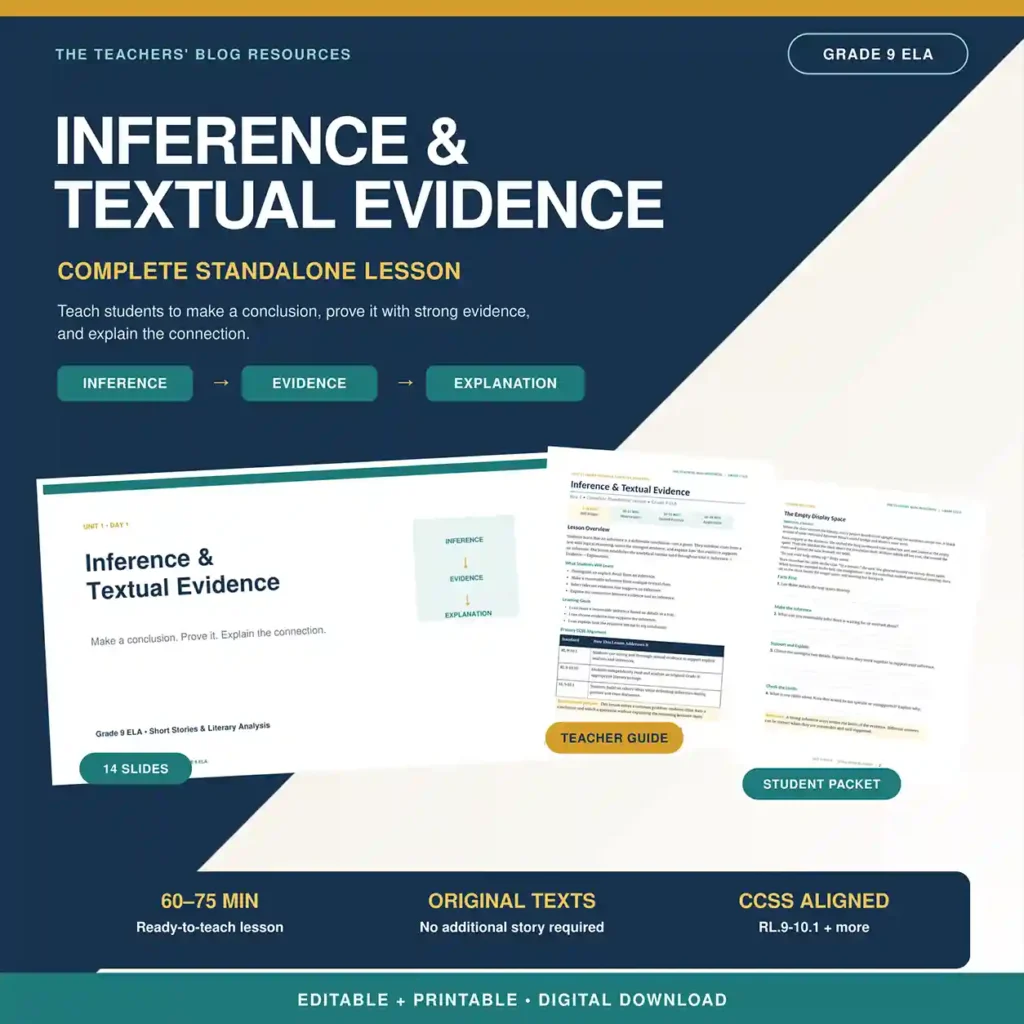
That’s why I created a complete Inference & Textual Evidence lesson for Grade 9 ELA as part of my Short Stories & Literary Analysis resources.
The ready-to-teach resource includes:
- a complete teacher guide;
- an instructional slide deck;
- guided inference practice;
- an original independent reading passage;
- student analysis questions;
- a student reference page;
- an exit ticket;
- differentiation and support suggestions;
- answer guidance and response criteria;
- editable teacher and student files; and
- printable PDF versions.
The lesson follows the same Inference → Evidence → Explanation process described above, but all of the passages, questions, organizers, slides, and assessment materials are already prepared.
Students move from identifying explicit details to making defensible interpretations, choosing strong evidence, and explaining the reasoning connecting the two.
[Get the complete Inference & Textual Evidence lesson on Teachers Pay Teachers.]
Building Better Literary Analysis One Inference at a Time
Teaching inference is not really about getting students to discover the one hidden answer we have in mind.
It is about teaching them to make interpretations that they can defend.
When students learn to slow down, notice details, combine clues, limit their claims, select strong evidence, and explain their reasoning, their reading responses become much more thoughtful.
More importantly, they develop a process they can reuse.
Inference. Evidence. Explanation.
Once students understand that sequence, it becomes a foundation for much of the literary analysis they will do throughout the rest of the course.