
5 Culturally Responsive Teaching Strategies That Work
You walk into a classroom full of kids who don’t share your background, and the standard lesson plan suddenly feels flat. Maybe a student rolls their eyes at a reading example that means nothing to their life, or a family history project falls flat because it assumes everyone celebrates the same holidays. That gap between your curriculum and your students’ lived experience is exactly what culturally-responsive teaching strategies are built to close.
This article skips the theory-heavy overview and gets straight to what you can use tomorrow. If you searched for strategies for culturally responsive teaching, you already know the research; you want the classroom-tested moves that actually shift engagement and outcomes for students from different backgrounds, the kind used in culturally responsive differentiated instruction.
Below are five approaches pulled from real classroom practice, not a diversity training slideshow. You’ll find ways to rework texts and examples, invite student identity into daily lessons, and adjust feedback so it respects different communication styles. Each one works whether you teach middle school English or high school history, and each pairs well with the culturally relevant teaching strategies and culturally sustaining pedagogy you may already be experimenting with. Read on for five that hold up under a full semester of use.
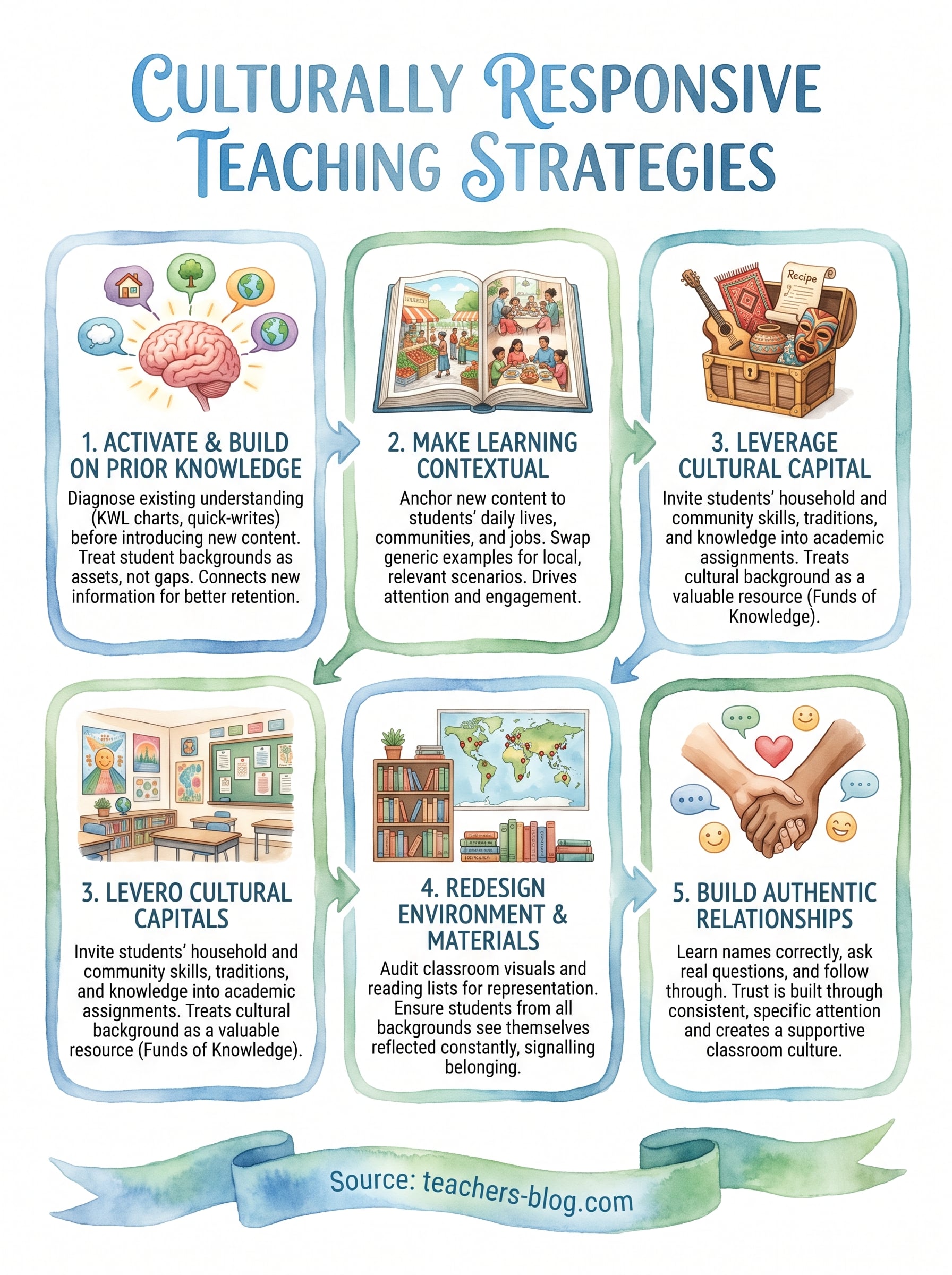
1. Activate and build on students’ prior knowledge
Every student walks in already knowing something related to your lesson, even if it doesn’t look like textbook knowledge. Activating prior knowledge means finding that existing understanding before you add new content on top of it, rather than assuming everyone starts from zero.
How it works
Start each unit with a quick diagnostic: a KWL chart, a short discussion, or a low-stakes writing prompt asking what students already associate with the topic. A lesson on ecosystems might open by asking students to describe a natural environment from their own neighborhood or home country before you introduce textbook vocabulary. You’re not testing them, you’re mapping what’s already there so the new material has somewhere to attach.
Why it matters for diverse classrooms
Students from immigrant families, rural backgrounds, or non-dominant cultures often carry knowledge that doesn’t match the examples in standard curricula. When you skip this step, that knowledge stays invisible and the student learns that school doesn’t value what they bring. Culturally responsive teaching strategies treat that background as an asset, not a gap to fix, which is the core of asset-based pedagogy. Research from Stanford’s Center to Support Excellence in Teaching backs this up: connecting new content to what students already know improves retention across subject areas, and it works even better when that prior knowledge includes cultural or linguistic experience the student rarely gets to use in class.
How to put it into practice
Try these entry points before introducing new material:
- Open with a quick-write: "What does [concept] remind you of from your own life?"
- Use visual prompts, like photos or objects, that invite multiple cultural interpretations.
- Pair students to swap prior knowledge before a whole-class discussion, so quieter students get a low-pressure first pass.
- Keep a running list of student-contributed examples you can reference later in the unit.
Prior knowledge isn’t a warm-up activity, it’s the foundation the entire lesson should be built on.
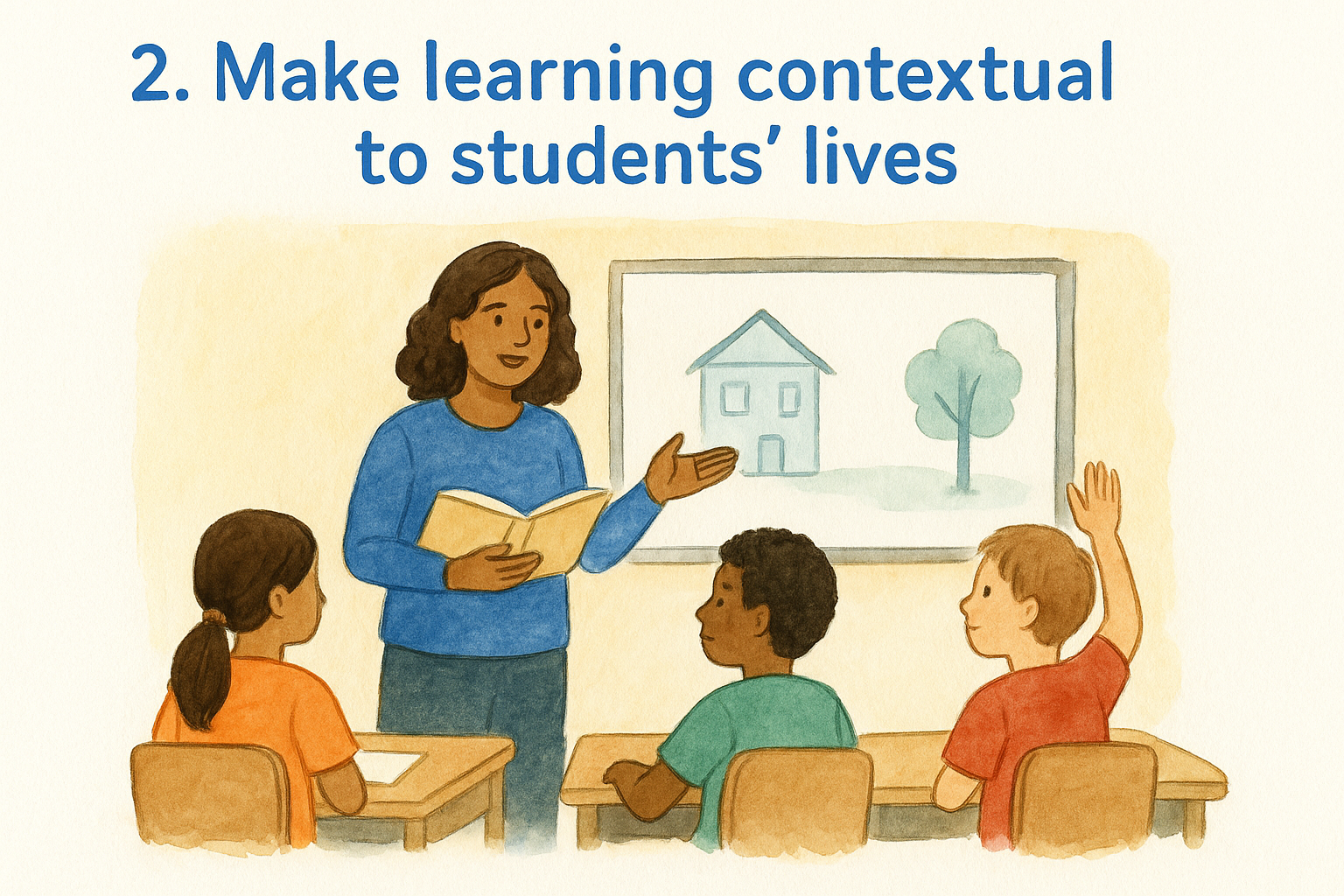
2. Make learning contextual to students’ lives
Once you know what students already carry into class, the next move is anchoring new content to their day-to-day world. Contextual learning means swapping generic examples for ones pulled from the neighborhoods, jobs, and routines your students actually know.
How it works
Instead of a word problem about splitting a pizza, use a scenario about splitting hours at a family restaurant shift or dividing a phone bill among roommates. A history lesson on migration gains weight when it connects to a student’s own family story instead of a textbook case study from a place they’ve never been.
Why it matters for diverse classrooms
Students disengage fast when material feels imported from someone else’s life. Culturally responsive teaching strategies work here because relevance drives attention, and attention drives retention. A lesson that mirrors real circumstances tells students the classroom sees them, not a hypothetical average kid.
Relevance isn’t a bonus feature of a lesson, it’s what makes the content stick.
How to put it into practice
- Swap textbook examples for local businesses, community events, or regional issues.
- Ask students to bring in an example from home that fits the day’s concept.
- Reframe math and science problems around jobs common in your students’ families.
3. Leverage students’ cultural capital as a learning asset
Every student arrives with skills, traditions, and knowledge shaped by their family and community, what researchers call cultural capital. Treating that background as a resource rather than a distraction changes how a lesson lands, and it’s one of the more overlooked culturally responsive teaching strategies available to you.
How it works
Invite students to bring specific cultural knowledge, a recipe, a proverb, a skill passed down at home, into an assignment where it directly supports the academic goal. A unit on persuasive writing might ask students to analyze an argument style used in their own household or community, then compare it to the rhetorical techniques you’re teaching.
Why it matters for diverse classrooms
Students who rarely see their traditions reflected in schoolwork often learn to keep that part of themselves separate from academics. Funds of knowledge research from University of Arizona anthropologist Luis Moll shows that students perform better when teachers actively draw on household and community expertise instead of ignoring it.
A student’s home knowledge isn’t extra credit, it’s raw material for the lesson.
How to put it into practice
- Assign a family knowledge interview tied to your current unit, one of the simplest family engagement strategies you can build into a lesson.
- Let students choose culturally specific examples for open-ended assignments.
- Highlight a different tradition or skill each month in class discussion.
4. Redesign your classroom environment and materials
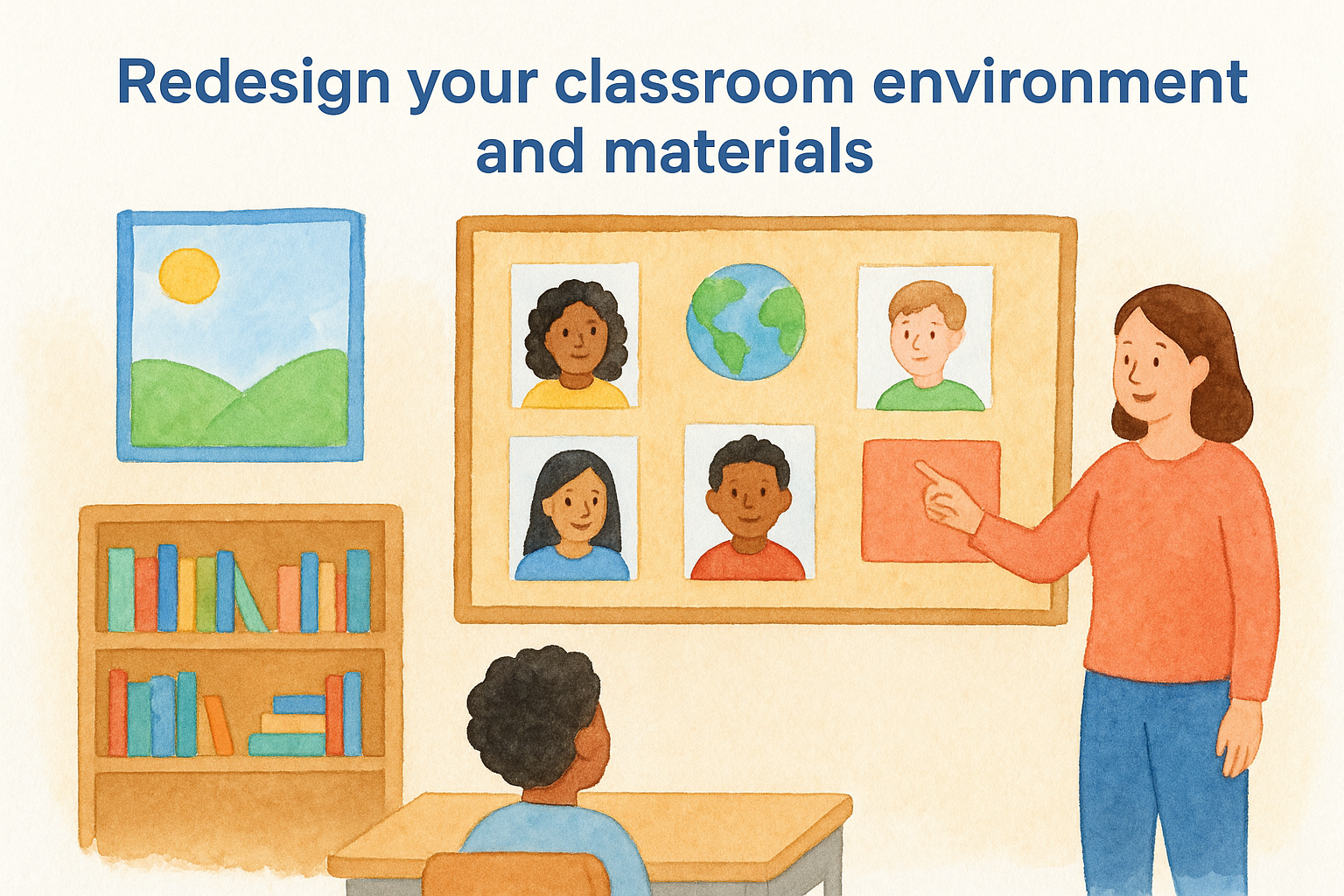
What hangs on your walls and what shows up in your reading lists sends a message before you say a word. Redesigning your classroom environment means auditing posters, books, and visuals so students from every background see themselves reflected, not just as an occasional theme unit but as a constant backdrop.
How it works
Walk your room like a visitor would. Count how many faces, names, and stories on display match your students’ actual backgrounds. Swap out a single-perspective reading list for texts by authors from different cultures, a first step toward inclusive curriculum development, and rotate bulletin boards so no single group’s history dominates the room all year.
Why it matters for diverse classrooms
Students notice representation gaps fast, even when they can’t name why the room feels unwelcoming. Culturally relevant teaching strategies applied to physical space signal belonging before a lesson even starts, which matters most for students used to feeling like an afterthought in curriculum design.
A classroom that only reflects one culture teaches a lesson before class even begins.
How to put it into practice
- Audit your bookshelf and swap in authors from underrepresented backgrounds.
- Replace generic clip art with images reflecting your actual student population.
- Rotate display materials quarterly instead of leaving the same posters up all year.
5. Build authentic relationships and classroom community
Strategies mean little if students don’t trust you enough to show up fully. Building authentic relationships means learning names correctly, asking real questions about students’ lives, and following through on what you learn instead of treating it as small talk before the real lesson starts.
How it works
Greet students by name at the door, learn how to pronounce names right the first time, and reference details from earlier conversations days or weeks later. Small, consistent gestures like these are daily strategies to build student-teacher connections, and they compound into a classroom culture where students feel known rather than managed.
Why it matters for diverse classrooms
Kids from marginalized backgrounds often brace for misunderstanding before they even sit down, especially when past teachers mispronounced names or misread cultural norms as behavior problems. Culturally responsive teaching strategies succeed or fail on trust, and trust builds through repeated, specific attention, not a single icebreaker in September.
Relationships aren’t the soft part of teaching, they’re the delivery system for everything else you’re trying to teach.
How to put it into practice
- Learn correct name pronunciation on day one and correct yourself if you get it wrong.
- Keep brief notes on student interests to reference later.
- Build in five minutes weekly for community circles, check-ins unrelated to grades, or other classroom activities to build community.
Making these strategies part of your everyday teaching
None of these five moves require a curriculum overhaul or a special grant. Culturally responsive teaching strategies work best as small, repeated habits: a prior-knowledge check before a unit, a word problem swapped for something local, a wall display that finally looks like your roster. Pick one strategy and run it for two weeks before adding another. Trying all five at once usually means none of them stick.
What separates a classroom that talks about equity from one that practices it is consistency, not intensity. Your students will notice the difference long before any test score does, and that trust pays off in engagement you can’t fake with a single lesson plan. If you want more classroom-tested tools like these, ready-to-use unit plans, and AI tools that make differentiation less of a scramble, start there and build a classroom every student recognizes as their own.